Phytogenics and botanical extracts

Garlic Extract

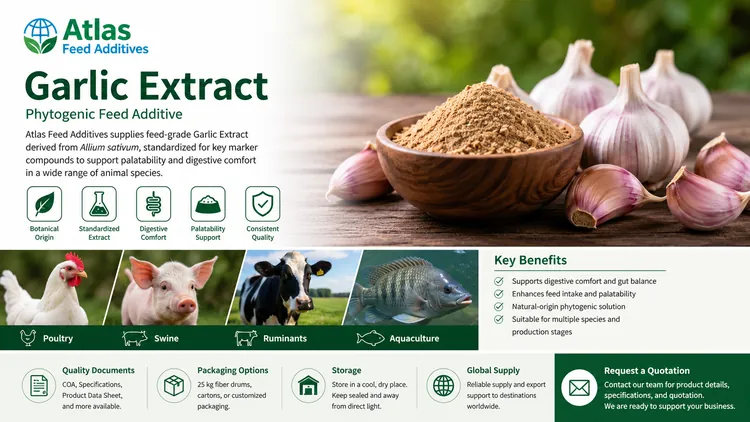
Garlic Extract supports natural-origin feeding programs focused on palatability, digestive comfort, feed hygiene strategies, odor-oriented programs, and production resilience.

Atlas Feed Additives helps feed mills, premix producers, integrators, distributors, aquaculture feed producers, ruminant nutrition companies, pet food manufacturers, and specialty nutrition brands source feed-suitable Garlic Extract with attention to botanical origin, marker compounds, extraction method, carrier system, physical form, documentation, packaging, regulatory suitability, and export logistics.

Garlic Extract feed additive visual

Product role

Where Garlic Extract fits

Garlic Extract is part of the phytogenics and botanical extracts group. It is commonly evaluated in animal nutrition programs that use plant-derived ingredients to support feed acceptance, digestive comfort, functional premix design, wellness-oriented feeding, odor-management strategies, and resilience during demanding production phases.

In commercial feed procurement, Garlic Extract should not be evaluated by name alone. Buyers typically compare botanical source, extraction ratio, marker compound concentration, active fraction, carrier, odor profile, physical form, standardization method, processing stability, intended species, inclusion method, documentation package, and regulatory suitability for the destination market.

Depending on the claim, destination country, and product registration framework, Garlic Extract may be positioned as a sensory additive, botanical extract, phytogenic ingredient, functional feed additive, or zootechnical-support ingredient. Final positioning must be confirmed against local feed regulations and customer labeling requirements.

Atlas Feed Additives can coordinate international supplier options for buyers that need consistent feed-grade material, clear document support, practical shipment planning, supplier comparison, and export-focused service from inquiry through delivery coordination.

Functional value

Why buyers evaluate Garlic Extract

  • Supports natural-origin and phytogenic feeding programs in poultry, swine, ruminant, aquaculture, pet food and specialty feed applications.
  • May help reinforce palatability programs where a recognizable botanical aroma or garlic note is desired.
  • Can be considered in digestive-comfort programs, especially when used as part of a broader nutritional strategy.
  • May be included in functional premixes with essential oils, organic acids, yeast derivatives, probiotics, prebiotics, enzymes, minerals or plant extracts when compatibility is confirmed.
  • Can support feeding programs designed around production resilience, transition periods, raw-material variation or nutritional stress.
  • May be evaluated in odor- and ammonia-management strategies where the product specification, claim framework and local rules are suitable.
  • Provides a botanical ingredient option for buyers seeking plant-derived materials with documented origin and quality controls.

Selection context

Why specification matching matters

  • Garlic Extract products may differ in botanical source, extraction ratio, active fraction, standardization method, carrier, odor profile and physical form.
  • Powder, granule, liquid, oil-based, coated or carrier-supported forms may behave differently during dosing, mixing, pelleting, extrusion, spraying or storage.
  • Marker compound declarations should be reviewed when buyers require standardized phytogenic activity or batch-to-batch consistency.
  • Heat stability should be checked when the product will be used in pelleted, extruded or high-temperature processed feeds.
  • Compatibility with acidifiers, essential oils, probiotics, enzymes, minerals, coccidiostat programs and medication where permitted should be confirmed when relevant.
  • Document expectations may differ by buyer quality system, destination country, end-use application and customer approval requirements.
  • Meaningful price comparison requires equivalent active level, extraction method, carrier, packaging, origin, lead time, logistics terms and document coverage.

Typical applications

Application areas for Garlic Extract

Garlic Extract may be considered in feed and premix systems where botanical origin, palatability, digestive comfort, functional additive design, odor-oriented positioning or natural-origin feeding concepts are important. The final inclusion rate and suitability should be confirmed by the buyer’s nutritionist, veterinarian, technical team, quality department and local regulatory requirements.

Poultry feed

In broiler, layer, breeder and turkey programs, Garlic Extract may be evaluated in phytogenic feeding strategies, starter feeds, transition periods, feed hygiene programs, digestive-comfort plans, odor-oriented programs and functional premixes designed for commercial production conditions.

Swine feed

For piglet, grower, finisher and sow nutrition, Garlic Extract may be reviewed in weaning diets, nursery feeds, palatability programs, phytogenic blends, odor-management concepts and functional premix systems focused on digestive support and intake consistency.

Ruminant feed

In dairy, beef, calf, lamb and kid programs, Garlic Extract may be considered in natural-origin feeding strategies, transition support, concentrate blends, mineral premixes, odor-oriented concepts and specialty nutrition programs.

Aquaculture feed

Aquafeed producers may evaluate Garlic Extract for formulas where botanical extracts, feed acceptance, digestive comfort, pellet coating, extrusion compatibility and water-stable feed performance are important considerations.

Pet food and treats

Pet food manufacturers may review Garlic Extract for dry food, treats, supplements or specialty products where botanical positioning, sensory identity, ingredient transparency and quality documentation are relevant to the product concept.

Premix and phytogenic blends

Premix producers may include Garlic Extract in blends with oregano oil, thyme oil, carvacrol, cinnamaldehyde, organic acids, yeast products, probiotics, prebiotics, enzymes or minerals, provided compatibility and label requirements are confirmed.

Specification guidance

Typical points to confirm before purchasing Garlic Extract

Every purchase should be based on the supplier’s official specification, safety data sheet and quality documents. The following table is a practical procurement checklist; it is not a fixed product specification. Final acceptance limits should be determined by the buyer’s quality system, formulation objective and destination market requirements.

Parameter Why it matters What to request
Botanical source Confirms the plant identity and supports traceability, label review and customer approval. Botanical declaration, plant part used and supplier origin statement.
Extraction ratio Helps compare extract strength and concentration between commercial offers. Declared extraction ratio, such as raw material-to-extract ratio, where available.
Marker compound concentration Supports standardization and batch-to-batch comparison for phytogenic programs. Marker compound declaration and batch certificate of analysis.
Standardization method Clarifies whether the extract is standardized by marker compounds, active fraction, odor profile or process controls. Technical data sheet, standardization statement or quality control method.
Active fraction Relevant when the buyer needs specific sulfur-containing compounds, oil fraction, botanical actives or sensory strength. Active fraction declaration, chromatographic profile or supplier technical statement where available.
Physical form Powder, granule, liquid, oil-based or coated forms affect dosing, mixing, spraying, dusting and stability. Specification sheet, product photo if useful and handling recommendation.
Carrier system Carriers influence flowability, label review, compatibility, cost-in-use and suitability for certain feed systems. Carrier declaration or composition statement where required.
Odor and sensory profile Garlic Extract may have strong aroma; sensory consistency affects palatability and handling. Supplier sensory description, sample evaluation and batch sensory confirmation where available.
Particle size Important for premix uniformity, segregation risk, automated dosing and feed distribution. Mesh size, particle size distribution or supplier handling statement.
Moisture / loss on drying Affects shelf life, flowability, caking risk and warehouse stability. Moisture limit and batch result where available.
Thermal stability Important for pelleting, extrusion, conditioning, drying and high-temperature feed processing. Supplier process guidance, stability data or trial recommendation.
Solvent residue Relevant for extracted botanical products depending on extraction process and regulatory requirements. Solvent declaration or residual solvent test result where applicable.
Pesticide residues Botanical raw materials may require residue review for feed safety and export compliance. Pesticide residue declaration or test report when required.
Heavy metals Supports feed safety compliance and customer quality programs. Limits or test results for relevant metals such as lead, arsenic, cadmium and mercury where required.
Microbiological status Important for young animal feeds, premixes, aquafeeds, pet food and sensitive applications. Total plate count, yeast and mold, Salmonella status and any buyer-specific parameters.
Mycotoxins and botanical contaminants May be relevant for plant-derived materials, depending on source, region and buyer quality system. Supplier declaration or test report when required.
Compatibility Garlic Extract may be combined with essential oils, acidifiers, probiotics, enzymes, minerals or other phytogenics. Supplier compatibility guidance or buyer-side premix stability testing.
Origin and traceability May affect import clearance, customer approval, regulatory acceptance and supplier qualification. Certificate of origin, batch number, manufacturing site information or supplier declaration.
Packaging Affects aroma retention, storage protection, handling, palletization and container loading. Bag, drum, carton or container type; net weight; inner liner; seal system; pallet details and label format.
Shelf life Supports purchasing volume planning, active retention, warehouse rotation and release decisions. Manufacturing date, expiry date, retest period or shelf-life declaration.

Quality documents

Recommended document package

Document requirements vary by destination market, final application, customer approval process and buyer quality system. Atlas Feed Additives can help collect the available supplier documents before order confirmation or shipment planning.

  • Product specification sheet
  • Certificate of analysis for the offered batch or recent production
  • Safety data sheet
  • Certificate of origin
  • Batch number and traceability information
  • Manufacturing date, expiry date or shelf-life declaration
  • Botanical source and plant part declaration
  • Extraction ratio or standardization declaration where available
  • Marker compound or active fraction declaration where required
  • Carrier or composition declaration where required
  • Recommended inclusion guidance by species or feed type where available
  • Thermal stability or processing guidance where available
  • Heavy metal declaration or test report when required
  • Microbiological declaration or test report when required
  • Pesticide residue, mycotoxin or botanical contaminant declaration where required
  • GMO, allergen, halal, kosher, BSE/TSE or other market-specific statements where applicable
  • Feed-grade suitability statement or registration-related documents where requested by the destination market

Buyer information

What to share for a faster quotation

A complete request allows Atlas Feed Additives to review more suitable supplier options and prepare a clearer commercial offer.

  • Product name: Garlic Extract or Allium sativum extract
  • Target marker compound, extraction ratio, active level or preferred physical form
  • Required quantity and order frequency
  • Destination country, port or delivery address
  • Preferred Incoterms such as EXW, FOB, CFR, CIF, DAP or DDP
  • Packaging preference, pallet requirement and labeling language
  • Application type: poultry, swine, ruminant, aquafeed, pet food, premix or specialty blend
  • Processing method: mash, pellet, extruded feed, liquid spray, coating or premix blend
  • Required document list for import, customer approval and internal quality release
  • Target shipment date and acceptable lead time
  • Payment term expectations
  • Any third-party inspection, sample approval or pre-shipment testing requirement

Procurement note

Ask for the right specification before comparing prices.

Garlic Extract offers can vary significantly because products may differ in botanical origin, extraction ratio, marker compound level, active fraction, carrier system, odor profile, physical form, thermal stability, particle size, origin, packaging, document coverage, lead time and shipment terms. A lower unit price may not be the best option if the extract is weaker, less standardized, unsuitable for the feed process or missing documents needed for import and quality release.

For sensitive applications, also review compatibility with pelleting, extrusion, liquid spraying, premix systems, mineral blends, organic acids, essential oils, probiotics, enzymes, yeast products, warehouse conditions and shelf-life expectations.

Commercial comparison checklist

  • Is the product suitable for feed applications?
  • Is the botanical source clearly declared?
  • Does the marker compound or active level match your target?
  • Is the extraction ratio comparable between offers?
  • Is the carrier or composition acceptable for your label and formula?
  • Is the form compatible with your dosing and mixing system?
  • Can the product tolerate your feed processing conditions?
  • Are batch documents available before shipment?
  • Is the origin acceptable for your market?
  • Are packaging and pallet details suitable for aroma retention and warehouse handling?
  • Are freight terms, insurance and delivery responsibilities clear?
  • Is the lead time realistic for your production schedule?

Handling and storage

Storage recommendations

Garlic Extract should generally be stored in original sealed packaging in a clean, dry, cool and well-ventilated warehouse. Because botanical extracts can contain volatile, aromatic or sensitive fractions, aroma protection, moisture control, temperature management and packaging integrity are especially important.

  • Keep bags, drums or containers sealed until use.
  • Protect from moisture, condensation, water exposure and damaged pallets.
  • Store away from direct sunlight, excessive heat and strong cross-odors.
  • Avoid storing near products that may absorb garlic aroma if cross-odor transfer is a concern.
  • Use clean handling equipment to avoid contamination and sensory carryover.
  • Follow first-expiry-first-out stock rotation.
  • Check aroma, color, caking, lumping, leakage, oxidation notes or flowability changes before use if the product has been stored for a long period.
  • Follow the supplier safety data sheet, label instructions and local workplace safety rules.

Packaging and logistics

Shipment planning points

Packaging and logistics influence aroma retention, active stability, total delivered cost, product condition, customs clearance and warehouse handling. Buyers should confirm loading details before order placement, especially for repeated supply programs, long-distance shipments or routes with heat exposure.

  • Common packaging may include sealed bags, lined cartons, fiber drums, plastic drums, cans, IBCs or supplier-specific industrial packaging.
  • Aroma barrier quality should be reviewed for long-distance shipments and extended storage.
  • Palletized or non-palletized loading should be confirmed according to buyer preference.
  • Container loading quantity depends on packaging size, palletization, route and supplier loading plan.
  • Labels should match product identity, batch details, net weight, origin and destination market requirements.
  • Export documents should be checked before shipment where possible.
  • Temperature exposure during storage and transport should be considered for volatile or heat-sensitive botanical extracts.
  • Buyers should confirm whether sample approval, inspection or pre-shipment testing is required before dispatch.

Technical selection

Choosing the right Garlic Extract profile

Garlic Extract is often reviewed alongside oregano oil, thyme oil, cinnamaldehyde, carvacrol, essential oil blends, organic acids, yeast derivatives, probiotics, prebiotics, enzymes and other phytogenic technologies. The best option depends on the species, feed type, active target, processing method, formulation combination, storage environment and customer quality requirements.

Botanical identity

Clear botanical identity helps buyers confirm that the product matches the intended plant source, customer label requirements and internal supplier approval process.

Marker compounds

Standardized marker compounds can help compare suppliers and monitor batch consistency, especially in technical phytogenic programs.

Carrier and form

Carrier selection and physical form influence flowability, dusting, aroma release, solubility, dispersibility, mixing behavior, labeling and compatibility with premix or compound feed systems.

Processing exposure

Pelleting, extrusion, high-temperature conditioning, drying and liquid spraying can affect active retention and aroma profile. Buyers should confirm stability with supplier guidance or in-plant trials.

Combination products

Garlic Extract may be used in blends with essential oils, organic acids, probiotics, yeast products, enzymes or minerals. Compatibility and stability should be verified before commercial use.

Quality system fit

The product should match the buyer’s specification, supplier approval process, document list, import rules and internal release procedure.

Responsible use

Formulation and compliance reminder

Garlic Extract should be used according to the target species, animal age, total diet composition, processing method, intended functional or sensory outcome, professional nutrition guidance and the laws of the destination market. Atlas Feed Additives supports sourcing and documentation coordination, but final inclusion decisions should be made by qualified nutritionists, veterinarians or technical teams responsible for the buyer’s feed program.

Before commercial use, buyers should confirm that the product specification, feed-grade status, label claims, documentation, storage conditions and use plan comply with applicable local rules and customer requirements. Regulatory and labeling expectations may vary between countries, sectors and end users.

Ordering process

How Atlas Feed Additives supports Garlic Extract buyers

1. Requirement review

Share your target specification, botanical source, marker compound target, extraction ratio, physical form, order quantity, destination, packaging requirement and document list. Atlas Feed Additives reviews the technical and commercial request.

2. Supplier coordination

Suitable supplier options are checked according to active profile, botanical origin, form, availability, documentation capability, packaging, lead time and shipment route.

3. Sample and quotation support

When available, sample review and quotation preparation can be coordinated based on requested Incoterms, quantity, packaging, delivery point, payment terms and valid offer period.

4. Document follow-up

Available specification, COA, SDS, origin, botanical, carrier and compliance documents can be coordinated for buyer review before shipment, depending on supplier and market requirements.

Questions

Useful answers

What is Garlic Extract used for in animal nutrition?

Garlic Extract supports natural-origin feeding programs focused on palatability, digestive comfort, feed hygiene strategies, odor-oriented programs and production resilience. It should be used according to the target species, formulation objective, product specification and applicable market rules.

Can Atlas Feed Additives quote Garlic Extract?

Yes. Send your required specification, marker compound target, extraction ratio, quantity, destination, packaging preference, application type and required documents so Atlas Feed Additives can review suitable supplier options for Garlic Extract.

What quality documents should buyers request for Garlic Extract?

Common documents include specification, certificate of analysis, safety data sheet, certificate of origin, batch details, shelf-life statement, botanical origin declaration, marker compound declaration, heavy metal declaration, microbiological statement and any market-specific certificates required by the buyer.

Is Garlic Extract the same as Garlic Flavor?

No. Garlic Flavor is usually selected mainly for sensory profile and palatability, while Garlic Extract is usually evaluated as a botanical or phytogenic ingredient with attention to plant source, extraction ratio, marker compounds and functional positioning. Some products may overlap in aroma, but the procurement criteria are different.

What marker compounds should be checked in Garlic Extract?

The relevant marker compounds depend on the supplier specification and extraction method. Buyers should request the supplier’s declared active or marker profile, test method and certificate of analysis rather than assuming all garlic extracts are standardized in the same way.

Can Garlic Extract be used in pelleted or extruded feeds?

It may be suitable for some pelleting or extrusion systems, but buyers should confirm thermal stability, active retention, odor profile, inclusion method and process compatibility with the supplier and their technical team.

Can Garlic Extract be combined with oregano oil or thyme oil?

Garlic Extract may be used in phytogenic blends with oregano oil, thyme oil, carvacrol, cinnamaldehyde or other botanical products, but compatibility, stability, label rules and final claims should be confirmed before commercial use.

Is Garlic Extract suitable for every animal species?

Suitability depends on the product specification, active level, species, life stage, feed type, inclusion level, intended claim and local regulations. Buyers should confirm use with their technical team and verify regulatory acceptance in the destination market.

How should Garlic Extract be stored?

Store Garlic Extract in original sealed packaging in a clean, dry, cool and well-ventilated warehouse. Protect it from moisture, heat, direct sunlight, contamination, damaged packaging and strong cross-odors. Always follow the supplier safety data sheet.

What information is needed for an accurate quotation?

Atlas Feed Additives needs the target specification, botanical source, marker compound target, extraction ratio, physical form, quantity, destination country, port or address, preferred Incoterms, packaging requirement, application type, document list, target shipment date and payment expectations.

Request a quotation

Tell us what you need

Send your product list, target specification, botanical source, marker compound target, destination country, packaging preference, required documents, order quantity, application type and target shipment timing. Our team will review your request and respond from orders@feedgradeadditives.com.

Recommended message format

Please include: “Garlic Extract / botanical source or marker compound target / powder or liquid / quantity / destination / Incoterms / packaging / application / required documents / target delivery date.” This helps us prepare a clearer and faster response.