Ruminant performance and environmental additives

Protected Niacin

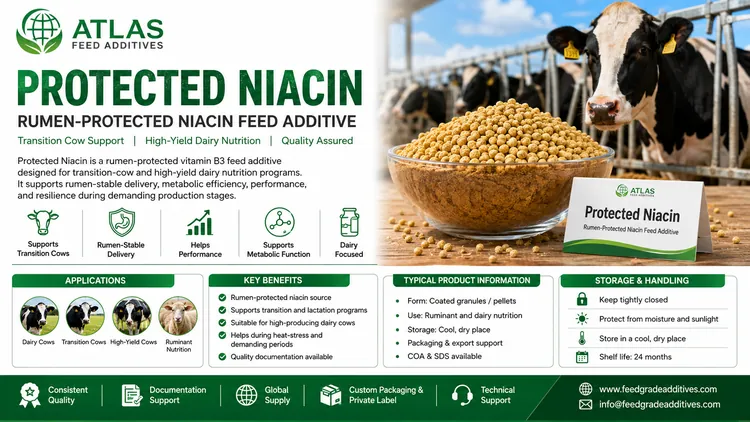
Protected Niacin is a specialty ruminant additive selected for transition-cow, high-yield dairy, heat-stress, rumen-stability, metabolic support, and performance-focused nutrition programs where targeted niacin delivery is preferred over standard unprotected forms.

Protected Niacin feed additive visual

Product role

Where Protected Niacin fits

Protected Niacin is part of the ruminant performance and environmental additives group. It is designed for nutrition programs where the buyer wants niacin support combined with a protection, coating, encapsulation, matrix, or delivery technology intended to improve rumen stability and targeted availability.

Niacin is also known as Vitamin B3. In ruminant nutrition, standard niacin can be exposed to rumen microbial activity before reaching the intended site of action. Protected Niacin products are therefore evaluated not only by active niacin concentration, but also by protection technology, rumen bypass profile, release behavior, physical handling, and supplier documentation.

Atlas Feed Additives can coordinate international supplier options for dairy farms, feed mills, premix producers, distributors, integrators, and importers that need consistent feed-grade material supported by technical documents, batch-level certificates, and export-focused service.

What Protected Niacin is designed to support

Protected Niacin is most often evaluated in dairy and ruminant programs that require additional nutritional support during demanding production phases. Depending on the product design and local authorization, it may be considered for metabolic support, energy metabolism, transition management, high milk output, heat-stress periods, and performance-oriented rations.

  • transition-cow nutrition programs before and after calving
  • early-lactation and peak-lactation dairy diets
  • high-producing cows with intensive energy demand
  • heat-stress and warm-season feeding strategies
  • ration programs focused on feed efficiency and metabolic resilience
  • specialty ruminant premixes and supplements
  • feedlot or finishing rations where authorized and nutritionally justified
  • rumen-stability or post-ruminal delivery programs

Typical applications

  • dairy transition and close-up dry cow premixes
  • fresh-cow and early-lactation supplements
  • peak-milk and high-yield dairy concentrates
  • total mixed ration support products
  • ruminant specialty blends for farm or feed-mill use
  • mineral-vitamin premixes for dairy cattle
  • heat-stress support formulas where permitted
  • energy-metabolism support programs designed by a qualified nutritionist
  • feedlot and finishing rations in authorized markets
  • distributor portfolios for advanced ruminant nutrition

Technical identity

Key specification points for buyers

Protected Niacin buyer reference table
Item Typical buyer reference Why it matters
Product group Specialty ruminant additive / protected vitamin product Confirms the product category and formulation purpose.
Active nutrient Niacin, also known as Vitamin B3 Allows nutritionists to calculate active contribution in the final diet.
Protection technology Coating, encapsulation, matrix, fat-based carrier, polymer system, or supplier-specific delivery technology Protection technology influences rumen stability, handling, release profile, and price comparison.
Active concentration Declared niacin percentage or guaranteed active content Essential for dosing, formulation cost, and comparing offers on an active basis.
Rumen stability Supplier-declared rumen bypass or stability data where available Helps evaluate whether the product matches the intended delivery objective.
Release profile Supplier-specific release behavior under digestive or laboratory conditions Important for technical comparison between protected products.
Physical form Granule, beadlet, microencapsulated particle, powder, or coated particle Physical form affects mixing, segregation risk, dust level, and flowability.
Carrier system Fat, hydrogenated vegetable oil, mineral carrier, organic matrix, or other supplier-declared carrier Carrier type affects compatibility, storage, melting behavior, and labeling.
Target species Dairy cows, beef cattle, small ruminants, or other ruminants depending on authorization Confirms legal and nutritional fit for the buyer’s market.
Documentation Specification, COA, SDS, technical sheet, origin, shelf life, and market-specific certificates Supports import, quality approval, traceability, and audit requirements.

Ruminant nutrition context

Why buyers request a protected form

In ruminants, feed ingredients and additives first pass through the rumen, where microbial fermentation can alter nutrient availability before digestion continues through the lower tract. Protected Niacin products are developed to manage this challenge by using a delivery system that helps preserve more active material during rumen exposure and release it later, depending on product design.

Because protection systems differ significantly between suppliers, procurement teams should request more than a simple product name. A complete comparison should review active concentration, protection method, rumen stability data, release information, physical form, shelf life, packaging, and technical support.

  • helps differentiate protected products from standard niacin sources
  • supports accurate active-cost comparison between suppliers
  • helps nutritionists select the right additive for the feeding objective
  • reduces risk of buying a product with unsuitable release behavior
  • supports better documentation during supplier approval

Buyer quality checklist

What to verify before approval

Protected Niacin offers should be evaluated by technical performance and document completeness, not only by price per kilogram. Different suppliers may use different active levels, coating materials, carrier systems, release profiles, and stability claims.

  • declared active niacin concentration
  • protection or delivery technology
  • rumen stability or bypass declaration, if available
  • post-ruminal or intestinal release profile, if available
  • particle size distribution and segregation risk
  • bulk density and flowability
  • dust level and handling characteristics
  • carrier type and coating composition
  • heat, moisture, and pelleting compatibility
  • shelf life and storage requirements
  • batch-to-batch consistency
  • certificate of analysis for each lot
  • market authorization for intended species and country

Documents

Recommended document package

Atlas Feed Additives can help buyers request and review the documents commonly needed for internal quality approval, import checks, distributor registration, customer audits, and feed-manufacturing systems.

  • product specification sheet
  • certificate of analysis by batch or lot
  • safety data sheet
  • technical data sheet
  • active concentration declaration
  • protection technology or release-profile information
  • country-of-origin statement
  • manufacturing-site or supplier declaration where required
  • GMO, allergen, BSE/TSE, dioxin, or contaminant statements where relevant
  • Halal, Kosher, ISO, FAMI-QS, GMP+, or other certificates if available and required
  • shelf-life and storage declaration
  • packing list, commercial invoice, and certificate of origin for export shipments

Formulation and handling

Practical notes for feed mills and premix producers

Premix compatibility

Protected Niacin should be checked for compatibility with mineral carriers, fat sources, trace minerals, buffers, live yeast, enzymes, organic acids, and other specialty additives used in ruminant premixes.

Mixing uniformity

Particle size, density, coating hardness, and electrostatic behavior can affect distribution in a premix or total mixed ration. Buyers should verify whether the product is suitable for their mixer and dosing system.

Pelleting and heat exposure

Some protected technologies are more sensitive to heat, friction, steam, or pressure than others. If the product will be pelleted, extruded, or exposed to high temperatures, request supplier guidance before use.

Moisture control

Store sealed bags in a dry warehouse and prevent condensation during transport or storage. Moisture may affect flowability, coating integrity, shelf life, and product appearance.

Farm-level use

If supplied for direct farm use, instructions should clearly state inclusion guidance, mixing method, storage conditions, and compatibility with the farm’s feeding system. Final use should be guided by a nutritionist.

Regulatory check

Feed additive authorization, labeling, species approval, claims, import requirements, and maximum levels vary by country. The buyer is responsible for confirming compliance in the destination market.

Commercial comparison

How to compare Protected Niacin offers

Commercial and technical comparison points
Comparison point Ask the supplier Reason for review
Active cost What is the guaranteed niacin content? Allows comparison by cost per unit of active niacin, not only cost per kilogram of product.
Protection method What coating, encapsulation, carrier, or matrix technology is used? Protection method affects rumen stability, release, handling, and storage behavior.
Performance data Is technical data available for rumen stability or release profile? Supports technical evaluation by nutritionists and quality teams.
Physical quality What are the particle size, dust level, bulk density, and flowability? Determines suitability for premix plants, feed mills, and farm-level application.
Storage What temperature, humidity, and shelf-life limits apply? Helps prevent product degradation and warehouse claims.
Documents Which documents are available before shipment? Reduces delays during buyer approval, customs clearance, and customer audits.
Packaging What bag size, liner, pallet, and container-loading options are available? Affects transport safety, moisture protection, and warehouse handling.
Lead time Is the product available from stock or produced to order? Important for transition-season planning and continuous supply programs.

Procurement note

Ask for the right specification before comparing prices.

Price comparisons are meaningful only when active concentration, protection technology, release profile, carrier system, particle size, packaging, origin, shelf life, and documentation are aligned. A low unit price may not be economical if the product has a lower active level, weaker protection profile, unsuitable physical properties, or incomplete documents.

For protected ruminant additives, the quotation should clearly identify whether the offer is based on finished-product weight, active niacin content, or a supplier-specific protection system. The buyer should also confirm if the product is suitable for the intended species, feeding stage, and destination market.

Quote request details to send

  • product name and preferred protection technology
  • required active niacin concentration
  • target application and species
  • required quantity and order frequency
  • destination country, port, or delivery address
  • preferred Incoterm
  • packaging requirement
  • required certificates and declarations
  • target shipment date
  • approved or restricted origins
  • payment and document requirements

Packaging and logistics

Commercial supply considerations

Protected Niacin products may be more specialized than standard commodity vitamins because the protection system, carrier, and particle form can affect transport, storage, handling, and shelf life. Packaging should protect the product from moisture, heat, contamination, and physical damage during international movement.

  • multi-layer bags with inner liner where suitable
  • sealed packaging to reduce moisture exposure
  • clear batch, net weight, expiry, and product labeling
  • palletized export packaging when required
  • container loading plan for larger shipments
  • warehouse storage away from heat, humidity, and direct sunlight
  • first-expired, first-out stock rotation
  • lot traceability from shipment to feed production

Who buys this product?

Suitable buyer profiles

  • dairy feed manufacturers
  • ruminant premix producers
  • large dairy farms and farm groups
  • feed additive distributors
  • integrators managing dairy or beef nutrition programs
  • importers supplying specialty feed additive portfolios
  • nutrition companies developing transition-cow programs
  • technical buyers comparing protected ruminant additives

Program positioning

Where Protected Niacin may be positioned in ruminant programs

Transition cows

Transition periods involve rapid changes in feed intake, energy demand, and metabolic pressure. Protected Niacin is often considered as part of broader close-up and fresh-cow support strategies.

High-yield dairy cows

High-producing animals require carefully balanced energy, protein, mineral, and vitamin nutrition. Protected Niacin may be selected when the nutritionist wants targeted niacin support in demanding diets.

Heat-stress programs

Warm conditions can affect intake, performance, and cow comfort. In some programs, Protected Niacin is evaluated alongside buffers, yeast, fat sources, electrolytes, and management practices.

Specialty premixes

Premix producers may include Protected Niacin in targeted ruminant blends where coating integrity, particle stability, and uniform distribution are important quality requirements.

Feedlot programs

In authorized markets, Protected Niacin may be considered in finishing or feedlot rations when the nutritionist identifies a clear metabolic or performance objective.

Distributor portfolios

Distributors may position Protected Niacin with other advanced ruminant additives such as rumen-protected choline, protected methionine, protected lysine, buffers, yeast products, and protected fats.

Why Atlas Feed Additives?

Support beyond a price quote

Atlas Feed Additives helps buyers approach Protected Niacin procurement with a technical and commercial checklist. This is especially useful when comparing multiple offers with different active concentrations, coating technologies, release profiles, and documentation standards.

  • supplier option review based on target specification
  • quotation coordination for spot or recurring demand
  • document collection before shipment where available
  • packaging, lead time, and logistics coordination
  • support for export-oriented buyers and distributors
  • clear communication in English and Turkish
  • feed-additive portfolio coordination from Ankara, Turkey

Important disclaimer

Use according to local rules and professional formulation

Protected Niacin should be used only according to the target species, product specification, qualified nutritionist guidance, customer formulation standards, supplier instructions, and applicable market rules. Atlas Feed Additives does not replace veterinary, regulatory, or nutritionist advice.

Product claims, allowed species, inclusion ranges, label statements, and import requirements can vary by country. Buyers should confirm compliance before ordering, importing, labeling, selling, or using the product in commercial feed.

Questions

Useful answers about Protected Niacin

What is Protected Niacin used for in animal nutrition?

Protected Niacin is mainly used in ruminant nutrition programs where formulators want niacin support with improved rumen stability. It is commonly considered for transition cows, early lactation, high milk yield, heat-stress periods, and specialty dairy performance programs.

Is Protected Niacin the same as regular niacin?

Protected Niacin contains niacin as the active component, but it is supplied with a coating, encapsulation, carrier, or matrix technology intended for ruminant delivery. Regular niacin and Protected Niacin should not be compared only by kilogram price because active level and delivery profile may differ.

Why does protection technology matter?

Protection technology influences rumen stability, post-ruminal release, handling, dust level, storage sensitivity, and total value in the ration. Buyers should request technical information from the supplier before approving a product.

Which animals can use Protected Niacin?

Protected Niacin is primarily positioned for dairy cattle and other ruminants, depending on the product specification, local authorization, and formulation goal. Final use should be confirmed by a qualified nutritionist and the buyer’s regulatory team.

Can it be used during the transition period?

Yes, transition-cow programs are one of the common areas where Protected Niacin may be considered. However, it should be part of a complete ration strategy that also reviews dry matter intake, energy balance, fiber, minerals, cow comfort, and management factors.

Can it be used in heat-stress programs?

Protected Niacin may be evaluated in warm-season or heat-stress support programs where authorized and nutritionally justified. It should be considered alongside total diet design, water availability, shade, ventilation, cow comfort, electrolyte balance, and feeding management.

What specification points should buyers compare?

Buyers should compare active niacin concentration, protection technology, release profile, rumen-stability information, physical form, carrier type, particle size, shelf life, packaging, origin, and document availability.

What documents should be requested?

Common documents include product specification, certificate of analysis, safety data sheet, technical data sheet, country of origin, shelf-life declaration, batch information, active concentration declaration, and any required market-specific certificates.

How should Protected Niacin be stored?

Store in sealed original packaging in a cool, dry, well-ventilated area. Protect from moisture, direct sunlight, strong odors, contamination, excessive heat, and physical damage. Always follow the supplier’s safety data sheet and storage instructions.

Can Atlas Feed Additives quote Protected Niacin?

Yes. Send your required specification, active concentration, target quantity, destination, preferred Incoterm, packaging requirement, shipment timing, and required documents so Atlas Feed Additives can review suitable supplier options.

Can Atlas quote related ruminant additives?

Yes. Atlas Feed Additives can review requests for related ruminant products such as rumen-protected choline, rumen-protected methionine, rumen-protected lysine, protected fat, calcium salts of fatty acids, live yeast, yeast culture, buffers, and other specialty feed additives depending on availability.

Request a quotation

Tell us what you need

Send your product list, target specification, active niacin requirement, destination country, packaging preference, annual or spot quantity, delivery term, required documents, and target shipment date. Our team will review your request and respond from orders@feedgradeadditives.com.