Ruminant performance and environmental additives

Calcium Salts of Fatty Acids

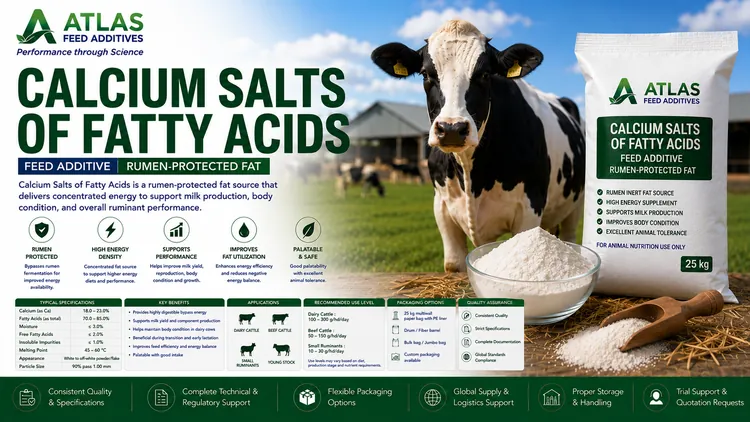
Calcium Salts of Fatty Acids are specialty ruminant feed additives used as a rumen-protected fat, bypass fat, or rumen-inert energy source for dairy and beef nutrition programs that require higher energy density with careful rumen management.

Calcium Salts of Fatty Acids feed additive visual
  • Rumen-protected supplemental fat concept
  • Used in energy-dense ruminant formulations
  • Specification-driven sourcing and document review

Product role

Where Calcium Salts of Fatty Acids fits

Calcium Salts of Fatty Acids belong to the ruminant performance and environmental additives group. They are generally selected when a nutrition program needs additional energy from fat while limiting the negative effect that unprotected free oils can have on rumen fermentation, fiber digestion, feed intake, and ration consistency.

The product is often described as calcium soaps of long-chain fatty acids, protected fat, bypass fat, or rumen-inert fat. In practical procurement, these names may refer to different raw materials, fatty acid profiles, physical forms, and production technologies, so buyers should confirm the exact specification before comparing offers.

Atlas Feed Additives can coordinate international supplier options for feed mills, premix producers, distributors, integrators, dairy groups, beef operations, and importers that need feed-grade material with consistent documentation and export-focused communication.

Nutrition concept

Why protected fat is used in ruminant diets

High-producing ruminants often face a gap between energy requirement and dry matter intake, especially around calving, early lactation, heat stress, or intensive finishing periods. Supplemental fat can raise ration energy density, but the source and form of fat matter because excessive rumen-available oil may interfere with microbial activity and fiber digestion.

Calcium Salts of Fatty Acids are designed to make long-chain fatty acids less disruptive in the rumen than many unprotected oils. After passing through the rumen environment, the product is intended to become available for digestion and absorption later in the digestive tract.

Commercial purpose

Why buyers request this product

  • Increase dietary energy density without adding large volumes of liquid oil
  • Support transition-cow and early-lactation energy programs
  • Help maintain body condition during high energy demand periods
  • Provide a dry, easier-to-handle fat source for feed mills and premix plants
  • Offer a specification-controlled option for TMR, compound feed, and premix use
  • Reduce formulation variability by defining fatty acid profile and physical form

Application areas

Typical applications in ruminant nutrition

Dairy transition cows

Transition cows may experience reduced intake while energy demand rises. Calcium Salts of Fatty Acids can be evaluated as part of a broader transition program that also considers effective fiber, starch, protein balance, mineral strategy, liver support, cow comfort, and feed access.

  • Used around calving when energy density is a key formulation target
  • Often reviewed together with body condition score and intake data
  • Should be balanced carefully with calcium, magnesium, DCAD, and total dietary fat strategy

Peak-lactation dairy diets

In high-yielding dairy cows, protected fat may be included to increase the energy density of the ration when dry matter intake limits energy supply. The final decision should consider milk yield, milk fat response, forage quality, rumen function, and total ration economics.

  • Suitable for high-energy dairy rations when authorized and correctly formulated
  • Can be evaluated when ration space is limited
  • Should be introduced gradually and monitored through production and intake response

Beef finishing and feedlot rations

In beef systems, protected fat may be considered where energy density, feed efficiency, finishing performance, and ration handling are important. Use depends on the feeding system, grain level, roughage level, market rules, and cost-benefit calculation.

  • May be used in finishing rations that require concentrated energy
  • Should be reviewed alongside starch, fiber, and acidosis management
  • Requires compatibility with local feeding regulations and customer specifications

Small ruminant and specialty programs

Sheep, goats, and specialty ruminant programs may evaluate Calcium Salts of Fatty Acids when a dry protected fat source is needed. Suitability depends on species authorization, life stage, feed form, and the nutritionist’s formulation objective.

  • Potential use in dairy goat or sheep energy programs where approved
  • Requires species-specific inclusion guidance
  • Should be checked against destination-country feed rules

Specification guide

Specification points to define before comparing offers

Calcium Salts of Fatty Acids should not be purchased only by product name. Buyers should compare the complete technical profile, because fatty acid composition, total fat, calcium level, raw material origin, physical form, and documentation can vary significantly between suppliers.

Specification area What to request Why it matters
Product identity Exact product name, description, raw material basis, and whether it is marketed as calcium salts, calcium soaps, bypass fat, or protected fat Different commercial terms may refer to different technologies or fatty acid profiles.
Total fat Supplier-declared total fat or ether extract value Useful for comparing energy contribution and commercial value.
Calcium content Typical and guaranteed calcium level Important for mineral balancing and confirming the calcium salt structure.
Fatty acid profile C16:0, C18:0, C18:1, C18:2, and other key fatty acids where available Fatty acid profile influences formulation objectives and expected response.
Free fatty acids Free fatty acid level or supplier method of analysis Supports evaluation of product consistency and processing quality.
Moisture Moisture maximum and test method High moisture can affect flowability, storage stability, and shelf life.
Ash Ash level and related mineral profile if required Helps buyers understand the non-fat fraction and formulation impact.
Physical form Powder, granule, bead, prill, flake, or custom form Physical form affects mixing, dust, flowability, storage, and feed plant handling.
Particle size Particle size range, screen analysis, or visual standard Important for premix uniformity, segregation control, and customer acceptance.
Color and odor Typical color, acceptable odor, and visual quality notes Useful for incoming quality checks and claim prevention.
Contaminants Heavy metals, dioxins, undesirable substances, microbiology, or other tests required by the buyer Destination markets and large feed groups may require specific limits.
Shelf life Declared shelf life under recommended storage conditions Important for import planning, warehouse rotation, and long-distance logistics.
Packaging Bag size, big-bag option, pallet quantity, liner type, and label language Packaging affects freight cost, storage, handling, and customs documentation.
Regulatory status Feed-grade statement, destination-market authorization, and applicable certificates Buyers must confirm compliance with local feed laws before import or use.

Quality control

Buyer quality checklist

  • Full product specification with guaranteed and typical values
  • Certificate of analysis for each batch or shipment
  • Safety data sheet in the required language where possible
  • Origin statement and manufacturer or supplier traceability
  • Batch number, production date, expiry date, and shelf-life declaration
  • Packaging photos, label artwork, and pallet configuration
  • Heavy metal, dioxin, microbiology, or undesirable-substance tests when required
  • GMP+, FAMI-QS, ISO, HACCP, or other quality-system documents if requested
  • Import documents required by the destination country
  • Non-GMO, Halal, Kosher, or other market-specific declarations where applicable

Incoming inspection

Practical checks at delivery

  • Confirm product name, batch number, net weight, and label details
  • Check bag integrity, pallet condition, and moisture exposure
  • Inspect color, odor, dust, lumps, caking, and foreign material
  • Compare certificate of analysis values with the purchase specification
  • Retain a representative sample according to internal quality procedures
  • Store away from water, direct sunlight, excessive heat, and strong odors
  • Apply first-expiry-first-out warehouse rotation
  • Report deviations before using the product in production

Formulation guidance

Nutrition and formulation considerations

Final use levels should be determined by a qualified nutritionist. Inclusion depends on the animal species, production stage, ration dry matter, forage quality, total fat level, starch level, effective fiber, mineral balance, other fat sources, feed form, environmental conditions, and commercial objectives.

Total dietary fat

Protected fat should be evaluated within the total fat load of the ration. Other fat sources such as oilseeds, distillers grains, vegetable oil, animal fat, and by-products may already contribute significant fat.

Rumen function

The purpose of using a protected source is to support energy supply while helping maintain rumen fermentation. Effective fiber, rumen pH, feed sorting, starch fermentability, and feeding management remain critical.

Fatty acid objective

Different fatty acid profiles may be selected for different objectives. Buyers should confirm whether the target is general energy density, milk fat support, body condition, reproduction-related energy balance, or a specific customer requirement.

Gradual introduction

When changing fat sources or inclusion rates, gradual introduction and careful monitoring of intake, manure, milk components, body condition, and performance data can help reduce ration transition issues.

Processing compatibility

Feed mills should confirm compatibility with mixing, premix production, pelleting, storage, and transport. Heat, pressure, moisture, and long storage periods can affect some fat products.

Regulatory approval

Use must comply with destination-country feed regulations, species authorization, customer standards, and any label or documentation requirements that apply to the final feed.

Procurement note

Ask for the right specification before comparing prices.

Price comparisons are meaningful only when assay, fatty acid profile, calcium level, moisture, physical form, packaging, origin, logistics terms, and documents are aligned. A lower unit price may not be the best value if the product has a different active profile, higher moisture, shorter shelf life, weaker documentation, or unsuitable packaging.

For sensitive procurement projects, Atlas Feed Additives can help clarify the technical request, collect supplier documents, coordinate quotation details, and support buyers with export-focused communication.

Packaging and logistics

Common shipment details to confirm

Packaging and logistics should be agreed before order confirmation because fat-based feed additives can be sensitive to moisture, heat, long storage, and rough handling.

  • Standard bag size, inner liner, and outer bag material
  • Big-bag availability for industrial users
  • Pallet quantity, pallet wrapping, and container loading plan
  • Label language, batch coding, and product identification
  • Container type, loading photos, and shipping marks
  • Storage temperature and humidity recommendations
  • Minimum order quantity and lead time
  • Incoterms, destination port, and required shipping documents

Quotation details

Information to send for a faster offer

  • Product name and target specification
  • Required fatty acid profile or reference product
  • Monthly or annual volume estimate
  • Destination country and delivery port or city
  • Preferred packaging format
  • Required certificates and quality documents
  • Target species and application area
  • Expected order timing and contract period
  • Any special labeling, language, or registration requirement
  • Preferred Incoterms and payment terms

Commercial positioning

Who typically buys Calcium Salts of Fatty Acids?

Feed mills

Feed mills may use the product in compound feeds, dairy concentrates, beef feeds, and specialty ruminant formulas where protected fat is part of the declared formulation strategy.

Premix producers

Premix companies may request consistent particle size, low dust, good flowability, and strong documentation to support use in high-value dairy or ruminant premix products.

Distributors

Regional distributors often need reliable packaging, stable shelf life, clear labels, and technical documentation that can be shared with feed mills and farm customers.

Integrators and large farms

Large dairy and beef operations may evaluate Calcium Salts of Fatty Acids as part of performance, energy-density, transition, or finishing programs managed by their nutrition teams.

Risk management

Important purchasing and use cautions

  • Do not assume all calcium salt products have the same fatty acid profile or energy value.
  • Do not compare quotations without checking moisture, fat level, calcium level, packaging, origin, and documents.
  • Do not formulate only by product name; use supplier-confirmed nutrient values.
  • Do not exceed nutritionist recommendations for total dietary fat or inclusion level.
  • Do not use the product in a destination market without confirming local feed authorization.
  • Do not store near water, strong odors, open sunlight, or excessive heat unless the supplier confirms suitability.
  • Do not accept damaged bags or unclear batch identification without documenting the issue.

Questions

Useful answers

What are Calcium Salts of Fatty Acids used for in animal nutrition?

Calcium Salts of Fatty Acids are used as a protected fat or bypass fat source in ruminant nutrition. They are commonly evaluated for dairy transition cows, high-yield dairy diets, beef finishing rations, and other ruminant programs where higher energy density is required.

Are Calcium Salts of Fatty Acids the same as bypass fat?

They are often sold under the bypass fat or rumen-protected fat category, but buyers should not rely only on the category name. The exact product may differ by raw material, fatty acid profile, calcium content, physical form, and manufacturing process.

Why use calcium salts instead of liquid oil?

Liquid oils can be difficult to handle and may increase rumen exposure to unsaturated fatty acids. Calcium salt products are dry and are intended to be more rumen-stable, making them easier to use in many feed mill, premix, and TMR applications.

Can Atlas Feed Additives quote Calcium Salts of Fatty Acids?

Yes. Send your required specification, quantity, destination, packaging preference, and documents so Atlas Feed Additives can review suitable supplier options for Calcium Salts of Fatty Acids.

What quality documents should buyers request?

Common documents include specification, certificate of analysis, safety data sheet, origin information, batch details, shelf-life statement, packaging details, and any market-specific certificates required by the buyer.

Which specification values are most important?

Important values include total fat, calcium content, moisture, ash, fatty acid profile, free fatty acids, physical form, particle size, shelf life, and contaminant limits requested by the buyer or destination market.

Can the product be used in dairy transition-cow diets?

It can be evaluated for transition-cow programs, but use should be determined by a qualified nutritionist. The full ration, mineral balance, dry matter intake, body condition, forage quality, and cow-management conditions should be considered.

Can it be used in beef finishing rations?

It may be considered for beef finishing rations where protected supplemental fat is suitable and legally authorized. The nutritionist should review energy density, starch level, roughage level, total dietary fat, and economic return.

Does Atlas Feed Additives provide dosage recommendations?

Atlas Feed Additives can help with product information and supplier documentation, but final inclusion rate should be set by the buyer’s nutritionist according to the ration, species, production stage, and local regulations.

What packaging options are commonly requested?

Buyers commonly request 20 kg or 25 kg bags, lined bags, palletized shipments, and sometimes big bags. Actual packaging depends on supplier availability, order volume, and destination requirements.

How should Calcium Salts of Fatty Acids be stored?

Store in a cool, dry, well-ventilated area away from water, direct sunlight, excessive heat, strong odors, and damaged packaging. Follow the supplier’s storage recommendation and apply first-expiry-first-out stock rotation.

What information should be included in a quotation request?

Include target specification, volume, destination country, delivery terms, packaging preference, application area, required certificates, expected order timing, and any reference product or fatty acid profile required by the nutrition team.

Request a quotation

Tell us what you need

Send your product list, target specification, destination country, packaging preference, and required documents. Our team will review your request and respond from orders@feedgradeadditives.com.

For faster processing, include:

  • Required product specification or reference product
  • Monthly or annual quantity
  • Destination port, country, or delivery address
  • Required certificates and quality documents
  • Preferred packaging and pallet configuration
  • Target application and animal species