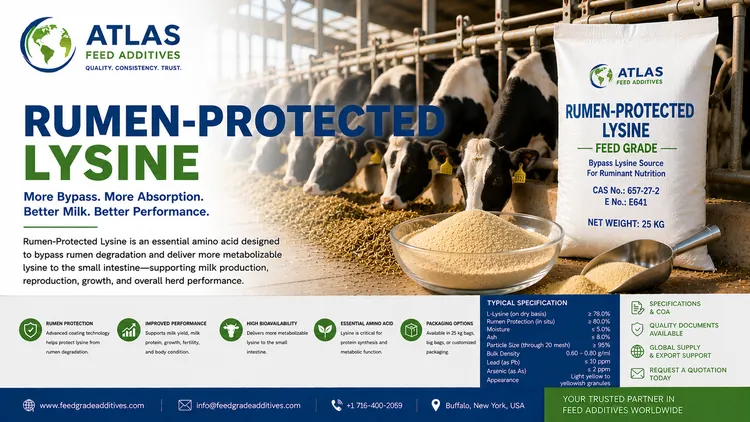
What is Rumen-Protected Lysine used for in animal nutrition?
Rumen-Protected Lysine is selected for transition-cow, high-yield dairy, metabolizable amino acid balancing, rumen-stability, protein-efficiency, feed-efficiency, or emissions-focused nutrition programs. It should be used according to the target species, formulation objective, product label, and applicable market rules.
Can Atlas Feed Additives quote Rumen-Protected Lysine?
Yes. Send your required specification, active lysine concentration, quantity, destination, packaging preference, delivery terms, and documents so Atlas Feed Additives can review suitable supplier options for Rumen-Protected Lysine.
What quality documents should buyers request for Rumen-Protected Lysine?
Common documents include specification, certificate of analysis, safety data sheet, technical data sheet, active concentration statement, lysine basis statement, origin information, batch details, shelf-life statement, storage guidance, and any market-specific certificates required by the buyer.
Why is rumen protection important?
Protection helps reduce breakdown of lysine in the rumen and supports delivery beyond the rumen. Buyers should request information about protection technology, rumen stability, release profile, and practical use guidance.
How should two protected lysine products be compared?
Compare active lysine concentration, lysine basis, protection technology, rumen stability, intestinal release, bioavailability information, particle size, handling stability, packaging, shelf life, documents, lead time, Incoterms, and cost per unit of usable lysine.
Is higher lysine concentration always better?
No. Higher active concentration can be useful, but the product also needs suitable protection, release, bioavailability, handling properties, and compatibility with the ration program.
What is lysine basis and why does it matter?
Lysine basis explains whether the declared percentage refers to pure L-lysine, lysine hydrochloride, lysine sulfate, or another equivalent. It matters because different bases can change the real active nutrient comparison between products.
Can Rumen-Protected Lysine be used in pelleted feed?
It depends on the product and processing conditions. Buyers should request supplier guidance about pelleting, heat exposure, friction, pressure, and coating stability before use in heat-treated feed.
What storage conditions should be checked?
Buyers should confirm recommended temperature range, humidity protection, sealed packaging requirements, shelf life, handling after opening, and whether the coating is sensitive to moisture or heat.
Can Rumen-Protected Lysine be used for every ruminant species?
No single product should be assumed suitable for every species, phase, or market. Suitability depends on product registration, label directions, species, ration objective, and local regulations.
What information helps Atlas respond faster?
The fastest quotation requests usually include required lysine concentration, lysine basis, protection technology preference, target species, quantity, destination country, Incoterm, packaging preference, required documents, and order timeline.
What does cost per unit of bioavailable lysine mean?
It means evaluating the offer based on how much usable lysine is expected to reach the animal after considering active concentration, rumen protection, intestinal release, and practical bioavailability, rather than only the product price per kilogram.
Does Atlas Feed Additives provide regulatory approval?
Atlas Feed Additives provides sourcing, quotation, and documentation coordination support. Buyers should confirm regulatory acceptance, product registration, label claims, and final use permissions with local authorities or qualified regulatory advisors.