Phytogenics and botanical extracts

Eugenol

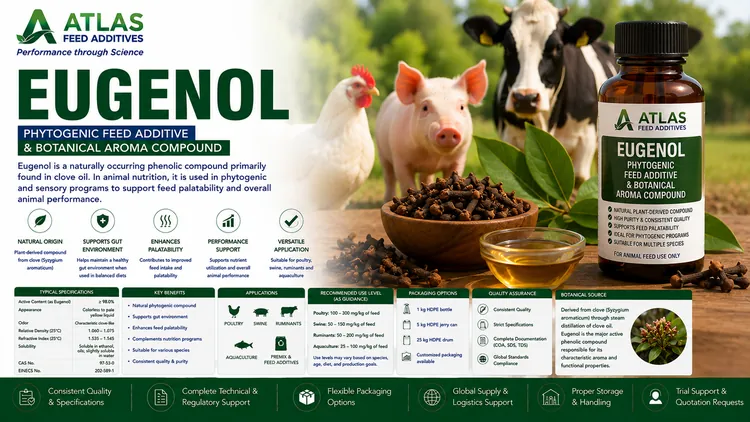
Eugenol is a clove-like aromatic phenolic compound used in phytogenic, sensory, and natural-origin feed programs where buyers need controlled active content, reliable odor profile, feed-grade documentation, and application-specific formulation support.

CAS 97-53-0 Common chemical identifier
C10H12O2 Molecular formula
Clove profile Warm, spicy, aromatic character
Flexible forms Liquid, powder, encapsulated, or premix
Eugenol feed additive visual

Product role

Where Eugenol fits

Eugenol is part of the phytogenics and botanical extracts group. It is commonly associated with clove oil and is recognized by its warm, spicy, clove-like aroma. In feed-additive sourcing, buyers usually evaluate Eugenol by active marker concentration, source, purity, carrier, stability, handling profile, intended species, manufacturing process, and regulatory classification in the destination market.

Depending on the product design and local authorization, Eugenol may be positioned as a sensory additive, flavouring compound, botanical active, essential-oil component, or part of a broader phytogenic blend. When a supplier presents performance-related claims, buyers should request the correct authorization, technical dossier support, recommended inclusion level, and trial or formulation basis.

Atlas Feed Additives can coordinate international supplier options for feed mills, premix manufacturers, distributors, integrators, and brand owners that need consistent feed-grade Eugenol, clove-oil actives, botanical blends, or carrier-based phytogenic premixes.

Important commercial positioning

Eugenol should not be treated as a generic commodity only by price per kilogram. A meaningful comparison requires active content, carrier system, liquid or powder form, botanical versus nature-identical origin, odor profile, encapsulation method, heat stability, packaging, shelf life, documentation, and destination-market compliance.

Product identity

A defined aromatic compound used in botanical feed programs

Eugenol is an aromatic phenolic compound naturally associated with clove bud oil, clove leaf oil, and certain other botanical sources. In feed and premix applications, it may be supplied as a purified liquid active, a standardized essential-oil fraction, a nature-identical compound, an oil blend, an adsorbed powder, or a microencapsulated product.

The correct purchase specification depends on how the buyer plans to use it. A liquid active may be suitable for liquid blends or oil-based premixes, while an encapsulated powder may be preferred where odor control, handling, flowability, pelleting resistance, or controlled release is important.

  • Used as a marker compound in clove-type phytogenic products
  • Can support flavouring and palatability-oriented feed concepts
  • Often combined with other botanicals such as carvacrol, thymol, cinnamaldehyde, oregano oil, or thyme oil
  • May be supplied as liquid, powder, encapsulated beadlet, or premix
  • Requires careful review of claims, regulatory status, and feed-label language

Buyer clarity

What buyers should define before comparing offers

Two Eugenol offers may look similar but perform very differently in production. The most important differences often involve active concentration, carrier type, standardization method, volatility control, thermal protection, particle size, odor intensity, product stability, and documentation quality.

  • Pure active, clove oil fraction, essential-oil blend, or premix
  • Minimum Eugenol assay and analytical method
  • Natural, botanical, nature-identical, or synthetic-origin declaration
  • Carrier material and carrier percentage for powder products
  • Encapsulation or coating technology, if applicable
  • Heat stability during pelleting, extrusion, or premix processing
  • Destination-market additive classification and permitted claims

Typical applications

Application areas in feed and premix programs

Eugenol is usually used as part of a formulation concept rather than as a standalone solution. It may contribute aroma, botanical identity, and active-marker standardization within phytogenic programs for several species, subject to local regulations and professional formulation guidance.

Poultry feed

Used in broiler, layer, and breeder feed concepts focused on botanical aroma, palatability, digestive comfort positioning, and natural-origin feed differentiation. Encapsulated powder formats may be preferred where premix uniformity and pelleting stability are important.

Swine feed

Used in piglet, grower, finisher, and sow programs as part of phytogenic or sensory blends. Buyers often request controlled odor, carrier compatibility, acidifier compatibility, and stable distribution in premixes or complete feed.

Ruminant feed

Used in dairy and beef concepts where botanical compounds are included in premixes, concentrates, mineral feeds, or specialty supplements. The final use should consider rumen environment, carrier selection, and practical inclusion method.

Aquaculture feed

May be considered in aquafeed concepts requiring aromatic botanical ingredients, oil-based coating compatibility, extrusion stability, and documentation aligned with the target species and market authorization.

Premix and specialty blends

Commonly used by premix producers in botanical blends with other active compounds. Important parameters include assay, carrier flowability, mixing uniformity, dust control, oxidation protection, and shelf-life stability.

Palatability and sensory systems

Used where a clove-like aromatic note is desired. The final odor profile should be tested in the finished feed because interaction with fats, acids, minerals, enzymes, vitamins, and other botanicals can change sensory perception.

Claims and compliance note

Do not market Eugenol as a medicine, disease treatment, antimicrobial replacement, or guaranteed performance enhancer unless the product has the correct authorization and the claim is permitted in the destination market. Feed-label language, species use, and inclusion levels should be reviewed by the buyer, importer, nutritionist, and regulatory team.

Specification guide

Typical technical points requested by buyers

The following table is a practical procurement guide. Exact values depend on supplier, origin, grade, product form, carrier system, and destination-market requirements. Always confirm the offered specification and lot-specific certificate of analysis before ordering.

Product name Eugenol, 4-Allyl-2-methoxyphenol, clove oil active compound, phytogenic feed additive, or feed flavouring compound depending on supplier documentation and market classification.
CAS number 97-53-0.
Molecular formula C10H12O2.
Molecular weight Approximately 164.20 g/mol.
Chemical family Aromatic phenolic compound / phenylpropanoid-type compound.
Typical appearance Colorless to pale yellow or amber liquid for active material; powder, granule, beadlet, or premix when supplied on a carrier or encapsulated system.
Odor profile Characteristic clove-like, spicy, warm, phenolic aroma. Odor intensity may vary by concentration, purity, carrier, and age of product.
Assay Buyer should specify minimum Eugenol content. Liquid actives, clove oil fractions, blends, and carrier-based powders require different assay expectations.
Analytical method Common approaches include GC-FID or GC-MS for active marker quantification and impurity profiling. Confirm the supplier method and whether it is validated for the matrix offered.
Origin declaration Request clear declaration of natural botanical origin, clove oil origin, nature-identical origin, synthetic origin, or blended origin as applicable.
Botanical source For natural products, buyers may request plant source, plant part, extraction or distillation method, country of origin, and supply-chain traceability.
Carrier system For powder or premix forms, confirm carrier name, carrier percentage, flowability, particle size, dust profile, bulk density, and compatibility with feed manufacturing.
Encapsulation For protected forms, request coating material, active release concept, heat-stability data, storage stability, and expected behavior during pelleting or extrusion.
Solubility and dispersion Liquid Eugenol is more compatible with oils, solvents, and aromatic blends than with water-based systems. For finished feeds, dispersion depends on carrier, mixing process, and formulation design.
Impurities Request limits or declarations for isoeugenol, methyl eugenol where relevant, residual solvents, heavy metals, pesticide residues, PAHs, and unwanted botanical contaminants according to market requirements.
Microbiology Pure oils normally have different microbiological risk than carrier-based powders. For powder products, buyers may request total plate count, yeast and mold, Salmonella, E. coli, and other criteria required by their quality system.
Packaging Liquid forms may be supplied in aluminum bottles, HDPE drums, steel drums, IBCs, or other sealed containers. Powder forms may be supplied in foil bags, paper bags with liners, cartons, drums, or big bags depending on the supplier.
Storage Store tightly closed in a cool, dry, well-ventilated area, away from heat, direct sunlight, ignition sources, moisture, and incompatible materials. Follow the supplier SDS and label instructions.
Shelf life Confirm supplier shelf-life statement, production date, retest date, storage conditions, and whether opened containers require nitrogen blanketing, resealing, or faster use.
Documentation Specification, COA, SDS, origin declaration, batch traceability, allergen statement, residual solvent statement, contaminant statement, packaging list, shelf-life statement, and market-specific feed documents.

Note: The values and checks above are procurement guidance only. The final specification must be agreed with the supplier and verified against the buyer's regulatory, technical, and quality requirements.

Procurement note

Ask for the right specification before comparing prices.

Price comparisons are meaningful only when active content, physical form, carrier, particle size, packaging, origin, stability data, documentation, and destination-market classification are aligned. Eugenol can be sold as a high-assay liquid, part of clove oil, an essential-oil blend, an encapsulated powder, or a premix. Each format has a different cost basis and a different application profile.

For sensitive products, also review storage conditions, shelf life, oxidation protection, odor control, worker handling, compatibility with acids and minerals, compatibility with pelleting or extrusion, and the supplier's ability to provide repeatable batch quality.

Recommended comparison rule

Compare offers by cost per kilogram of active Eugenol delivered to your facility, not only by product price per kilogram. For powder products, include the active percentage, carrier cost, process loss, inclusion rate, stability, packaging, freight, and customs documentation.

Quality checklist

Buyer quality checklist for Eugenol

A well-prepared quality checklist helps avoid confusion between pure active, essential-oil fraction, botanical extract, encapsulated ingredient, and finished feed premix.

Identity and assay

  • Product name and grade
  • Eugenol assay or active marker percentage
  • Analytical method and test basis
  • CAS number and chemical identity
  • Natural, nature-identical, or synthetic declaration

Carrier and stability

  • Carrier material and percentage
  • Particle size and bulk density
  • Encapsulation or coating details
  • Heat stability and pelleting compatibility
  • Oxidation and volatility control

Compliance and documents

  • COA and product specification
  • SDS and handling guidance
  • Origin and batch traceability
  • Contaminant and impurity statements
  • Destination-market feed documents

Best RFQ practice

For faster supplier matching, send your desired product form, minimum Eugenol assay, species or application, target inclusion range if available, processing conditions, destination country, order quantity, packaging preference, Incoterm, and required documentation list.

Formulation considerations

Use the right form for the manufacturing process

Eugenol is aromatic and volatile compared with many mineral or amino acid feed ingredients. Product performance in a feed mill or premix plant depends on the form selected and how it is added to the formula. A liquid ingredient may require dosing equipment, while a powder or encapsulated form may be easier to handle in dry premix systems.

  • For premixes, confirm flowability, carrier compatibility, and mixing uniformity.
  • For pelleted feed, request heat-stability or post-pelleting application guidance.
  • For liquid blends, confirm solubility, viscosity, odor intensity, and packaging compatibility.
  • For mineral feeds, check interaction with minerals, acids, binders, and other aromatic compounds.
  • For multi-active phytogenic blends, define the marker compounds and analytical method for each active.
  • For export products, verify labeling language and additive classification before shipment.

Species planning

Match the product to the target animal and claim

Species suitability depends on the final product, inclusion level, feed type, application method, and local authorization. A sensory claim may require one set of documents, while a zootechnical or performance claim may require a different regulatory basis.

  • Poultry: review pelleting stability and premix uniformity.
  • Swine: review piglet palatability, odor profile, and carrier compatibility.
  • Ruminants: review mineral-feed and concentrate-feed compatibility.
  • Aquaculture: review extrusion, oil coating, and water stability effects.
  • Pet food: review palatability, aroma profile, and applicable pet food rules.
  • All species: confirm permitted use, inclusion guidance, and label claims locally.

Documentation package

Documents commonly requested by professional buyers

Because Eugenol may be sold in multiple grades and forms, documentation is central to supplier approval. Buyers should request documents before placing an order, especially when the shipment is intended for feed manufacturing, premix production, private-label products, or export resale.

Core product documents

  • Product specification sheet
  • Lot-specific certificate of analysis
  • Safety data sheet
  • Technical data sheet
  • Recommended storage and shelf-life statement
  • Packaging specification

Origin and compliance

  • Country of origin declaration
  • Natural or nature-identical declaration
  • Botanical source declaration when applicable
  • Feed-grade suitability statement
  • Regulatory status or authorization statement
  • Non-GMO, halal, kosher, or vegan statement if required

Safety and impurity control

  • Heavy metals statement
  • Pesticide residue statement when botanical origin applies
  • Residual solvent statement
  • Allergen statement
  • Methyl eugenol or isoeugenol statement when relevant
  • Microbiological criteria for carrier-based powders

Regulatory responsibility

Atlas Feed Additives can help collect supplier documents and coordinate quotations, but final approval for import, label claims, feed formulation, species use, and customer-facing marketing language must be confirmed by the buyer, importer, regulatory advisor, and qualified nutrition team.

Handling and storage

Practical handling guidance for liquid and powder forms

Eugenol has a strong aroma and should be handled with good industrial hygiene. Product-specific SDS instructions should always be followed, especially for concentrated liquid forms and high-active botanical blends.

Liquid active handling

Use sealed containers, controlled dosing, compatible pumps, and spill-prevention procedures. Avoid unnecessary exposure to air, heat, and sunlight. Confirm drum, bottle, or IBC compatibility with the supplier.

Powder premix handling

Check dusting potential, flowability, particle distribution, and odor release during batching. Use appropriate local ventilation and personal protective equipment according to the SDS.

Storage control

Store closed containers in a dry, cool, well-ventilated area. Keep away from direct sunlight, ignition sources, moisture, incompatible chemicals, and non-feed materials.

Warehouse records

Maintain lot number, production date, expiry or retest date, received quantity, released quantity, retained sample, and customer allocation records for traceability.

Logistics and packaging

Packaging options should match product form and destination

Eugenol logistics depend on whether the product is a concentrated liquid, an oil blend, an encapsulated powder, or a low-inclusion premix. Buyers should confirm packaging, palletization, labeling, transport classification, and customs documentation before shipment.

Liquid packaging Small bottles, aluminum containers, HDPE drums, steel drums, or IBCs may be available depending on supplier, grade, and order volume.
Powder packaging Foil bags, fiber drums, cartons, 20 kg or 25 kg bags, or lined export bags may be available for adsorbed, encapsulated, or carrier-based products.
Label information Product name, batch number, net weight, production date, expiry or retest date, storage instructions, manufacturer or supplier details, and required hazard or feed labels.
Shipment planning Confirm Incoterm, destination port, HS code support, container type, temperature exposure, pallet requirements, and whether dangerous-goods transport rules apply to the specific product.
Sampling For supplier approval, buyers may request a lab sample, pre-shipment sample, retained sample, or sealed batch sample depending on order value and quality procedures.

Quotation workflow

How Atlas Feed Additives reviews Eugenol requests

Atlas Feed Additives supports buyers by matching technical needs with suitable supplier options, documentation availability, logistics conditions, and destination-market requirements.

  1. Define the product form. Confirm whether you need pure Eugenol, clove oil fraction, essential-oil blend, encapsulated powder, adsorbed powder, or a finished premix.
  2. Confirm active specification. Share minimum Eugenol assay, preferred analytical method, impurity limits, origin declaration, and any special requirements for isoeugenol, methyl eugenol, residual solvents, heavy metals, or pesticide residues.
  3. Review application and process. Tell us the target species, feed type, inclusion method, pelleting or extrusion temperature, liquid or dry dosing method, and whether the product will be used in premix, complete feed, liquid feed, mineral feed, or specialty blend.
  4. Check documents and compliance. Atlas reviews available specification, COA, SDS, origin statement, feed-grade suitability statement, shelf-life data, and optional certificates requested by the buyer.
  5. Compare commercial and logistics terms. Confirm quantity, packaging, destination, Incoterm, payment terms, lead time, palletization, freight option, and quotation validity.
  6. Prepare supplier options. When suitable options are available, Atlas can provide pricing, specification summary, packaging details, available documents, and next steps for sample or order confirmation.

Incoming quality control

Suggested receiving checks

Feed mills and premix manufacturers should define incoming inspection standards before shipment. The receiving plan should match the contract specification, supplier COA, and internal quality procedures.

  • Confirm product name, batch number, and packaging against documents.
  • Inspect containers for leaks, swelling, damage, moisture, odor leakage, or contamination.
  • Verify COA values against agreed assay and impurity limits.
  • Check appearance, odor, color, flowability, and caking where relevant.
  • Retain a representative sample according to internal quality policy.
  • Store released product under stated conditions and segregate non-conforming lots.
  • Record production use by batch for traceability.

Risk reduction

Common procurement risks to avoid

  • Comparing a low-assay powder with a high-assay liquid only by price per kilogram.
  • Ignoring carrier type, carrier percentage, or encapsulation system.
  • Accepting botanical-origin claims without origin and traceability documents.
  • Using product claims that are not allowed in the destination market.
  • Assuming heat stability without pelleting or extrusion support data.
  • Skipping impurity, allergen, or residual solvent statements when required by customers.
  • Not checking transport classification for concentrated liquid products.
  • Using strong aromatic products without odor-control and warehouse handling procedures.

Buyer questions

Questions to include in your inquiry

To help Atlas Feed Additives review suitable options quickly, include as many of the following details as possible in your first message.

Technical request

  • Required product form
  • Minimum Eugenol assay
  • Natural or nature-identical preference
  • Carrier or encapsulation preference
  • Required analytical method
  • Impurity or contaminant limits

Application request

  • Target species
  • Feed type or premix type
  • Liquid or dry application
  • Pelleting or extrusion conditions
  • Target inclusion level if available
  • Claim or positioning objective

Commercial request

  • Order quantity
  • Annual demand estimate
  • Destination country and port
  • Preferred Incoterm
  • Packaging preference
  • Required documents and certificates
Phytogenic additive Botanical extract Clove profile Feed flavouring Sensory additive GC assay Carrier-based premix Encapsulated powder Liquid active COA review SDS available Global sourcing

Questions

Useful answers

What is Eugenol used for in animal nutrition?

Eugenol is used in natural-origin, phytogenic, and sensory feed programs where a clove-like aromatic compound is desired. It may support palatability, feed aroma, digestive-comfort positioning, and botanical formulation concepts, depending on the product form, target species, inclusion level, and local feed regulations.

Is Eugenol a botanical extract or a single compound?

It can be purchased in different ways. Eugenol is a defined aromatic compound, but commercial products may be pure active material, clove oil fraction, standardized botanical extract, nature-identical material, essential-oil blend, encapsulated powder, or carrier-based premix.

What is the CAS number of Eugenol?

The commonly used CAS number for Eugenol is 97-53-0.

What physical form should buyers choose?

Liquid forms may be suitable for oil blends and liquid dosing systems. Powder or encapsulated forms may be preferred for dry premixes, pelleted feeds, odor control, easier handling, and improved processing stability. The right form depends on the manufacturing process and final feed application.

What quality documents should buyers request for Eugenol?

Common documents include specification sheet, certificate of analysis, safety data sheet, technical data sheet, origin declaration, batch traceability, residual solvent statement, allergen statement, contaminant statement, shelf-life statement, and market-specific feed authorization documents.

Which analytical method is commonly used for Eugenol assay?

GC-FID or GC-MS methods are commonly used for aromatic compounds and essential-oil actives. Buyers should confirm that the supplier's method is suitable for the offered matrix, especially if the product is encapsulated or supplied on a carrier.

Can Eugenol be used in pelleted feed?

It may be used in pelleted feed when the product form and application method are suitable. Buyers should request heat-stability information, encapsulation details, or post-pelleting application guidance because aromatic compounds can be affected by heat, pressure, and storage conditions.

Is Eugenol suitable for all animal species?

Suitability depends on the final product, local regulations, species, animal age, application method, inclusion level, and claim. Buyers should confirm permitted use with a qualified nutritionist and regulatory advisor before commercial application.

What is the difference between Eugenol and clove oil?

Eugenol is a specific active aromatic compound. Clove oil is a botanical essential oil that may contain Eugenol along with other natural constituents. Buyers should not assume that clove oil and pure Eugenol have the same assay, odor profile, impurity profile, regulatory status, or formulation behavior.

Can Atlas Feed Additives quote Eugenol?

Yes. Send your required assay, physical form, carrier preference, quantity, destination, packaging preference, Incoterm, target delivery timing, and required documents so Atlas Feed Additives can review suitable supplier options for Eugenol.

Request a quotation

Tell us what you need

Send your product list, target specification, desired Eugenol assay, physical form, destination country, packaging preference, quantity, Incoterm, and required documents. Our team will review your request and respond from orders@feedgradeadditives.com.

Helpful message example

Please quote Eugenol for feed additive use. Required form: encapsulated powder or liquid active. Target assay: please offer available options. Destination: CIF Mersin / or your destination. Quantity: 500 kg trial order or 1 FCL. Required documents: COA, SDS, specification, origin declaration, shelf-life statement, and feed-grade suitability statement.