
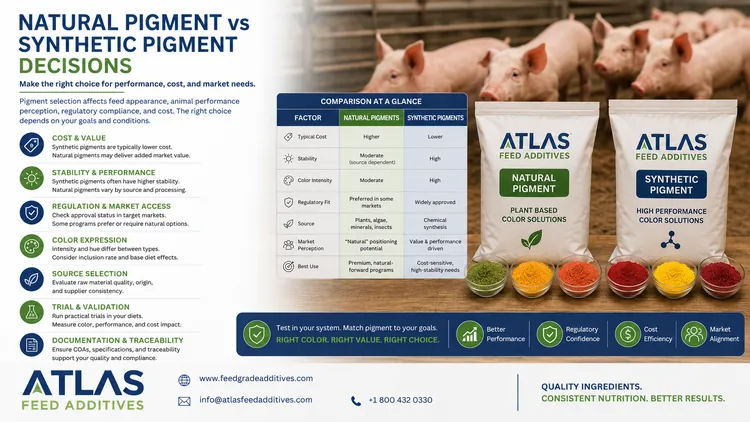
Feed additive decisions are strongest when they begin with a clear production objective. Natural Pigment vs Synthetic Pigment Decisions is not a single-product decision; it is a practical process of matching animal needs, market color expectations, raw material background, feed manufacturing conditions, regulatory requirements, and the commercial target.
Why this topic matters
Pigments and colorants are used when the appearance of the final animal product or feed product has commercial importance. In some markets, egg yolk color, skin tone, fish flesh color, or feed appearance can influence customer acceptance, product positioning, and repeat purchasing decisions.
Cost, stability, regulation, and color-expression considerations should be reviewed together. In real operations, the result depends on feed quality, pigment source, fat level, antioxidant protection, storage, species, genetics, health status, processing conditions, and how consistently the additive is applied.
Practical approach
- Nutrient matrix values, pigment claims, and expected color outcomes should be used conservatively until verified under local production conditions.
- Check raw material variability, natural color contribution, fat quality, storage time, processing temperature, and premix compatibility before comparing products.
- Balance cost, regulatory suitability, stability, palatability, color target, and measurable performance indicators.
- Use a defined color scoring or analytical method so natural and synthetic pigment options can be compared fairly.
Natural pigment considerations
Natural pigments may be selected when the buyer wants a plant-based, algae-based, fermentation-derived, or naturally positioned color source. They can support market positioning and customer preferences, but their active pigment concentration, stability, and color expression may vary by source and supplier.
Buyers should review the declared active content, carrier, processing method, batch consistency, shelf-life, heat stability, antioxidant protection, and storage recommendations. Natural sources can be attractive, but they should still be evaluated with the same discipline as any other feed additive.
Synthetic pigment considerations
Synthetic pigments may offer more standardized concentration, predictable dosing, and consistent color response in some programs. They are often reviewed when the production target requires tighter color control, clear inclusion economics, or repeatable results across feed batches.
However, synthetic pigment use must be checked against destination-market rules, permitted species, label requirements, and customer specifications. The most practical option is not always the lowest price per kilogram; it is the option that delivers the required color outcome at an acceptable cost-in-use while meeting documentation and regulatory expectations.
Trial and measurement planning
A pigment decision should be tested against a defined baseline. Before the trial begins, the team should agree on target color, product groups, feed batches, inclusion levels, sampling frequency, and evaluation method. Visual scoring, customer feedback, or laboratory analysis may be used depending on the application.
Trials should also account for timing. Pigment response may not be immediate, and the review period should be long enough to reflect the animal category and production objective. Feed storage conditions, fat quality, antioxidant use, and ingredient color variation should be recorded so the result can be interpreted correctly.
Product groups to review
Depending on the challenge, the following product group may be worth reviewing with your nutrition, technical, quality, or procurement team:
Buyer checklist
Before ordering, request the product specification, certificate of analysis, shelf-life, storage conditions, recommended inclusion range, packaging details, and destination-market documents. For pigment products, also review active pigment concentration, source type, carrier, stability data, particle size or dispersion behavior, regulatory status, label suitability, and compatibility with the complete feed formula.
For commercial trials, define the baseline, control group, feed batches, performance indicators, color target, and review period before the additive is introduced. Useful indicators may include color score, visual uniformity, customer feedback, feed intake, product quality, retained samples, shelf-life observations, and cost-in-use comparison between natural and synthetic options.
How Atlas Feed Additives can support
Atlas Feed Additives can help buyers compare feed-grade additive options, coordinate supplier documentation, and structure inquiries for international shipments. We can support discussions around natural or synthetic pigment options, color targets, product specifications, packaging preference, supplier documentation, and destination-market requirements.
Send the target species, product type, desired color outcome, current pigment source if used, expected quantity, destination country, and required documents so we can review the request efficiently.