
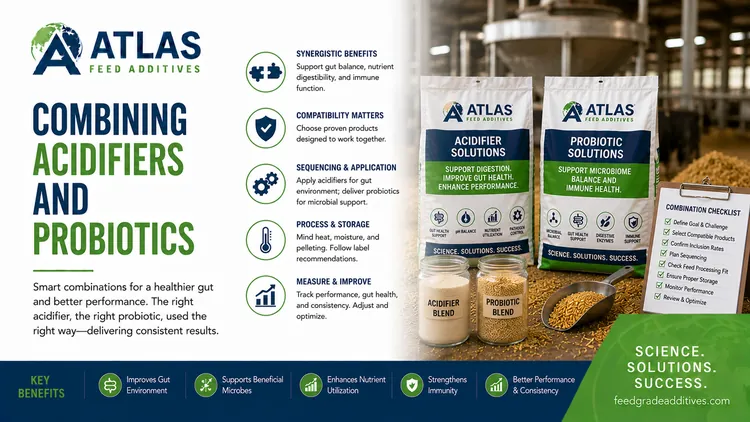
Feed additive decisions are strongest when they begin with a clear production objective. Combining Acidifiers and Probiotics is not a single-product decision; it is a practical process of matching animal needs, gut-health pressure, feed manufacturing conditions, product stability, raw material risk, and the commercial target.
Why this topic matters
Compatibility and sequencing concepts matter because acidifiers and probiotics are often used for related gut-health goals, but they do not always behave the same way in feed, water, premixes, or finished rations. A well-designed program should support digestive balance, feed hygiene, and performance without reducing the viability or practical value of the probiotic component.
In real operations, the result depends on feed quality, species, production phase, farm management, health status, storage conditions, processing temperature, product form, and how consistently each additive is applied. The best approach is to review both product chemistry and field practicality before combining them in a commercial program.
Practical approach
- Nutrient matrix values, probiotic claims, and acidifier claims should be used conservatively and supported by supplier documentation.
- Check raw material variability, feed hygiene, water quality, and processing conditions before choosing the program.
- Review whether the probiotic strain can tolerate the expected acid exposure, pelleting temperature, storage time, and moisture conditions.
- Consider sequencing: in some programs, acidifiers and probiotics may be used at different points, phases, or delivery routes.
- Balance cost, risk, palatability, feed intake, gut-health indicators, and measurable performance outcomes.
Compatibility points to review
Organic acids can help manage feed or water hygiene and support digestive conditions, while probiotics are selected to deliver viable beneficial microorganisms or fermentation-related activity. When these tools are combined, buyers should ask whether the acid type, acid strength, coating system, carrier, and inclusion level are compatible with the probiotic strain and delivery method.
Compatibility can be affected by pH, moisture, heat, storage time, premix concentration, and direct contact between ingredients. A probiotic that performs well in one feed format may require different handling in pelleted feed, mash feed, water application, or young-animal starter diets. Supplier guidance should be checked before assuming that two additives can be mixed freely.
Sequencing and application strategy
In some programs, acidifiers and probiotics are included together in the same finished feed. In others, the acidifier may be used in feed or water while the probiotic is applied through a separate premix, top-dress, gel, liquid, or phase-specific product. The right strategy depends on the species, age, digestive stress level, feed form, and practical handling capacity of the farm or feed mill.
Sequencing is especially important around stressful periods such as weaning, diet transitions, transport, heat stress, disease pressure, or feed ingredient changes. During these periods, the program should be simple enough for staff to apply consistently and clear enough for the technical team to measure results.
Product groups to review
Depending on the challenge, the following product groups may be worth reviewing with your nutrition, technical, quality, or procurement team. The objective is not to combine products automatically, but to select compatible tools that support the target gut-health outcome and fit the feed manufacturing process.
Buyer checklist
Before ordering, request the product specification, certificate of analysis, shelf-life, storage conditions, recommended inclusion range, packaging details, safety data sheet, strain or active description where applicable, and destination-market documents. For probiotic products, ask about viable count, stability during storage, heat tolerance, moisture sensitivity, and compatibility with acids or other common feed additives.
For commercial trials, define the baseline, control group, feed batches, inclusion points, processing conditions, performance indicators, and review period before the additive is introduced. Practical indicators may include feed intake, fecal quality, growth, feed conversion, mortality, treatment records, uniformity, and customer feedback on feed handling or palatability.
Monitoring and review
A practical monitoring plan should connect technical data with farm observations. Review whether products were stored correctly, dosed consistently, and exposed to conditions within the supplier’s recommendations. If performance is unclear, check whether the challenge level, diet composition, disease pressure, or feed processing conditions changed during the trial.
Documentation should also be reviewed periodically. Supplier specifications, certificates, label claims, and recommended use directions should remain aligned with the target species, destination market, and intended application route. This reduces the risk of compatibility problems, unsupported claims, or unnecessary additive cost.
How Atlas Feed Additives can support
Atlas Feed Additives can help buyers compare feed-grade acidifier, organic acid, probiotic, and fermentation product options, coordinate supplier documentation, and structure inquiries for international shipments. Send the target species, production phase, current challenge, product group, processing conditions, order volume, destination country, and required documents so we can review the request efficiently.