
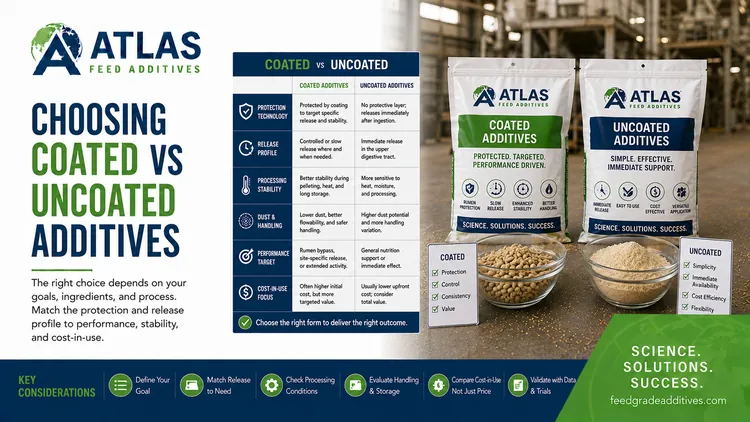
Feed additive decisions are strongest when they begin with a clear production objective. Choosing Coated vs Uncoated Additives is not a single-product decision; it is a practical process of matching animal needs, release target, feed manufacturing conditions, handling requirements, storage risk, and the commercial target.
Why this topic matters
Coating technology can affect how an additive handles, mixes, survives processing, resists moisture, releases in the digestive tract, and performs in the final feed. In some programs, an uncoated additive is sufficient and cost-effective. In others, a coated form may help protect the active ingredient, reduce odor or palatability issues, improve stability, or support a more controlled release profile.
In real operations, the result depends on feed quality, species, production phase, health status, storage conditions, pelleting temperature, mixing sequence, particle size, and how consistently the additive is applied. The decision should be based on the target function and measurable value, not only on whether the product is coated or uncoated.
Practical approach
- Define why protection is needed: heat stability, rumen bypass, intestinal release, odor reduction, moisture protection, or handling improvement.
- Compare active concentration, coating percentage, carrier material, release profile, and recommended inclusion rate.
- Check raw material variability, feed processing temperature, mixing time, pelleting conditions, and storage conditions.
- Review whether coating changes flowability, dust level, palatability, bulk density, or compatibility with other additives.
- Balance cost, risk, release target, practical handling, and measurable performance indicators before large-scale adoption.
When coated forms may help
Coated additives may be useful when the active ingredient is sensitive to heat, moisture, oxidation, rumen degradation, early release, or direct contact with other ingredients. Coating can also help mask strong odors or tastes, improve handling, or reduce irritation during manufacturing. These benefits are most valuable when they solve a defined technical or commercial problem.
However, coating is not automatically better. It can reduce the active concentration per kilogram, increase product cost, or require a higher inclusion rate to deliver the same active amount. Buyers should confirm that the coating technology supports the intended release point and does not simply add cost without a clear benefit.
When uncoated forms may be enough
Uncoated additives are often practical when the active ingredient is stable, the release point is not restrictive, the feed is not exposed to harsh processing, and palatability is acceptable. They may also be easier to evaluate because the active concentration is often more direct and the cost-in-use calculation can be simpler.
For many feed mills, uncoated forms remain attractive when speed of supply, straightforward documentation, lower price, and simple handling are priorities. The key is to confirm that the uncoated form remains stable under the actual manufacturing and storage conditions used by the customer.
Product groups to review
Depending on the challenge, the following product groups may be worth reviewing with your nutrition, technical, quality, or procurement team. The best option should match the species, production phase, processing conditions, release target, and expected return from the additive program.
Buyer checklist
Before ordering, request the product specification, certificate of analysis, shelf-life, storage conditions, recommended inclusion range, packaging details, safety data sheet, batch traceability, and destination-market documents. For coated products, also ask for the coating type, active concentration, release concept, stability data, handling guidance, and whether the product is suitable for pelleting or other processing conditions.
For commercial trials, define the baseline, control group, feed batches, processing conditions, performance indicators, cost target, and review period before the additive is introduced. Useful trial indicators may include feed intake, feed conversion, production response, visible feed quality, flowability, dust, palatability, and storage stability.
Cost-in-use considerations
Coated and uncoated products should be compared on a delivered-value basis. A coated product may have a higher invoice price but still be justified if it improves stability, release, intake, or performance. An uncoated product may be preferred when it delivers the required active level reliably at a lower cost per tonne of finished feed.
To compare fairly, review price per kilogram, active concentration, inclusion rate, freight, packaging, handling losses, shelf-life, and expected performance value. The most economical option is the product that meets the technical target with consistent results, not always the product with the lowest unit price.
How Atlas Feed Additives can support
Atlas Feed Additives can help buyers compare coated and uncoated feed-grade additive options, coordinate supplier documentation, and structure inquiries for international shipments. Send the target species, production phase, current challenge, additive group, processing conditions, order volume, destination country, and required documents so we can review the request efficiently.