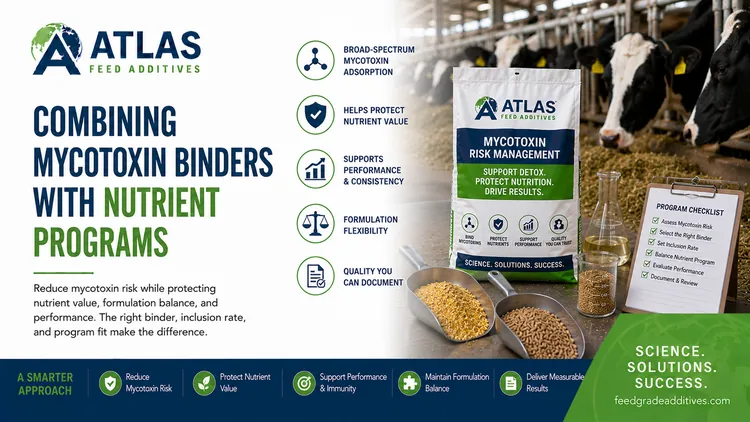
Feed additive decisions are strongest when they begin with a clear production objective. Combining Mycotoxin Binders with Nutrient Programs is not a single-product decision; it is a practical process of matching raw material risk, target species, production phase, nutrient density, feed manufacturing conditions, and the commercial target.
Why this topic matters
Reducing mycotoxin risk while avoiding unnecessary nutrient binding is important because binders are often used in feeds that also contain valuable vitamins, trace minerals, amino acids, enzymes, pigments, and other functional additives. The goal is to support risk management without reducing the value of the nutrient program.
In real operations, the result depends on raw material quality, storage conditions, mycotoxin type, contamination level, species sensitivity, feed processing, farm management, health status, and how consistently the binder is applied. A good program should connect analytical testing, formulation decisions, supplier evidence, and measurable field indicators.
Practical approach
- Nutrient matrix values, binder claims, and detox-support claims should be used conservatively and supported by documentation.
- Check raw material variability, storage conditions, moisture risk, and processing conditions before choosing a binder program.
- Match the product to the expected mycotoxin challenge, species sensitivity, production phase, and feed type.
- Review whether the binder may interact with vitamins, trace minerals, medications, pigments, enzymes, or other high-value additives.
- Balance cost, risk level, palatability, feed intake, and measurable performance indicators before large-scale adoption.
Binder selection considerations
Different binder products may focus on different risk profiles. Some are based on mineral clays, yeast cell wall components, activated carbon, organic acids, plant extracts, or blended detox-support systems. Buyers should review the product’s intended toxin spectrum, recommended inclusion rate, supporting trial data, and practical compatibility with the existing feed program.
It is also important to avoid assuming that one binder performs equally across all mycotoxins. A product that works well for one challenge may not be the best choice for another. Testing raw materials and finished feed helps the nutrition and quality teams decide whether a standard prevention program, seasonal adjustment, or higher-risk intervention is more appropriate.
Nutrient program alignment
When binders are used in nutrient-dense diets, formulation teams should review the timing and level of sensitive additives. Vitamins, trace minerals, amino acids, enzymes, pigments, probiotics, and acidifiers may each have different stability and interaction considerations. The objective is to maintain nutrient delivery while still managing toxin exposure.
For high-value formulas, it can be useful to compare performance data, feed intake, manure quality, growth or production records, egg or milk indicators, and veterinary observations. These field indicators help determine whether the binder program is protecting performance or simply adding cost to the ration.
Product groups to review
Depending on the challenge, the following product group may be worth reviewing with your nutrition, technical, quality, or procurement team. The right solution should match the raw material risk, toxin profile, target species, and formulation strategy rather than relying only on a general-purpose claim.
Buyer checklist
Before ordering, request the product specification, certificate of analysis, shelf-life, storage conditions, recommended inclusion range, packaging details, safety data sheet, batch traceability, and destination-market documents. Ask for information on target mycotoxins, binding evidence, in-feed stability, palatability, and compatibility with common nutrient programs.
For commercial trials, define the baseline, control group, raw material risk profile, feed batches, inclusion rate, performance indicators, health observations, and review period before the additive is introduced. A clear trial design makes it easier to separate binder performance from changes in ingredient quality, disease pressure, or farm management.
Monitoring and review
A practical monitoring plan may include raw material testing, finished feed testing, feed intake, growth rate, feed conversion, production level, mortality, veterinary treatments, manure quality, and visible feed quality. If results are unclear, review whether the challenge level changed during the trial and whether the product was dosed consistently across feed batches.
Documentation should also be reviewed periodically. Supplier specifications, analytical methods, batch certificates, and label claims should remain aligned with the buyer’s market, species, and intended use. This is especially important when the same binder is used across several species or production phases.
How Atlas Feed Additives can support
Atlas Feed Additives can help buyers compare feed-grade mycotoxin binder and detox-support options, coordinate supplier documentation, and structure inquiries for international shipments. Send the target species, production phase, current challenge, raw material risk, product group, order volume, destination country, and required documents so we can review the request efficiently.