
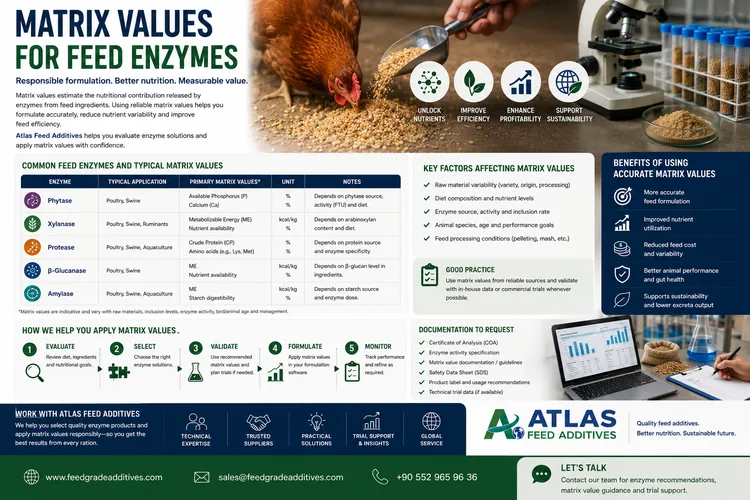
Feed additive decisions are strongest when they begin with a clear production objective. Matrix Values for Feed Enzymes is not a single-product decision; it is a practical process of matching animal needs, raw material risk, feed manufacturing conditions, enzyme activity, and the commercial target.
Why this topic matters
Matrix values help nutritionists estimate the nutrient contribution of an enzyme when it is included in a feed formula. In practical terms, they may allow a formulation team to account for improved phosphorus availability, better energy release, improved amino acid digestibility, or reduced anti-nutritional pressure, depending on the enzyme type and the raw materials used.
However, matrix values should be used responsibly. The result in real operations depends on feed quality, raw material variability, animal age, species, genetics, health status, feed processing conditions, storage, and how consistently the additive is applied. A value that works in one formulation program may not be suitable for another without technical review.
Practical approach
- Nutrient matrix values and additive claims should be used conservatively, especially when changing suppliers or raw material sources.
- Check raw material variability, substrate availability, feed processing temperature, moisture, and pelleting conditions.
- Confirm the enzyme activity, declared units, recommended inclusion range, and application method before formulation changes are made.
- Balance cost, risk, palatability, litter or manure quality, feed conversion, and measurable performance indicators.
- Review whether the formulation uses a full matrix, partial matrix, or performance-only approach.
Product groups to review
Depending on the challenge, the following product groups may be worth reviewing with your nutrition, technical, or procurement team. Phytase products are commonly reviewed for phosphorus and calcium contribution. Xylanase, beta-glucanase, cellulase, and other NSP enzymes may be considered where cereals or fibrous ingredients create digestibility challenges. Protease products may be reviewed when amino acid digestibility, protein cost, or raw material variation is a concern.
When comparing feed enzymes, buyers should check the declared activity, enzyme source, coating or granulation form, heat stability, carrier material, shelf-life, storage requirements, and compatibility with premixes, acids, minerals, and other feed additives. The matrix value should always be connected to the specific product, recommended dosage, target species, and formulation strategy.
Using matrix values responsibly
A matrix value is most useful when it is supported by supplier data, nutritionist review, and field performance monitoring. For new programs, many teams prefer a conservative starting point rather than applying the maximum suggested nutrient release immediately. This helps reduce formulation risk while the team observes feed intake, performance, uniformity, and commercial results.
It is also important to avoid double-counting nutrients. If multiple enzymes or digestibility-support additives are used together, the nutritionist should review whether their benefits overlap. A combined program can be useful, but the matrix values should be coordinated so the final formula remains safe, balanced, and commercially realistic.
Trial and performance review
Commercial trials should define the baseline, control formula, enzyme dose, feed batches, animal group, performance indicators, and review period before the additive is introduced. For poultry programs, common review points may include feed conversion ratio, body weight, uniformity, litter condition, mortality, and processing results. For swine programs, teams may review average daily gain, feed efficiency, manure consistency, and diet cost per kilogram of gain.
Results should be interpreted with care because performance can also be affected by ingredient quality, disease pressure, stocking density, water quality, temperature, management, and feed delivery. A clear trial structure makes it easier to decide whether the selected matrix values are suitable for routine formulation.
Buyer checklist
Before ordering, request the product specification, certificate of analysis, declared enzyme activity, test method, shelf-life, storage conditions, recommended inclusion range, packaging details, safety data sheet, and destination-market documents. For formulation use, also request the supplier’s suggested matrix values, technical explanation, target species, and any limitations related to feed processing or ingredient type.
For international shipments, confirm label requirements, customs documentation, product classification, batch traceability, and whether the product is accepted in the destination market. Clear documentation helps procurement, quality control, and technical teams evaluate the product before it enters commercial production.
How Atlas Feed Additives can support
Atlas Feed Additives can help buyers compare feed-grade enzyme options, coordinate supplier documentation, and structure inquiries for international shipments. Our team can support the early review stage by clarifying the target species, production phase, current formula challenge, required enzyme group, packaging format, and document expectations.
Send the target application, current challenge, product group, estimated quantity, and destination country so we can review the request efficiently and help identify suitable feed enzyme options for your formulation program.