Prebiotics and gut-support ingredients

Synbiotic Blend

Synbiotic Blend is a functional feed additive concept combining prebiotic substrates and probiotic microorganisms, or complementary gut-support components, to support digestive resilience and targeted gut-health programs.

Atlas Feed Additives supports international buyers with Synbiotic Blend sourcing, strain and active-fraction review, quality-document coordination, heat-stability and compatibility checks, packaging comparison, and export-focused quotation service for feed mills, premix producers, integrators, distributors, aquaculture feed producers, pet food manufacturers, and specialty nutrition companies.

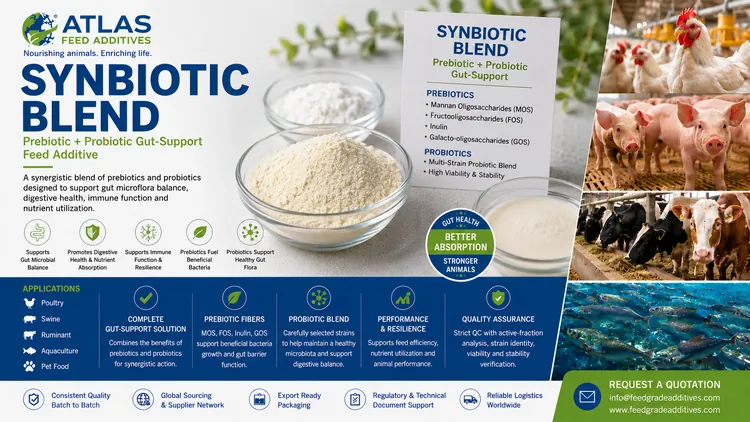
Synbiotic Blend feed additive visual

Product role

Where Synbiotic Blend fits

Synbiotic Blend is part of the prebiotics and gut-support ingredients group. It is typically designed to combine the activity of prebiotic ingredients, such as selected fibers or oligosaccharides, with probiotic microorganisms or other functional gut-support components. The goal is to provide a more complete digestive-health tool than a single ingredient can offer on its own.

Buyers typically evaluate Synbiotic Blend by active composition, probiotic strain identity, declared viable count, prebiotic fraction, carrier system, particle size, moisture level, heat stability, shelf-life, storage conditions, compatibility with feed processing, and documentation quality. Because synbiotic products can differ greatly by supplier, the product name alone is not enough to compare offers accurately.

Atlas Feed Additives can coordinate international supplier options for customers that need consistent feed-grade material, responsive documentation, export support, and clear comparison of technical and commercial offers.

Technical identity

Product names and commercial descriptions

Suppliers may present Synbiotic Blend using different technical and commercial names. Before approving a product, buyers should confirm the exact formulation, active components, strain details, viable count, prebiotic specification, and intended species.

  • Synbiotic Blend
  • Synbiotic feed additive
  • Prebiotic-probiotic blend
  • Gut-support blend
  • Digestive-support premix
  • Functional gut-health additive
  • Yeast and probiotic blend
  • Oligosaccharide and probiotic blend
  • Encapsulated synbiotic product
  • Water-dispersible synbiotic product

Gut-support role

Why synbiotic programs are used

Synbiotic products are selected where nutritionists want coordinated support for the gut environment, microbial balance, digestive function, and transition-period resilience. They are often used in programs that aim to reduce nutritional stress and maintain consistent performance under changing feed, housing, or production conditions.

  • Supports targeted digestive-health programs
  • Useful in young animal transition diets
  • Helps support gut resilience during feed changes
  • Can complement acidifiers, enzymes, phytogenics, and fiber strategies
  • Useful in wellness-oriented and antibiotic-reduction feeding concepts where suitable
  • Supports formulation strategies focused on consistency, gut barrier support, and performance stability

Formulation value

A combined approach for digestive resilience

A synbiotic product is more than a simple mixture. A well-designed blend should match the probiotic strain or strains with compatible prebiotic substrates or gut-support ingredients. The prebiotic component may help support beneficial microbial activity, while the probiotic component may contribute live microorganisms or defined microbial functions when the product is stored, processed, and applied correctly.

The value of a Synbiotic Blend depends on active composition, strain stability, prebiotic standardization, application rate, processing conditions, shelf-life, and the quality of documentation. Buyers should compare delivered active value, not only the price per kilogram.

Typical applications

Where Synbiotic Blend is commonly evaluated

Synbiotic Blend may be used in complete feed, premixes, concentrates, milk replacers, water-compatible systems when technically suitable, pet food, aquaculture feed, and specialty additive programs. Final use should always match the product specification, target species, processing conditions, local feed legislation, and nutritionist recommendation.

Poultry programs

Used in broiler, layer, breeder, turkey, and specialty poultry programs where gut resilience, litter quality strategies, performance consistency, and transition support are important. Buyers should review heat stability during pelleting, compatibility with coccidiostats where used, and viability at the point of feeding.

Swine programs

Reviewed in piglet, nursery, grower, finisher, and sow diets where weaning stress, diet transition, digestive comfort, and performance stability are major formulation priorities. Carrier quality, acidifier compatibility, and probiotic strain survival should be checked.

Ruminant programs

May be evaluated for calves, dairy cows, beef cattle, sheep, and goats in programs focused on digestive support, transition periods, calf starter intake, milk replacers, or specialty functional premixes. Rumen compatibility and delivery format should be reviewed carefully.

Aquaculture feed

Can be reviewed for fish and shrimp feeds where gut environment support, feed transition, water stability, pellet quality, and microbial management are important. Buyers should confirm extrusion stability, water compatibility, and finished-feed viability targets.

Pet food and specialty feed

May be used in pet food, treats, supplements, equine feed, game animal feed, and specialty formulas where digestive support, stool quality positioning, and label-friendly gut-support concepts are part of the product design.

Premix and additive blends

Commonly reviewed by premix producers and additive manufacturers for blends containing MOS, FOS, inulin, GOS, yeast derivatives, probiotic strains, enzymes, acidifiers, phytogenics, and mineral-support ingredients.

Specification guide

What to check before approving a Synbiotic Blend supplier

Synbiotic Blend prices and performance vary widely because suppliers may offer different strains, CFU levels, prebiotic fractions, carriers, encapsulation systems, and document packages. Buyers should align the following details before comparing offers.

Parameter Why it matters What to request
Probiotic strain identity Different strains can have different stability, target species, and functional profiles. Genus, species, strain code, deposit or identification information where available.
Viable count Determines the delivered probiotic level and cost per active unit. Declared CFU per gram, method of enumeration, COA result, and guarantee at manufacture or expiry.
Prebiotic active fraction Prebiotic value depends on the type and concentration of functional substrate. MOS, FOS, inulin, GOS, beta-glucans, fiber fraction, yeast derivative, or other active declaration.
Blend ratio Shows how much of the product is active material versus carrier or processing aid. Active composition, carrier declaration, inclusion guidance, and formulation rationale.
Carrier system Carrier affects flowability, dusting, moisture protection, compatibility, and dilution value. Carrier type, feed-grade declaration, allergen status, GMO status, and physical data.
Encapsulation or protection Protected products may improve heat stability, moisture resistance, shelf-life, and delivery to the gut. Protection technology, release profile, heat-stability data, and application recommendation.
Heat stability Important for pelleting, extrusion, expansion, conditioning, and storage in warm climates. Stability data under relevant processing conditions and expected CFU recovery after processing.
Moisture and water activity High moisture can reduce probiotic viability, cause caking, and shorten shelf-life. Moisture limit, water activity where available, packaging protection, and storage conditions.
Particle size and flowability Affects dosing accuracy, blend uniformity, segregation risk, and premix manufacturing. Sieve analysis, bulk density, flowability data, dusting information, and appearance.
Microbiological safety Critical for feed safety, customer approval, and export markets. Pathogen absence, Salmonella status, E. coli, coliforms, yeast and mold where relevant, and contaminant limits.
Compatibility Synbiotic components may be affected by acids, antibiotics where permitted, coccidiostats, minerals, enzymes, or heat. Compatibility guidance for acidifiers, enzymes, phytogenics, organic acids, coccidiostats, medications, minerals, and pelleting.
Regulatory suitability Permitted microorganisms, claims, and labeling rules differ by destination market. Feed-use declaration, strain authorization support, label wording guidance, and destination-market compliance documents.

Formulation considerations

How buyers evaluate practical use

Synbiotic Blend should be reviewed as a living or biologically active system when probiotic strains are included. The best product depends on how it will be stored, mixed, processed, delivered, and measured at the point of use.

  • Confirm whether the product contains live probiotics, postbiotic components, prebiotic substrates, or a combination.
  • Check CFU guarantee at manufacture and at end of shelf-life.
  • Review compatibility with pelleting, extrusion, acidifiers, enzymes, minerals, and medications where applicable.
  • Evaluate moisture sensitivity and packaging protection.
  • Match particle size with the premix or feed manufacturing system.
  • Confirm species and life-stage suitability.
  • Review finished-feed analytical expectations and label declarations.
  • Use qualified nutritionist guidance for inclusion levels and program design.

Application review

Questions before use

  • Which species and production stage will use the product?
  • Will the blend be used in complete feed, premix, concentrate, milk replacer, water line, pet food, aquafeed, or supplement?
  • Which probiotic strains and CFU levels are required?
  • Which prebiotic component is required: MOS, FOS, inulin, GOS, beta-glucan, yeast derivative, or another active?
  • Will the feed be pelleted, extruded, expanded, or stored in warm or humid conditions?
  • Will the product be combined with acidifiers, enzymes, phytogenics, minerals, antibiotics where permitted, or coccidiostats?
  • Is a coated, protected, or encapsulated format required?
  • Does the destination market require strain registration or specific label wording?

Buyer quality checklist

Documents to request for Synbiotic Blend

Documentation requirements vary by buyer, country, species, and application. For Synbiotic Blend products, procurement teams normally request a complete technical, microbiological, quality, and regulatory package before approving a new source.

Core product documents

  • Product specification sheet
  • Certificate of Analysis
  • Safety Data Sheet
  • Technical Data Sheet
  • Manufacturing date, batch number, and shelf-life
  • Country of origin statement
  • Feed-grade declaration
  • Recommended storage conditions

Active-component documents

  • Probiotic strain identification where applicable
  • Declared CFU per gram and enumeration method
  • CFU guarantee at manufacture and at end of shelf-life
  • Prebiotic active-fraction declaration
  • Carrier and processing-aid declaration
  • Encapsulation or protection technology description when relevant
  • Recommended inclusion rate and species guidance

Safety and contaminant controls

  • Salmonella absence statement
  • E. coli and coliform limits where required
  • Yeast and mold limits where relevant
  • Heavy metal limits
  • Mycotoxin statement when required
  • Dioxin, PCB, or PAH statement when requested
  • Allergen, GMO, BSE/TSE, and animal-origin declarations when required

Market certificates

  • Halal certificate when required
  • Kosher certificate when required
  • ISO, GMP+, FAMI-QS, HACCP, or similar quality-system documents when available
  • Free sale certificate or registration support when needed
  • Strain authorization or regulatory support where applicable
  • Customer-specific questionnaire or vendor approval package

Procurement note

Ask for the right specification before comparing prices.

Price comparisons are meaningful only when strain identity, CFU level, prebiotic fraction, carrier, active ratio, encapsulation system, heat stability, packaging, shelf-life, origin, regulatory status, and documentation are aligned. A lower price per kilogram may not be the best value if the viable count is lower, the prebiotic fraction is undefined, the carrier dominates the formula, or the supplier cannot provide strain and batch documentation.

For sensitive gut-support products, buyers should also review storage conditions, compatibility with acidifiers and enzymes, pelleting or extrusion conditions, moisture exposure, finished-feed application method, and destination-market rules. Atlas Feed Additives can help collect supplier information so your technical, regulatory, and purchasing teams can compare offers clearly.

Storage and handling

Practical warehouse guidance

Storage and handling should always follow the supplier's SDS, label, and technical sheet. Synbiotic products that contain live microorganisms can be sensitive to heat, moisture, oxygen, direct sunlight, and long storage under poor conditions. Proper handling helps maintain product performance and declared activity through shelf-life.

  • Keep bags, cartons, drums, or containers tightly closed when not in use.
  • Store in a clean, cool, dry, well-ventilated warehouse.
  • Protect from high humidity, condensation, and water contact.
  • Avoid unnecessary heat exposure during storage and processing.
  • Keep away from incompatible chemicals and non-feed materials.
  • Prevent contamination during weighing, transfer, and mixing.
  • Use dust-control practices and suitable personal protective equipment according to the SDS.
  • Maintain batch traceability and first-in, first-out stock rotation.
  • Respect any cold-chain, temperature-limit, or humidity-limit instructions from the supplier.

Packaging options

Common commercial packing

Available packaging depends on supplier, product form, active components, order size, and export route. Atlas Feed Additives can request packaging alternatives during quotation.

  • Small bags for premix and specialty nutrition users
  • Aluminum foil bags for moisture-sensitive blends
  • Multi-layer paper or composite bags with inner liner
  • Cartons or fiber drums depending on supplier format
  • Sealed containers for water-dispersible or high-value formats
  • Palletized cargo for safer export handling
  • Temperature-controlled shipment where required by supplier specification
  • Customer-specific labeling when available
  • Sample packing for trial approval when supplier policy allows

Quotation preparation

Information to send for a faster Synbiotic Blend offer

To prepare a complete quotation, please include technical, commercial, and documentation requirements. This helps match the correct supplier, active system, product form, packing, and export document package.

Product requirements

  • Required product name: Synbiotic Blend
  • Target species and production stage
  • Required probiotic strain or CFU level, if specified
  • Required prebiotic component such as MOS, FOS, inulin, GOS, beta-glucan, or yeast derivative
  • Powder, granule, encapsulated, coated, or water-dispersible preference
  • Pelleting, extrusion, or heat-stability requirement
  • Current specification sheet if available

Commercial requirements

  • Required quantity
  • Trial order, spot order, tender, or regular monthly volume
  • Destination country and destination port
  • Preferred Incoterms
  • Target delivery schedule
  • Preferred payment and shipping document requirements

Documentation requirements

  • Specification and COA
  • SDS and technical data sheet
  • Strain identification and CFU data where applicable
  • Prebiotic active-fraction declaration
  • Origin and feed-grade statement
  • Heavy metals and microbiology limits
  • GMO, allergen, BSE/TSE, halal, kosher, or customer-specific statements
  • Registration, import, or strain authorization documents required by your market

Commercial support

How Atlas Feed Additives supports your purchase

Supplier matching

We review your required active components, target species, processing conditions, destination market, order size, packaging preference, and documentation needs to identify suitable Synbiotic Blend supplier options.

Specification comparison

We help collect and organize key details such as strain identity, CFU level, prebiotic fraction, carrier, particle size, moisture, heat stability, origin, shelf-life, packing, container loading, and available batch documents.

Document coordination

We coordinate supplier communication for specifications, COA, SDS, technical data sheets, origin declarations, feed-grade statements, strain documents, quality-system certificates, and other documents required for import or customer approval.

Export-focused service

We support international customers with quotation follow-up, packing clarification, shipment timing, document expectations, and communication from Ankara, Turkey.

Questions

Useful answers

What is Synbiotic Blend used for in animal nutrition?

Synbiotic Blend is used in gut-support programs focused on digestive resilience, young animal transitions, performance consistency, wellness-oriented feeding strategies, and functional premix development. It should be used according to the target species, formulation objective, nutritionist guidance, and applicable market rules.

What is the difference between prebiotics, probiotics, and synbiotics?

Prebiotics are substrates or functional ingredients used to support beneficial gut microbial activity. Probiotics are live microorganisms supplied for a beneficial effect when used appropriately. Synbiotics combine prebiotic and probiotic components, or complementary gut-support ingredients, to create a targeted digestive-support system.

Which components can be included in a Synbiotic Blend?

Depending on supplier specification, a Synbiotic Blend may include probiotic strains, MOS, FOS, inulin, GOS, beta-glucans, yeast derivatives, fermentation metabolites, fibers, carriers, stabilizers, encapsulated actives, or other gut-support ingredients.

Can Synbiotic Blend be used in pelleted feed?

It may be used in pelleted feed when the product is designed for heat exposure, but buyers should request heat-stability data, CFU recovery information, moisture tolerance, and application guidance. Some products may require post-pellet application or protected formats.

What should buyers compare before purchasing Synbiotic Blend?

Buyers should compare strain identity, CFU guarantee, prebiotic active fraction, carrier system, encapsulation technology, heat stability, moisture sensitivity, compatibility, shelf-life, packaging, documentation, origin, and destination-market regulatory suitability.

What quality documents should buyers request for Synbiotic Blend?

Common documents include product specification, certificate of analysis, safety data sheet, technical data sheet, strain identification where applicable, viable count or CFU declaration, prebiotic active-fraction data, origin statement, batch details, shelf-life, microbiological quality, contaminant limits, and market-specific certificates.

Can Atlas Feed Additives quote Synbiotic Blend?

Yes. Send your required specification, target species, active components, quantity, destination, packaging preference, processing conditions, and documents so Atlas Feed Additives can review suitable supplier options for Synbiotic Blend.

What should be included in a quotation request?

Please include the product name, target species, desired strains or CFU level, required prebiotic components, product form, quantity, destination country and port, Incoterms, packaging preference, required documents, processing conditions, and whether the order is for a trial, spot purchase, tender, or regular supply.

How should Synbiotic Blend be stored?

Follow the supplier's SDS and technical sheet. In general, keep Synbiotic Blend in tightly closed packaging in a clean, cool, dry, ventilated area, away from moisture, heat, direct sunlight, incompatible materials, and contamination. Respect any temperature or humidity limits listed by the supplier.

Can Synbiotic Blend be combined with acidifiers or enzymes?

It may be combined with acidifiers, enzymes, phytogenics, minerals, and other additives when compatible, but buyers should request supplier guidance. Live probiotic components can be sensitive to low pH, heat, moisture, and certain active substances.

Request a quotation

Tell us what you need

Send your product list, target specification, desired active components, target species, processing conditions, destination country, packaging preference, quantity, and required documents. Our team will review your request and respond from orders@feedgradeadditives.com.

Suggested message details

  • Required product: Synbiotic Blend
  • Target species and production stage
  • Desired probiotic strains or CFU level
  • Desired prebiotic component such as MOS, FOS, inulin, GOS, beta-glucan, or yeast derivative
  • Processing conditions such as pelleting, extrusion, or post-application
  • Required quantity and delivery schedule
  • Destination country and port
  • Required documents and certificates
  • Current specification sheet if available