Prebiotics and gut-support ingredients

Inulin

Feed-grade Inulin is a plant-derived prebiotic fructan used in digestive-health programs where fermentable fiber contribution, gut-support positioning, microbiota-support strategies, young-animal transition nutrition, and synbiotic premix design require careful specification review.

  • Prebiotic soluble fiber
  • Inulin-type fructan
  • Often sourced from chicory root
  • Young animal, poultry, swine, aquaculture and pet food
  • Specification-led sourcing support
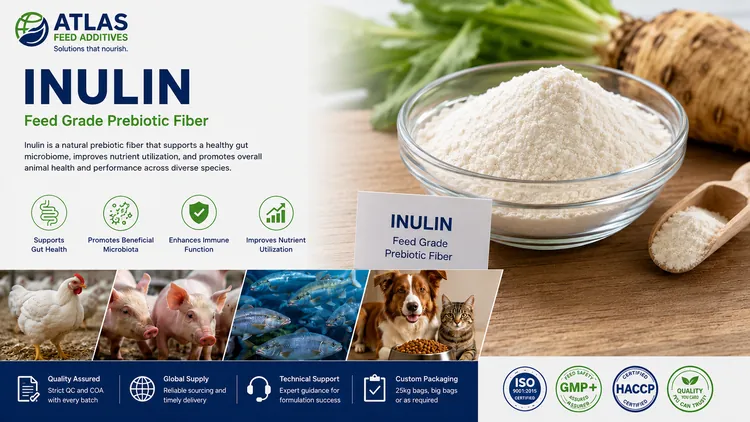
Inulin feed additive visual
Product type Prebiotic soluble fiber
Ingredient class Inulin-type fructan
Typical form Powder, granule, agglomerate or premix blend
Supply model Global sourcing and quotation support

Product role

Where Inulin fits in animal nutrition

Inulin is part of the prebiotics and gut-support ingredients group. It is a plant-derived fructan ingredient, commonly described as a soluble dietary fiber or prebiotic substrate, and is used in feed programs where digestive-health positioning and functional fiber contribution are part of the formulation objective.

In practical feed formulation, Inulin is reviewed by source, purity, inulin content, fructan profile, degree of polymerization, FOS or oligofructose fraction, sugar content, solubility, particle size, moisture, flowability, microbial quality, processing stability, and compatibility with other gut-support ingredients.

Inulin may be considered in young-animal transition diets, poultry gut-support programs, swine nursery diets, calf starter feeds, pet food formulas, aquaculture diets, functional premixes, synbiotic blends, and specialty nutrition programs. It is often evaluated alongside probiotics, organic acids, yeast derivatives, enzymes, phytogenics, fibers, and mineral sources.

Atlas Feed Additives can coordinate international supplier options for feed mills, premix producers, functional ingredient blenders, distributors, integrators, aquaculture feed producers, pet food manufacturers, and importers that require consistent feed-grade Inulin with clear quality documentation.

Technical overview

Typical technical profile buyers request

Final values must always follow the manufacturer specification and certificate of analysis. The table below is a practical procurement guide for common feed-grade Inulin requests.

Product name Inulin, feed-grade Inulin, chicory inulin, inulin-type fructan, long-chain inulin, short-chain inulin, oligofructose-rich inulin, or prebiotic fiber premix depending on the requested grade.
Ingredient identity Plant-derived fructan ingredient composed mainly of fructose units with beta(2,1)-type linkages and variable degree of polymerization. Commercial products may contain different proportions of inulin, oligofructose, simple sugars, moisture, minerals, and carrier.
Common CAS reference 9005-80-5 is commonly referenced for inulin. Buyer documents should confirm whether the offered material is pure inulin, chicory root fiber, oligofructose, FOS, or a blended premix.
Ingredient class Prebiotic soluble fiber and gut-support functional feed additive. In feed sourcing, it is commonly grouped with prebiotics, oligosaccharides, yeast fractions, and digestive-health ingredients.
Common source Commercial inulin is often extracted from chicory root. Jerusalem artichoke, agave, and other plant sources may also be referenced depending on region and supplier. Source should be confirmed on the specification and origin documents.
Active fraction Buyers should request declared inulin content, fructan content, dietary fiber basis, FOS or oligofructose fraction, degree of polymerization range, residual sugar profile, and analytical method.
Chain length and DP Long-chain inulin, native inulin, short-chain inulin, and oligofructose-rich products may behave differently in solubility, sweetness, fermentation profile, viscosity, and premix use. DP information should be requested when the application requires a specific profile.
Appearance Typically white to cream powder, fine powder, agglomerated powder, granule, or carrier-based blend. Color, odor, particle size, dust level, flowability, and solubility may vary by source and processing method.
Solubility and processing Solubility depends on chain length, temperature, particle size, agglomeration, and grade. Compatibility with premixing, pelleting, extrusion, liquid application, spray systems, and post-pellet coating should be confirmed before purchase.
Carrier and blending Some products may be supplied as pure inulin, standardized inulin powder, agglomerated material, carrier-based premix, or blended synbiotic ingredient. Carrier and blend declarations should be requested when required by the buyer or market.
Packaging Common packaging options may include 20 kg or 25 kg bags, cartons, fiber drums, foil-lined packaging, palletized shipments, big bags, or container-load supply. Final packaging depends on source, moisture sensitivity, order size, and destination requirements.
Shelf life Use the manufacturer shelf-life statement. Store under dry, cool, clean, and ventilated conditions according to the supplier label and safety data sheet.
Regulatory status Use must comply with feed additive rules, import rules, labeling rules, claims restrictions, botanical source declarations, and species-specific requirements in the destination market.

Animal nutrition applications

Where feed mills and nutrition teams evaluate Inulin

Poultry and swine programs

Inulin may be evaluated in poultry and swine diets when digestive-health positioning, transition-period support, prebiotic fiber contribution, litter or manure-management strategy, and functional premix design are part of the nutrition plan.

  • Broiler starter, grower, finisher, layer, breeder, and turkey feed review
  • Piglet starter, nursery, grower-finisher, sow, and transition-period programs
  • Low medication, antibiotic-reduction, or gut-support feeding strategies where permitted
  • Functional premixes containing acidifiers, enzymes, probiotics, phytogenics, yeast derivatives, or fibers
  • Review of inclusion rate, pellet durability, flowability, and processing temperature
  • Evaluation with crude fiber, soluble fiber, starch, protein source, electrolyte balance, and water quality

Calves, youngstock and specialty animals

In young-animal and specialty nutrition programs, Inulin may be considered in transition diets where digestive adaptation, feed intake, ingredient tolerance, and consistency of gut-support ingredients are important.

  • Calf starter, lamb, kid, foal, and young-animal feed applications
  • Milk replacer or dry-feed compatibility checks where applicable
  • Transition-period programs requiring gentle functional fiber contribution
  • Use with probiotics, MOS, beta-glucans, organic acids, electrolytes, and phytogenic blends
  • Solubility and dispersibility review for liquid or mash applications
  • Palatability and osmotic load review with nutrition and product teams

Aquaculture and pet food

Inulin can be evaluated in aquaculture and pet food formulas where prebiotic fiber, digestive tolerance, stool quality, extrusion performance, palatability, and label-positioning objectives must be balanced together.

  • Fish and shrimp feeds with functional gut-support positioning
  • Dog, cat, companion animal, and specialty pet food formulas
  • Extruded feeds where heat, moisture, expansion, and particle quality must be checked
  • High-protein, limited-ingredient, sensitive-digestion, or fiber-balanced formulas
  • Use in synbiotic blends with probiotics or postbiotics when permitted
  • Review with fiber sources, palatants, fats, proteins, organic acids, and mineral systems
Formulation note: Inulin should be evaluated by a qualified nutritionist using the complete diet matrix. Species, life stage, inclusion level, soluble fiber load, chain length, FOS fraction, processing conditions, probiotic compatibility, and local feed rules all influence whether a specific Inulin grade is appropriate.

Formulation value

Why Inulin specification matters before price comparison

Inulin purchasing decisions should not be based only on price per kilogram. A meaningful comparison reviews the declared inulin or fructan content, degree of polymerization, source, residual sugar profile, moisture, solubility, particle size, carrier system, microbial status, process suitability, and documentation required by the buyer.

Short-chain, long-chain, native, agglomerated, and oligofructose-rich grades can behave differently in premixes, liquid systems, pelleting, extrusion, and finished feed. A lower-cost product may not be equivalent if the active fraction, chain-length profile, sugar content, dust level, or microbial quality differs from the target specification.

  • Supports prebiotic and gut-support formulation strategies across multiple species
  • Can be used in synbiotic concepts when paired with compatible probiotic strains
  • Requires comparison on declared inulin or fructan content, not only gross product weight
  • May differ in fermentation profile depending on chain length and FOS fraction
  • Should be entered into formulation software using verified nutrient and fiber values
  • Must be used according to local feed additive regulations, claims rules, and buyer specifications

Practical formulation checks

Questions for the nutritionist and premix team

  • Which active fraction is required? Confirm whether the formula needs native inulin, long-chain inulin, short-chain inulin, oligofructose, FOS-rich material, or a standardized prebiotic blend.
  • Which species and life stage? Poultry, swine, calves, aquaculture, pets, and specialty animals may require different inclusion levels, fiber loads, palatability checks, and regulatory review.
  • Which process will be used? Check premixing, pelleting, extrusion, spray application, liquid blending, top-dressing, high-temperature exposure, and long storage before selecting the grade.
  • Which ingredients may affect performance? Review contact with organic acids, enzymes, probiotics, yeast derivatives, minerals, choline chloride, salts, flavors, fats, moisture, and hygroscopic ingredients.

Quality assurance

Buyer quality checklist for Inulin

A clear purchasing file helps reduce risk during supplier approval, import clearance, feed registration, premix production, warehouse receiving, and finished-feed declaration. Atlas Feed Additives can help buyers request the right documents before comparing offers.

Identity and active fraction

  • Product specification sheet
  • Certificate of analysis for each batch
  • Declared inulin, fructan, or dietary fiber content
  • FOS, oligofructose, or short-chain fraction where applicable
  • Degree of polymerization range or average chain length when available
  • Analytical method for inulin or fructan determination
  • Botanical source and plant part declaration
  • Confirmation that the product is Inulin rather than generic fiber, starch, maltodextrin, or undeclared carrier blend

Physical and nutritional profile

  • Moisture or loss on drying
  • Ash content
  • Residual glucose, fructose, sucrose, and total sugar profile
  • pH or acidity information when applicable
  • Solubility and dispersibility guidance
  • Particle size and bulk density
  • Color, odor, dust level, and flowability description
  • Carrier, anti-caking agent, or blend declaration if applicable

Safety parameters

  • Safety data sheet
  • Total plate count, yeast, mold, coliforms, and Salmonella status where required
  • Heavy metals such as lead, arsenic, cadmium, and mercury
  • Pesticide residue status for plant-derived material
  • Mycotoxin review where required by buyer policy
  • Dioxins, PCBs, or other contaminants if market requires
  • Allergen, gluten, GMO, and irradiation statements when requested
  • Melamine or adulterant testing when required by buyer policy

Traceability and market documents

  • Batch or lot number
  • Manufacturing date
  • Expiry or retest date
  • Country of origin
  • Manufacturer or approved supplier information
  • Packaging label copy
  • Free-sale, health, phytosanitary, veterinary, Halal, Kosher, GMO, organic, or registration documents if required
  • Legalized or chamber-stamped documents if required by the destination country

Storage and handling

Protect quality, flowability, and shelf life

Inulin products should be handled as moisture-sensitive functional feed ingredients. Storage and handling conditions can affect caking, microbial status, odor, color, flowability, solubility, dosing accuracy, and suitability for premix or feed mill systems.

  • Store in original, closed packaging in a clean, dry, and ventilated warehouse
  • Protect from moisture, condensation, high humidity, direct sunlight, and high heat
  • Keep away from strong odors, non-feed chemicals, fuels, pesticides, and cleaning products
  • Use pallets and avoid direct contact with floors or warehouse walls
  • Protect bags, cartons, or drums from tearing, puncture, water exposure, and contamination
  • Apply first-in, first-out stock rotation based on manufacturing date, expiry date, or retest date
  • Limit open-bag exposure and reseal partly used material according to supplier guidance
  • Follow the supplier label, safety data sheet, and local occupational safety procedures

Procurement note

Ask for the right specification before comparing prices.

Price comparisons are meaningful only when inulin content, fructan profile, degree of polymerization, source, residual sugar profile, particle size, moisture, microbial status, carrier, packaging, origin, documentation, Incoterm, delivery schedule, payment terms, and supplier approval status are aligned.

For sensitive or regulated markets, confirm feed additive authorization, import registration, label language, certificate format, botanical source claims, prebiotic claims, organic or non-GMO claims, and whether the manufacturer or exporter must appear on official documents.

  • Define the required grade. State whether you need native inulin, long-chain inulin, short-chain inulin, oligofructose-rich inulin, chicory root fiber, agglomerated powder, or a carrier-based premix grade.
  • Confirm active equivalence. Compare cost per kilogram of declared inulin, fructan, or fiber fraction, not only cost per kilogram of supplied product.
  • Review process compatibility. Ask whether the product is suitable for your premix, pelleting, extrusion, liquid application, top-dress, or specialty-feed process.
  • Check documentation before ordering. Review COA, SDS, specification, origin, shelf life, botanical source, microbial status, pesticide residue statement, and destination-market certificates before shipment.

Quotation preparation

Information to send for a faster quotation

The more complete the request, the faster Atlas Feed Additives can compare suitable supplier options and avoid mismatched offers.

Commercial details

  • Required quantity and shipment frequency
  • Sample request, trial order, pallet quantity, FCL, or annual contract volume
  • Destination country, port, or delivery address
  • Preferred Incoterm such as EXW, FCA, FOB, CFR, CIF, CPT, or DAP
  • Target shipment date and delivery deadline
  • Payment preference and banking requirements

Technical details

  • Required product grade and inulin or fructan content
  • Native, long-chain, short-chain, FOS-rich, agglomerated, or premix-grade form
  • Accepted botanical source, origin, or manufacturer list
  • Particle size, solubility, moisture, or flowability preference
  • Packaging format, pallet requirements, and label requirements
  • Any internal specification or buyer standard
  • Species, formulation application, or intended feed category when relevant

Document details

  • COA and SDS requirements
  • Import registration documents
  • Health, veterinary, phytosanitary, or free-sale certificates
  • Halal, Kosher, GMO, allergen, gluten-free, organic, or origin statements
  • Pesticide residue, microbiology, heavy metal, and mycotoxin statements if required
  • Label language, legalization, or chamber-stamp requirements

Questions

Useful answers

What is Inulin used for in animal nutrition?

Inulin is used as a prebiotic soluble fiber in feed programs that require digestive-health positioning, fermentable fiber contribution, gut-support strategies, young-animal transition nutrition, synbiotic premixes, aquaculture formulas, or pet food fiber balancing. It should be used according to the target species, formulation objective, product grade, and applicable market rules.

Is Inulin the same as FOS?

No. Inulin and fructooligosaccharides are related fructan ingredients, but they can differ in degree of polymerization, chain length, solubility, sweetness, fermentation profile, and supplier specification. Some products are native inulin, some are long-chain inulin, and some are oligofructose or FOS-rich grades.

Which species commonly evaluate Inulin?

Inulin may be evaluated in poultry, swine, calves, youngstock, aquaculture, pet food, companion animals, and specialty feed programs. Correct use depends on species, production stage, formulation objective, diet composition, product form, processing conditions, and applicable feed rules.

Can Inulin be used in synbiotic blends?

Yes, Inulin may be evaluated as part of synbiotic concepts when paired with compatible probiotic strains or other gut-support ingredients. Compatibility, moisture, storage conditions, processing temperature, and regulatory claims should be checked before use.

Is Inulin suitable for pelleting or extrusion?

Suitability depends on the grade, moisture, particle size, chain length, process temperature, residence time, humidity exposure, and post-processing storage. Buyers should request supplier process guidance before using Inulin in pelleted or extruded feeds.

Can Atlas Feed Additives quote Inulin?

Yes. Send your required specification, product grade, source preference, inulin or fructan content, quantity, destination, packaging preference, shipment timing, and required documents so Atlas Feed Additives can review suitable supplier options for Inulin.

What quality documents should buyers request for Inulin?

Common documents include specification, certificate of analysis, safety data sheet, source declaration, origin information, active content declaration, microbiology results, heavy metals, pesticide residue statement, batch details, shelf-life statement, label copy, and any market-specific certificates required by the buyer or destination authority.

How should Inulin be stored?

Store Inulin in clean, dry, cool, and ventilated conditions in original closed packaging. Keep away from moisture, condensation, direct sunlight, high heat, damaged packaging, strong odors, and non-feed chemicals. Always follow the supplier label and SDS.

What should be checked before comparing two Inulin offers?

Compare inulin content, fructan profile, degree of polymerization, FOS fraction, source, residual sugar profile, particle size, microbial quality, origin, manufacturer, documents, packaging, shelf life, Incoterm, freight route, payment terms, and whether the source is accepted in the destination market.

Request a quotation

Tell us what you need

Send your product list, target specification, destination country, packaging preference, shipment timing, and required documents. Our team will review your request and respond from orders@feedgradeadditives.com.

Product: Inulin, chicory inulin, long-chain inulin, short-chain inulin, oligofructose-rich grade, or your required specification
Active profile: state the required inulin content, fructan content, FOS fraction, degree of polymerization, source, carrier, or blend requirements
Quantity: sample request, trial order, pallet quantity, FCL, or annual contract volume
Delivery: destination port, warehouse, or preferred Incoterm
Documents: COA, SDS, origin, health certificate, phytosanitary certificate, Halal, Kosher, GMO statement, pesticide residue statement, allergen statement, or registration file