Prebiotics and gut-support ingredients

Fructooligosaccharides

Fructooligosaccharides, commonly known as FOS, are prebiotic fructan oligosaccharides used in targeted digestive-health, transition-feeding, microbiota-support, and synbiotic feed programs.

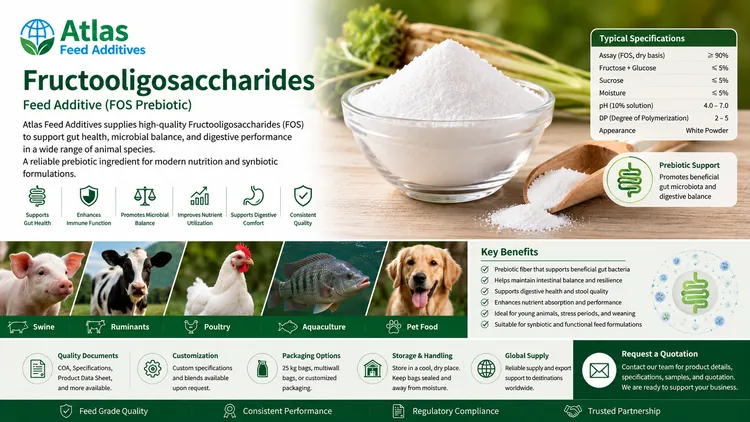
Fructooligosaccharides feed additive visual

Product role

Where Fructooligosaccharides fit in feed and premix production

Fructooligosaccharides are part of the prebiotics and gut-support ingredients group. In animal nutrition, FOS products are usually evaluated as functional carbohydrate ingredients that can provide fermentable substrates for selected intestinal microorganisms and support digestive-health strategies when used within a balanced feed program.

FOS is commonly considered in young-animal transition diets, piglet starter formulas, calf and companion animal products, poultry and aquafeed programs, specialty premixes, synbiotic blends, and gut-resilience formulas that combine prebiotics with probiotics, organic acids, yeast products, enzymes, botanicals, or immune-support ingredients.

Buyers usually evaluate Fructooligosaccharides by matching active FOS content, degree of polymerization profile, mono- and disaccharide content, dry matter, moisture, ash, solubility, carrier system, microbiological quality, species target, processing conditions, inclusion guidance, documentation package, and destination market requirements.

Atlas Feed Additives can coordinate international supplier options for feed mills, premix producers, pet food manufacturers, aquafeed producers, calf nutrition companies, livestock integrators, distributors, and importers that need consistent feed-grade gut-support ingredients with reliable documentation and export-focused service.

Why prebiotic ingredients matter

Gut-support programs depend on ingredient quality, diet design, and animal stage.

Modern animal nutrition programs often use prebiotic ingredients to support gut microbiota balance, digestive resilience, transition feeding, and performance consistency. FOS can be part of these programs because it provides a fermentable carbohydrate fraction that can be used by selected gut microorganisms.

  • Supports targeted digestive-health programs in sensitive feeding phases.
  • Can be used in young-animal formulas where gut development and feed transition are important.
  • May be combined with probiotics in synbiotic strategies.
  • Can complement organic acids, yeast derivatives, enzymes, and botanical gut-support products.
  • Helps nutrition teams build non-antibiotic gut-management programs where permitted and technically justified.

The practical value of a FOS ingredient depends on the full diet. Species, age, gut maturity, feed intake, protein quality, fiber profile, hygiene, mycotoxin pressure, water quality, management, and health status can all influence the response to a prebiotic program.

  • Performance should be validated in the target species and feed matrix.
  • FOS products should be compared by active fraction, not only by price per kilogram.
  • Solubility and sugar profile can influence handling and formulation behavior.
  • Heat and moisture exposure should be reviewed before pelleting, extrusion, or long storage.
  • Regulatory status and label claims must be reviewed market by market.

Product identity

FOS is a family of related fructan oligosaccharides, not one fixed molecule.

Fructooligosaccharides are short-chain fructan carbohydrates. Commercial FOS products can vary by source, production method, degree of polymerization, sugar profile, dry matter, and carrier. Some products are derived from inulin-rich plant sources such as chicory, while others are produced enzymatically from sucrose through transfructosylation. These production routes can create products with different technical behavior.

Because supplier grades can differ significantly, buyers should not compare offers by product name alone. Important comparison points include FOS content, kestose/nystose/fructosylnystose profile where available, residual glucose/fructose/sucrose levels, DP range, moisture, ash, carrier, bulk density, solubility, color, microbiological status, country of origin, shelf life, and document package.

The term FOS may refer to dry powder, syrup, liquid concentrate, food-grade material, feed-grade material, or a formulated gut-support blend. Each form should be evaluated against the intended use, dosing equipment, feed processing conditions, species target, and destination-market rules.

Composition profile

What buyers usually mean by “FOS content”

Short-chain fructans

FOS products commonly contain short chains of fructose units, often with a glucose terminal unit depending on production route. The exact mixture may include compounds such as kestose, nystose, fructosylnystose, and related oligomers. Suppliers may describe this through degree of polymerization, chromatographic profile, or total FOS assay.

  • Ask whether the specification reports total FOS content.
  • Request a DP profile if the application requires detailed comparison.
  • Confirm whether the product is short-chain FOS, oligofructose, inulin-derived FOS, or a blend.
  • Check whether free sugars are included or excluded from the active fraction.

Residual sugars and dry matter

Commercial FOS can contain residual glucose, fructose, and sucrose. These sugars may affect sweetness, hygroscopicity, fermentation behavior, labeling, energy contribution, and handling. For syrups and liquid concentrates, dry matter and solids content are especially important for price comparison.

  • Compare active FOS percentage, not only total solids.
  • Ask for glucose, fructose, sucrose, and total sugar values where relevant.
  • Confirm dry matter for liquid or syrup products.
  • Check whether the quoted price is based on wet product, dry matter, or active FOS equivalent.

Powder and granule forms

Dry FOS products are often preferred for premixes, powder feed, supplements, and feed mill dosing systems. They should be checked for moisture, flowability, caking tendency, particle size, dust behavior, and mixing uniformity in the intended carrier.

  • Useful in premixes and dry feed systems.
  • Requires attention to caking and moisture protection.
  • Particle size affects uniformity and segregation risk.
  • Bulk density matters for dosing systems and warehouse planning.

Syrup and liquid forms

Liquid FOS products can be suitable for liquid feed, coating, specialty manufacturing, and certain pet food or aquafeed processes. Buyers should check dry matter, viscosity, microbial control, preservative system, pumpability, and storage temperature requirements.

  • Useful where liquid dosing or coating is preferred.
  • Dry matter and viscosity influence logistics and dosing.
  • Microbiological stability requires careful storage review.
  • Containers, pumps, and transfer lines should be compatible with the product.

Technical data

Typical Fructooligosaccharides specification points buyers review

Common commercial profile

FOS specifications vary by supplier, grade, source, production route, and physical form. The points below are general purchasing references. Final values must always be confirmed against the supplier’s current specification, safety data sheet, and certificate of analysis.

Product
Fructooligosaccharides
Common abbreviation
FOS
Ingredient family
Fructan oligosaccharides / oligofructose-type prebiotic ingredient
Common components
Kestose, nystose, fructosylnystose, and related fructan oligomers depending on supplier profile
Typical production routes
Inulin hydrolysis or enzymatic conversion of sucrose, depending on supplier and grade
Typical form
Powder, granule, syrup, liquid concentrate, spray-dried powder, or carrier-based blend
Appearance
White to off-white or pale yellow powder/granule; clear to light yellow syrup or liquid depending on grade
Odor and taste
Mild, slightly sweet, characteristic carbohydrate profile; confirm against approved sample
Solubility
Generally water-dispersible or water-soluble depending on form and solids content; confirm supplier data
Main performance target
Prebiotic substrate supply, gut-support formulation, synbiotic blend development, and transition-feeding support
Primary comparison basis
Active FOS content, DP profile, sugar profile, dry matter, microbiological quality, and cost per active unit
Typical packaging
Bags, cartons, drums, pails, IBCs, or other packaging depending on powder, granule, syrup, or liquid form

Specification comparison

What to align before comparing Fructooligosaccharides prices

A low price per kilogram can be misleading if the active FOS content, sugar profile, dry matter, carrier, physical form, and documentation are different. Buyers should compare cost per active FOS unit and cost per ton of finished feed, not only the purchase price of the commercial product.

Parameter Why it matters What to ask the supplier
Total FOS content Determines the active prebiotic fraction being purchased. Request assay value, test method, and COA result for the offered batch.
DP profile Chain length can influence solubility, fermentation behavior, sweetness, and product comparison. Ask for chromatographic profile or DP range if available.
Residual sugars Glucose, fructose, and sucrose can affect sweetness, energy value, hygroscopicity, and labeling. Request sugar profile and clarify whether sugars are counted in the active fraction.
Dry matter Critical for syrup and liquid products because water content changes landed cost. Confirm total solids, dry matter, and active FOS on dry basis.
Physical form Powder, granule, syrup, and liquid products require different handling and dosing systems. Confirm product form and suitability for the buyer’s equipment.
Carrier or blend system Formulated products may contain carriers or other gut-support ingredients. Ask for carrier declaration, composition guidance, and active FOS percentage.
Moisture and hygroscopicity High moisture or hygroscopic behavior can increase caking and storage risk. Request moisture limits, packaging details, and warehouse recommendations.
Microbiological quality Important for feed safety, liquid products, premixes, pet food, and sensitive animal categories. Ask for total plate count, yeast, mold, coliform, Salmonella, and other required parameters.
Heat stability Pelleting, extrusion, and drying may affect product handling or functional consistency. Ask for supplier guidance under the buyer’s processing conditions.
Compatibility FOS may be used with probiotics, enzymes, acids, yeast products, minerals, and botanicals. Request compatibility guidance and validate in the actual formula.
Packaging Packaging affects moisture protection, shelf life, container loading, and customer approval. Confirm net weight, liner, drum, pail, IBC, pallet, closure, and label language.
Documents Missing documents can delay customs clearance, formulation approval, or customer qualification. List COA, SDS, origin, allergen, GMO, animal-origin, contaminant, and regulatory statements required.

Applications

Typical application areas for Fructooligosaccharides in feed-related supply chains

Piglet and swine programs

  • Pre-starter, starter, and nursery diets during weaning transition.
  • Programs designed around gut microbiota support and digestive resilience.
  • Synbiotic blends combining FOS with selected probiotic strains.
  • Diets that also include organic acids, yeast products, enzymes, or functional fibers.
  • Strategies where intake, gut development, and fecal consistency are monitored.

Calf, lamb, and kid nutrition

  • Milk replacer support products where FOS is technically suitable and permitted.
  • Calf starter feeds and transition formulas.
  • Young ruminant programs focused on gut adaptation and early feed intake.
  • Functional blends with yeast derivatives, probiotics, organic acids, and vitamins.
  • Programs that monitor fecal consistency, intake, growth, and overall resilience.

Poultry feed programs

  • Broiler, layer, breeder, and turkey formulas where gut-support ingredients are permitted.
  • Starter and grower diets requiring non-antibiotic digestive-support strategies.
  • Programs combining FOS with probiotics, enzymes, organic acids, phytogenics, or yeast products.
  • Feed systems where litter quality, gut integrity, and performance consistency are evaluated.
  • Specialty premixes for integrators, feed mills, and distributors.

Pet food and companion animal products

  • Dry pet food, wet pet food, treats, supplements, and functional products.
  • Digestive-health formulas for dogs, cats, and companion animals.
  • Synbiotic blends with probiotics and fermentable fibers.
  • Products where stool quality, palatability, and label positioning matter.
  • Applications requiring careful documentation, allergen statements, and ingredient declarations.

Aquafeed and specialty species

  • Aquafeed formulas where FOS is permitted and technically justified.
  • Functional feed programs for fish, shrimp, and specialty aquaculture species.
  • Extruded feeds requiring processing and stability review.
  • Programs combining prebiotics with probiotics, organic acids, immunonutrition, or yeast ingredients.
  • Field validation under water quality, stocking density, and health-challenge conditions.

Premixes and synbiotic blends

  • Functional premixes for gut-support programs.
  • Synbiotic products combining FOS with live microbial strains.
  • Blends with mannan oligosaccharides, inulin, GOS, beta-glucans, organic acids, and yeast derivatives.
  • Customized distributor blends with defined active FOS levels.
  • Private-label gut-support products requiring stable documentation and repeatable sensory quality.

How FOS works

FOS supports gut programs by acting as a selective fermentable substrate.

Fructooligosaccharides are used in feed programs because selected intestinal microorganisms can ferment them as carbohydrate substrates. This fermentation can contribute to the production of short-chain fatty acids and may influence gut environment, microbial balance, and digestive function depending on species, age, diet, health status, and management conditions.

The practical response to FOS is not automatic. A successful program depends on correct species targeting, feed formulation, inclusion level, product quality, feed hygiene, gut health status, raw-material quality, and the presence of other functional ingredients. For this reason, FOS should be evaluated through controlled trials and practical field data.

  • Substrate role: Provides fermentable carbohydrate fractions for selected gut microorganisms.
  • Transition support: Often considered during weaning, early growth, diet change, or stress-sensitive phases.
  • Synbiotic use: Can be paired with probiotics when strain compatibility and product stability are confirmed.
  • Gut environment: May contribute to fermentation patterns that influence intestinal conditions.
  • Diet interaction: Response depends on fiber, protein, minerals, acidifiers, enzymes, and feed hygiene.
  • Validation: Performance should be checked with target species, actual feed matrix, and real production conditions.

Formulation notes

Practical factors that influence Fructooligosaccharides performance

Species, age, and gut maturity

Young animals, recently weaned animals, pets, and aquaculture species may respond differently to FOS. The same product and inclusion level may not produce the same result across piglets, calves, poultry, pets, fish, or shrimp because gut microbiota, digestion, diet type, and management conditions differ.

  • Ask for species-specific supplier guidance.
  • Check whether the supplier has trials in the target species.
  • Evaluate response during the intended production phase.
  • Monitor feed intake, growth, fecal consistency, mortality, and health indicators where relevant.

Diet composition and fermentability

FOS works within the context of the full diet. Fiber sources, protein level, starch type, minerals, organic acids, enzymes, yeast products, probiotics, and raw-material quality can all influence microbial fermentation patterns and gut response.

  • Review fermentable fiber level in the complete diet.
  • Check interaction with probiotics and synbiotic strains.
  • Consider protein digestibility and undigested substrate load.
  • Evaluate whether organic acids, enzymes, or yeast ingredients are part of the same program.

Processing and stability

FOS products can be exposed to heat, pressure, steam, drying, extrusion, and storage stress. Powder and granule products may need moisture protection, while syrups and liquid concentrates may require microbial control and viscosity review.

  • Confirm suitability for pelleting or extrusion conditions.
  • Check caking risk in powder premixes.
  • Review liquid product viscosity and pumpability.
  • Test active content and sensory quality after processing if the application is sensitive.

Compatibility with other additives

FOS may be used alongside probiotics, enzymes, organic acids, essential oils, yeast products, beta-glucans, MOS, minerals, vitamins, and binders. Compatibility should be checked because moisture, pH, heat, and carrier choice can influence blend stability.

  • Check probiotic viability in synbiotic blends.
  • Review compatibility with acidifiers and low-pH products.
  • Confirm whether hygroscopic FOS affects premix flowability.
  • Test blend stability under realistic warehouse conditions.

Palatability and sweetness

Some FOS products have mild sweetness because of their carbohydrate profile and residual sugars. This can be useful in some applications, but it should not be treated as the same function as a dedicated flavor or high-intensity sweetener.

  • Evaluate taste and aroma in the actual feed matrix.
  • Check whether residual sugars affect palatability or labeling.
  • Consider combination with fruit, milk, or vanilla flavors where needed.
  • Compare cost and performance against dedicated sweetener systems.

Trial design

FOS programs should be validated with clear trial objectives. A buyer may track feed intake, growth, feed conversion, fecal score, litter quality, stool consistency, microbiota indicators, gut morphology, or survival depending on species and application.

  • Define the expected outcome before the trial starts.
  • Use a representative control and enough animals for meaningful comparison.
  • Record feed composition, management, health status, and environmental conditions.
  • Evaluate cost per ton and cost per performance outcome.

Quality assurance

Buyer quality checklist for Fructooligosaccharides procurement

Documents to request

  • Current product specification
  • Certificate of analysis for each batch
  • Safety data sheet in the required language
  • Total FOS content and test method
  • Degree of polymerization profile where available
  • Residual sugar profile where relevant
  • Dry matter or total solids for liquid products
  • Country of origin statement
  • Manufacturing site or producer declaration where available
  • Feed-grade suitability statement where applicable
  • Microbiological statement, including yeast and mold where required
  • Heavy metal and contaminant declarations
  • Allergen, GMO, animal-origin, BSE/TSE, irradiation, and solvent statements where required
  • Shelf-life and recommended storage condition statement
  • Halal, Kosher, FAMI-QS, GMP+, ISO, HACCP, or other certificates where relevant and available
  • Regulatory or destination-market compliance statements if required by the buyer

Batch review points

  • Batch number and manufacturing date
  • Expiry date or retest date
  • FOS assay result and active fraction
  • Moisture for powder/granule grades
  • Dry matter and solids for liquid/syrup grades
  • Glucose, fructose, sucrose, and total sugar values where specified
  • Appearance, color, odor, and taste compared with approved sample
  • Bulk density, flowability, and particle size where specified
  • Microbiological results and pathogen absence where required
  • Packaging integrity and closure condition
  • Remaining shelf life at dispatch
  • Label accuracy and destination-language requirements
  • Consistency between COA, invoice, packing list, label, and product specification
  • Retention sample availability for future comparison

Supplier approval

How to evaluate a new Fructooligosaccharides source

A new FOS supplier should be approved through both document review and practical testing. Products with the same name can differ in active content, DP profile, sugar level, moisture, caking behavior, microbiological quality, solubility, and performance in the target formula.

Evaluation step Purpose Recommended action
Document review Confirms suitability before sample approval. Review specification, COA, SDS, origin, FOS content, microbiology, and regulatory statements.
Sample approval Creates a benchmark for future orders. Approve a retained sample with supplier name, product code, batch number, and date.
Laboratory comparison Checks active content and physical quality. Compare FOS assay, moisture, sugar profile, solubility, and appearance against current standard.
Feed matrix test Shows handling behavior in the real formula. Mix into the target premix or feed and evaluate uniformity, caking, dust, and flowability.
Processing test Checks behavior under pelleting, extrusion, drying, or coating. Evaluate finished feed quality and active retention where relevant.
Stability test Checks shelf-life behavior in realistic warehouse conditions. Monitor caking, moisture uptake, microbial quality, and assay over time.
Animal trial Confirms practical value in the target species. Run controlled field or pen trials with clear intake, growth, fecal, health, or performance endpoints.
Commercial validation Confirms repeatability at production scale. Review production batches, customer feedback, complaint history, and cost per ton of feed.

Storage and handling

Recommended storage review for Fructooligosaccharides shipments

Always follow the supplier’s safety data sheet and product label. FOS products should be protected from moisture, contamination, temperature stress, and poor closure after opening. Storage needs differ between powder, granule, syrup, and liquid concentrate forms.

  • Store in a cool, dry, well-ventilated area.
  • Protect powder and granule products from moisture, condensation, and high humidity.
  • Keep bags, liners, drums, pails, and IBCs tightly closed when not in use.
  • Store away from strong odors, chemicals, incompatible materials, and contaminated raw materials.
  • Use first-expired, first-out stock rotation.
  • Inspect packaging for punctures, leaks, caking, swelling, or broken seals at receipt.
  • Use dust control procedures for dry powder products.
  • Use sanitary transfer and clean pumps for syrup or liquid products.
  • Monitor liquid products for microbial stability according to supplier recommendations.
  • Use appropriate personal protective equipment according to SDS guidance.
  • Keep retained samples and warehouse records for batch number, receipt date, dispatch date, and stock rotation.

Regulatory note

Check authorization, labeling, and claims before import or formulation.

Fructooligosaccharides can be sold as feed-grade ingredients, food-grade ingredients, syrups, powders, or formulated blends. Regulatory treatment may differ by country, product form, animal species, intended claim, final feed type, and ingredient declaration rules. The word “prebiotic” can also be regulated differently depending on the market and the claim being made.

Buyers should verify whether FOS is permitted in the destination market, whether the supplier grade is suitable for feed use, which declarations are required, whether any health or performance claims are allowed, and whether the product needs registration before import, formulation, or resale.

Extra care is recommended for pet food, aquafeed, young-animal diets, organic or specialty products, private-label formulas, and synbiotic blends that include live microorganisms. These applications may require additional documentation, label review, strain compatibility data, or customer approval before purchase.

Atlas Feed Additives can help collect supplier statements and technical documents, but final compliance decisions belong to the buyer, importer, manufacturer, and local regulatory advisor.

Comparison guide

How buyers compare Fructooligosaccharides with related gut-support ingredients

FOS is one part of a broader gut-support toolbox. Depending on the target species and formula challenge, buyers may compare FOS with inulin, mannan oligosaccharides, galacto-oligosaccharides, yeast beta-glucans, probiotics, organic acids, enzymes, and other functional fibers.

Ingredient type Common role Buyer notes
Fructooligosaccharides Prebiotic fructan substrate for gut-support and synbiotic programs. Compare active FOS content, DP profile, sugar profile, form, solubility, and cost per active unit.
Inulin Longer-chain fructan fiber often used in gut-support and fiber-enrichment programs. Usually differs from FOS in chain length, solubility, sweetness, and fermentation rate.
Mannan Oligosaccharides Yeast-derived gut-support ingredient often linked with binding and gut-resilience strategies. Different structure and function from FOS; compare yeast source, MOS content, and documentation.
Galacto-Oligosaccharides Prebiotic carbohydrate ingredient used in selected digestive-health formulas. Compare sugar profile, active GOS content, source, and application data.
Yeast Beta-Glucans Yeast cell wall fraction used in immune and gut-support programs. Different function from FOS; compare beta-glucan content, yeast source, and purity.
Probiotics Live microorganisms used for microbiota-support and performance programs. When combined with FOS, check strain compatibility, viability, moisture, and shelf-life stability.
Organic acids Acidification, hygiene, and digestive-support strategies. Can complement FOS, but compatibility and pH sensitivity should be reviewed.
Functional fiber blends Combination systems for gut resilience, stool quality, and fermentation profile management. Compare total fiber, active ingredients, carrier, inclusion rate, and claim support.

Procurement note

Ask for the right specification before comparing prices.

Price comparisons are meaningful only when active FOS content, DP profile, sugar profile, dry matter, physical form, carrier, packaging, origin, shelf life, and documentation are aligned. For Fructooligosaccharides, the key commercial comparison is often the cost per active FOS unit or cost per ton of finished feed, not only price per kilogram of commercial product.

Atlas Feed Additives helps buyers prepare clear RFQs, compare supplier offers, request samples, review quality documents, and coordinate export-focused service from quotation to shipment planning.

  • Define whether you need powder, granule, syrup, liquid, or carrier-based blend.
  • State the required active FOS content or current supplier specification.
  • Confirm whether a DP profile or sugar profile is needed for approval.
  • Identify the target species and production stage.
  • Share processing conditions such as pelleting, extrusion, coating, or premix blending.
  • Confirm whether the product will be used alone or in a synbiotic blend.
  • List required documents before requesting final price.
  • Request samples and approve retained references before commercial order.

Logistics

Packaging, shipping, and import planning

Packaging review

Packaging affects moisture control, microbiological stability, caking risk, shelf life, container loading, and customer approval. FOS powders and granules usually require moisture-protective packaging, while syrups and liquids require leak-resistant containers and clean handling systems.

  • Confirm net weight and gross weight per package.
  • Ask whether powder products use moisture barrier liners.
  • Check drum, pail, IBC, bag, carton, or pallet dimensions.
  • Request label photos before shipment if customs or customer approval is strict.
  • Confirm whether packaging is suitable for long sea freight or humid climates.
  • Ask how opened packaging should be resealed and stored.

Shipment planning

For international shipments, align documentation early. FOS shipments can be delayed if product name, grade, HS code, batch number, origin, invoice, packing list, SDS, microbiology statements, and certificates are inconsistent.

  • Confirm HS code with the importer or customs broker.
  • Check whether the destination requires feed additive registration or pre-approval.
  • Align invoice name with approved product specification.
  • Request SDS and batch quality documents before dispatch.
  • Confirm whether the buyer needs legalized, apostilled, or chamber-certified documents.
  • Plan storage conditions according to form: dry powder, granule, syrup, or liquid concentrate.

Decision guide

When Fructooligosaccharides may be a good candidate

FOS may be considered when the buyer needs a prebiotic carbohydrate ingredient for a gut-support, transition, synbiotic, pet food, aquafeed, or functional premix program. The decision should be based on target species, active FOS content, formula context, supplier data, local authorization, and practical trials.

  • The product is intended for young-animal, weaning, starter, or transition feeding.
  • The feed program includes gut microbiota support or digestive resilience objectives.
  • The buyer wants to build a synbiotic blend with selected probiotic strains.
  • The formula includes other gut-support ingredients such as organic acids, yeast products, enzymes, or fibers.
  • The product must support a pet food, aquafeed, or specialty feed digestive-health concept.
  • The buyer needs a defined FOS active fraction rather than a generic carbohydrate carrier.
  • The product can legally be used in the destination market and target feed application.

Trial planning

How to test a new FOS source

A new Fructooligosaccharides source should be tested in the intended feed system before commercial approval. Document review is important, but real performance depends on the product’s active fraction, physical behavior, diet context, animal status, and production conditions.

  • Request a representative sample from the same grade that will be quoted commercially.
  • Record supplier name, product code, batch number, origin, active FOS content, and packaging.
  • Compare the sample against your current product or internal specification.
  • Check appearance, odor, solubility, caking tendency, flowability, and dust behavior.
  • Mix into the real formula, not only into a neutral carrier.
  • Evaluate compatibility with probiotics, enzymes, acidifiers, yeast products, and minerals.
  • Check performance after pelleting, extrusion, drying, coating, or storage if relevant.
  • Run animal trials with defined intake, growth, fecal, gut-health, or performance endpoints.
  • Calculate cost per ton of finished feed at the selected inclusion level.
  • Keep approved reference samples for future batch comparison.

Questions

Useful answers about Fructooligosaccharides

What are Fructooligosaccharides used for in animal nutrition?

Fructooligosaccharides are used as prebiotic gut-support ingredients in animal nutrition programs. They can provide fermentable substrates for selected intestinal microorganisms and are commonly evaluated in young animal transition diets, synbiotic blends, pet food, aquafeed, and functional premixes.

What does FOS mean?

FOS means Fructooligosaccharides. The term is often used for short-chain fructan oligosaccharides, also called oligofructose or fructan oligosaccharides, depending on source and supplier specification.

Is FOS the same as inulin?

No. FOS and inulin are related fructan ingredients, but they usually differ in chain length, solubility, sweetness, fermentation behavior, and specification. Buyers should compare active content and DP profile before substitution.

Is FOS a probiotic?

No. FOS is not a live microorganism. It is a prebiotic carbohydrate ingredient. Probiotics are live microorganisms, while FOS may be used as a substrate in synbiotic products that combine prebiotics and probiotics.

Can FOS be used in piglet feeds?

FOS is commonly evaluated in piglet pre-starter, starter, and nursery diets. Suitability depends on the FOS specification, inclusion level, complete formula, animal age, management conditions, supplier guidance, and local regulation.

Can FOS be used in calf feeds?

FOS may be considered in calf starters, milk-replacer support products, and young-ruminant transition formulas where permitted and technically suitable. Buyers should validate response through intake, fecal consistency, growth, and health observations.

Can FOS be used in poultry feeds?

FOS may be evaluated in poultry gut-support programs, especially where nutritionists use prebiotics, probiotics, organic acids, enzymes, or yeast products as part of a broader digestive-health strategy.

Can FOS be used in pet food?

FOS may be used in pet food and companion animal products where permitted and suitable. Pet food buyers should review stool quality objectives, label claims, ingredient declaration, palatability, processing stability, and regulatory status.

Can FOS be used in aquafeed?

FOS may be evaluated in aquafeed and specialty species formulas where permitted and technically justified. Extrusion stability, water exposure, species response, and formula compatibility should be checked carefully.

What is a synbiotic blend?

A synbiotic blend combines a prebiotic ingredient such as FOS with one or more probiotic strains. Buyers should check strain compatibility, moisture, pH, heat exposure, probiotic viability, and shelf-life stability.

Does FOS replace good feed hygiene practice?

No. FOS can be part of a gut-support program, but it does not replace feed hygiene, clean raw materials, proper storage, water quality, biosecurity, mycotoxin control, veterinary management, or balanced formulation.

What should be checked on the certificate of analysis?

Buyers should check batch number, FOS assay, dry matter or moisture, sugar profile where listed, microbiological values, appearance, manufacturing date, expiry or retest date, and consistency with the approved specification.

What quality documents should buyers request for Fructooligosaccharides?

Common documents include product specification, certificate of analysis, safety data sheet, origin information, FOS content, sugar profile, microbiological statement, heavy metal statement, batch details, shelf-life statement, storage statement, and market-specific certificates required by the buyer.

How should Fructooligosaccharides be stored?

Follow the supplier’s SDS and label. In general, FOS products should be stored in a cool, dry, well-ventilated area, protected from moisture, contamination, direct sunlight, excessive heat, and poor closure after opening. Liquid products may require additional microbial-control and temperature guidance.

How should buyers compare FOS prices?

Buyers should compare active FOS content, dry matter, DP profile, sugar profile, physical form, packaging, shelf life, documentation, and cost per ton of finished feed. Price per kilogram alone may not reflect real value.

Can Atlas Feed Additives quote Fructooligosaccharides?

Yes. Send the required FOS specification, active fraction, physical form, target species, quantity, destination, packaging preference, preferred Incoterm, and required documents so Atlas Feed Additives can review suitable supplier options.

Are Fructooligosaccharides allowed in every country?

No. Authorization, ingredient declaration, feed category, species scope, import rules, and prebiotic claims can vary by country. Buyers should verify current local requirements before import, formulation, or resale.

Request a quotation

Tell us what you need

Send your product list, target species, required FOS specification, active fraction, physical form, destination country, packaging preference, delivery schedule, processing conditions, and required documents. Our team will review your request and respond from orders@feedgradeadditives.com.

Fast RFQ checklist

  • Product name: Fructooligosaccharides / FOS
  • Required form: powder, granule, syrup, liquid, or blend
  • Target active FOS content or current supplier specification
  • Required DP profile or sugar profile, if applicable
  • Target species and feed type
  • Application: premix, feed mill, pet food, aquafeed, synbiotic blend, or distribution
  • Processing conditions: mash, pellet, extrusion, coating, liquid dosing, or premix blending
  • Annual volume and first order quantity
  • Destination country and preferred Incoterm
  • Packaging and pallet requirements
  • Required certificates and approval documents