Vitamins and vitamin-like nutrients

Pyridoxine Hydrochloride

Pyridoxine Hydrochloride is a feed-grade Vitamin B6 source used in premixes, concentrates, complete feeds, aquaculture diets, pet food, and specialty animal nutrition programs where accurate micronutrient fortification is required.

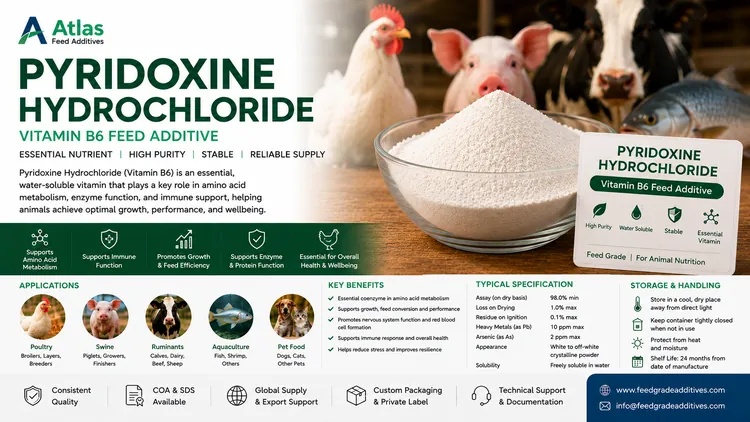
Pyridoxine Hydrochloride feed additive visual

Product role

Where Pyridoxine Hydrochloride fits in feed formulation

Pyridoxine Hydrochloride belongs to the Vitamin B6 group of nutritional additives. In animal nutrition, Vitamin B6 is associated with metabolic processes connected to amino acid utilization, energy metabolism, enzyme systems, nervous-system support, growth performance, reproductive performance, immune resilience, and general feed efficiency.

Feed mills and premix manufacturers typically use Pyridoxine Hydrochloride when they need a standardized, easy-to-dose Vitamin B6 source that can be incorporated into vitamin premixes, mineral-vitamin premixes, concentrates, compound feeds, and specialty nutritional blends.

Atlas Feed Additives coordinates international sourcing options for feed mills, premix producers, integrators, distributors, and importers that require feed-grade material supported by specification, lot-level quality documents, export documentation, and quotation assistance.

What Pyridoxine Hydrochloride contributes

Vitamin B6 nutrition is important because animals rely on dietary supply and formulated supplementation to maintain dependable intake across production cycles. Pyridoxine is converted in biological systems into active Vitamin B6 coenzyme forms that participate in numerous metabolic reactions.

  • supports balanced micronutrient fortification in complete feed
  • helps maintain consistent Vitamin B6 supply in premixes and concentrates
  • fits poultry, swine, ruminant, aquaculture, pet food, and specialty formulations
  • supports nutrition programs where amino acid metabolism and growth performance are key formulation priorities
  • helps reduce variation when natural raw-material Vitamin B6 contribution is inconsistent

Typical applications

  • vitamin premixes for commercial feed production
  • mineral-vitamin premixes for integrators and premix plants
  • starter feeds and young-animal nutrition programs
  • broiler, layer, breeder, turkey, duck, and other poultry feeds
  • piglet, sow, grower, and finisher swine diets
  • dairy, beef, calf, sheep, goat, and other ruminant feeds
  • aquaculture feeds for fish and shrimp production
  • pet food, treats, and specialty companion-animal nutrition
  • stress, transition-period, recovery, and high-performance diets
  • custom concentrates, supplements, and nutritional blends

Technical identity

Key identification and formulation information

Buyer reference table for Pyridoxine Hydrochloride
Item Typical buyer reference Why it matters
Product group Vitamin B6 nutritional additive Confirms the nutritional purpose and category for formulation and procurement records.
Common commercial form Pyridoxine Hydrochloride / Pyridoxine HCl The hydrochloride form is widely used for commercial standardization and premix handling.
Physical appearance Usually white to off-white crystalline powder or fine powder, depending on supplier specification Appearance, flowability, and particle profile affect blending and quality control.
Solubility profile Generally water-soluble; verify against supplier specification Useful for liquid applications, analytical testing, and process evaluation.
Assay / potency Must be confirmed on the certificate of analysis Assay is required for accurate dosing, formulation cost comparison, and acceptance testing.
Intended use Feed, premix, concentrate, supplement, pet food, aquaculture feed Intended-use declaration helps confirm regulatory and documentation alignment.
Storage sensitivity Protect from moisture, contamination, heat, and direct sunlight Correct storage helps preserve quality during warehousing and distribution.
Documentation Specification, COA, SDS, origin, batch data, shelf-life statement Documentation reduces risk during import, audit, and internal quality approval.

Species coverage

Use across animal nutrition programs

Pyridoxine Hydrochloride can be considered in a wide range of feed programs, but final inclusion must always be determined by a qualified nutritionist, the target species, diet composition, raw-material contribution, production stage, local legislation, and the customer’s own formulation standards.

  • Poultry: broiler, layer, breeder, turkey, duck, and specialty poultry premixes.
  • Swine: piglet, nursery, grower-finisher, sow, and breeding-stock nutrition.
  • Ruminants: dairy, beef, calf, small-ruminant, and transition-period programs.
  • Aquaculture: fish and shrimp formulations requiring precise vitamin fortification.
  • Pet food: dry, wet, treat, and supplement applications where Vitamin B6 declaration is required.

Specification review

Buyer quality checklist

Price comparisons are meaningful only when the technical specification, assay method, packaging, origin, batch documents, and delivery terms are aligned. For Vitamin B6 products, buyers should confirm the product is suitable for the intended feed or premix use before comparing offers.

  • declared assay and test method
  • product grade and intended use declaration
  • appearance, odor, and physical-form description
  • particle size or mesh range, if required by the premix plant
  • bulk density and flowability expectations
  • moisture or loss-on-drying limits
  • heavy metal and undesirable-substance limits where required
  • microbiological limits where applicable
  • shelf-life and retest-date policy
  • storage guidance and transport conditions
  • country of origin and manufacturing site declaration where needed
  • certificate of analysis for each lot

Documents

Recommended document package

Atlas Feed Additives can help buyers collect the technical and commercial documents normally requested for internal approval, customs clearance, distributor registration, audit review, and feed-manufacturing quality systems.

  • product specification sheet
  • certificate of analysis by batch or lot
  • safety data sheet
  • technical data sheet
  • country-of-origin information
  • packing list and commercial invoice
  • certificate of origin when required
  • GMO, allergen, BSE/TSE, dioxin, or contaminant statements when relevant
  • Halal, Kosher, ISO, FAMI-QS, GMP+, or other certificates if available and required
  • transport, storage, and shelf-life declaration

Formulation and processing

Practical handling notes for premix and feed production

Premix uniformity

Pyridoxine Hydrochloride is normally used at low inclusion rates, so premix design should consider carrier selection, dilution steps, mixer performance, dosing accuracy, and analytical verification.

Carrier compatibility

Buyers should confirm whether the product will be blended with mineral carriers, organic carriers, other vitamins, trace minerals, enzymes, amino acids, acids, or specialty additives that may affect stability or flow.

Pelleting and heat exposure

Thermal processing, conditioning time, moisture, pressure, and post-pellet handling can influence vitamin retention. Evaluate formulation safety margins according to your process and supplier guidance.

Storage and warehouse control

Store sealed bags away from moisture, direct sunlight, strong odors, incompatible materials, and excessive heat. Use first-expired, first-out inventory rotation and keep lot traceability from receipt to production.

Sampling and testing

Use representative sampling procedures and retain reference samples when required. Lot acceptance should be based on the agreed specification, COA review, packaging condition, and incoming quality inspection.

Regulatory responsibility

Feed additive approval, maximum levels, labeling rules, import requirements, and claims vary by market. The buyer should verify local compliance before import, sale, or use in commercial feed.

Procurement note

Ask for the right specification before comparing prices.

Pyridoxine Hydrochloride offers should not be compared only by unit price. Assay, physical form, origin, manufacturer approval, packaging, delivery term, shelf life, document availability, and payment conditions can all change the real value of a quotation.

For sensitive vitamin products, Atlas Feed Additives recommends confirming the target specification, approved origin, shipment urgency, destination-country rules, preferred Incoterm, and required documents before requesting a final commercial offer.

Quote request details to send

  • product name and required grade
  • target assay or supplier specification
  • required quantity and frequency
  • destination country, port, or delivery address
  • preferred Incoterm
  • packaging requirement
  • required certificates and declarations
  • target shipment date
  • any approved or restricted origins
  • payment and documentation requirements

Packaging and logistics

Commercial supply considerations

Typical commercial points to confirm before order placement
Topic What to confirm Commercial importance
Packaging Bag size, inner liner, palletization, labeling, and container loading plan Protects product quality and supports efficient warehouse handling.
Shelf life Manufacturing date, expiry date, retest policy, and remaining shelf life at shipment Prevents short-dated stock and improves inventory planning.
Lead time Stock availability, production lead time, document preparation, and transit time Helps avoid premix-production interruptions.
Origin Country of origin and manufacturer approval status Important for import registration, customer approval, and procurement policy.
Documents COA, SDS, specification, invoice, packing list, certificate of origin, and special certificates Supports customs clearance, audit files, and buyer quality systems.
Incoterms EXW, FCA, FOB, CFR, CIF, DAP, or other requested delivery term Clarifies responsibility for freight, insurance, risk transfer, and import costs.
Batch traceability Lot number, production date, COA reference, and retained sample policy Supports recall readiness and quality investigation procedures.

Who buys this product?

Suitable buyer profiles

  • feed mills that formulate complete feed
  • premix manufacturers producing vitamin and mineral premixes
  • integrators managing poultry, swine, ruminant, or aquaculture nutrition programs
  • distributors supplying feed additive portfolios to local markets
  • pet food producers and specialty supplement manufacturers
  • traders and importers requiring export-ready documentation
  • quality teams evaluating alternative approved suppliers

Why Atlas Feed Additives?

Support beyond price quotation

  • supplier option review based on target specification
  • quotation coordination for spot or recurring demand
  • document collection and pre-shipment review
  • packaging, lead time, and logistics coordination
  • export-focused communication from Ankara, Turkey
  • support for buyers comparing multiple feed additive products
  • clear communication in English and Turkish

Questions

Useful answers about Pyridoxine Hydrochloride

What is Pyridoxine Hydrochloride used for in animal nutrition?

Pyridoxine Hydrochloride is used as a Vitamin B6 source in feed, premix, concentrate, aquaculture, pet food, and specialty animal nutrition applications. It helps maintain reliable micronutrient fortification across species when used according to the formulation objective and local rules.

Is Pyridoxine Hydrochloride the same as Vitamin B6?

Pyridoxine Hydrochloride is a commercial hydrochloride salt form of pyridoxine, one of the Vitamin B6 forms used in nutrition. Buyers should specify whether they require Pyridoxine Hydrochloride and confirm assay, grade, and intended use on the supplier specification.

Which species can use Pyridoxine Hydrochloride?

It may be used in nutrition programs for poultry, swine, ruminants, aquaculture species, pets, and specialty animals. Final use level should be determined by a qualified nutritionist and checked against local regulations.

What quality documents should buyers request?

Common documents include product specification, certificate of analysis, safety data sheet, technical data sheet, origin statement, batch information, shelf-life declaration, and any market-specific certificates requested by the buyer.

What specification points are most important?

Buyers typically review assay, appearance, particle size, moisture, impurities, heavy metals, microbiological limits where applicable, packaging, shelf life, origin, and compliance declarations.

How should Pyridoxine Hydrochloride be stored?

Store it in sealed original packaging in a cool, dry, well-ventilated area. Protect it from moisture, direct sunlight, contamination, strong odors, excessive heat, and damaged packaging. Follow the supplier SDS and specification.

Can Pyridoxine Hydrochloride be used in premixes?

Yes. It is commonly considered for vitamin premixes and mineral-vitamin premixes. Because it is used at low inclusion levels, premix manufacturers should pay attention to dilution, carrier selection, dosing accuracy, mixer performance, and uniformity testing.

Can Atlas Feed Additives quote Pyridoxine Hydrochloride?

Yes. Send your required specification, quantity, destination, packaging preference, target shipment date, approved origin requirements, and document list so Atlas Feed Additives can review suitable supplier options for Pyridoxine Hydrochloride.

Can Atlas quote other vitamins together with Pyridoxine Hydrochloride?

Yes. Atlas Feed Additives can review requests for multiple feed-grade vitamin products, including Vitamin A, Vitamin D3, Vitamin E, Vitamin K3, thiamine, riboflavin, niacinamide, biotin, folic acid, calcium D-pantothenate, and other nutritional additives depending on availability.

Request a quotation

Tell us what you need

Send your product list, target specification, destination country, packaging preference, annual or spot quantity, delivery term, required documents, and target shipment date. Our team will review your request and respond from orders@feedgradeadditives.com.