Vitamins and vitamin-like nutrients

Riboflavin

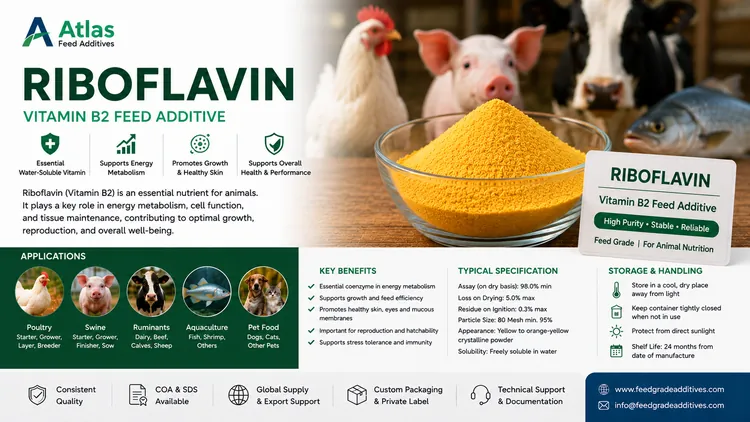
Riboflavin, also known as Vitamin B2, is a nutritional feed additive used by premix producers and feed mills to support consistent micronutrient fortification across poultry, swine, ruminant, aquafeed, pet food, and specialty animal nutrition programs.

Riboflavin feed additive visual

Product role

Where Riboflavin fits

Riboflavin is part of the vitamins and vitamin-like nutrients group. In feed production, it is commonly included in vitamin premixes, mineral-vitamin concentrates, complete feed, starter feeds, breeder diets, high-performance diets, aquafeed, pet food, and specialty nutrition programs where accurate Vitamin B2 fortification is required.

Vitamin ingredients must be evaluated with more detail than the product name alone. Buyers typically compare Riboflavin by declared potency, assay method, physical form, carrier or diluent, particle size, flowability, stability, shelf life, packaging, origin, certificate of analysis, and compatibility with the buyer's premix and feed manufacturing process.

Atlas Feed Additives can coordinate international supplier options for feed-grade Riboflavin for feed mills, premix producers, distributors, integrators, and animal nutrition companies that need consistent material, reliable documentation, export support, and quotation coordination.

Typical applications

  • Complete feed premixes and vitamin-mineral concentrates for poultry, swine, ruminants, aquaculture, and companion animals.
  • Starter feeds, grower feeds, breeder feeds, layer feeds, and high-performance diets where precise micronutrient fortification is required.
  • Stress, transition, production, reproduction, and performance-oriented nutrition programs designed by qualified nutrition specialists.
  • Premix plants that require consistent Vitamin B2 potency, batch traceability, flowability, and reliable documentation.
  • Feed mills producing compound feed with defined vitamin fortification targets and quality-control procedures.
  • Aquafeed and pet food applications where micronutrient consistency, stability, and finished-product shelf life are important.
  • Export-oriented premixes and concentrates requiring strong documentation, batch records, and market-specific certificates.

Buyer quality checklist

  • Declared potency and assay basis.
  • Certificate of analysis for each lot or representative batch.
  • Physical form, carrier system, particle size, and bulk density.
  • Flowability, dusting behavior, and compatibility with dosing equipment.
  • Stability under storage, premix conditions, pelleting, and finished feed manufacturing where relevant.
  • Shelf-life statement and recommended storage conditions.
  • Origin information, batch traceability, and manufacturing details where available.
  • Market-specific authorization, import documents, and customer certificates when required.

Technical overview

Why Riboflavin specification matters

Riboflavin products can differ in potency, particle size, carrier system, flow behavior, dusting tendency, color intensity, moisture sensitivity, stability, packaging, and documentation. Two offers with the same product name may not deliver the same cost-in-use or the same performance in a premix line.

For premix producers, accurate potency is essential because Vitamin B2 is typically included at low levels and must be distributed uniformly across the finished blend. Small variations in assay, dosing, segregation, or premix handling can affect finished feed fortification. This is why buyers should review both chemical specification and physical handling characteristics before purchase.

Atlas Feed Additives helps buyers clarify specification, documentation, packaging, and shipment requirements before comparing quotations, reducing the risk of mismatched offers, incomplete documents, unsuitable material, or approval delays.

Specification guidance

Common Riboflavin specification items

Final parameters depend on supplier, production route, potency, carrier system, physical form, and buyer requirements. Buyers should request a current product specification sheet and certificate of analysis for the exact grade being offered.

Identity and potency

  • Product name and commercial grade name.
  • Declared active ingredient: Riboflavin / Vitamin B2.
  • Potency or assay value, expressed according to supplier specification.
  • Analytical method and accepted assay range.
  • Carrier or diluent declaration where applicable.
  • Batch number, production date, expiry date, and traceability details.

Physical characteristics

  • Appearance, color, odor, and physical form.
  • Particle size distribution or mesh size.
  • Bulk density and tapped density where required.
  • Flowability, caking tendency, and dusting behavior.
  • Compatibility with micro-dosing systems, premix lines, and bag filling equipment.
  • Packaging type and resistance to moisture or light exposure.

Quality and purity parameters

  • Assay result on certificate of analysis.
  • Moisture or loss on drying.
  • Residue on ignition or ash where specified.
  • Heavy metals according to buyer or market requirements.
  • Microbiological information where relevant to the application.
  • Contaminant, solvent, GMO, allergen, and BSE/TSE declarations when requested.

Commercial and logistics data

  • Packaging size, net weight, and pallet configuration.
  • Container loading estimate and shipment conditions.
  • Minimum order quantity and lead time.
  • Shelf life and recommended storage conditions.
  • Incoterms, destination port, and required shipment documents.
  • Document availability before shipment for customer approval.

Application guidance

How buyers use Riboflavin in animal nutrition

Poultry nutrition

Riboflavin is commonly included in poultry vitamin premixes and complete feeds for broilers, layers, breeders, pullets, and turkeys according to the nutritionist's formulation target. Buyers should focus on accurate potency, uniform distribution, premix stability, feed processing conditions, and customer-specific fortification programs.

Swine nutrition

Swine premixes and compound feeds may include Riboflavin as part of complete vitamin fortification programs for piglets, growers, finishers, and breeding animals. Premix handling, dosing precision, and compatibility with minerals, acids, enzymes, and other vitamins should be reviewed during formulation and production.

Ruminant nutrition

Riboflavin may be included in ruminant premixes, concentrates, milk replacer systems, and specialty nutrition products depending on the formulation objective and professional guidance. Buyers should verify whether the product grade fits the target application, processing method, and market requirements.

Aquafeed and pet food

Aquafeed and pet food manufacturers often require stable, well-documented vitamin ingredients because finished products may face longer storage times, extrusion or thermal processing, and strict label expectations. Riboflavin selection should consider stability, premix compatibility, processing conditions, and final product claims.

Premix performance

Uniform Vitamin B2 delivery depends on more than assay

Assay confirms the active content of Riboflavin, but practical premix performance also depends on the ingredient's physical behavior. Particle size, density, electrostatic tendency, carrier type, dusting, and flowability can influence mixing uniformity, segregation risk, and dosing accuracy.

For low-inclusion vitamin ingredients, the premix carrier system and mixing sequence are especially important. Buyers should evaluate Riboflavin in their own equipment when changing supplier, potency, particle size, packaging, or premix design.

Production checks

What to review during trials

  • Compatibility with premix carrier and other vitamins.
  • Mixing time required for uniform distribution.
  • Segregation risk after bagging, transport, and storage.
  • Flow through micro-dosing and weighing systems.
  • Dust level during manual and automated handling.
  • Effect of pelleting, extrusion, or thermal processing where relevant.
  • Finished premix color, odor, and appearance.
  • Stability over the intended storage period.

Stability and storage

Protect potency from warehouse to finished feed

Vitamin ingredients should be protected throughout storage, premix production, transport, and feed manufacturing. Riboflavin should be stored according to the supplier's label and technical documents, typically in sealed packaging, away from excessive heat, moisture, direct sunlight, contamination, and strong odors.

Buyers should review shelf life, packaging integrity, storage temperature guidance, light protection, moisture control, and compatibility with other premix ingredients. When Riboflavin is used in vitamin premixes containing minerals, acids, choline chloride, enzymes, or other reactive ingredients, stability should be checked under the buyer's own formulation and storage conditions.

Warehouse checklist

  • Keep bags or drums closed until use.
  • Store in a clean, dry, ventilated area.
  • Protect from direct sunlight and high humidity.
  • Avoid contact with damaged pallets or wet floors.
  • Separate from strong odors and incompatible materials.
  • Record batch number, receiving date, and expiry date.
  • Use first-expiry, first-out stock rotation.
  • Inspect packaging before acceptance and before use.

Quality documents

Documents to request before purchase

Documentation requirements vary by country, customer, species, certification program, and final application. Atlas Feed Additives can help buyers organize supplier documentation for commercial and technical review before shipment.

Core documents

  • Product specification sheet.
  • Certificate of analysis for the offered batch or representative batch.
  • Safety data sheet.
  • Technical data sheet.
  • Batch number, production date, expiry date, and shelf-life statement.
  • Origin information and manufacturing details where available.

Analytical and quality documents

  • Potency or assay result.
  • Analytical method information where available.
  • Moisture or loss on drying.
  • Particle size or mesh information where required.
  • Heavy metal and contaminant results according to buyer requirements.
  • Microbiological information where relevant.

Compliance and customer documents

  • GMO, allergen, BSE/TSE, irradiation, and residual solvent statements where required.
  • Feed-grade suitability declaration where applicable.
  • Halal, kosher, ISO, HACCP, GMP+, FAMI-QS, or other certificates when available.
  • Country of origin certificate when required.
  • Market-specific feed additive documentation where applicable.
  • Supplier questionnaire or vendor approval documents when requested by the buyer.

Shipment documents

  • Commercial invoice and packing list.
  • Bill of lading, airway bill, or transport document.
  • Pallet configuration and container loading details.
  • Packaging specification and label copy where required.
  • Insurance, inspection, or legalization documents where requested.
  • Pre-shipment document review for import and customer approval.

Procurement note

Ask for the right specification before comparing prices

Price comparisons are meaningful only when potency, assay basis, carrier system, particle size, packaging, origin, shelf life, documentation, and logistics conditions are aligned. A lower price per kilogram may not be economical if the potency is different, the material has poor flowability, the shelf life is short, or the documentation does not meet the buyer's approval process.

For vitamins, cost-in-use should consider delivered active content, dosage calculation, stability, premix performance, production handling, rejected-batch risk, and supplier reliability. Buyers should always request the specification and certificate of analysis before confirming a purchase.

Quotation preparation

Information to send for a faster quote

  • Required product name: Riboflavin / Vitamin B2.
  • Target potency, assay, or grade requirement.
  • Powder, coated, carrier-based, or premix-grade preference where relevant.
  • Application area such as vitamin premix, complete feed, aquafeed, or pet food.
  • Estimated first-order quantity and annual demand.
  • Destination country, destination port, or delivery location.
  • Required packaging size and pallet preference.
  • Required documents, certificates, and customer approval requirements.

Comparison guide

Riboflavin compared with other vitamin additives

Vitamin sourcing decisions should be based on nutrient target, formulation role, stability, potency, market requirements, and supplier documentation. Riboflavin is usually purchased as part of a broader vitamin portfolio for premix and complete feed production.

Riboflavin / Vitamin B2

Used for Vitamin B2 fortification in premixes, concentrates, compound feeds, aquafeed, and pet food. Key checks include potency, assay method, stability, particle size, flowability, and certificate of analysis.

Vitamin A Acetate

Commonly evaluated where Vitamin A fortification is required. Buyers typically review potency, beadlet quality, stability, carrier, antioxidant protection, and storage conditions.

Vitamin D3

Used in precise fortification programs where potency and uniform distribution are critical. Buyers should confirm assay, safety handling, premix dilution, documentation, and market requirements.

Vitamin E Acetate and Vitamin K3

Often included in vitamin premixes with different stability and handling requirements. Buyers should compare grade, potency, physical form, compatibility, and customer documentation needs.

Related products

Other vitamins and vitamin-like nutrients

Atlas Feed Additives can support sourcing requests for Riboflavin and other vitamin ingredients used in premixes, concentrates, compound feed, aquafeed, pet food, and specialty animal nutrition programs.

Questions

Useful answers

What is Riboflavin used for in animal nutrition?

Riboflavin, also known as Vitamin B2, is used to support reliable micronutrient fortification in premixes, concentrates, compound feed, aquafeed, pet food, and specialty animal nutrition programs. It should be used according to the target species, formulation objective, and applicable market rules.

Can Atlas Feed Additives quote Riboflavin?

Yes. Send your required potency, specification, quantity, destination country, packaging preference, application area, and required documents so Atlas Feed Additives can review suitable supplier options for Riboflavin.

What quality documents should buyers request for Riboflavin?

Common documents include product specification, certificate of analysis, safety data sheet, technical data sheet, origin information, batch details, potency and assay results, shelf-life statement, storage guidance, and market-specific certificates required by the buyer.

Why is Riboflavin potency important?

Potency determines the amount of Vitamin B2 supplied by the ingredient and affects formulation, dosage calculation, cost-in-use, premix design, and finished feed fortification. Buyers should compare offers on the same potency basis.

Is Riboflavin suitable for all species?

Riboflavin may be used in many animal nutrition programs, but application and inclusion should be determined by the target species, production stage, formulation target, nutritionist guidance, and applicable market rules.

What should buyers check when changing Riboflavin suppliers?

Buyers should review potency, assay method, particle size, carrier, flowability, dusting, stability, shelf life, packaging, certificate of analysis, origin, and compatibility with existing premix equipment and formulation procedures.

How should Riboflavin be stored?

Store Riboflavin according to supplier instructions, typically in sealed packaging, protected from moisture, excessive heat, direct sunlight, contamination, and strong odors. Maintain batch traceability and use first-expiry, first-out stock rotation.

Can Riboflavin be compared only by price per kilogram?

No. Buyers should compare potency, assay, stability, documentation, shelf life, packaging, supplier reliability, logistics cost, and cost-in-use. Price alone can be misleading if the active content or documentation differs.

Request a quotation

Tell us what you need

Send your product list, target potency, specification, destination country, packaging preference, application area, expected quantity, and required documents. Our team will review your request and respond from orders@feedgradeadditives.com.