Vitamins and vitamin-like nutrients

Folic Acid

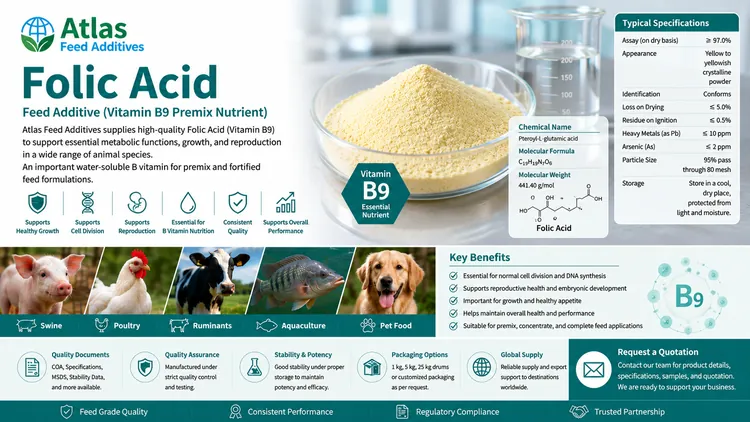
Folic Acid is a vitamin B9 nutritional additive used by premix producers and feed mills to support reliable micronutrient fortification, reproductive nutrition, growth-stage feeding, and species-specific vitamin programs.

Folic Acid feed additive visual

Product role

Where Folic Acid fits in feed and premix production

Folic Acid is part of the vitamins and vitamin-like nutrients group. In animal nutrition, it is used as a vitamin B9 source in complete feeds, concentrates, vitamin-mineral premixes, specialty supplements, breeder programs, sow diets, young-animal diets, pet food, aquafeed, and high-performance feeding programs where permitted by applicable market rules.

Folic Acid supports nutritional programs connected with one-carbon metabolism, cell division, nucleic-acid synthesis, red blood cell formation, reproductive nutrition, embryo development, tissue growth, immune function, and general micronutrient adequacy. Its practical value depends on the complete diet, species, age, production stage, basal raw materials, vitamin premix design, processing conditions, and storage management.

Buyers usually evaluate Folic Acid by matching assay, potency declaration, grade, purity, particle size, physical form, carrier or dilution system, stability, flowability, intended species, processing conditions, shelf life, packaging, documentation package, and destination-market requirements.

Atlas Feed Additives can coordinate international supplier options for feed mills, premix producers, vitamin blend manufacturers, pet food companies, aquafeed producers, livestock integrators, distributors, and importers that need consistent feed-grade vitamin material with reliable export-focused service.

Why vitamin B9 matters

Folic Acid is a small-inclusion nutrient with high formulation importance.

Vitamins are required in small amounts but can have a large effect on the reliability of animal nutrition programs. Folic Acid contributes to folate nutrition and is commonly included in vitamin premixes to help maintain micronutrient fortification across production batches, species, and feeding phases.

  • Supports vitamin B9 fortification in complete feed and premixes.
  • Relevant for reproductive, breeder, gestation, lactation, and young-animal programs.
  • Supports nutrition programs connected with cell division and tissue development.
  • Can be part of high-performance diets where micronutrient density is carefully managed.
  • Helps premix producers design consistent vitamin profiles across different feed lines.

The commercial challenge with Folic Acid is not only choosing the correct inclusion level. Buyers must also control assay, stability, premix uniformity, compatibility with other vitamins and minerals, light exposure, moisture, particle size, packaging, and shelf life. Small dosing errors can matter because vitamin B9 is typically used at low inclusion levels.

  • Compare products by active potency and assay basis, not only by price per kilogram.
  • Review stability under premix storage, pelleting, extrusion, and long-distance transport.
  • Check uniformity when Folic Acid is diluted into carriers or vitamin premix blends.
  • Use retained samples and batch COAs for quality traceability.
  • Verify local authorization, label declaration, and permitted claims before sale.

Technical identity

Folic Acid is the synthetic vitamin B9 form widely used in fortification programs.

Folic Acid is a synthetic vitamin B9 compound used in feed, food, and supplement applications. In commercial feed additive sourcing, it may be supplied as a high-assay pure material, a premix-grade dilution, a stabilized carrier-based product, or a customer-specific vitamin blend. The exact grade should be reviewed before purchase.

Folic Acid is normally described as a yellow to orange crystalline powder. It is sensitive to light, moisture, oxidizing conditions, and some aggressive premix environments. Its stability can be influenced by trace minerals, choline chloride, organic acids, enzymes, probiotics, high humidity, elevated temperature, and storage time.

Because supplier grades can differ, buyers should not compare offers by product name alone. Confirm assay, potency basis, particle size, carrier, dilution ratio, stabilizing system, impurity limits, packaging, shelf life, country of origin, manufacturing site declaration, and complete document package before comparing prices.

Technical data

Typical Folic Acid specification points buyers review

Common technical profile

The values below are general purchasing references. Final values must always be confirmed against the supplier’s current specification, safety data sheet, certificate of analysis, and local regulatory requirements.

Product
Folic Acid
Vitamin family
Vitamin B9 / folate family
Chemical name
Pteroyl-L-glutamic acid
CAS number
59-30-3
Molecular formula
C19H19N7O6
Molecular weight
441.40 g/mol
Appearance
Yellow to orange crystalline powder or fine powder; diluted grades may appear lighter depending on carrier
Odor
Usually slight characteristic odor or practically odorless depending on grade
Solubility behavior
Low solubility in water; solubility may improve in alkaline systems. Confirm supplier guidance for the intended application.
Typical commercial grades
Pure high-assay Folic Acid, feed grade, food grade, premix-grade dilution, stabilized blend, or carrier-supported product
Main nutritional role
Vitamin B9 fortification for complete feed, concentrates, supplements, and premixes
Primary comparison basis
Assay, potency, purity, carrier, stability, flowability, particle size, and cost per active unit
Typical packaging
Foil bags, cartons, fiber drums, composite drums, lined bags, or supplier-specific light- and moisture-protective packaging

Specification comparison

What to align before comparing Folic Acid prices

A low price per kilogram can be misleading if assay, potency, carrier, dilution level, stability, particle size, shelf life, and documentation are different. Buyers should compare cost per active vitamin unit and cost per ton of finished feed, not only the purchase price of the commercial product.

Parameter Why it matters What to ask the supplier
Assay / potency Determines the true vitamin B9 value being purchased. Request assay value, test method, and COA result for the offered batch.
Grade Feed, food, pharmaceutical, and premix grades may have different purity and document support. Confirm grade, intended-use statement, and suitability for feed-related applications.
Carrier or dilution Premix-grade products may contain lower active concentration but easier handling. Ask for carrier declaration, active percentage, and dilution ratio.
Particle size Folic Acid is used at low inclusion levels, so particle size affects blend uniformity. Request mesh range, sieve profile, or particle size distribution.
Flowability Poor flow can create dosing errors in vitamin premix systems. Ask for bulk density, flowability guidance, and anti-caking system if used.
Stability Vitamin loss can occur during storage, premix blending, pelleting, or long transport. Request shelf-life data, storage guidance, and stability information for premix conditions.
Compatibility Trace minerals, choline chloride, organic acids, moisture, and heat can affect vitamin stability. Ask for compatibility guidance with the buyer’s premix formula.
Packaging Light, oxygen, moisture, and heat protection are important for vitamin ingredients. Confirm bag, liner, carton, drum, pallet, label, and barrier properties.
Remaining shelf life Important for slow-moving vitamin premix stock and long-distance exports. Request manufacturing date and minimum remaining shelf life at shipment.
Regulatory status Permitted forms, declarations, and labeling may vary by country and application. Ask for destination-market compliance statements before purchase.
Documents Missing documents can delay customs clearance, customer approval, or feed registration. List COA, SDS, origin, certificates, allergen, GMO, animal-origin, and compliance statements required.
Commercial basis The cheapest product may not be cheapest in use if active concentration differs. Compare cost per active kilogram, cost per billion mg of active vitamin, and cost per ton of feed.

Applications

Typical application areas for Folic Acid in feed-related supply chains

Swine nutrition

  • Sow gestation and lactation vitamin programs.
  • Breeding herd nutrition where reproductive performance is carefully managed.
  • Piglet pre-starter, starter, and nursery feeds requiring complete micronutrient fortification.
  • High-performance swine diets with balanced B-vitamin profiles.
  • Vitamin premixes for integrators, feed mills, and distributors.

Poultry nutrition

  • Broiler starter, grower, and finisher vitamin programs.
  • Layer and breeder diets where egg production and reproductive nutrition are monitored.
  • Turkey, duck, and specialty poultry vitamin premixes.
  • Programs focused on growth, feathering, hatchability support, and general micronutrient adequacy.
  • Premixes that combine Folic Acid with other B vitamins, fat-soluble vitamins, minerals, and amino acids.

Ruminant nutrition

  • Dairy cow transition and lactation programs where B-vitamin nutrition is reviewed.
  • Calf starter feeds, milk replacer support products, and young-ruminant supplements.
  • Beef cattle and small-ruminant concentrates where vitamin fortification is needed.
  • Rumen-protected or specialty formulations where appropriate and available.
  • Premixes requiring careful compatibility with minerals, choline, buffers, and trace elements.

Pet food and companion animal products

  • Dry pet food, wet pet food, treats, supplements, and functional nutrition products.
  • Complete vitamin-mineral premixes for dogs, cats, and companion animals.
  • Life-stage formulas for growth, reproduction, maintenance, and senior nutrition.
  • Products requiring precise label declaration and consistent micronutrient levels.
  • Private-label products requiring stable documentation and batch traceability.

Aquafeed and specialty species

  • Aquafeed formulas for fish and shrimp where vitamin fortification is specified.
  • Extruded feeds requiring stability and processing review.
  • Specialty species diets that need low-inclusion micronutrient consistency.
  • Premixes combined with vitamin C, vitamin E, B-complex vitamins, minerals, and functional additives.
  • Programs where water stability, processing losses, and finished-feed shelf life are evaluated.

Premixes, concentrates, and supplements

  • Vitamin-mineral premixes for complete feed production.
  • Concentrates, basemixes, top-dress products, and specialty supplements.
  • Custom B-complex blends for feed mills and integrators.
  • Distributor vitamin premixes requiring consistent active levels and documentation.
  • Export premixes where long transport and warehouse storage must be considered.

Nutritional function

Folic Acid supports folate-dependent metabolic pathways.

Folic Acid is converted through biological pathways into active folate forms that participate in one-carbon metabolism. These pathways are associated with nucleic-acid synthesis, methyl-group transfer, amino-acid metabolism, red blood cell formation, and rapidly dividing tissues. In practical animal nutrition, this makes vitamin B9 relevant to growth, reproduction, immune function, and tissue development programs.

The response to Folic Acid depends on the complete diet and animal condition. Basal folate contribution from raw materials, microbial synthesis, species physiology, gut health, production stage, vitamin losses during processing, and the presence of other B vitamins can all influence the final requirement and premix design.

  • One-carbon metabolism: Supports folate-dependent transfer reactions in animal metabolism.
  • Cell division: Relevant to tissues with rapid growth or renewal.
  • Nucleic-acid synthesis: Supports DNA and RNA-related nutrition through folate pathways.
  • Reproductive nutrition: Often reviewed in breeder, sow, and gestation programs.
  • Growth-stage feeding: Important in starter, young-animal, and high-performance formulas.
  • Vitamin premix balance: Works in context with vitamin B12, choline, methionine, riboflavin, niacin, and other nutrients.

Stability and premix design

Vitamin stability depends on storage, carriers, processing, and formula chemistry.

Light, heat, and moisture

Folic Acid should be protected from direct sunlight, high humidity, excessive heat, and long exposure to air. Poor storage can reduce vitamin potency and make premix results less reliable. Barrier packaging, cool warehouses, and first-expired stock rotation help protect value.

  • Use light- and moisture-protective packaging where possible.
  • Keep containers tightly closed after opening.
  • Store away from steam, condensation, and high-temperature areas.
  • Monitor remaining shelf life for export and slow-moving stocks.

Trace minerals and reactive ingredients

Vitamin premixes may contain trace minerals, choline chloride, organic acids, enzymes, probiotics, and other reactive ingredients. These can influence vitamin stability, especially when moisture and heat are present. Separate premix systems or stabilized grades may be useful in sensitive formulas.

  • Review compatibility with copper, iron, zinc, manganese, and other trace minerals.
  • Check interaction risk with choline chloride and hygroscopic ingredients.
  • Separate vitamins and minerals when the customer specification requires it.
  • Ask suppliers for premix stability guidance under real storage conditions.

Pelleting and extrusion

Feed processing can expose vitamins to heat, steam, pressure, and moisture. Processing losses depend on temperature, retention time, conditioning, extrusion severity, formula composition, and whether the vitamin is protected or added through a post-processing system.

  • Confirm whether the offered grade is suitable for pelleted or extruded feed.
  • Ask for overage guidance if the buyer designs premixes with processing losses in mind.
  • Test finished-feed potency after processing where vitamin guarantees are required.
  • Consider post-pellet or post-extrusion application for sensitive specialty systems.

Mixing uniformity

Because Folic Acid is normally used at low inclusion levels, premix uniformity is critical. Particle size, carrier selection, bulk density, mixing sequence, electrostatic behavior, and micro-dosing accuracy should be reviewed before approving a new grade.

  • Use suitable dilution and carrier systems for low-inclusion dosing.
  • Validate mixer uniformity with representative sampling.
  • Check segregation risk during transport and storage of premixes.
  • Use calibrated micro-dosing equipment and documented batch records.

Quality assurance

Buyer quality checklist for Folic Acid procurement

Documents to request

  • Current product specification
  • Certificate of analysis for each batch
  • Safety data sheet in the required language
  • Assay method and potency declaration
  • Country of origin statement
  • Manufacturing site or producer declaration where available
  • Feed-grade, food-grade, or intended-use statement where applicable
  • Carrier declaration for diluted or premix-grade products
  • Stability and shelf-life statement
  • Recommended storage condition statement
  • Heavy metal and contaminant declarations where required
  • Microbiological statement where required by the buyer
  • Allergen, GMO, animal-origin, BSE/TSE, irradiation, and solvent statements where required
  • Halal, Kosher, FAMI-QS, GMP+, ISO, HACCP, or other certificates where relevant and available
  • Regulatory or destination-market compliance statements if required by the buyer

Batch review points

  • Batch number and manufacturing date
  • Expiry date or retest date
  • Assay and potency result
  • Moisture or loss on drying
  • Appearance, color, odor, and physical condition
  • Particle size or mesh range where specified
  • Bulk density and flowability where specified
  • Carrier or dilution level where applicable
  • Purity and impurity results where specified
  • Heavy metals and contaminants where required
  • Packaging integrity and liner condition
  • Remaining shelf life at dispatch
  • Label accuracy and destination-language requirements
  • Consistency between COA, invoice, packing list, label, and product specification
  • Retention sample availability for future comparison

Supplier approval

How to evaluate a new Folic Acid supplier

A new Folic Acid supplier should be approved through document review, sample testing, premix performance checks, and commercial validation. Even when two products declare the same active vitamin, they may differ in particle size, carrier system, assay method, stability, flowability, packaging, and documentation.

Evaluation step Purpose Recommended action
Document review Confirms whether the material can be considered for approval. Review specification, COA, SDS, origin, assay, shelf life, and regulatory statements.
Sample approval Creates a reference standard for future orders. Retain a sealed sample with supplier name, product code, batch number, and date.
Laboratory comparison Checks active content and quality consistency. Compare assay, moisture, appearance, particle size, and impurity profile against current standard.
Premix trial Shows behavior in the buyer’s actual carrier and formula. Test flowability, mixing uniformity, segregation risk, and micro-dosing performance.
Compatibility review Protects vitamin potency in complex premixes. Evaluate interaction with trace minerals, choline, organic acids, enzymes, and other vitamins.
Processing check Verifies finished-feed potency after pelleting or extrusion. Analyze feed samples before and after processing if guarantees or overages are required.
Storage test Checks stability under local warehouse conditions. Monitor potency, caking, color, odor, and packaging condition over time.
Commercial validation Confirms supplier reliability and landed value. Review batch consistency, complaint history, lead time, document accuracy, and cost per active unit.

Storage and handling

Recommended storage review for Folic Acid shipments

Always follow the supplier’s safety data sheet and product label. Vitamin ingredients should be protected from moisture, light, heat, oxygen exposure, contamination, and poor closure after opening.

  • Store in a cool, dry, well-ventilated warehouse.
  • Protect from direct sunlight, moisture, condensation, and excessive heat.
  • Keep bags, cartons, drums, and liners tightly closed when not in use.
  • Store away from strong odors, oxidizing agents, chemicals, and incompatible materials listed in the SDS.
  • Use first-expired, first-out stock rotation.
  • Inspect packaging for punctures, broken seals, caking, moisture damage, or label problems at receipt.
  • Use dust control procedures when handling fine powder grades.
  • Avoid cross-contamination with high-inclusion ingredients or medicated additives.
  • Use clean, dry scoops, dosing equipment, and transfer containers.
  • Keep retained samples and warehouse records for batch number, receipt date, dispatch date, and stock rotation.

Regulatory note

Check authorization, declaration, and vitamin claims before import or formulation.

Folic Acid rules can differ by country, product grade, animal species, feed category, and final label claim. Some markets treat Folic Acid as a nutritional feed additive or vitamin source; others may require specific declarations, maximum levels, minimum guarantees, registration, or customer approval before use in complete feed, premix, pet food, aquafeed, or specialty supplements.

Buyers should verify whether the supplier grade is suitable for feed use, whether the product may be declared as Folic Acid, folate, vitamin B9, folacin, or another approved term, and whether the finished feed label can carry any vitamin-related claims. Requirements may differ between livestock feed, pet food, aquafeed, organic production, export premixes, and private-label products.

Extra care is recommended when Folic Acid is used in fortified premixes, reproductive nutrition products, pet food, aquafeed, young-animal diets, medicated feed programs, or products shipped across multiple markets. These applications may require additional documentation, label review, or customer-specific approval.

Atlas Feed Additives can help collect supplier statements and technical documents, but final compliance, labeling, formulation, and use decisions belong to the buyer, importer, manufacturer, and local regulatory advisor.

Comparison guide

How buyers compare Folic Acid with related vitamin products

Folic Acid is one ingredient within a broader vitamin premix system. The correct vitamin design depends on species, feed type, production goal, basal raw materials, stability requirements, processing losses, and local regulation. Folic Acid should be compared with related vitamins by function, compatibility, and finished-feed guarantee rather than by name alone.

Vitamin product Common role Buyer notes
Folic Acid Vitamin B9 source for folate nutrition, premix fortification, and reproductive/growth-stage programs. Compare assay, stability, particle size, carrier, and cost per active unit.
Vitamin B12 Cobalamin source involved in methyl metabolism and red blood cell-related nutrition. Often reviewed together with Folic Acid in one-carbon metabolism and B-vitamin programs.
Choline Chloride Methyl donor and lipotropic nutrient used in many poultry, swine, and ruminant formulas. Highly reactive and hygroscopic; compatibility with vitamins should be managed carefully.
Riboflavin Vitamin B2 source for energy metabolism and growth-stage diets. Compare assay, granulation, flowability, and stability in B-complex premixes.
Niacin / Nicotinamide Vitamin B3 source for energy metabolism and specialty nutrition programs. Different forms and grades may have different handling and declaration requirements.
Vitamin A Acetate Fat-soluble vitamin for growth, reproduction, immunity, and epithelial integrity programs. More sensitive to oxidation; stabilization and beadlet quality are key procurement points.
Vitamin D3 Fat-soluble vitamin for calcium-phosphorus metabolism and skeletal nutrition. Low inclusion and potency make accurate dosing and uniformity critical.
Vitamin E Acetate Antioxidant vitamin for reproductive, immune, and oxidative-stress nutrition programs. Often compared by potency, carrier, beadlet quality, and finished-feed stability.
Vitamin K3 Vitamin K activity source for blood coagulation-related nutrition programs. Different commercial forms require specific stability and compatibility review.

Procurement note

Ask for the right specification before comparing prices.

Price comparisons are meaningful only when assay, potency, grade, particle size, carrier, dilution system, packaging, origin, shelf life, and documentation are aligned. For Folic Acid, buyers should also review stability in the intended premix, compatibility with minerals and choline chloride, and the finished-feed vitamin guarantee expected by the customer.

Atlas Feed Additives helps buyers prepare clear RFQs, compare supplier offers, request samples, review quality documents, and coordinate export-focused service from quotation to shipment planning.

  • Define whether you need pure Folic Acid, feed grade, food grade, premix grade, or diluted carrier grade.
  • State the required assay, potency basis, and test method if specified.
  • Confirm whether particle size, bulk density, or flowability is critical for your micro-dosing system.
  • Identify the target species and feed type.
  • Share processing conditions such as mash feed, pelleting, extrusion, coating, or premix blending.
  • Confirm whether Folic Acid will be used in a vitamin-only premix or combined vitamin-mineral premix.
  • List required documents before requesting final price.
  • Request samples and approve retained references before commercial order.

Logistics

Packaging, shipping, and import planning

Packaging review

Packaging affects vitamin stability, moisture control, light protection, shelf life, container loading, and customer approval. Folic Acid should be protected from humidity, light, heat, contamination, and accidental exposure during storage and transport.

  • Confirm net weight and gross weight per bag, carton, drum, or pallet.
  • Ask whether the product uses foil bags, inner liners, vacuum packing, or nitrogen flushing.
  • Request pallet dimensions and container loading estimates.
  • Ask for label photos before shipment if customs or customer approval is strict.
  • Confirm whether packaging is suitable for long sea freight or humid climates.
  • Ask how opened packaging should be resealed and stored.

Shipment planning

For international shipments, align documentation early. Folic Acid shipments can be delayed if product name, grade, HS code, batch number, origin, invoice, packing list, SDS, COA, and certificates are inconsistent.

  • Confirm HS code with the importer or customs broker.
  • Check whether the destination requires feed additive registration or pre-approval.
  • Align invoice name with approved product specification.
  • Request SDS and batch quality documents before dispatch.
  • Confirm whether legalized, apostilled, or chamber-certified documents are required.
  • Plan storage and rotation because vitamin potency can decline during long storage.

Decision guide

When Folic Acid may be a key ingredient in your premix

Folic Acid may be considered when the buyer needs vitamin B9 fortification for complete feeds, concentrates, young-animal diets, reproductive programs, pet food, aquafeed, or specialty supplements. The decision should be based on target species, active potency, premix stability, supplier data, local authorization, and finished feed guarantees.

  • The formula requires a defined vitamin B9 contribution.
  • The product is intended for breeder, gestation, lactation, starter, or growth-stage feeding.
  • The buyer needs a complete B-vitamin premix with traceable active levels.
  • The finished feed carries vitamin guarantees or customer-specific micronutrient specifications.
  • The premix will be exported and must keep potency through transport and storage.
  • The product must be compatible with minerals, choline, acids, enzymes, or other additives in the formula.
  • The product can legally be used in the destination market and target feed application.

Technical trial planning

How to test a new Folic Acid source

A new supplier should be approved through document review, sample testing, premix evaluation, stability review, and commercial validation. Folic Acid should not be substituted only by name because assay, carrier, stability, and physical handling can vary between grades.

  • Request a representative sample from the same grade that will be quoted commercially.
  • Record supplier name, product code, batch number, origin, assay, packaging, and document package.
  • Check COA values against the buyer’s approved specification.
  • Compare appearance, color, odor, particle size, flowability, and caking tendency.
  • Test micro-dosing accuracy and mixing uniformity in the actual premix carrier.
  • Evaluate compatibility with trace minerals, choline chloride, acids, enzymes, probiotics, and other vitamins.
  • Check finished-feed potency after pelleting, extrusion, or storage if relevant.
  • Run shelf-life or retained-sample monitoring for critical customer programs.
  • Calculate cost per active vitamin unit and cost per ton of finished feed.
  • Keep approved reference samples for future batch comparison.

Questions

Useful answers about Folic Acid

What is Folic Acid used for in animal nutrition?

Folic Acid is used as a vitamin B9 source in feed and premix programs. It helps maintain reliable micronutrient fortification and supports nutrition programs connected with cell division, nucleic-acid synthesis, reproductive performance, growth-stage feeding, and general vitamin adequacy.

What vitamin is Folic Acid?

Folic Acid is the synthetic form of vitamin B9. It is also known as folacin or pteroyl-L-glutamic acid.

Is Folic Acid the same as folate?

Folic Acid is a specific synthetic form commonly used in fortification and premix production. Folate is a broader term for vitamin B9 compounds. In purchasing and labeling, the exact supplier declaration and local regulatory terminology should be followed.

Can Folic Acid be used in swine diets?

Folic Acid is commonly evaluated in swine vitamin programs, including sow, gestation, lactation, piglet, and starter formulas. Inclusion levels should be set by the buyer’s nutritionist according to species, stage, basal diet, supplier potency, and applicable regulations.

Can Folic Acid be used in poultry diets?

Folic Acid may be used in poultry vitamin premixes for broilers, layers, breeders, turkeys, and specialty poultry where permitted. Buyers should review potency, stability, finished-feed guarantee, and premix compatibility.

Can Folic Acid be used in ruminant diets?

Folic Acid may be considered in calf, dairy, beef, sheep, and goat nutrition programs where vitamin B9 fortification is required. Rumen effects, protected forms, production stage, and local rules should be reviewed with the buyer’s technical team.

Can Folic Acid be used in pet food?

Folic Acid may be used in pet food and companion animal products where permitted and suitable. Pet food buyers should review label declaration, finished-product guarantees, processing stability, shelf life, and local regulations.

Can Folic Acid be used in aquafeed?

Folic Acid may be used in aquafeed formulas where vitamin B9 fortification is specified and permitted. Extrusion stability, water exposure, finished-feed guarantee, and species requirements should be checked.

Is Folic Acid stable in premixes?

Folic Acid stability depends on product grade, carrier, moisture, light, temperature, trace minerals, choline chloride, organic acids, storage time, and packaging. Buyers should request supplier stability guidance and validate stability under their own premix conditions.

Does pelleting reduce Folic Acid potency?

Heat, steam, pressure, and moisture can affect vitamin potency. The level of loss depends on processing conditions, product grade, formula composition, and residence time. Finished-feed analysis may be needed when vitamin guarantees are important.

What is the difference between pure Folic Acid and premix-grade Folic Acid?

Pure Folic Acid normally has higher active content and may require careful dilution for uniform dosing. Premix-grade products may contain a carrier or dilution system to improve handling, flowability, and mixing uniformity. Buyers should compare active potency and cost per active unit.

What quality documents should buyers request for Folic Acid?

Common documents include product specification, certificate of analysis, safety data sheet, origin information, assay method, potency declaration, batch details, shelf-life statement, storage statement, carrier declaration where applicable, and market-specific certificates required by the buyer or importer.

What should be checked on the certificate of analysis?

Buyers should check batch number, assay or potency, moisture or loss on drying, appearance, particle size where listed, impurity results where required, manufacturing date, expiry or retest date, and consistency with the approved specification.

How should Folic Acid be stored?

Follow the supplier’s SDS and label. In general, Folic Acid should be stored in a cool, dry, well-ventilated area, protected from direct sunlight, moisture, excessive heat, contamination, and poor closure after opening.

How should buyers compare Folic Acid prices?

Buyers should compare assay, potency, active concentration, carrier, stability, particle size, packaging, shelf life, documentation, and cost per active vitamin unit. Price per kilogram alone may not show real commercial value.

Can Atlas Feed Additives quote Folic Acid?

Yes. Send the required potency, assay, physical form, target species, quantity, destination, packaging preference, preferred Incoterm, and required documents so Atlas Feed Additives can review suitable supplier options for Folic Acid.

Is Folic Acid allowed in every country?

No. Authorization, declaration name, feed category, maximum or minimum levels, finished-feed guarantees, import rules, and label claims can vary by country. Buyers should verify current local requirements before import, formulation, or resale.

Request a quotation

Tell us what you need

Send your product list, required potency, target specification, destination country, packaging preference, delivery schedule, target species, premix application, processing conditions, and required documents. Our team will review your request and respond from orders@feedgradeadditives.com.

Fast RFQ checklist

  • Product name: Folic Acid / Vitamin B9
  • Required assay, potency, or active concentration
  • Required grade: pure, feed grade, food grade, premix grade, or carrier-supported dilution
  • Target species and feed type
  • Application: vitamin premix, complete feed, pet food, aquafeed, supplement, or distribution
  • Processing conditions: mash, pellet, extrusion, coating, or premix blending
  • Annual volume and first order quantity
  • Destination country and preferred Incoterm
  • Packaging and pallet requirements
  • Required certificates and approval documents