Vitamins and vitamin-like nutrients

Niacinamide

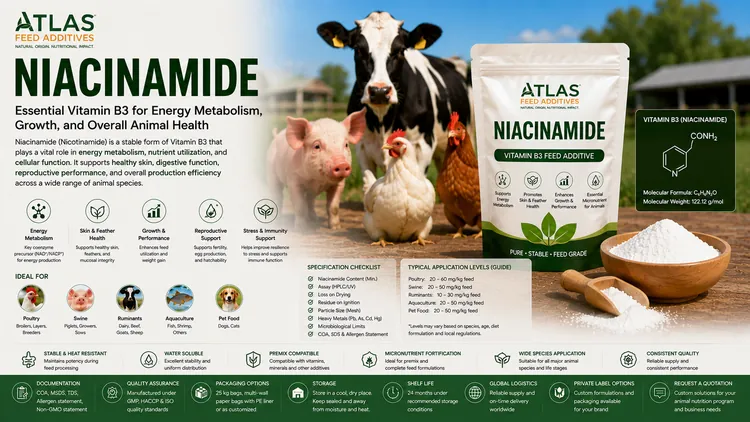
Niacinamide, also known as nicotinamide, is a feed-grade Vitamin B3 source used by premix producers, feed mills, integrators, aquafeed manufacturers, and pet food producers to maintain reliable micronutrient fortification across species, production phases, and feed formats.

Niacinamide feed additive visual

Product role

Where Niacinamide fits

Niacinamide is part of the vitamins and vitamin-like nutrients group. In animal nutrition, it is used as a practical Vitamin B3 source for complete feeds, vitamin-mineral premixes, concentrates, milk replacers, aquafeeds, pet foods, and specialty supplements. It is valued by feed manufacturers because it can be handled as a defined micronutrient ingredient with clear assay, purity, and lot documentation.

Vitamin B3 nutrition is linked with cellular coenzyme systems such as NAD and NADP, which are involved in energy metabolism and many oxidation-reduction reactions. In feed formulation, the actual inclusion rate and fortification strategy depend on species, age, production stage, diet composition, natural vitamin contribution from ingredients, stress level, feed intake, processing loss assumptions, and local regulatory rules.

Atlas Feed Additives can coordinate international supplier options for feed mills, premix producers, vitamin blenders, distributors, poultry integrators, swine producers, ruminant programs, aquafeed manufacturers, pet food companies, and private-label feed additive brands that require consistent feed-grade material, clear documentation, export support, and reliable quotation handling.

Vitamin nutrition role

Why Niacinamide is used in feed programs

Niacinamide is selected when formulators need a consistent and measurable Vitamin B3 source for animal feed. It is commonly used in vitamin premixes because feed manufacturers need predictable micronutrient delivery, stable assay information, and documentation that supports batch release, formulation records, and customer compliance requirements.

In commercial feed production, vitamins are often added with safety margins because raw-material vitamin levels vary and because manufacturing, storage, and feed intake conditions can influence the amount of vitamin ultimately consumed by the animal. Niacinamide sourcing therefore focuses on reliable assay, physical handling, premix compatibility, shelf life, packaging integrity, and documentation rather than product name alone.

Practical value

Procurement-focused benefits

  • Supports Vitamin B3 fortification in complete feeds, concentrates, premixes, and specialty nutrition products.
  • Provides a defined micronutrient source for poultry, swine, ruminant, aquaculture, pet food, horse, and specialty species programs.
  • Can be used in starter feeds, transition feeds, high-performance diets, breeding programs, milk replacers, and functional premixes.
  • Allows buyers to compare suppliers by assay, purity, particle size, flowability, solubility, shelf life, and documentation.
  • Can be requested as a straight ingredient, premix-ready grade, repacked material, or custom vitamin blend component.
  • Can be sourced with COA, SDS, specification, origin information, batch traceability, packaging details, and market-specific certificates.

Typical applications

Species, feed types, and formulation situations

Niacinamide can be used wherever Vitamin B3 fortification is required by the nutrition program. Final suitability depends on the target species, diet design, premix system, desired nutrient contribution, local regulations, and supplier specification.

  • Poultry feeds for broilers, layers, breeders, turkeys, ducks, and specialty poultry programs.
  • Swine diets for piglets, nursery pigs, growers, finishers, sows, and boars.
  • Ruminant feeds, calf starters, milk replacers, dairy concentrates, beef feeds, and mineral-vitamin supplements.
  • Aquafeeds for fish and shrimp where water-stable and extrusion-compatible micronutrient programs are required.
  • Pet food, treats, supplements, powders, tablets, and specialty companion-animal products.
  • Vitamin-mineral premixes, basemixes, concentrates, complete feeds, top-dress products, and liquid nutrition products where suitable.
  • Stress and transition-period nutrition where micronutrient fortification is reviewed carefully.
  • Starter feeds and high-performance diets where consistent intake and nutrient density are important.

Buyer quality checklist

What to confirm before comparing Niacinamide offers

Niacinamide offers should not be compared by price per kilogram alone. Two products can differ by assay, purity, compendial reference, particle size, bulk density, dust level, flowability, solubility, packaging, origin, shelf life, and documentation. Buyers should request a full technical package before comparing suppliers.

Technical specification points

  • Declared product identity: Niacinamide, nicotinamide, Vitamin B3, or nicotinic acid amide.
  • Assay and potency, commonly expressed as percentage of active ingredient.
  • Assay method and reference standard.
  • Purity profile and impurity limits.
  • Compendial or internal specification, such as USP, EP, BP, FCC, feed grade, or supplier standard where applicable.
  • CAS number and chemical identity where required by buyer documentation.
  • Physical form: fine powder, crystalline powder, granule, or premix-ready grade.
  • Particle size distribution, bulk density, flowability, and dusting tendency.
  • Solubility and dispersibility where liquid or specialty applications are planned.
  • Moisture content, loss on drying, residue on ignition, and pH where included in specification.
  • Carrier-free status or carrier declaration when supplied as a blend.
  • Compatibility with vitamins, minerals, choline chloride, trace minerals, enzymes, probiotics, organic acids, flavors, pigments, and medications where permitted.
  • Premix stability and finished-feed stability during storage.
  • Heat stability during conditioning, pelleting, extrusion, drying, or milk-replacer processing where relevant.
  • Contaminant controls, including heavy metals, microbiology, residual solvents, and undesirable substances required by the destination market.
  • Packaging size, liner type, moisture barrier, pallet configuration, and lot traceability.
  • Storage temperature, shelf life, opened-package handling, and warehouse rotation guidance.
  • Destination-market regulatory status, label wording, and permitted nutrient declaration.

Formulation design

How buyers define the right Niacinamide specification

The best Niacinamide specification depends on the target species, premix design, final feed format, manufacturing process, regulatory requirements, and buyer quality system. A poultry premix, swine basemix, calf milk replacer, aquafeed, pet food supplement, and private-label vitamin blend may require different particle size, documentation, packaging, and declaration formats.

  • Define whether the product is needed as straight Niacinamide or as part of a custom vitamin blend.
  • Specify assay requirement and acceptable reference standard.
  • Share whether feed grade, food grade, pharma grade, or compendial material is required.
  • Confirm target species and feed type before finalizing inclusion guidance.
  • Review whether the material will be used in premix, complete feed, milk replacer, aquafeed, pet food, liquid feed, or supplement products.
  • Confirm whether low-dust, granular, high-flow, or special particle-size material is required.
  • Check compatibility with other vitamins and minerals in the buyer's premix system.
  • Confirm label wording, nutrient declaration, and registration requirements in the destination market.

Processing notes

Feed manufacturing factors that affect Niacinamide value

Niacinamide is commonly handled as a dry vitamin ingredient, but practical performance depends on flowability, dust level, particle size, mixing uniformity, moisture control, packaging, and compatibility with other premix components. Product selection should consider the feed mill's dosing system, premix process, storage duration, and final feed format.

  • Confirm whether the product is suitable for premix, complete feed, pellet, crumble, mash, milk replacer, aquafeed, pet food, liquid application, or top-dress use.
  • Check flowability and dusting tendency for automated dosing and worker handling.
  • Review particle size to support uniform distribution in premix and finished feed.
  • Ask whether the product is compatible with vitamins A, D3, E, K3, choline chloride, trace minerals, enzymes, probiotics, and organic acids.
  • Confirm whether hygroscopicity or moisture sensitivity affects storage and blending.
  • Review heat stability if the product will pass through pelleting, extrusion, drying, or milk-replacer processing.
  • Use appropriate sequencing and mixing time to improve homogeneity.
  • Follow supplier guidance for shelf life, opened-package use, and warehouse storage.

Procurement note

Ask for the right specification before comparing prices.

Price comparisons are meaningful only when assay, purity, reference standard, particle size, physical form, packaging, origin, shelf life, storage conditions, and documentation are aligned. For vitamin products, buyers should also review premix compatibility, finished-feed stability, COA details, batch traceability, contaminant limits, and destination-market regulatory requirements.

For export orders, confirm regulatory status, permitted source names, nutrient declaration, label wording, import documents, and required certificates before purchase. Atlas Feed Additives can help organize supplier communication so each quotation is evaluated against the same technical and commercial basis.

Documentation

Documents commonly requested for Niacinamide

Document requirements vary by destination country, buyer type, product grade, final label claim, and whether the product is supplied as straight Niacinamide, a repacked ingredient, a vitamin premix component, or a private-label blend. Buyers should confirm required documents before order confirmation so the supplier can verify availability and lead time.

Quality and technical documents

  • Product specification sheet.
  • Certificate of analysis for the supplied batch.
  • Safety data sheet.
  • Assay declaration and analytical method.
  • Compendial reference or feed-grade specification where applicable.
  • CAS number, chemical identity, and synonym statement where required.
  • Particle size, bulk density, flowability, and dust information where available.
  • Solubility, moisture, loss on drying, pH, and purity information where included in specification.
  • Premix and finished-feed stability information where available.
  • Batch number, production date, retest date, and expiry date.
  • Storage and handling instruction sheet.
  • Product label or draft label for approval.
  • Allergen, GMO, heavy metal, microbiological, residual solvent, dioxin, PCB, or contaminant statements when required by the buyer.
  • Origin statement, manufacturer statement, free sale certificate, or registration-support document where required.
  • Ingredient declaration or composition statement when needed for regulatory or label review.

Trade and shipment documents

  • Commercial invoice and packing list.
  • Certificate of origin, if required.
  • Health certificate, free sale certificate, veterinary certificate, or registration-support documents when applicable.
  • Bill of lading, airway bill, or road transport document depending on shipment mode.
  • Insurance certificate when required by Incoterms.
  • Import registration or buyer-specific declaration forms.
  • Private-label artwork approval and label compliance documents.
  • Halal, kosher, ISO, GMP+, FAMI-QS, HACCP, or other quality certificates when available and required.

Packaging and storage

Handling Niacinamide products correctly

Because vitamin products must remain dry, uniform, traceable, and protected through storage, packaging and handling conditions are important purchasing details. Buyers should confirm the recommended storage temperature, moisture protection, shelf life, and transport requirements before shipment.

  • Keep the product in unopened packaging until it is ready for use.
  • Protect from moisture, direct sunlight, excessive heat, strong odors, and repeated temperature cycling.
  • Store away from incompatible materials when required by the safety data sheet or buyer quality system.
  • Follow the supplier's storage temperature and expiry guidance.
  • Reseal opened packs quickly if partial use is allowed by the supplier.
  • Check whether ambient, cool, or controlled dry storage is recommended.
  • Confirm whether the product is suitable for sea freight, air freight, or road transport.
  • Use appropriate handling precautions to reduce dust exposure when handling fine powders.
  • Review warehouse rotation and first-expiry-first-out control for vitamin ingredients.

Formulation compatibility

Questions for premix and private-label buyers

When Niacinamide is used in a premix, vitamin blend, supplement, or private-label product, buyers should confirm compatibility with all ingredients and processing conditions. Vitamin premix performance can be influenced by moisture, trace minerals, choline chloride, acidity, heat, storage duration, packaging, and ingredient sequencing.

  • Is the Niacinamide compatible with the planned carrier and premix base?
  • Can it be blended with Vitamin A, Vitamin D3, Vitamin E, Vitamin K3, B-vitamins, choline chloride, trace minerals, enzymes, probiotics, acidifiers, or medications where permitted?
  • Will the assay remain stable for the required shelf life?
  • Does the product tolerate the expected feed mill temperature and processing conditions?
  • Is the powder, crystal, or granule suitable for the buyer's dosing system?
  • Are label claims and nutrient declarations approved for the destination market?
  • Does the product need additional moisture protection or separation from reactive premix components?

Quotation request guide

Information to send for a faster Niacinamide offer

Atlas Feed Additives can review supplier options more efficiently when the request includes both technical and commercial details. If you do not yet have a final specification, send the target grade, assay, product form, destination country, and required documents so the team can help identify the missing parameters.

Technical details

  • Required product name: Niacinamide.
  • Accepted synonyms: nicotinamide, Vitamin B3, Vitamin PP, or nicotinic acid amide.
  • Required grade: feed grade, food grade, pharma grade, USP, EP, BP, FCC, or supplier standard.
  • Required assay or potency.
  • Target product form: powder, crystalline powder, granule, low-dust grade, premix-ready grade, or custom blend.
  • Target species: poultry, swine, ruminants, aquaculture, pets, horses, rabbits, or other.
  • Target feed type: complete feed, premix, basemix, concentrate, milk replacer, aquafeed, pet food, supplement, liquid feed, or top-dress product.
  • Required particle size, bulk density, flowability, or dust-control preference.
  • Expected conditioning, pelleting, extrusion, drying, liquid mixing, or storage conditions.
  • Required documents and certificates.
  • Destination-market regulatory or label requirements.

Commercial details

  • Required order quantity or annual forecast.
  • Destination country and delivery address or port.
  • Preferred Incoterms and shipment method.
  • Packaging preference and pallet requirements.
  • Target delivery date or seasonal demand window.
  • Private-label, neutral-label, or Atlas-coordinated supplier-label requirement.
  • Buyer company details for proforma invoice preparation.
  • Sample request details, including sample quantity, target formula, and testing timeline.

Technical buying notes

Important points for feed additive distributors and vitamin buyers

Assay matters

Niacinamide should be compared by active assay and delivered Vitamin B3 contribution. Buyers should request a COA for every lot and confirm whether the assay method and reference standard match their quality system.

Physical form matters

Particle size, dusting, flowability, and bulk density can affect dosing accuracy, premix uniformity, worker handling, and automated feeding systems. These details should be reviewed before ordering large volumes.

Premix compatibility matters

Vitamin premixes often contain reactive minerals, choline chloride, acids, and moisture-sensitive ingredients. Buyers should review compatibility, storage time, packaging, and sequencing with the supplier.

Regulatory wording matters

Destination markets may prefer different names such as Niacinamide, nicotinamide, Vitamin B3, or Vitamin PP. Buyers should confirm the permitted label name, nutrient declaration, and import documents before shipment.

Questions

Useful answers

What is Niacinamide used for in animal nutrition?

Niacinamide is used as a Vitamin B3 source in animal nutrition and premix programs. It helps premix producers and feed mills maintain reliable micronutrient fortification across species and feed formats when used according to target species, formulation objective, and applicable market rules.

Is Niacinamide the same as nicotinamide?

Yes. Niacinamide is commonly used as another name for nicotinamide. It is also associated with Vitamin B3 and Vitamin PP terminology. Buyers should confirm which name is accepted on labels and import documents in the destination market.

Is Niacinamide the same as niacin?

Niacinamide and niacin are related Vitamin B3 forms, but they are not identical product names. Feed buyers should confirm whether the formulation requires niacinamide, nicotinamide, nicotinic acid, or another Vitamin B3 source before requesting a quotation.

Which species can use Niacinamide?

Niacinamide may be used in poultry, swine, ruminant, aquaculture, pet food, horse, rabbit, and specialty species programs when it is included according to the feed formulation, supplier instructions, and local rules.

Can Niacinamide be used in vitamin premixes?

Yes. Niacinamide is commonly evaluated for vitamin-mineral premixes and basemixes. Buyers should confirm assay, particle size, flowability, premix stability, compatibility with other ingredients, and required documentation.

What specification should buyers request?

Buyers should request product identity, assay, purity, grade, reference standard, particle size, bulk density, flowability, solubility, moisture, shelf life, storage conditions, packaging, and required documents.

What quality documents should buyers request for Niacinamide?

Common documents include a specification sheet, certificate of analysis, safety data sheet, assay declaration, batch number, manufacturing date, expiry date, storage instructions, origin information, contaminant statements, and any market-specific certificates required by the buyer.

Can Atlas Feed Additives quote Niacinamide?

Yes. Send your required specification, grade, assay, product form, quantity, destination country, packaging preference, shipment terms, and documents so Atlas Feed Additives can review suitable supplier options for Niacinamide.

What should I include in the message when requesting a price?

Please include the required assay, grade, product form, order quantity, destination country, packaging preference, required documents, target application, and whether the product is for resale, premix production, private label, or direct feed mill use.

Can Niacinamide be supplied under private label?

Private-label availability depends on supplier capability, order quantity, packaging format, label wording, nutrient declaration, artwork approval, and destination-market rules. Atlas Feed Additives can review private-label options when the buyer provides the required label and regulatory details.

Request a quotation

Tell us what you need

Send your product list, target specification, assay requirement, grade, product form, destination country, packaging preference, expected order quantity, Incoterms, regulatory documents, and required certificates. Our team will review your request and respond from orders@feedgradeadditives.com.

Note: Product availability, specification, documents, labels, permitted source names, nutrient declarations, and market claims depend on supplier confirmation and destination-market rules. Information on this page is for B2B sourcing support and does not replace regulatory, nutritionist, or quality-system review.