Feed enzymes

Protease

Protease is a feed enzyme additive selected to support protein breakdown, amino acid release, nutrient digestibility, feed efficiency, and formulation flexibility when the enzyme activity, substrate profile, feed process, and target species are correctly matched.

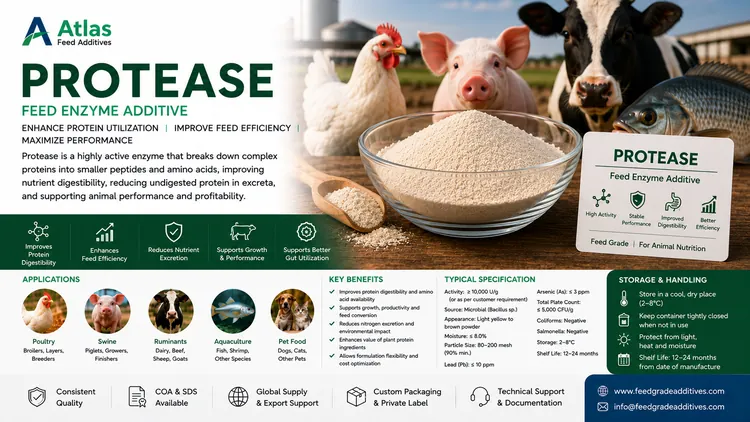
Protease feed additive visual

Product role

Where Protease fits in feed formulation

Protease belongs to the feed enzymes group. It is used in animal nutrition to help hydrolyze dietary proteins into smaller peptides and amino acids, supporting improved nutrient availability and helping nutritionists extract more value from protein-containing raw materials.

Feed proteases are typically evaluated by enzyme activity, activity-unit definition, pH activity profile, thermostability, coating or granulation technology, premix stability, finished-feed stability, source organism, substrate specificity, recommended matrix values, and the technical data supporting each claim.

Atlas Feed Additives can coordinate international supplier options for feed mills, premix producers, integrators, aquafeed producers, pet food manufacturers, distributors, and importers that need feed-grade Protease supported by technical documents, batch-level quality certificates, and export-ready service.

What Protease is designed to support

Protein ingredients can vary in digestibility because of processing history, raw-material quality, anti-nutritional factors, fiber association, heat damage, and species-specific digestive capacity. Protease is used to support the breakdown of proteins that may otherwise be less available to the animal.

  • improved protein and amino acid digestibility when correctly matched to the diet
  • better nutrient release from soybean meal, rapeseed meal, sunflower meal, fishmeal, meat meal, and other protein sources
  • support for feed efficiency and performance-oriented formulation programs
  • potential formulation flexibility when using alternative or variable protein raw materials
  • support for young-animal diets where digestive capacity is still developing
  • reduction of undigested protein flow to the hindgut in selected programs
  • possible support for litter quality, gut comfort, and nitrogen-management strategies depending on formulation and farm conditions

Typical applications

  • corn-soy poultry diets
  • wheat, barley, rye, and mixed-cereal formulations
  • broiler, layer, breeder, turkey, and duck feeds
  • piglet, nursery, grower, finisher, and sow diets
  • young-animal and starter feeds
  • aquaculture feeds with fishmeal, soybean meal, or alternative proteins
  • pet food and specialty companion-animal diets
  • formulas containing high-protein by-products or variable protein meals
  • low-crude-protein or amino-acid-balanced diets where permitted and technically justified
  • multi-enzyme programs with phytase, xylanase, beta-glucanase, amylase, or mannanase

Technical identity

Key specification points for Protease buyers

Protease buyer reference table
Item Typical buyer reference Why it matters
Product group Feed enzyme / zootechnical additive Confirms the product category for formulation, registration, and purchasing records.
Primary enzyme function Hydrolysis of dietary proteins into smaller peptides and amino acids Defines the main nutritional objective and expected substrate target.
Declared activity Supplier-declared enzyme activity units per gram, kilogram, or milliliter Activity declaration is essential for dosing, comparison, and incoming quality approval.
Activity unit definition Supplier-specific analytical definition and assay conditions Protease units are not always directly comparable unless the method and unit definition match.
Enzyme source Bacterial, fungal, or other microbial source depending on supplier specification Source can influence pH profile, heat tolerance, substrate preference, and regulatory review.
pH activity profile Acid, neutral, alkaline, or broad-range activity depending on enzyme design Activity profile should match the target digestive environment and species program.
Thermostability Heat-stable, coated, granulated, liquid post-application, or supplier-specific technology Important when feed is pelleted, conditioned, expanded, or extruded.
Physical form Powder, granule, coated granule, microgranule, liquid, or blend Affects dust level, mixing, segregation, dosing, and worker handling.
Matrix values Supplier-recommended amino acid, crude protein, or energy matrix values where supported Matrix use requires technical confidence, local approval, and nutritionist validation.
Documentation Specification, COA, SDS, technical data sheet, activity declaration, shelf-life statement Supports customs clearance, supplier approval, audits, and traceability.

How Protease works

Protein digestibility and substrate matching

Protease enzymes act on protein substrates by breaking peptide bonds. In feed applications, the commercial objective is to improve the availability of amino acids and peptides from protein-containing ingredients. The practical result depends on diet composition, feed processing, enzyme stability, species, age, health status, inclusion rate, and the supplier’s specific enzyme technology.

A Protease selected for one diet may not perform the same way in another diet. For example, corn-soy diets, wheat-barley diets, high-fiber formulas, fishmeal-based aquafeeds, and formulas using alternative protein meals may require different technical evaluation. Buyers should therefore compare Protease products by activity, pH profile, stability, trial data, and recommended formulation matrix rather than product name alone.

  • match enzyme activity to the protein substrates in the ration
  • confirm whether the product is suitable for the target species and production stage
  • check whether the enzyme is intended for mash, pellet, crumble, extruded, or liquid application
  • review technical data before assigning matrix values in formulation software
  • validate performance under local feed ingredients and processing conditions where possible

Buyer quality checklist

What to verify before approval

Protease products should be compared by enzyme performance and document completeness, not only by price per kilogram. Different products can use different activity units, assay conditions, source organisms, coating technologies, dose recommendations, and matrix assumptions.

  • declared enzyme activity and minimum guaranteed activity
  • activity-unit definition and analytical method
  • source organism and production technology
  • pH activity range and digestive-site relevance
  • temperature tolerance and expected post-pelleting recovery
  • coating, granulation, or encapsulation technology
  • recommended dosage by species and feed type
  • substrate specificity and target raw materials
  • premix stability and finished-feed stability
  • compatibility with minerals, acids, choline chloride, trace elements, and other premix components
  • dust level, flowability, and bulk density
  • carrier type and physical form
  • shelf life, storage temperature, and moisture sensitivity
  • certificate of analysis for each batch or lot
  • market authorization for the intended species and country

Documents

Recommended document package

Atlas Feed Additives can help buyers request the technical and commercial documents commonly required for internal quality approval, import control, customer audits, feed-mill documentation, and distributor registration.

  • product specification sheet
  • certificate of analysis by batch or lot
  • safety data sheet
  • technical data sheet
  • enzyme activity declaration
  • activity-unit definition and assay method
  • recommended dosage and matrix guidance
  • stability data for premix and finished feed, if available
  • heat-stability or post-pelleting recovery information
  • country-of-origin statement
  • manufacturing-site or supplier declaration where required
  • GMO, allergen, BSE/TSE, contaminant, or microbiological statements where relevant
  • Halal, Kosher, ISO, FAMI-QS, GMP+, or other certificates if available and required
  • packing list, commercial invoice, and certificate of origin for export shipments

Formulation and processing

Practical notes for feed mills and premix producers

Activity units must be understood

Protease activity units can differ between suppliers because assay substrates, pH, temperature, reaction time, and analytical definitions may vary. Buyers should avoid direct comparison unless the activity definition is clearly understood.

Matrix values require technical support

Some Protease suppliers provide amino acid, crude protein, or energy matrix recommendations. These values should be reviewed by a qualified nutritionist and validated against species, diet type, processing, and performance expectations.

Pelleting conditions matter

Conditioning temperature, moisture, steam quality, retention time, pressure, and die friction can affect enzyme recovery. Heat-stable or coated products may be required for pelleted or crumbled feed.

Liquid application may be an option

Some enzyme programs use liquid post-pellet application to reduce heat exposure. Buyers should verify dosing equipment, spray uniformity, liquid stability, microbial control, and application accuracy.

Premix compatibility should be checked

Protease can be sensitive to humidity, acids, oxidizing agents, trace minerals, choline chloride, and long premix storage. Confirm compatibility when the enzyme will be included in concentrated premixes.

Worker handling and dust control

Enzyme powders and dust can be sensitizing. Buyers should follow the safety data sheet, use suitable personal protective equipment, and choose low-dust granulated or coated forms when needed.

Species and diet positioning

Where Protease may be used

Typical Protease positioning by feed program
Program Typical objective Buyer considerations
Broiler feeds Support protein digestibility, amino acid availability, and feed conversion Check matrix values, pelleting stability, dose rate, and compatibility with phytase or NSP enzymes.
Layer and breeder feeds Support nutrient utilization and formulation consistency Review long-term feed stability, mineral-vitamin premix compatibility, and species authorization.
Piglet and nursery diets Support digestibility in young animals with developing digestive capacity Check acid pH activity, protein source compatibility, palatability, and finished-feed stability.
Grower-finisher swine Support feed efficiency and formulation-cost optimization Review amino acid matrix, ingredient variation, and processing conditions.
Aquaculture feeds Support digestion of fishmeal, soybean meal, and alternative protein meals Extrusion stability, water stability, species biology, and feed format are important.
Pet food Support digestibility and ingredient flexibility in specialty diets Check regulatory status, extrusion conditions, claims, palatability, and label requirements.
Multi-enzyme programs Combine Protease with phytase, xylanase, beta-glucanase, amylase, or mannanase Confirm compatibility, additive or complementary effects, and supplier technical guidance.

Procurement note

Ask for the right specification before comparing prices.

Price comparisons are meaningful only when enzyme activity, activity-unit definition, source organism, dosage rate, heat stability, coating technology, matrix recommendation, physical form, packaging, shelf life, and documentation are aligned. A lower price per kilogram may not be economical if the product has a lower activity, weaker stability, unsuitable pH profile, or unclear technical support.

For Protease, the most important commercial question is often not “What is the price per kilogram?” but “What is the cost per effective enzyme activity at the recommended dose under my feed-processing conditions?” Atlas Feed Additives helps buyers frame quotation requests so offers can be compared more accurately.

Quote request details to send

  • product name and target enzyme type
  • required declared activity and unit definition, if known
  • target species and production stage
  • feed type: mash, pellet, crumble, extruded, or liquid application
  • main raw materials and protein sources
  • required dosage or supplier matrix target
  • required quantity and order frequency
  • destination country, port, or delivery address
  • preferred Incoterm
  • packaging requirement
  • required certificates and declarations
  • target shipment date
  • approved or restricted origins

Commercial comparison

How to compare Protease offers

Commercial and technical comparison points
Comparison point Ask the supplier Reason for review
Activity level What is the guaranteed Protease activity per gram or kilogram? Allows calculation of active enzyme cost and dose efficiency.
Unit definition How is one unit of activity defined and under what assay conditions? Prevents misleading comparisons between different analytical methods.
pH profile At which pH range does the enzyme show useful activity? Helps determine suitability for poultry, swine, aquaculture, or pet food digestive conditions.
Heat stability What activity remains after pelleting or processing? Critical for pelleted, crumbled, expanded, or extruded feed.
Physical form Is the product powder, granule, coated granule, or liquid? Influences dust, handling, mixing, application method, and worker safety.
Matrix values What nutrient matrix values are recommended and what data supports them? Important for formulation savings and technical confidence.
Stability How stable is the enzyme in premix and finished feed? Supports inventory planning and quality assurance.
Documents Which documents are available before shipment? Reduces delays in approval, customs, audits, and customer registration.
Lead time Is the product available from stock or produced to order? Helps feed mills avoid production interruptions.
Packaging What bag, drum, carton, pallet, or liquid container options are available? Affects transport protection, warehouse handling, and moisture control.

Packaging and logistics

Storage and shipment considerations

Protease products are biological enzyme preparations and should be protected from excessive heat, moisture, contamination, direct sunlight, and damaged packaging. Storage and shipping conditions should follow the supplier’s safety data sheet and technical specification.

  • sealed bags, drums, cartons, or containers suitable for enzyme stability
  • moisture-resistant packaging where required
  • clear product, batch, net weight, manufacturing date, and expiry labeling
  • palletized export packaging for international shipments
  • temperature and humidity guidance during warehousing
  • first-expired, first-out inventory rotation
  • lot traceability from receipt to premix or feed production
  • protection from strong odors, incompatible chemicals, and contamination

Who buys this product?

Suitable buyer profiles

  • poultry feed mills
  • swine feed manufacturers
  • aquafeed producers
  • pet food manufacturers
  • premix and concentrate producers
  • feed additive distributors
  • integrators managing nutrition programs
  • importers building enzyme portfolios
  • technical buyers comparing feed-efficiency additives
  • nutrition companies developing multi-enzyme programs

Program positioning

Where Protease may add value

Protein-cost management

Protease may support formulation programs that aim to make better use of protein ingredients and reduce dependency on high-cost protein sources when validated by nutritionists and supported by data.

Young-animal nutrition

Young animals may have less mature digestive capacity. Protease can be evaluated in starter and nursery diets where digestibility, gut comfort, and nutrient availability are important.

Alternative raw materials

Ingredient flexibility can be valuable when raw-material prices shift. Protease may help nutritionists use alternative protein meals more confidently when the product matches the substrate profile.

Low-crude-protein concepts

In some programs, Protease is evaluated with amino acid balancing and careful formulation to support nutrient efficiency. These programs require technical validation and market compliance checks.

Multi-enzyme strategies

Protease can be combined with phytase or NSP enzymes when the formulation objective includes protein, phosphorus, energy, fiber, or overall nutrient-release support.

Sustainability-focused feeding

Improved nutrient utilization may contribute to nitrogen-management and resource-efficiency goals, depending on diet design, farm conditions, performance response, and regulatory framework.

Why Atlas Feed Additives?

Support beyond a price quote

Atlas Feed Additives helps buyers approach Protease sourcing with a technical and commercial checklist. This is especially important because feed enzymes can vary widely in activity units, production technology, heat stability, dosage guidance, matrix values, and documentation standards.

  • supplier option review based on target specification
  • quotation coordination for spot or recurring demand
  • support for enzyme activity and document comparison
  • packaging, lead time, and logistics coordination
  • support for feed mills, premixers, distributors, and integrators
  • export-focused communication from Ankara, Turkey
  • clear communication in English and Turkish

Important disclaimer

Use according to local rules and professional formulation

Protease should be used according to the target species, supplier instructions, feed process, qualified nutritionist guidance, customer formulation standards, and applicable market rules. Atlas Feed Additives does not replace veterinary, regulatory, or nutritionist advice.

Enzyme authorization, label claims, species approvals, activity declarations, inclusion rates, and import requirements can vary by country. Buyers should confirm compliance before ordering, importing, labeling, selling, or using the product in commercial feed.

Questions

Useful answers about Protease

What is Protease used for in animal nutrition?

Protease is used as a feed enzyme to help break down dietary proteins and improve nutrient release. It is commonly considered for poultry, swine, aquaculture, pet food, and other feed programs where protein digestibility, feed efficiency, amino acid utilization, or formulation flexibility is important.

How does Protease work?

Protease enzymes hydrolyze peptide bonds in proteins, helping convert larger protein structures into smaller peptides and amino acids. The practical benefit depends on enzyme type, diet composition, species, age, feed processing, inclusion rate, and the supplier’s specific technology.

Which species can use Protease?

Protease may be used in poultry, swine, aquaculture, pet food, and other species where the product is authorized and nutritionally justified. Final use should be confirmed by a qualified nutritionist and the buyer’s regulatory team.

Is Protease useful in corn-soy diets?

Protease is often evaluated in corn-soy diets because soybean meal and other protein ingredients can contain protein fractions that vary in digestibility. Buyers should review supplier data and matrix values for the specific diet and species.

Can Protease be used with phytase or xylanase?

Yes. Protease may be used in multi-enzyme programs with phytase, xylanase, beta-glucanase, amylase, mannanase, or other enzymes. Compatibility, dose rate, and expected matrix contribution should be checked before formulation.

Why are Protease activity units important?

Activity units define how enzyme strength is measured. Because suppliers may use different substrates, pH conditions, temperatures, reaction times, and analytical methods, activity values are not always directly comparable unless the unit definition is understood.

Is heat stability important for Protease?

Yes. Pelleting, conditioning, expansion, extrusion, and long storage can affect enzyme activity. Buyers should request heat-stability data, coating information, and expected post-processing recovery when Protease will be used in processed feed.

What quality documents should buyers request?

Common documents include product specification, certificate of analysis, safety data sheet, technical data sheet, activity-unit definition, enzyme activity declaration, origin statement, shelf-life declaration, batch information, and any market-specific certificates required by the buyer.

How should Protease be stored?

Store Protease in sealed original packaging in a cool, dry, well-ventilated area. Protect it from moisture, excessive heat, direct sunlight, strong odors, contamination, and damaged packaging. Always follow the supplier’s SDS and storage instructions.

Can Atlas Feed Additives quote Protease?

Yes. Send your required enzyme activity, target species, feed type, quantity, destination, packaging preference, required documents, preferred Incoterm, and shipment timing so Atlas Feed Additives can review suitable supplier options.

Can Atlas quote related feed enzymes?

Yes. Atlas Feed Additives can review requests for related enzymes such as phytase, xylanase, beta-glucanase, beta-mannanase, amylase, cellulase, alpha-galactosidase, and multi-enzyme complexes depending on availability and target specification.

Request a quotation

Tell us what you need

Send your product list, required enzyme activity, target species, feed process, destination country, packaging preference, annual or spot quantity, delivery term, required documents, and target shipment date. Our team will review your request and respond from orders@feedgradeadditives.com.