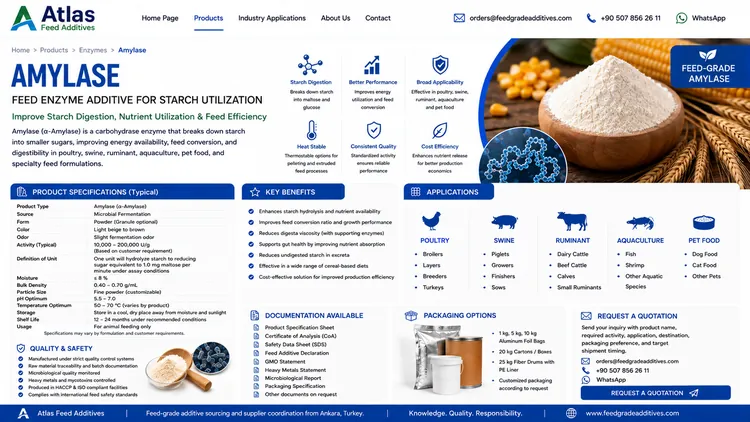
| Product identity |
Trade name, technical name, enzyme class, alpha-amylase confirmation where relevant, enzyme source, feed-grade status, functional group, intended species, and intended use. |
Confirms that the offered product matches the buyer’s feed enzyme program and regulatory classification. |
| Declared activity |
Activity units per gram or kilogram, unit definition, minimum guaranteed activity, activity at expiry where available, and analytical method. |
Amylase products should be compared by active units and expected recovery, not by product name or price per kilogram alone. |
| Assay method |
Substrate used in the assay, pH, temperature, incubation time, unit definition, and whether the method is supplier-specific or standardized. |
Activity values are not always directly comparable if different test methods or unit definitions are used. |
| Enzyme source |
Microbial source, production strain information where available, fermentation origin, purification level, and regulatory status. |
Source can influence activity profile, thermostability, safety documentation, and market authorization. |
| pH activity profile |
Optimum pH, active pH range, species-relevant digestive pH, and activity retention across expected gut conditions. |
Practical performance depends on whether the enzyme remains active under the target animal’s digestive conditions. |
| Temperature profile |
Optimum temperature, heat tolerance, conditioning temperature tolerance, pelleting recovery, extrusion recovery, drying tolerance, and storage temperature guidance. |
Feed processing can reduce activity if the product is not protected or applied at the correct process point. |
| Coating technology |
Coated or uncoated form, granulation technology, protective matrix, release behavior, dusting tendency, and post-process recovery data. |
Coating can improve handling and heat stability, but release and activity must still match the target application. |
| Physical form |
Powder, granule, coated granule, liquid, carrier-based premix, particle size, bulk density, flowability, and dusting tendency. |
Affects mixing uniformity, worker handling, dosing accuracy, segregation risk, and compatibility with premixes. |
| Carrier system |
Mineral carrier, organic carrier, starch carrier, fermentation carrier, coating carrier, liquid stabilizer, or customer-specific carrier declaration. |
Carrier type may influence flow, stability, dusting, moisture sensitivity, inclusion flexibility, and premix compatibility. |
| Substrate target |
Starch source, cereal type, gelatinization status, particle size, raw-material processing history, and diet matrix information. |
Enzyme value depends on substrate availability and how well the enzyme fits the feed matrix. |
| Dose guidance |
Recommended inclusion level, species-specific guidance, matrix values where available, application point, and maximum use guidance where relevant. |
Correct dosage depends on active concentration, diet type, feed process, and target outcome. |
| Premix stability |
Stability in vitamin-mineral premixes, trace mineral compatibility, moisture limits, storage time, and carrier interactions. |
Enzyme activity may decline in aggressive premix environments if compatibility is not reviewed. |
| Finished feed stability |
Activity retention after pelleting, extrusion, storage, transport, and shelf-life testing in finished feed. |
Buyers need to know how much activity remains at the point of animal consumption. |
| Microbiological quality |
Total plate count, yeast and mold, Salmonella status, Enterobacteriaceae limits, and other relevant microbiological parameters. |
Supports feed safety and buyer quality programs, especially for imported additives and premix applications. |
| Contaminants |
Heavy metals, mycotoxins, dioxins or PCBs where relevant, pesticide residues where relevant, solvent residues where relevant, and unwanted impurities. |
Supports feed safety, export compliance, customer approval, and internal quality programs. |
| Stability |
Shelf-life, expiry date, retest date, storage temperature, humidity limits, moisture protection, activity retention, and opened-pack handling. |
Helps buyers protect enzyme activity during shipping, warehousing, and production use. |
| Packaging |
Net weight, bag, foil liner, drum, carton, pallet configuration, container loading estimate, label language, and batch coding. |
Affects logistics, warehouse control, moisture protection, handling safety, and traceability. |
| Documents |
Technical data sheet, product specification, COA, SDS, origin statement, batch details, GMO or non-GMO statement where relevant, allergen statement where relevant, and market-specific certificates. |
Allows importers and feed manufacturers to confirm quality and compliance before purchase and shipment. |