Feed enzymes

Beta-Mannanase

Beta-Mannanase is a feed enzyme selected to improve nutrient release, feed efficiency, gut performance, and formulation flexibility in diets containing beta-mannan, galactomannan, glucomannan, and other mannan-rich plant ingredients.

  • Designed for formulas containing soybean meal, palm kernel meal, copra meal, guar meal, sesame meal, and other mannan-containing raw materials
  • Useful in poultry, swine, aquaculture, premix, and specialty feed programs when substrate level and enzyme activity are aligned
  • Specification review available for declared activity units, carrier, coating, pelleting stability, premix stability, and finished-feed stability
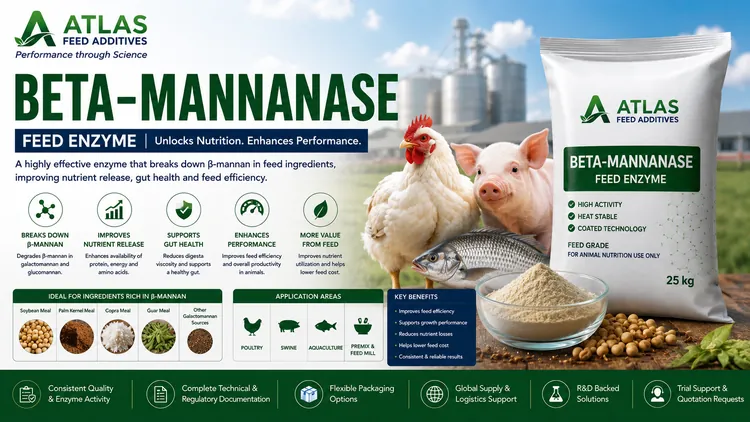
Beta-Mannanase feed additive visual

Product role

Where Beta-Mannanase fits in feed formulation

Beta-Mannanase is part of the feed enzymes group and is used to target beta-mannan and related mannan-containing non-starch polysaccharides in feed raw materials. These substrates are found at different levels in soybean meal, palm kernel meal, copra meal, guar meal, sesame meal, legume meals, and some plant-protein by-products. When the substrate is present and the enzyme is correctly selected, Beta-Mannanase can help break down viscous or poorly digestible cell-wall components and support more efficient nutrient use.

In practical feed formulation, Beta-Mannanase is not evaluated only by price per kilogram. Buyers should compare declared activity units, analytical method, activity at intestinal pH, substrate specificity, heat stability, coating or granulation technology, premix stability, finished-feed stability, carrier system, dust level, particle size, dosage recommendation, and supplier matrix values.

Atlas Feed Additives can coordinate international supplier options for feed mills, premix producers, poultry and swine integrators, aquafeed manufacturers, distributors, and regional importers that need consistent feed-grade enzyme products with suitable technical and commercial documentation.

Functional purpose

Why formulators use Beta-Mannanase

  • Substrate breakdown: targets beta-mannan, galactomannan, glucomannan, and related mannans in plant-based feed ingredients.
  • Nutrient-release support: helps reduce the nutritional barrier created by selected non-starch polysaccharides so energy, protein, and other nutrients can be used more efficiently.
  • Feed-efficiency support: may contribute to improved feed conversion when the enzyme is matched to the diet substrate and animal production stage.
  • Gut-performance support: reducing poorly digestible mannan fractions may help support intestinal function and more consistent nutrient flow.
  • Formulation flexibility: can help nutritionists review higher inclusion of cost-effective ingredients such as soybean meal, palm kernel meal, copra meal, or guar-related materials.
  • Young-animal support: relevant in starter and nursery programs where digestive capacity is still developing and anti-nutritional substrate effects can be more noticeable.

Buying focus

Key points before comparing offers

  • Confirm the declared enzyme activity unit and the analytical method used to measure it.
  • Check whether the product is powder, granule, coated granule, liquid, or part of a multi-enzyme blend.
  • Compare recommended dosage per metric ton of complete feed, not only price per kilogram.
  • Ask for heat-stability data if the product will be pelleted, expanded, or extruded.
  • Confirm stability in premix and finished feed under expected storage conditions.
  • Review matrix-value guidance carefully and validate it with your nutritionist before reformulation.

Technical overview

Substrate fit is the key to Beta-Mannanase value

Feed enzymes deliver value only when the correct enzyme is matched to the correct substrate under suitable processing and digestive conditions. Beta-Mannanase is most relevant when the formula contains beta-mannan or related mannan structures. In practical diets, the substrate source may come from soybean meal, palm kernel meal, copra meal, guar meal, guar by-products, sesame meal, certain legume meals, or other plant ingredients.

The enzyme works by hydrolyzing mannan structures into shorter fragments, which can reduce the anti-nutritional effect of the substrate and support nutrient accessibility. However, performance depends on the enzyme strain or source, activity profile, pH range, temperature tolerance, physical form, coating technology, dosage, feed process, and animal species.

Atlas Feed Additives can help buyers request comparable supplier data so that offers are evaluated according to activity, stability, dosage, substrate fit, and documentation rather than only product name.

Typical applications

Application areas in animal nutrition

Poultry feed

In broiler, layer, breeder, and turkey diets, Beta-Mannanase may be evaluated when formulas contain soybean meal, palm kernel meal, guar meal, sesame meal, or other mannan-containing ingredients. It is often considered in programs focused on feed conversion, nutrient release, litter quality, gut performance, and formulation cost control.

  • Broiler starter, grower, and finisher diets
  • Layer and breeder diets with soybean meal or alternative plant proteins
  • Programs where feed conversion and nutrient digestibility are closely monitored
  • Enzyme systems combined with xylanase, phytase, protease, or beta-glucanase

Swine feed

In pig nutrition, Beta-Mannanase may be reviewed for nursery, grower-finisher, and sow formulas that include soybean meal, palm kernel meal, copra meal, guar-related ingredients, or other plant-based raw materials. It may be especially relevant where diet viscosity, fiber complexity, gut development, feed conversion, and raw-material flexibility are important.

  • Nursery diets where digestive development and feed intake are critical
  • Grower-finisher diets using economical plant-protein sources
  • Sow diets where fiber structure and nutrient availability are formulation topics
  • Programs combining mannanase with xylanase, phytase, protease, or organic-acid strategies

Aquaculture feed

In fish and shrimp feeds, Beta-Mannanase may be considered when plant-protein replacement introduces mannan-rich or non-starch polysaccharide fractions. Aquafeed use should be reviewed carefully because extrusion temperature, water stability, pellet durability, feed size, and species-specific digestion can all influence final performance.

  • Tilapia, carp, catfish, trout, seabass, seabream, shrimp, and specialty aquafeed programs
  • Low-fishmeal formulas using soybean meal, guar meal, or other plant proteins
  • Feeds where digestibility, feed conversion, and gut condition are priority metrics
  • Extruded and pelleted feeds requiring heat-stability and water-stability review

Ruminant feed

In ruminant programs, enzyme use depends strongly on ration type, forage level, concentrate level, rumen conditions, enzyme stability, and the intended technical objective. Beta-Mannanase may be reviewed in selected dairy, beef, sheep, and goat formulas where mannan-containing ingredients are used and where the product is suitable for the process and market rules.

  • Dairy and beef feed concepts containing mannan-rich by-products
  • Specialty premixes or concentrates requiring enzyme-stability review
  • Programs where technical support and supplier guidance are available

Pet food and specialty feed

Pet food and specialty feed formulas often contain plant proteins, fiber sources, and functional ingredients. Beta-Mannanase may be considered where substrate fit, processing tolerance, label suitability, and final product stability are confirmed.

  • Dry pet food and functional treat formulas
  • Specialty feeds using soybean meal, guar-related materials, or legume ingredients
  • Products requiring careful enzyme stability and labeling review

Premix and multi-enzyme systems

Premix producers may use Beta-Mannanase as a single enzyme or as part of a tailored enzyme blend. In premix applications, the main concerns are enzyme activity recovery, premix carrier compatibility, mineral interaction, moisture exposure, storage stability, dust control, and uniform distribution in the final feed.

  • Single-enzyme premixes
  • Multi-enzyme blends with xylanase, beta-glucanase, cellulase, protease, amylase, or phytase
  • Vitamin-mineral premixes requiring verified enzyme compatibility
  • Distributor products requiring consistent activity and shelf-life

Substrate review

Ingredients where Beta-Mannanase is commonly considered

Before selecting a mannanase product, buyers should review the formula’s mannan substrate level. The presence of soybean meal alone does not automatically guarantee the best economic response; total inclusion level, ingredient quality, processing history, soluble and insoluble NSP profile, animal age, diet phase, and feed process all matter.

  • Soybean meal: common in poultry and swine diets and often part of mannanase evaluation.
  • Palm kernel meal: a high-fiber by-product where mannanase may be relevant depending on inclusion rate and species.
  • Copra meal: may contain mannan-rich fiber fractions and requires careful digestibility review.
  • Guar meal and guar by-products: can contain galactomannan fractions that affect viscosity and feed performance.
  • Sesame meal and legume meals: may contribute NSP complexity depending on processing and origin.
  • Plant-protein blends: substrate contribution may be distributed across several ingredients, making diet-level review important.

Evaluation questions

What nutritionists should confirm

  • Which ingredients supply the main mannan or galactomannan substrate?
  • Is the target animal young, stressed, high-performing, or digestively sensitive?
  • Will the enzyme be used for performance improvement, raw-material flexibility, or matrix-value reformulation?
  • Is the selected activity unit comparable across suppliers?
  • Does the supplier provide recommended dosage and matrix values for the target species?
  • Has the product been tested under similar pelleting, storage, and feeding conditions?

Specification guidance

Typical feed-grade specification items

The values below are procurement guidance points, not a universal specification. Exact limits vary by enzyme source, fermentation process, concentration, carrier, coating technology, activity method, and supplier. Buyers should always confirm the latest supplier specification and certificate of analysis before purchase.

Common specification review table

Parameter Typical buyer question Why it matters
Product identity Is the product Beta-Mannanase, a multi-enzyme blend, or a coated enzyme preparation? Prevents confusion between single enzymes and blended products with different activity profiles.
Declared activity What activity unit is declared per gram or per kilogram? Core value for dosage, comparison, and cost calculation.
Activity method Which substrate, pH, temperature, and analytical method are used? Activity units are not always directly comparable between suppliers.
Enzyme source What microbial source or production strain is used, when disclosed? Can affect activity profile, pH tolerance, heat tolerance, and regulatory review.
pH activity profile What activity is retained under gastric and intestinal pH conditions? Important because enzyme action must match the digestive environment.
Temperature profile What temperature range supports activity and what happens during pelleting? Heat exposure can reduce enzyme activity if protection is insufficient.
Heat stability Is the product uncoated, granulated, coated, or thermostable? Important for pelleted, expanded, or extruded feeds.
Carrier system What carrier, coating, or granulation material is used? Affects handling, compatibility, dosage, label review, and feed processing.
Appearance Powder, granule, coated granule, or liquid? Impacts mixing, dust level, segregation risk, and dosing method.
Particle size Is the particle-size distribution suitable for premix and feed production? Supports uniform distribution and reduces segregation.
Moisture / loss on drying What is the moisture limit? Influences shelf-life, flowability, caking risk, and enzyme stability.
Dust level Is the product low-dust or granulated? Important for worker handling and uniform application.
Premix stability How stable is the enzyme in vitamin-mineral premix? Minerals, moisture, and storage conditions can affect enzyme activity over time.
Finished-feed stability What activity recovery remains after storage in complete feed? Important for distributor supply chains and long storage periods.
Heavy metals Are lead, arsenic, cadmium, and mercury controlled? Required for feed safety, import clearance, and customer quality programs.
Microbiological status Are total plate count, yeast, mold, Salmonella, and other parameters declared? Important for feed-safety systems and export documentation.
Packaging Is the product supplied in bags, cartons, drums, foil packs, or liquid containers? Impacts storage, moisture protection, handling, and shipment planning.
Shelf-life What is the expiry or retest period under recommended storage? Needed for stock planning, distributor resale, and quality control.
Country of origin Where is the product manufactured? Often required for import clearance, customer approval, and traceability.

Processing compatibility

Pelleting, extrusion, coating, and premix use

Feed enzymes are sensitive biological products, and their final value depends on activity recovery after manufacturing and storage. Beta-Mannanase should be selected according to the feed mill process, conditioning temperature, steam quality, residence time, pellet diameter, cooling efficiency, storage conditions, and final feed destination.

  • Powder enzymes: may be suitable for mash feed, premixes, or low-temperature processes when dust and stability are controlled.
  • Granulated enzymes: may improve handling and distribution in feed production.
  • Coated enzymes: may provide better protection during pelleting or storage, depending on technology and process severity.
  • Liquid enzymes: may be applied post-pellet or by spray systems, but require dosing equipment, storage control, and application validation.
  • Multi-enzyme blends: require compatibility review because each enzyme may have different stability and activity behavior.

Factory questions

Questions to ask before purchase

  • What activity recovery remains after pelleting at the buyer’s target temperature?
  • Is the enzyme added before pelleting, after cooling, or through liquid application?
  • Does the product tolerate the buyer’s conditioning time, steam pressure, and moisture level?
  • Will minerals, organic acids, choline chloride, or other premix components reduce activity during storage?
  • Does the supplier provide activity recovery data in premix and complete feed?
  • Can the product be tested in the buyer’s finished feed to confirm recovered activity?

Matrix values

Use matrix values carefully and validate them in the target diet

Some Beta-Mannanase suppliers provide nutrient or energy matrix values that allow nutritionists to reformulate diets based on expected enzyme contribution. These values should not be copied blindly between products, species, or raw-material programs. A matrix value depends on enzyme activity, substrate level, species, diet phase, ingredient quality, processing conditions, and the supplier’s validation data.

Performance approach

The enzyme is added on top of the formula without removing nutrient value. This approach is often used in trials to observe potential improvements in feed conversion, weight gain, uniformity, gut condition, or production performance.

Reformulation approach

The nutritionist applies a supplier-supported matrix value to reduce selected nutrient or energy safety margins. This approach requires technical confidence, formulation control, and performance monitoring.

Raw-material flexibility approach

The enzyme is used to support inclusion of economical mannan-containing ingredients. This approach should be based on substrate mapping, raw-material variability, process tolerance, and animal response.

Combination-enzyme approach

Beta-Mannanase may be paired with xylanase, beta-glucanase, protease, amylase, phytase, cellulase, or alpha-galactosidase. Overlapping matrix values must be checked to avoid double-counting nutrient release.

Procurement note

Ask for the right enzyme specification before comparing prices.

Price comparisons are meaningful only when activity units, activity method, dosage, carrier, coating technology, heat stability, premix stability, finished-feed stability, packaging, origin, and documentation are aligned. A low price per kilogram can be misleading if the product requires a higher inclusion rate, has weaker heat recovery, has poor premix stability, or does not provide suitable technical documentation.

For enzyme products, the most useful commercial comparison is often cost per metric ton of complete feed at the recommended dose, supported by recovered activity and performance data in the target process. Atlas Feed Additives can help buyers collect supplier specifications and review offers on a more comparable basis.

Quality assurance

Documents buyers should request

Documentation requirements vary by buyer, country, species, feed process, and import procedure. Atlas Feed Additives can help collect and review supplier documentation before confirming an order.

Core commercial and quality documents

  • Product specification sheet
  • Certificate of analysis for the offered batch or representative lot
  • Declared enzyme activity unit and analytical method
  • Safety data sheet
  • Commercial invoice and packing list
  • Certificate of origin or origin declaration when required
  • Batch number, manufacturing date, expiry date, or retest date

Technical support documents

  • Recommended inclusion rate by species and feed type
  • Heat-stability or pelleting-recovery data
  • Premix stability and finished-feed stability data
  • pH activity profile and temperature activity profile, if available
  • Matrix-value guidance and validation background, if offered
  • Compatibility notes for vitamins, minerals, organic acids, choline chloride, and other feed additives

Feed-safety and compliance documents

  • Heavy-metal declaration
  • Microbiological declaration
  • GMO status statement when required
  • Allergen statement when required
  • Animal-origin-free, BSE/TSE, or animal-origin declaration where applicable
  • Halal, Kosher, ISO, GMP+, FAMI-QS, HACCP, or other certificates when available and relevant
  • Market-specific documents for feed registration or import clearance

Traceability and supplier qualification

  • Manufacturer name and site information when disclosed
  • Country of origin
  • Lot number and production date
  • Retained-sample policy, if available
  • Change-control statement for recurring supply programs
  • Distributor authorization or supply-chain confirmation when required

Storage and handling

Protect enzyme activity from heat, moisture, and time

Beta-Mannanase should be stored according to the supplier’s instructions. Enzymes can lose activity if exposed to excessive heat, moisture, humidity, direct sunlight, incompatible chemicals, or long storage beyond the recommended shelf-life. Practical warehouse control is especially important for distributors and feed mills that store enzymes before premix or finished-feed production.

  • Store in a cool, dry, well-ventilated warehouse.
  • Keep bags, cartons, drums, or containers sealed until use.
  • Protect from moisture, rain, condensation, and direct floor contact.
  • Keep away from direct sunlight, strong odors, acids, oxidizing agents, and incompatible materials.
  • Avoid storing enzyme products near hot walls, boilers, or steam lines.
  • Apply first-in, first-out stock rotation.
  • Do not use damaged, wet, caked, overheated, or contaminated packages without quality review.

Packaging and logistics

Plan packaging around shelf-life and handling

Packaging, palletization, container loading, label language, and document preparation should be confirmed before shipment. Enzyme products may require extra attention to storage temperature, moisture protection, and long transit times. Export buyers should also check whether their importing country requires feed registration, special labeling, veterinary clearance, or additional certificates.

  • Common packaging may include 20 kg or 25 kg bags, cartons, drums, foil packs, or liquid containers depending on supplier.
  • Moisture-protective liners or sealed packaging may be important for activity retention.
  • Palletized or non-palletized loading should be agreed before quotation.
  • Container loading quantity depends on packaging, pallet use, temperature exposure, and local road or port limits.
  • Buyers should confirm HS code, import permits, feed registration, and enzyme-specific label requirements with local authorities.

Supplier qualification

How Atlas Feed Additives supports Beta-Mannanase buyers

1. Requirement review

We review your target species, feed process, enzyme activity requirement, substrate profile, inclusion objective, destination country, packaging preference, delivery terms, and documentation requirements before matching supplier options.

2. Specification alignment

We help align offers so that activity units, dosage, activity method, heat stability, coating technology, premix stability, finished-feed stability, packaging, origin, and quality documents can be compared clearly.

3. Quotation coordination

We coordinate price, lead time, payment terms, shipment terms, packaging, palletization, document availability, sample availability, and market-specific requirements before order confirmation.

4. Export-focused follow-up

We support buyers with practical export communication, document tracking, shipment coordination, and recurring-supply planning from inquiry stage through commercial execution.

Trial planning

Suggested evaluation approach

Before moving to large-scale use, buyers may run a controlled feed trial in the target species and production system. The goal is to confirm practical response in the real feed matrix, not only in an ingredient specification or supplier brochure.

  • Map the main mannan-containing ingredients in the formula.
  • Set a control diet and one or more test diets with the selected enzyme dose.
  • Keep energy, protein, amino acids, minerals, and other enzymes consistent where possible.
  • Monitor feed intake, feed conversion, growth, body weight uniformity, manure or litter quality, gut observations, and survival.
  • Record pelleting temperature, feed form, storage time, ingredient batch, and recovered enzyme activity if available.
  • Evaluate cost per ton of complete feed together with biological results and feed-mill practicality.

Buyer checklist

Information to send for a faster quotation

  • Product name: Beta-Mannanase
  • Required activity unit and preferred activity level
  • Target species and feed phase
  • Main feed ingredients and expected mannan-containing raw materials
  • Feed process: mash, pellet, crumble, extruded feed, premix, liquid application, or post-pellet coating
  • Conditioning or pelleting temperature, if relevant
  • Monthly, trial, or spot quantity requirement
  • Destination country and delivery port or address
  • Preferred Incoterms, such as EXW, FOB, CFR, CIF, or DAP
  • Packaging preference and pallet requirement
  • Required certificates, declarations, or registration support

Commercial comparison

How to compare competing Beta-Mannanase offers

  • Compare cost per ton of finished feed: calculate cost at the supplier’s recommended dose, not only cost per kilogram of product.
  • Check activity-unit method: two products with similar numbers may not be equivalent if the analytical method differs.
  • Review heat recovery: a cheaper product may become expensive if activity is lost during pelleting or extrusion.
  • Check substrate relevance: mannanase value depends on the level and type of mannan substrate in the formula.
  • Review matrix values carefully: avoid double-counting nutrient release when using multiple enzymes.
  • Validate stability: ask for premix and finished-feed stability data for your storage conditions.
  • Review documentation: ensure COA, SDS, origin, traceability, and certificates are acceptable for your market.
  • Evaluate supplier consistency: recurring supply programs need stable activity, batch traceability, and reliable document flow.

Questions

Useful answers about Beta-Mannanase

What is Beta-Mannanase used for in animal nutrition?

Beta-Mannanase is used to hydrolyze beta-mannan and related mannan-containing non-starch polysaccharides in feed ingredients. It is selected to support nutrient release, feed efficiency, gut performance, and formulation flexibility when the target substrate is present and the enzyme is suitable for the species, process, and dosage program.

Which ingredients make Beta-Mannanase most relevant?

It is often reviewed in formulas containing soybean meal, palm kernel meal, copra meal, guar meal, guar by-products, sesame meal, legume meals, and other plant-based raw materials that may contain mannan, galactomannan, or glucomannan fractions.

Can Beta-Mannanase be used in poultry feed?

Yes. It may be evaluated in broiler, layer, breeder, and turkey diets, especially where soybean meal, alternative plant proteins, or mannan-containing ingredients are included. Suitability depends on formulation, enzyme activity, processing conditions, and the nutritionist’s objective.

Can Beta-Mannanase be used in swine feed?

Yes. It may be reviewed for nursery, grower-finisher, and sow diets when substrate levels and feed process make the enzyme relevant. Young animals may require special attention because digestive capacity and gut stability are important during early phases.

Can Beta-Mannanase be used in aquafeed?

Yes, it may be evaluated in fish and shrimp feeds that use plant proteins or mannan-containing ingredients. Aquafeed applications should review extrusion temperature, pellet water stability, feed size, species digestion, and recovered activity after processing.

Can Beta-Mannanase be combined with phytase or xylanase?

Yes. Beta-Mannanase may be used with phytase, xylanase, beta-glucanase, protease, amylase, cellulase, alpha-galactosidase, or multi-enzyme systems. Compatibility, dosage, stability, and matrix values should be reviewed carefully to avoid overestimating nutrient release.

What is the most important quality parameter?

Declared enzyme activity and the method used to measure it are critical. Buyers should also review heat stability, activity recovery after pelleting, pH activity profile, premix stability, finished-feed stability, carrier system, moisture, particle size, and microbiological status.

Is a coated Beta-Mannanase always better?

Not always. Coating can improve protection during pelleting or storage, but the best product depends on the feed process, dosage, activity recovery, release behavior, cost per ton of complete feed, and the buyer’s manufacturing system.

What documents should buyers request?

Common documents include product specification, certificate of analysis, activity-unit method, safety data sheet, origin declaration, batch details, manufacturing date, expiry or retest date, heat-stability data, premix and finished-feed stability data when available, heavy-metal declaration, microbiological declaration, and market-specific certificates required by the buyer.

How should Beta-Mannanase be stored?

Store according to supplier instructions, generally in a cool, dry, well-ventilated warehouse. Keep packages sealed, protect from moisture and heat, avoid direct sunlight and incompatible materials, and use first-in, first-out stock rotation.

Can Atlas Feed Additives support recurring supply?

Yes. Atlas Feed Additives can review recurring monthly demand, supplier availability, packaging needs, shipment planning, documentation requirements, and distributor support for regular feed-enzyme supply programs.

Can Atlas Feed Additives quote Beta-Mannanase?

Yes. Send your required enzyme activity, target species, feed process, quantity, destination, packaging preference, delivery terms, and required documents so Atlas Feed Additives can review suitable supplier options for Beta-Mannanase and prepare a quotation.

Request a quotation

Tell us what you need

Send your product list, target specification, enzyme activity requirement, target species, feed process, destination country, packaging preference, quantity, delivery terms, and required documents. Our team will review your request and respond from orders@feedgradeadditives.com.

For faster pricing, include:

  • Required activity unit and dosage target
  • Target species and feed phase
  • Feed process and pelleting or extrusion temperature
  • Main mannan-containing raw materials in the formula
  • Order quantity and delivery frequency
  • Destination country and port
  • Packaging and pallet preference
  • Required certificates or declarations