What is Multi-Enzyme Blend used for in animal nutrition?
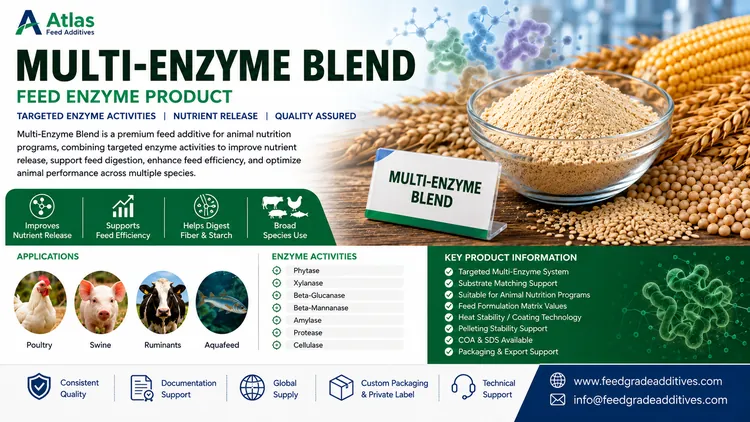
Multi-Enzyme Blend is used to improve nutrient release, feed efficiency, and formulation flexibility when enzyme activities are matched to the substrates in the diet. It may support phosphorus release, NSP breakdown, fiber management, starch digestion, protein digestibility, and raw-material flexibility depending on the enzyme profile and supplier data.
Which enzyme activities can be included?
Depending on supplier specification, a Multi-Enzyme Blend may include phytase, xylanase, beta-glucanase, beta-mannanase, cellulase, amylase, protease, pectinase, alpha-galactosidase, or other enzyme activities. Buyers should request declared activity units for every enzyme.
Why is substrate matching important?
Enzymes act on specific substrates. Phytase requires phytate, xylanase targets arabinoxylans, beta-glucanase targets beta-glucans, and beta-mannanase targets mannans. The right enzyme blend depends on the actual feed ingredients and formulation objective.
Can Multi-Enzyme Blend be used in poultry feed?
Yes, Multi-Enzyme Blend may be evaluated in broiler, layer, breeder, turkey, and specialty poultry programs where nutrient release, phosphorus management, viscosity control, or raw-material flexibility is required. Suitability depends on enzyme profile, diet substrate, processing, and local rules.
Can Multi-Enzyme Blend be used in swine feed?
Yes, it may be considered in piglet, nursery, grower, finisher, sow, and boar programs, especially where phytate phosphorus, fiber, NSP, starch, or protein digestibility are important. Buyers should match the enzyme activities to the target diet.
Can Multi-Enzyme Blend be used in aquafeed?
Yes, it may be evaluated in fish and shrimp feeds, especially formulas using plant proteins, cereal fractions, oilseed meals, or by-products. Buyers should review extrusion stability, water stability, activity retention, and species authorization.
What are matrix values?
Matrix values are nutrient-release or nutrient-saving values assigned to an enzyme product in feed formulation. They may relate to phosphorus, calcium, energy, amino acids, or other nutrients. Buyers should use matrix values only when supported by supplier data and suitable for the target formula.
Does Multi-Enzyme Blend survive pelleting?
Survival depends on enzyme type, coating, granulation, thermostability, conditioning temperature, pelleting temperature, moisture, and residence time. Buyers should request pelleting recovery data for the actual processing conditions.
What specification should buyers request?
Buyers should request enzyme activity list, activity units, unit definitions, assay methods, inclusion rate, matrix values, substrate recommendations, pH activity range, heat stability, carrier, particle size, shelf life, storage conditions, and required documents.
What quality documents should buyers request for Multi-Enzyme Blend?
Common documents include a specification sheet, certificate of analysis, safety data sheet, enzyme activity declaration, assay method, activity unit definition, batch number, manufacturing date, expiry date, storage instructions, origin information, stability data where available, and any market-specific certificates required by the buyer.
Can Atlas Feed Additives quote Multi-Enzyme Blend?
Yes. Send your target species, formula type, required enzyme activities, activity units, matrix expectations, processing temperature, required quantity, destination country, packaging preference, shipment terms, and documents so Atlas Feed Additives can review suitable supplier options.
Can Multi-Enzyme Blend be supplied under private label?
Private-label availability depends on supplier capability, enzyme profile, order quantity, product form, packaging format, label wording, activity declarations, artwork approval, and destination-market rules. Atlas Feed Additives can review private-label options when the buyer provides the required label and regulatory details.