Ruminant performance and environmental additives

Propylene Glycol

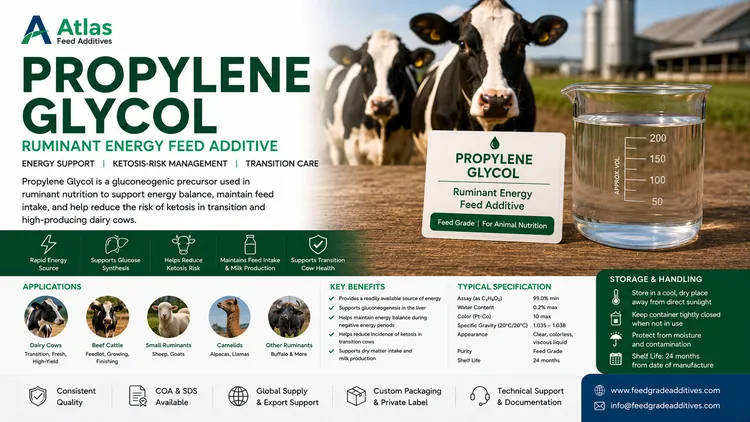
Propylene Glycol is a feed-grade liquid additive selected for dairy transition-cow, fresh-cow, early-lactation, and high-yield ruminant nutrition programs where energy balance, gluconeogenic support, and practical on-farm delivery are important formulation priorities.

Propylene Glycol feed additive visual

Product role

Where Propylene Glycol fits in ruminant nutrition

Propylene Glycol is part of the ruminant performance and environmental additives group. In dairy nutrition, it is commonly positioned as an energy-support ingredient and gluconeogenic precursor for cows facing high energy demand around calving and early lactation.

During the transition period, cows may experience reduced dry matter intake while milk-production demand increases. This can create negative energy balance. Propylene Glycol may be used as one tool within a wider transition-cow program that also considers forage quality, starch level, effective fiber, minerals, body condition, cow comfort, water access, grouping, and health monitoring.

Atlas Feed Additives can coordinate international supplier options for feed mills, premix producers, dairy-farm supply companies, distributors, integrators, and importers that need consistent feed-grade Propylene Glycol supported by technical documents, batch-level certificates, and export-ready service.

What Propylene Glycol is designed to support

Propylene Glycol is mainly used in dairy and ruminant programs where nutritionists want a concentrated liquid energy-support ingredient. It can be delivered through controlled drenching, top-dressing, liquid supplements, farm blends, or specialty feed products depending on the program and local rules.

  • transition-cow nutrition before and after calving
  • fresh-cow and early-lactation support programs
  • high-yield dairy diets with elevated energy demand
  • negative energy balance management strategies
  • ketosis-risk management programs where authorized and professionally guided
  • liquid supplement and on-farm application systems
  • specialty ruminant blends for dairy farms and feed suppliers
  • supportive feeding programs during periods of low intake or metabolic challenge

Typical applications

  • dairy transition-cow programs
  • fresh-cow protocols after calving
  • peak-lactation and high-producing cow programs
  • oral drench products where permitted and correctly managed
  • top-dress feeding applications
  • liquid feed supplements
  • energy-support products for farm distribution
  • ruminant specialty premixes and blends
  • veterinary or nutritionist-guided metabolic support programs
  • feedlot or finishing programs only where authorized and technically justified

Technical identity

Key specification points for Propylene Glycol buyers

Propylene Glycol buyer reference table
Item Typical buyer reference Why it matters
Product group Specialty ruminant additive / liquid energy-support ingredient Confirms the product category for formulation, registration, purchasing, and quality records.
Chemical name 1,2-Propanediol Helps confirm product identity and avoid confusion with other glycols or solvents.
Physical form Clear, viscous liquid, depending on supplier specification Important for pumping, dosing, storage, blending, and farm handling.
Purity Supplier-declared assay or minimum purity Purity affects technical suitability, commercial comparison, and buyer approval.
Water content Declared maximum water or moisture value Higher water content can affect active value, storage, density, and commercial comparison.
Density Supplier-declared density range Useful for converting between kilograms, liters, dosing systems, tanks, and logistics calculations.
Color and odor Supplier-declared appearance and sensory limits Supports incoming quality inspection and helps identify contamination or degradation.
Grade Feed grade or other buyer-required grade declaration Grade declaration is important for feed use, import approval, and customer acceptance.
Packaging Drum, IBC, flexitank, tanker, or other liquid packaging Packaging affects transport cost, handling, storage, contamination risk, and order size.
Documentation Specification, COA, SDS, origin, shelf life, batch details, feed-grade statement where available Supports customs clearance, supplier approval, audits, and traceability.

Dairy nutrition context

Why Propylene Glycol is used in transition-cow programs

The transition period is one of the most demanding phases in dairy production. Around calving, feed intake can drop while nutrient demand rises sharply. This creates pressure on energy metabolism and can increase the need for carefully managed support strategies.

Propylene Glycol is commonly selected because it can be used as a practical liquid ingredient in controlled energy-support programs. It should not be treated as a standalone solution; it works best when combined with good ration design, cow comfort, adequate bunk management, health monitoring, body-condition control, and professional nutritionist guidance.

  • supports transition-cow programs during periods of elevated energy demand
  • fits fresh-cow management protocols where approved and professionally guided
  • can be used in liquid supplement systems or controlled on-farm applications
  • helps nutrition teams manage targeted energy-support strategies
  • should be used with clear dosage, handling, and monitoring procedures

Buyer quality checklist

What to verify before approval

Propylene Glycol should be evaluated by identity, purity, feed-use suitability, packaging integrity, supplier documentation, and logistics conditions. Buyers should make sure the offered product matches the intended feed or farm-use application.

  • product identity and chemical name confirmation
  • declared purity or assay
  • water content or moisture specification
  • density range and viscosity information, if needed
  • appearance, color, and odor limits
  • acidity, residue, or impurity limits where specified
  • feed-grade status or intended-use declaration
  • heavy metal or contaminant limits where required
  • microbiological or hygiene statements where applicable
  • packaging type, seal integrity, and container cleanliness
  • shelf life and recommended storage conditions
  • certificate of analysis for each lot
  • market authorization for the intended species and country

Documents

Recommended document package

Atlas Feed Additives can help buyers request the technical and commercial documents commonly needed for internal quality approval, import control, distributor registration, customer audits, and feed-manufacturing quality systems.

  • product specification sheet
  • certificate of analysis by batch or lot
  • safety data sheet
  • technical data sheet
  • country-of-origin statement
  • feed-grade declaration where available
  • manufacturer or supplier declaration where required
  • GMO, allergen, BSE/TSE, contaminant, or residual-solvent statements where relevant
  • Halal, Kosher, ISO, FAMI-QS, GMP+, or other certificates if available and required
  • shelf-life and storage declaration
  • packing list, commercial invoice, and certificate of origin for export shipments
  • transport and container-cleanliness declarations where applicable

Handling and use

Practical notes for feed suppliers and dairy farms

Liquid handling

Propylene Glycol is a viscous liquid. Buyers should confirm pump compatibility, transfer method, hose cleanliness, tank condition, dosing accuracy, and whether the product will be handled from drums, IBCs, flexitanks, or bulk tanks.

Dosing accuracy

On-farm use should follow a clear protocol. Overuse, inconsistent delivery, or poor mixing can reduce program value. Final dosage and use period should be determined by a qualified nutritionist or veterinary advisor.

Palatability and delivery

Propylene Glycol may be used as a drench, top-dress, blend component, or liquid supplement ingredient depending on the system. Delivery method can influence intake consistency and labor requirements.

Storage control

Store in tightly closed containers and protect from contamination, excessive heat, freezing risk where relevant, strong odors, incompatible chemicals, and damaged packaging. Follow the supplier’s SDS.

Traceability

Keep batch numbers, COA references, delivery notes, storage-tank records, and use records where required. Traceability helps with audits, customer assurance, and quality investigations.

Regulatory check

Feed additive authorization, species use, label claims, import requirements, and usage guidance vary by country. Buyers should confirm compliance before import, sale, or feed application.

Commercial comparison

How to compare Propylene Glycol offers

Commercial and technical comparison points
Comparison point Ask the supplier Reason for review
Grade Is the product suitable for feed use and supported by relevant declarations? Ensures the product matches the intended animal-nutrition application.
Purity What is the guaranteed purity or assay? Allows comparison of technical quality and value between offers.
Water content What is the maximum water content? Affects active value, storage, density, and delivered-product consistency.
Density What density range should be used for volume-to-weight conversion? Important for dosing, tanks, IBCs, drums, invoices, and logistics calculations.
Packaging Is it supplied in drums, IBCs, flexitanks, tankers, or other packaging? Packaging affects handling cost, contamination risk, and shipment efficiency.
Documents Which documents are available before shipment? Reduces delays during supplier approval, customs clearance, and customer audits.
Lead time Is the product available from stock or produced to order? Helps buyers plan seasonal transition-cow demand and avoid supply interruptions.
Logistics What Incoterm, port, container type, and transport conditions are offered? Clarifies total landed cost, risk transfer, and import responsibility.
Origin What is the country of origin and manufacturer source? Important for buyer approval, import rules, and customer documentation.
Shelf life What is the remaining shelf life at shipment? Supports inventory planning and helps avoid short-dated product.

Procurement note

Ask for the right specification before comparing prices.

Price comparisons are meaningful only when purity, grade, water content, density, packaging, origin, documentation, delivery term, and shipment format are aligned. A lower price may not be economical if the product has unsuitable documentation, inconvenient packaging, uncertain origin, high water content, or logistics conditions that increase landed cost.

For liquid additives such as Propylene Glycol, buyers should also compare the delivered cost per usable kilogram, drum or IBC handling costs, container loading, tank availability, unloading method, storage requirements, and local transport arrangements.

Quote request details to send

  • product name and required grade
  • required purity or specification
  • target application and species
  • required quantity and order frequency
  • preferred packaging: drum, IBC, flexitank, tanker, or bulk
  • destination country, port, or delivery address
  • preferred Incoterm
  • required certificates and declarations
  • target shipment date
  • approved or restricted origins
  • payment and document requirements
  • unloading or storage limitations at destination

Packaging and logistics

Supply-format considerations

Propylene Glycol can be supplied in different liquid packaging formats depending on quantity, destination, supplier capability, and buyer handling equipment. The best option depends on consumption rate, warehouse setup, unloading method, and total landed cost.

  • drums for smaller or flexible orders
  • IBCs for moderate-volume users and distributor stock
  • flexitanks for larger export quantities where infrastructure allows
  • bulk tanker supply for large-volume local distribution where available
  • sealed containers to reduce contamination risk
  • clear product, batch, net weight, and expiry labeling
  • palletized or containerized shipment planning
  • container cleanliness and food/feed-contact suitability where required
  • first-expired, first-out inventory rotation
  • lot traceability from shipment to farm or feed production

Who buys this product?

Suitable buyer profiles

  • dairy farm supply companies
  • feed additive distributors
  • ruminant premix and supplement manufacturers
  • liquid feed supplement producers
  • integrators managing dairy nutrition programs
  • veterinary or nutrition-service companies
  • importers building ruminant additive portfolios
  • large dairy farms and farm groups
  • feed mills producing transition-cow support products
  • technical buyers comparing liquid energy-support additives

Program positioning

Where Propylene Glycol may be positioned

Close-up cows

Close-up cow programs focus on preparing animals for calving and early lactation. Propylene Glycol may be considered when a nutritionist includes targeted energy support in the transition plan.

Fresh cows

Fresh cows can experience high energy demand and variable intake. Propylene Glycol is often positioned in controlled protocols after calving where professional guidance and farm monitoring are available.

High-yield herds

High-producing dairy herds require careful energy, protein, fiber, mineral, and management balance. Propylene Glycol may be evaluated as part of broader metabolic-support and performance programs.

Liquid supplement systems

Liquid feed systems may use Propylene Glycol as an ingredient in controlled blends. Buyers should confirm mixing behavior, viscosity, tank hygiene, and dosing accuracy.

Distributor portfolios

Distributors may position Propylene Glycol with other dairy-support ingredients such as protected choline, protected niacin, protected methionine, buffers, live yeast, and protected fats.

Farm protocols

Farm-level use requires clear instructions, trained staff, correct measurement, animal identification, safe handling, and recordkeeping. Protocols should be approved by the farm’s nutritionist or veterinarian.

Why Atlas Feed Additives?

Support beyond a price quote

Atlas Feed Additives helps buyers approach Propylene Glycol procurement with a technical and commercial checklist. This is especially important for liquid additives where packaging, logistics, grade, purity, documentation, and handling conditions can strongly affect the final landed value.

  • supplier option review based on target specification
  • quotation coordination for spot or recurring demand
  • support for document collection before shipment where available
  • packaging and logistics comparison for drums, IBCs, flexitanks, or bulk options
  • coordination for feed mills, distributors, farms, and importers
  • export-focused communication from Ankara, Turkey
  • clear communication in English and Turkish

Important disclaimer

Use according to local rules and professional guidance

Propylene Glycol should be used according to the target species, product specification, qualified nutritionist guidance, veterinary advice where appropriate, supplier instructions, farm protocol, and applicable market rules. Atlas Feed Additives does not replace veterinary, regulatory, or nutritionist advice.

Product claims, allowed species, inclusion guidance, labeling, import requirements, and feed-use rules can vary by country. Buyers should confirm compliance before ordering, importing, labeling, selling, or using the product in commercial feed or farm programs.

Questions

Useful answers about Propylene Glycol

What is Propylene Glycol used for in animal nutrition?

Propylene Glycol is used mainly in ruminant nutrition as an energy-support ingredient and gluconeogenic precursor. It is commonly considered for dairy transition-cow, fresh-cow, early-lactation, and high-yield programs where energy balance is a key management priority.

Why is Propylene Glycol used around calving?

Around calving, dairy cows often experience high energy demand and variable feed intake. Propylene Glycol may be used as part of a broader transition-cow program to support energy balance and ketosis-risk management where approved and professionally guided.

Is Propylene Glycol only for dairy cows?

Propylene Glycol is most commonly positioned for dairy cattle, especially transition and fresh cows. Other ruminant uses depend on product specification, local authorization, nutritional objective, and professional guidance.

Can Propylene Glycol be drenched?

It may be used in oral drench protocols where permitted and correctly managed. Drenching should be done only by trained personnel following farm protocol, supplier guidance, veterinary advice where appropriate, and local rules.

Can Propylene Glycol be mixed into feed?

Yes, depending on the feeding system and product specification. It may be used in top-dress applications, liquid supplements, or specialty blends. Uniform delivery and accurate dosing are important.

What specification points should buyers compare?

Buyers should compare purity, water content, density, appearance, odor, grade, impurity limits, packaging format, shelf life, origin, supplier reliability, documentation, and total landed cost.

What documents should buyers request?

Common documents include product specification, certificate of analysis, safety data sheet, technical data sheet, country of origin, feed-grade declaration where available, shelf-life declaration, batch details, and any market-specific certificates required by the buyer.

How should Propylene Glycol be stored?

Store it in tightly closed original containers in a clean, dry, well-ventilated area. Protect from contamination, excessive heat, incompatible materials, strong odors, and damaged packaging. Always follow the supplier’s safety data sheet and storage instructions.

Which packaging formats are common?

Propylene Glycol may be supplied in drums, IBCs, flexitanks, tankers, or other liquid packaging depending on quantity, supplier capability, destination, and buyer handling equipment.

Can Atlas Feed Additives quote Propylene Glycol?

Yes. Send your required grade, specification, quantity, destination, preferred packaging, Incoterm, required documents, and target shipment date so Atlas Feed Additives can review suitable supplier options.

Can Atlas quote related ruminant additives?

Yes. Atlas Feed Additives can review requests for related ruminant products such as rumen-protected choline, protected niacin, rumen-protected methionine, rumen-protected lysine, protected fat, calcium salts of fatty acids, live yeast, yeast culture, buffers, and other specialty additives depending on availability.

Request a quotation

Tell us what you need

Send your product list, target specification, required grade, destination country, packaging preference, annual or spot quantity, delivery term, required documents, and target shipment date. Our team will review your request and respond from orders@feedgradeadditives.com.