What is Potassium Chloride used for in animal nutrition?
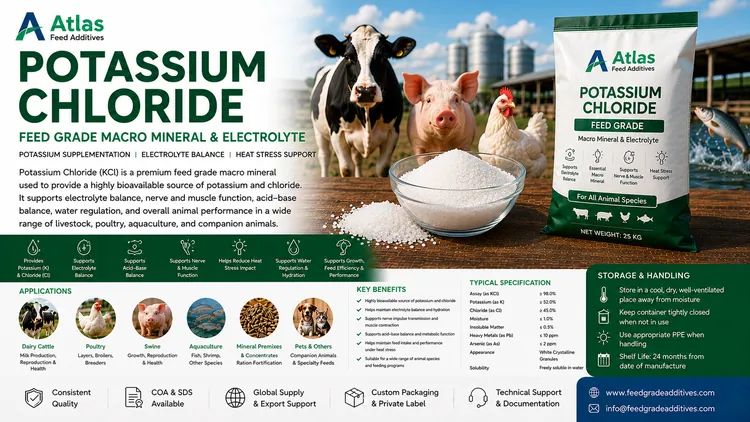
Potassium Chloride is used as a potassium and chloride source in animal feed, mineral premixes,
electrolyte products, heat-stress support programs, liquid supplements, and specialty formulations. It
should be used according to species needs, ration targets, and local rules.
Why is potassium important in animal feed?
Potassium is a macro mineral involved in electrolyte balance, fluid balance, nerve and muscle function,
and acid-base management. Feed programs may include potassium sources when the ration requires additional
potassium contribution.
Why does chloride contribution matter?
Potassium Chloride contributes chloride as well as potassium. Chloride should be considered in electrolyte
and acid-base formulation, especially in heat-stress strategies, dairy rations, and DCAD-related work.
Can Potassium Chloride be used in electrolyte products?
Yes, it may be used in dry or soluble electrolyte products where authorized and technically suitable.
Buyers should confirm solubility, insoluble matter, taste, mineral balance, water-use instructions, and
destination-market rules.
Can Potassium Chloride be used in dairy rations?
Yes, it may be used in dairy rations where professionally formulated. Buyers should account for potassium,
chloride, sodium, sulfur, magnesium, calcium, DCAD objectives, and the total ration mineral profile.
What specification points should buyers compare?
Buyers should compare KCl assay, potassium content, chloride content, grade declaration, particle size,
granulation, dust level, moisture, insoluble matter, caking tendency, impurity limits, packaging, shelf
life, origin, authorization status, and documents.
What documents should buyers request?
Common documents include product specification, certificate of analysis, safety data sheet, technical data
sheet, potassium and chloride declarations, country of origin, shelf-life declaration, feed-use declaration
where available, heavy metal statement, and market-specific certificates.
How should Potassium Chloride be stored?
Store Potassium Chloride in sealed packaging in a cool, dry, well-ventilated area. Protect it from
moisture, contamination, strong odors, damaged packaging, and incompatible materials. Always follow the
supplier’s SDS and storage instructions.
Is granulation important?
Yes. Granulation affects dust level, flowability, segregation, solubility, dosing behavior, and premix
uniformity. Buyers should match particle size to the intended feed, premix, supplement, or soluble product.
Can Atlas Feed Additives quote Potassium Chloride?
Yes. Send your required specification, assay, granulation, quantity, destination, packaging preference,
required documents, preferred Incoterm, and shipment timing so Atlas Feed Additives can review suitable
supplier options.
Can Atlas quote related macro minerals?
Yes. Atlas Feed Additives can review requests for related products such as monocalcium phosphate,
dicalcium phosphate, tricalcium phosphate, calcium carbonate, magnesium oxide, sodium bicarbonate, sodium
chloride, potassium carbonate, and other macro mineral or electrolyte sources depending on availability
and target specification.