Macro minerals and electrolytes

Calcium Carbonate

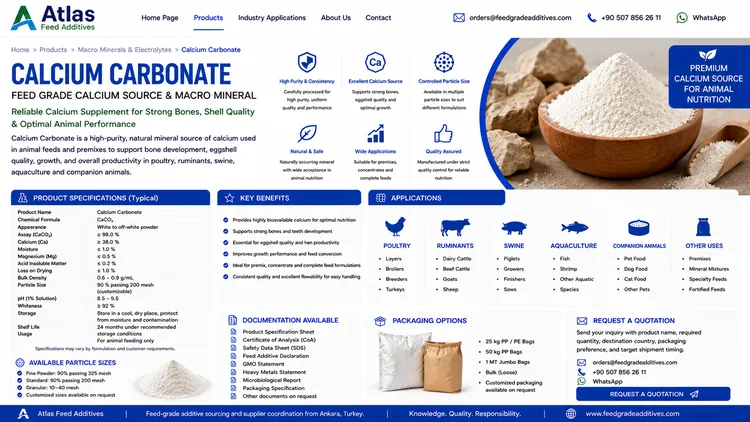
Calcium Carbonate is a feed-grade macro mineral ingredient used as a calcium source in poultry, ruminant, swine, aquaculture, pet food, premix, mineral feed, and compound feed programs where calcium level, particle size, purity, handling behavior, and documentation must be clearly defined.

Calcium Carbonate feed additive visual
  • Feed-grade calcium source for macro mineral programs
  • Available as fine powder, granular material, or application-specific particle sizes
  • Specification-driven sourcing and documentation review

Product role

Where Calcium Carbonate fits

Calcium Carbonate is part of the macro minerals and electrolytes group. It is one of the most widely used calcium sources in animal nutrition because it can supply calcium in a dry, mineral form that is suitable for many feed manufacturing systems. Buyers commonly request it for layer feeds, broiler feeds, breeder feeds, dairy and beef feeds, calf feeds, swine feeds, aquaculture feeds, pet food, mineral premixes, concentrates, and general compound feed production.

In procurement, Calcium Carbonate is often described as limestone powder, limestone granules, ground calcium carbonate, feed-grade limestone, or calcium source. These names may refer to different origins, purity levels, colors, particle-size ranges, and physical forms. For this reason, buyers should confirm the full specification before comparing offers.

Calcium Carbonate is not selected only for its mineral content. Particle size, granulation, dust level, flowability, insoluble matter, heavy metals, fluorine, moisture, whiteness, packaging, origin, and consistency can all influence its suitability for a specific feed mill or animal program.

Atlas Feed Additives can coordinate international supplier options for feed mills, premix producers, mineral feed manufacturers, distributors, and integrators that need consistent feed-grade Calcium Carbonate with export-focused communication, batch documentation, and quotation support.

Macro mineral concept

Why calcium sources are used in feed

Calcium is a major mineral required in animal diets for skeletal development, eggshell formation, muscle and nerve function, mineral balance, and general productive performance. In commercial feed production, Calcium Carbonate is widely used to help meet defined calcium targets in complete feeds, concentrates, premixes, mineral feeds, and specialty formulations.

Because calcium interacts with phosphorus, vitamin D, trace minerals, electrolytes, dietary acid-base balance, particle size, and feed intake, Calcium Carbonate should be selected and dosed according to the full diet, not only according to price per metric ton.

Commercial purpose

Why buyers request Calcium Carbonate

  • Provide a cost-effective calcium source for animal feed
  • Support layer and breeder calcium programs where shell quality matters
  • Support skeletal development and mineral balance in growing animals
  • Help feed mills meet finished-feed calcium guarantees
  • Provide fine or coarse particle-size options for different applications
  • Improve premix and feed uniformity through controlled granulation
  • Support mineral feed, concentrate, and compound feed production
  • Allow specification-based purchasing with clear assay and particle-size data
  • Support export projects that require documentation, traceability, and stable packaging

Application areas

Typical applications in animal nutrition

Layer and breeder feeds

Layer and breeder programs often require carefully managed calcium supply because eggshell formation creates a high and repeated calcium demand. Calcium Carbonate may be used as fine powder, coarse limestone, or a controlled particle-size blend depending on the nutritionist’s program and feed manufacturing process.

  • Used in layer feeds, breeder feeds, and egg-production programs
  • Particle size may be adjusted to support calcium availability through the production cycle
  • Should be evaluated alongside vitamin D, phosphorus, sodium, chloride, shell quality data, and feed intake
  • Requires consistent calcium assay and particle-size distribution

Broiler and poultry feeds

Broiler, turkey, duck, and other poultry feeds use calcium sources to support skeletal development, growth, feed efficiency, and complete mineral balance. Calcium Carbonate should be balanced with available phosphorus, phytase strategy, vitamin D program, and species-specific nutrient requirements.

  • Relevant for starter, grower, finisher, and breeder formulas
  • Particle size should be compatible with mash, pellet, or crumble production
  • Requires attention to calcium-to-phosphorus balance and enzyme use
  • Should comply with feed-grade mineral and contaminant requirements

Dairy and beef cattle

Dairy and beef rations may include Calcium Carbonate to adjust calcium supply, support mineral balance, and contribute to ration structure depending on the feeding system. In dairy cattle, use should be reviewed alongside phosphorus, magnesium, potassium, sodium, chloride, DCAD strategy, forage mineral content, and production stage.

  • Used in dairy concentrates, beef feeds, calf feeds, mineral packs, and total mixed ration programs
  • Requires attention to calcium balance, phosphorus balance, and transition-cow strategy
  • Should be checked against forage analysis and complete ration mineral data
  • Particle size and flowability matter for TMR, premix, and concentrate production

Swine feeds

Swine diets require controlled calcium and phosphorus balance across sow, piglet, nursery, grower, and finisher phases. Calcium Carbonate is commonly used as a calcium source in complete feed and premixes, but the inclusion rate should be adjusted according to available phosphorus, phytase, feed phase, and production objective.

  • Used in sow, piglet, nursery, grower, and finisher feed programs
  • Should be balanced with phosphorus sources and phytase strategy
  • Fine particle size may be preferred for uniform blending in premixes and complete feed
  • Use rate should be determined by a qualified nutritionist

Aquaculture feeds

Aquaculture feed producers may use Calcium Carbonate in mineral premixes, fish feeds, shrimp feeds, and specialty aquatic formulas where calcium contribution, buffering behavior, pellet quality, and mineral balance are relevant. Suitability depends on species, processing method, water stability, and local authorization.

  • Relevant for selected fish, shrimp, and specialty aquatic feed programs
  • Requires review of particle size, extrusion behavior, pellet quality, and water stability
  • Should be checked against species-specific mineral requirements
  • Documentation and batch consistency are important for export programs

Premixes, mineral feeds, and concentrates

Premix and mineral-feed producers may use Calcium Carbonate as a calcium source, carrier-support ingredient, or mineral component. Particle size, density, dust, flowability, whiteness, and segregation behavior should be checked before use in precision premix systems.

  • Used in vitamin-mineral premixes, mineral feeds, concentrates, and specialty packs
  • Particle size and density should match the carrier system and dosing equipment
  • Dust level and flowability are important for plant handling and worker comfort
  • Requires strong documentation, label clarity, and batch traceability

Specification guide

Specification points to define before comparing offers

Calcium Carbonate should not be purchased only by product name. Feed-grade materials can differ by calcium content, carbonate assay, origin, particle size, granulation, impurities, moisture, acid-insoluble matter, heavy metals, fluorine, color, flowability, packaging, and documentation. Buyers should request a complete technical specification before comparing prices.

Specification area What to request Why it matters
Product identity Exact product name, origin, mineral source, grade, and feed-grade declaration Confirms that the material is suitable for animal feed use and not only industrial mineral use.
Calcium Carbonate assay Guaranteed or typical CaCO3 percentage and analytical method Supports active mineral comparison and helps buyers evaluate product purity.
Elemental calcium Declared calcium percentage and test method Essential for feed formulation, finished-feed calcium guarantees, and cost-in-use calculation.
Origin and source Limestone, marble, oyster shell, or other declared mineral source where relevant Origin may influence color, hardness, particle behavior, solubility, and customer preference.
Particle size Mesh size, sieve analysis, fine powder, granule, coarse grade, or customer-specific range Particle size affects mixing, feed texture, calcium availability, layer-feed performance, and segregation risk.
Granulation Powder, granular, coarse limestone, blended particle-size range, or custom grade Different species and feed forms may require different particle-size profiles.
Moisture Maximum moisture and analytical method Moisture affects flowability, caking, shelf life, and warehouse handling.
Acid-insoluble matter Acid-insoluble ash or insoluble residue limit Useful for evaluating impurities such as silica or non-calcium mineral fractions.
Magnesium and other minerals Magnesium, iron, aluminum, silica, or other mineral profile where required Helps nutritionists and quality teams understand mineral contribution and impurity profile.
Heavy metals Lead, arsenic, cadmium, mercury, and any buyer-specific limits Important for feed safety, import clearance, and customer compliance programs.
Fluorine Fluorine limit or test result where required Some mineral feed ingredients require fluorine control for feed safety and regulatory compliance.
Undesirable substances Dioxins, PCBs, microbiology, or market-specific contaminant tests where applicable Some destination markets and large feed groups require strict contaminant documentation.
Whiteness and color Color description, whiteness value, or visual standard when required Important for premixes, pet food, mineral products, and customer-facing feed applications.
Bulk density Loose density, tapped density, or handling-density range Useful for dosing equipment, storage volume, packaging planning, and freight optimization.
Dust and flowability Dust profile, anti-caking information, flowability statement, or customer-specific handling standard Important for feed plant handling, worker comfort, dosing accuracy, and equipment cleanliness.
Packaging Bag size, bulk bag, silo delivery option, liner type, pallet quantity, and label information Packaging affects handling, moisture protection, warehouse safety, and freight cost.
Shelf life Declared shelf life or storage stability statement under recommended conditions Important for import planning, distributor stock rotation, and long-distance shipments.
Certification ISO, HACCP, GMP+, FAMI-QS, Halal, Kosher, or other certificates when required Some buyers require supplier quality-system documents before approval.
Regulatory status Destination-market authorization, feed-grade status, and import documentation Use and import must comply with the rules of the destination country.

Quality control

Buyer quality checklist

  • Full product specification with guaranteed and typical values
  • Calcium Carbonate assay and elemental calcium declaration
  • Certificate of analysis for each batch or shipment
  • Safety data sheet in the required language where possible
  • Feed-grade declaration and mineral origin information
  • Batch number, production date, expiry date, and shelf-life declaration where applicable
  • Particle-size distribution, mesh analysis, and granulation profile
  • Moisture, acid-insoluble matter, color, bulk density, and flowability information
  • Heavy metal and fluorine limits required by the buyer
  • Undesirable-substance and contaminant statements where required
  • Microbiological statement or test report if required by the buyer
  • GMP+, FAMI-QS, ISO, HACCP, Halal, Kosher, or other certification when applicable
  • Packaging specification, label details, and pallet configuration
  • Import documents required by the destination country
  • Supplier traceability and complaint-handling process

Incoming inspection

Practical checks at delivery

  • Confirm product name, grade, batch number, net weight, and label details
  • Check that calcium content and particle size match the purchase contract
  • Inspect bags, bulk bags, pallets, shrink wrap, and moisture exposure
  • Check color, odor, dust, lumps, caking, leakage, and foreign material
  • Verify that fine, granular, or coarse grade matches the intended feed application
  • Compare certificate of analysis values with the agreed specification
  • Retain a representative sample according to internal quality procedures
  • Store away from water, direct sunlight, excessive moisture, strong odors, and contamination risks
  • Apply first-in-first-out or first-expiry-first-out warehouse rotation as appropriate
  • Record any deviation before releasing the product for premix or feed production

Formulation guidance

Technical considerations before use

Final inclusion should be determined by a qualified nutritionist, feed technologist, veterinarian, or regulatory specialist. Effective use depends on the target species, life stage, calcium requirement, calcium-to-phosphorus balance, vitamin D program, phytase strategy, feed intake, feed form, processing conditions, local regulations, and finished-feed guarantees.

Calcium-to-phosphorus balance

Calcium Carbonate should be evaluated with the full calcium and phosphorus program. Excessive or poorly balanced calcium can affect phosphorus utilization, enzyme strategy, mineral interactions, and finished-feed nutrient balance.

Particle-size selection

Fine powder is often selected for premixes and uniform blending, while coarser particles may be requested for specific layer or breeder programs. The best particle size depends on species, feed form, feed mill equipment, and nutrition objective.

Feed manufacturing behavior

Calcium Carbonate can influence bulk density, flowability, dust, pellet quality, segregation risk, and equipment wear. Feed mills should review particle size and handling characteristics before large-scale production.

Mineral interactions

Calcium interacts with phosphorus, magnesium, zinc, manganese, trace minerals, vitamin D, and acid-base balance. Nutritionists should review the complete mineral profile, not only the Calcium Carbonate inclusion rate.

Ruminant ration context

For dairy and beef applications, Calcium Carbonate should be reviewed with forage analysis, DCAD strategy, transition-cow program, magnesium supply, phosphorus supply, and total ration mineral balance.

Regulatory compliance

Use must comply with destination-country feed regulations, species authorization, contaminant limits, labeling rules, customer standards, and any required import or registration procedures.

Procurement note

Ask for the right specification before comparing prices.

Price comparisons are meaningful only when calcium content, Calcium Carbonate assay, particle size, origin, moisture, acid-insoluble matter, contaminant limits, packaging, documentation, certification, shelf life, and logistics terms are aligned. A lower unit price may not be the best value if the product has weaker calcium content, higher impurities, excessive dust, unsuitable particle size, poor flowability, short shelf life, or limited documentation.

For sensitive mineral procurement projects, Atlas Feed Additives can help clarify the technical request, collect supplier documents, coordinate quotation details, and support buyers with export-focused communication.

Packaging and logistics

Common shipment details to confirm

Packaging and logistics should be agreed before order confirmation because Calcium Carbonate is often purchased in high volumes and may be handled as bagged, big-bag, palletized, or bulk material. Freight cost, moisture protection, dust control, label clarity, and unloading equipment can strongly influence total landed cost.

  • Standard bag size and net weight
  • Big-bag size, lifting-loop design, and discharge-spout requirement
  • Bulk delivery or silo delivery option where available
  • Inner liner, laminated bag, or moisture-resistant packaging where required
  • Pallet quantity, pallet dimensions, stretch wrap, and loading plan
  • Label language, product name, batch coding, and shipping marks
  • Container loading photos and pallet photos where required
  • Storage temperature and humidity recommendations
  • Minimum order quantity and production lead time
  • Incoterms, destination port, and required shipping documents
  • Any registration, legalization, or certificate authentication required by the destination country

Quotation details

Information to send for a faster offer

  • Product name and target specification
  • Required calcium content or Calcium Carbonate assay
  • Preferred particle size: fine powder, granular, coarse, or custom mesh
  • Target application: layer feed, broiler feed, ruminant feed, swine feed, aquaculture feed, premix, mineral feed, or pet food
  • Monthly, quarterly, or annual volume estimate
  • Destination country and delivery port or city
  • Preferred packaging format and pallet requirements
  • Required certificates and quality documents
  • Any heavy metal, fluorine, or insoluble-matter limits required by the buyer
  • Expected order timing and contract period
  • Any special labeling, language, or registration requirement
  • Preferred Incoterms and payment terms

Commercial positioning

Who typically buys Calcium Carbonate?

Feed mills

Feed mills may use Calcium Carbonate in compound feeds, concentrates, poultry feeds, swine feeds, ruminant feeds, and aquaculture formulas where defined calcium contribution is required.

Layer and breeder feed producers

Layer and breeder producers often request specific particle-size profiles to support shell-quality programs, calcium availability, and consistent finished-feed performance.

Premix producers

Premix producers may request fine particle size, controlled density, low dust, good flowability, and strong documentation for uniform blending and predictable mineral contribution.

Mineral-feed manufacturers

Mineral-feed companies may use Calcium Carbonate in loose minerals, blocks, dairy minerals, beef minerals, sheep minerals, goat minerals, and specialty supplementation products where authorized.

Distributors

Regional distributors often require reliable packaging, stable shelf life, clear labels, and technical documents that can be shared with feed mills, farms, and local authorities.

Integrated producers

Integrated poultry, swine, ruminant, aquaculture, and pet food companies may evaluate Calcium Carbonate as part of controlled mineral nutrition and finished-feed quality programs.

Comparison guide

Calcium Carbonate compared with related mineral ingredients

Buyers often evaluate Calcium Carbonate together with calcium phosphates, sodium chloride, sodium bicarbonate, magnesium sources, and trace mineral ingredients. The best choice depends on the required mineral contribution, feed type, target species, processing system, regulatory status, and cost-in-use.

Product option Typical buyer consideration Procurement note
Calcium Carbonate Calcium source for macro mineral programs, premixes, concentrates, and complete feeds Compare elemental calcium, CaCO3 assay, particle size, impurities, packaging, and feed-grade documents.
Monocalcium Phosphate Calcium and phosphorus source with high phosphorus contribution Review available phosphorus, calcium level, fluorine limits, solubility, and feed-grade compliance.
Dicalcium Phosphate Calcium and phosphorus source used in many feed mineral programs Compare phosphorus content, calcium content, origin, fluorine, heavy metals, and granulation.
Tricalcium Phosphate Mineral ingredient used where calcium and phosphorus contribution meets formulation needs Check calcium-phosphorus ratio, availability, impurity profile, and regulatory suitability.
Sodium Chloride Electrolyte and sodium-chloride source for feed and mineral programs Review purity, granulation, moisture, iodine status where relevant, and anti-caking system.
Sodium Bicarbonate Buffering and sodium source used in selected ruminant and heat-stress programs Compare sodium content, bicarbonate content, particle size, flowability, and storage stability.

Risk management

Important purchasing and use cautions

  • Do not assume all Calcium Carbonate products have the same calcium content, particle size, impurity profile, or feed-grade documentation.
  • Do not compare offers without checking assay, elemental calcium, moisture, particle-size distribution, origin, packaging, and certificate availability.
  • Do not formulate only from product name; use supplier-confirmed calcium contribution and analytical data.
  • Do not ignore calcium-to-phosphorus balance, vitamin D status, phytase strategy, or total mineral interactions.
  • Do not use the product in a destination market without confirming local feed authorization and contaminant limits.
  • Do not use coarse or fine grades interchangeably without checking the intended species, feed form, and nutrition objective.
  • Do not accept damaged bags, unclear labels, moisture-exposed pallets, or missing batch identification without documenting the issue.
  • Do not store near water, direct sunlight, excessive humidity, strong odors, chemicals, or damaged packaging.
  • Do not overlook dust, flowability, and segregation risk in premix and feed mill systems.
  • Do not rely on price per ton alone; cost-in-use depends on calcium content, particle size, freight, packaging, and consistency.

Questions

Useful answers

What is Calcium Carbonate used for in animal nutrition?

Calcium Carbonate is used as a feed-grade calcium source. It supports mineral balance, calcium supplementation, layer and breeder programs, skeletal development, feed formulation, premix production, and finished-feed calcium guarantees. It should be used according to the target species, formulation objective, and applicable market rules.

Is Calcium Carbonate the same as limestone?

Feed-grade Calcium Carbonate is often supplied as limestone powder or limestone granules, but buyers should confirm the exact source, calcium content, particle size, impurity profile, feed-grade status, and documentation before purchase.

Can Atlas Feed Additives quote Calcium Carbonate?

Yes. Send your required specification, quantity, destination, packaging preference, particle-size requirement, and documents so Atlas Feed Additives can review suitable supplier options for Calcium Carbonate.

What quality documents should buyers request for Calcium Carbonate?

Common documents include specification, certificate of analysis, safety data sheet, origin information, batch details, shelf-life statement, feed-grade declaration, packaging details, and any market-specific certificates required by the buyer.

Which specification values are most important?

Important values include Calcium Carbonate assay, elemental calcium content, moisture, particle size, acid-insoluble matter, heavy metals, fluorine, color, bulk density, dust level, flowability, packaging, origin, and feed-grade status.

Why does particle size matter?

Particle size affects mixing uniformity, segregation risk, feed texture, dust, flowability, pellet behavior, and calcium availability. Fine powder may be preferred for premixes, while coarser grades may be selected for certain layer and breeder programs.

Can Calcium Carbonate be used in layer feed?

Yes. Calcium Carbonate is widely evaluated in layer and breeder feed programs, but the correct particle-size profile, calcium level, phosphorus balance, vitamin D program, shell-quality objective, and feed intake should be reviewed by a qualified nutritionist.

Can Calcium Carbonate be used in ruminant diets?

Yes. It can be used in dairy and beef rations, concentrates, mineral packs, and total mixed ration programs where calcium supplementation is needed. It should be reviewed with forage mineral analysis, phosphorus balance, magnesium, DCAD strategy, and production stage.

Does Calcium Carbonate provide phosphorus?

No. Calcium Carbonate is mainly used as a calcium source. If phosphorus is required, buyers may need to evaluate mineral phosphate sources such as monocalcium phosphate, dicalcium phosphate, or other permitted phosphorus ingredients.

Can Calcium Carbonate be used in pelleted feed?

It may be suitable for pelleted feed depending on particle size, inclusion rate, feed formulation, grinding, mixing, pelleting, cooling, and storage conditions. Feed mills should confirm process compatibility before large-scale use.

What packaging options are commonly requested?

Buyers commonly request 25 kg bags, 40 kg bags, 50 kg bags, big bags, palletized shipments, or bulk delivery depending on supplier availability, destination, unloading equipment, and volume. Packaging should match the buyer’s warehouse and production system.

How should Calcium Carbonate be stored?

Store in a dry, clean, well-ventilated area away from water, excessive humidity, strong odors, chemicals, damaged packaging, and contamination risks. Follow the supplier’s storage recommendation and apply proper warehouse rotation.

How should buyers compare Calcium Carbonate prices?

Compare prices only after confirming calcium content, Calcium Carbonate assay, particle-size distribution, moisture, impurity limits, packaging, origin, certification, minimum order quantity, freight terms, and document availability. Cost-in-use can be more important than unit price alone.

What information should be included in a quotation request?

Include target specification, required calcium content, particle size, volume, destination country, delivery terms, packaging preference, application area, required certificates, expected order timing, and any reference product or customer standard that must be matched.

Request a quotation

Tell us what you need

Send your product list, target specification, destination country, packaging preference, and required documents. Our team will review your request and respond from orders@feedgradeadditives.com.

For faster processing, include:

  • Required product specification or reference product
  • Target calcium content and Calcium Carbonate assay
  • Required particle size, mesh range, or granulation profile
  • Monthly or annual quantity
  • Destination port, country, or delivery address
  • Required certificates and quality documents
  • Preferred packaging and pallet configuration
  • Target application and animal species
  • Any contaminant, fluorine, heavy metal, or regulatory limit
  • Any registration, labeling, or compliance requirement