Macro minerals and electrolytes

Monocalcium Phosphate

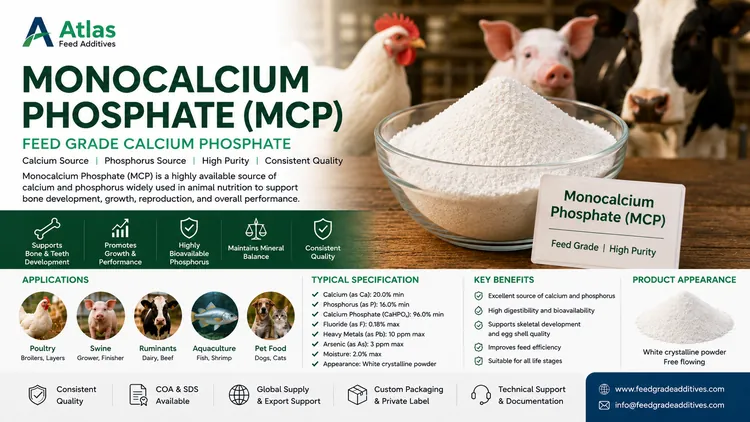
Feed-grade Monocalcium Phosphate, commonly known as MCP, is an inorganic calcium phosphate used to supply available phosphorus and calcium in compound feeds, premixes, mineral concentrates, and species-specific nutrition programs.

Monocalcium Phosphate feed additive visual

Product role

Where Monocalcium Phosphate fits

Monocalcium Phosphate belongs to the inorganic feed phosphate family. It is selected when a formulation needs a dependable mineral source that can contribute phosphorus and calcium without relying only on plant-based phosphorus, which may have limited availability in many monogastric species.

In commercial feed production, MCP may be used in poultry, swine, ruminant, aquaculture, pet food, mineral block, premix, and compound feed applications. The exact inclusion level should always be determined by a qualified nutritionist according to species, age, production stage, basal raw materials, phytase use, total calcium-phosphorus balance, and local regulations.

Atlas Feed Additives supports feed mills, premix producers, distributors, importers, and integrators by coordinating international supplier options, reviewing target specifications, collecting documentation, and preparing quotation information for feed-grade Monocalcium Phosphate shipments.

Typical applications

  • Broiler, layer, breeder, turkey, and other poultry mineral programs
  • Swine starter, grower, finisher, sow, and piglet feed formulations
  • Ruminant mineral supplements, concentrates, and compound feeds
  • Aquaculture feeds where mineral density and feed stability are important
  • Premix and mineral concentrate production for feed manufacturers
  • Pet food and specialty animal nutrition applications when suitable documentation is available

Buyer quality checklist

  • Available phosphorus and total phosphorus declaration
  • Calcium content and calcium-to-phosphorus contribution
  • Moisture, insoluble matter, and loss on drying
  • Particle size, granulation profile, flowability, and dust level
  • Limits for fluorine, arsenic, lead, cadmium, mercury, and other contaminants
  • Feed-grade compliance documents, safety data sheet, and certificate of analysis

Technical overview

What formulators evaluate before choosing MCP

Monocalcium Phosphate is valued because it can provide a concentrated contribution of phosphorus together with calcium. In feed purchasing, the practical value of MCP depends not only on the headline phosphorus number, but also on the declared grade, consistency, digestibility expectations, production process, impurities, physical form, documentation, and compatibility with the customer’s manufacturing system.

For monogastric animals such as poultry and pigs, available phosphorus is a central formulation parameter. For ruminants, phosphorus supply must be balanced with the needs of the animal, rumen microbial activity, total ration mineral balance, and farm performance targets. In aquaculture, the buyer may also review pellet durability, water stability, and fine-particle behavior depending on feed technology.

Common specification points

Phosphorus
Total and/or available phosphorus, depending on supplier specification
Calcium
Declared calcium contribution for ration balancing
Moisture
Important for storage stability, flowability, and handling
Particle size
Relevant for premix uniformity, segregation control, and dust management
Contaminants
Limits should meet buyer, market, and regulatory requirements

Formulation value

Why Monocalcium Phosphate is used in feed programs

Phosphorus contribution

Phosphorus is required for skeletal development, energy metabolism, cellular function, reproduction, and productivity. In many feed formulas, inorganic feed phosphates are used to close the gap between the animal’s requirement and the usable phosphorus supplied by grains, oilseed meals, by-products, and other raw materials.

Calcium balance

MCP also contributes calcium, so it should be evaluated together with limestone, dicalcium phosphate, tricalcium phosphate, calcium carbonate, sodium bicarbonate, salt, magnesium sources, and other mineral ingredients. Correct calcium-phosphorus balance is especially important in growing animals, laying birds, breeders, and high-performance systems.

Manufacturing performance

Physical properties such as granulation, dust level, bulk density, flowability, and caking tendency can affect unloading, storage, dosing accuracy, mixer distribution, premix uniformity, and worker handling. Buyers should align physical form with their plant equipment and final feed format.

Procurement security

For regular import programs, buyers often need repeatable quality, predictable documentation, consistent packaging, shipment planning, and supplier communication. Atlas Feed Additives can support specification alignment before price comparison so quotations are easier to evaluate.

Species notes

Application considerations by animal group

  • Poultry: Used in broiler, layer, breeder, and turkey feeds where available phosphorus, calcium balance, bone development, eggshell quality, and feed conversion targets must be managed.
  • Swine: Used in piglet, grower-finisher, and sow feeds where phosphorus availability, mineral balance, growth rate, fertility, and skeletal support are important.
  • Ruminants: Used in mineral mixes, concentrates, and complete feeds where total ration phosphorus, calcium balance, forage mineral profile, and production stage must be considered.
  • Aquaculture: Used when the formulation requires a dense mineral source and when physical behavior in extruded or pelleted feed is compatible with the feed technology.
  • Premix production: Used in mineral premixes where uniform particle size, reliable assay, and low dust are important for accurate micro- and macro-ingredient distribution.

Commercial notes

Information that helps us quote faster

  • Required monthly or spot quantity
  • Destination country, port, warehouse, or delivery address
  • Preferred Incoterms such as EXW, FOB, CFR, CIF, DAP, or DDP
  • Packaging format: 25 kg bags, jumbo bags, palletized cargo, or buyer-specific packing
  • Target specification and minimum acceptable assay
  • Required documents for customs, registration, internal QA, or customer approval
  • Shipment timing, contract duration, and repeat-order expectations

Procurement note

Ask for the right specification before comparing prices.

Price comparisons are meaningful only when assay, physical form, impurity limits, packaging, origin, documentation, Incoterms, and shipment timing are aligned. A lower price may not be commercially useful if the product has unsuitable granulation, unacceptable contaminant limits, incomplete documents, inconsistent flowability, or packaging that does not match the buyer’s unloading and storage system.

Specification alignment

Before selecting a supplier, confirm whether the offer is for feed grade MCP, whether the quoted phosphorus and calcium values are reported on the same basis, and whether the certificate of analysis format matches the buyer’s internal approval process.

Documentation alignment

For international shipments, documentation can be as important as product assay. Buyers may need technical data sheets, safety data sheets, certificates of analysis, origin declarations, health or feed compliance documents, registration support, and market-specific statements.

Logistics alignment

Packaging type, pallet configuration, container loading, humidity protection, bag strength, and labeling should be reviewed before shipment. This is especially important for long transit routes, humid climates, and warehouses without climate control.

Supplier alignment

Repeat buyers should review supplier consistency, communication speed, batch traceability, production capacity, lead time, seasonal availability, and the ability to support future purchase programs rather than only one-time spot cargo.

Handling and storage

Protect product quality from moisture, contamination, and package damage.

Monocalcium Phosphate should be stored in a clean, dry, well-ventilated area away from direct water exposure, incompatible materials, damaged bags, and sources of contamination. Keep packaging closed when the product is not in use. Use first-in, first-out stock rotation and follow the supplier safety data sheet for handling, personal protection, spill cleanup, and disposal instructions.

For feed mills and premix plants, storage planning should consider humidity, caking risk, dust control, forklift movement, pallet condition, warehouse hygiene, and separation from products that may compromise feed safety or product identity.

Documents

Documents commonly requested by buyers

  • Technical specification sheet
  • Certificate of analysis for the offered batch or recent production
  • Safety data sheet
  • Product origin and manufacturer information when available
  • Packing list and commercial invoice
  • Certificate of origin when required
  • Feed-grade, GMP, HACCP, ISO, or other market-specific documents when applicable
  • Heavy metal, fluorine, microbiological, or dioxin-related statements when requested by the buyer

Quotation details

Recommended RFQ message

To receive a practical offer, send a clear request including: product name, target specification, required quantity, destination, Incoterm, packaging, document list, preferred shipment date, payment expectations, and whether the purchase is for trial, spot shipment, tender, or long-term supply.

Example: “We need feed-grade Monocalcium Phosphate for poultry feed production, 1 FCL or 100 MT monthly, CIF destination port, 25 kg bags or jumbo bags, with COA, SDS, origin certificate, and heavy metal limits. Please quote available options and lead time.”

Questions

Useful answers

What is Monocalcium Phosphate used for in animal nutrition?

Monocalcium Phosphate is used as a feed-grade inorganic phosphate source. It supplies phosphorus and calcium for mineral balance, skeletal development, productivity, reproduction, and species-specific feed formulation objectives.

Is Monocalcium Phosphate the same as Dicalcium Phosphate?

No. Both are calcium phosphates used in animal nutrition, but they are different materials with different chemical composition, typical phosphorus and calcium levels, solubility characteristics, and supplier specifications. Buyers should compare them by declared analysis, availability, physical form, contaminants, documentation, and nutritionist approval.

Can Atlas Feed Additives quote Monocalcium Phosphate?

Yes. Send your required specification, quantity, destination, packaging preference, Incoterm, and required documents so Atlas Feed Additives can review suitable supplier options for Monocalcium Phosphate.

What quality documents should buyers request for Monocalcium Phosphate?

Common documents include specification, certificate of analysis, safety data sheet, origin information, batch details, packing list, certificate of origin when required, and any market-specific certificates required by the buyer, importer, or local authority.

Which parameters matter most in MCP specifications?

Important parameters may include phosphorus, available phosphorus, calcium, moisture, particle size, granulation, insoluble matter, fluorine, arsenic, lead, cadmium, mercury, appearance, odor, packaging, shelf life, and feed-grade compliance documents.

How should MCP be stored?

Store MCP in a cool, dry, clean, well-ventilated area. Protect the product from moisture, damaged packaging, contamination, and direct contact with water. Follow the supplier safety data sheet and local handling requirements.

Can MCP be used in premixes?

Yes, feed-grade MCP may be used in premix and mineral concentrate production when the physical form, particle size, assay, dust level, and compatibility are suitable for the premix process. The exact use level should be determined by the formulation team.

Does MCP require special regulatory review?

Requirements vary by country and buyer. Importers should confirm feed additive, feed material, labeling, contaminant, documentation, and registration requirements before purchase. Atlas Feed Additives can help collect supplier documents for buyer review.

Request a quotation

Tell us what you need

Send your product list, target specification, destination country, packaging preference, quantity, Incoterm, shipment timing, and required documents. Our team will review your request and respond from orders@feedgradeadditives.com.