Macro minerals and electrolytes

Dicalcium Phosphate

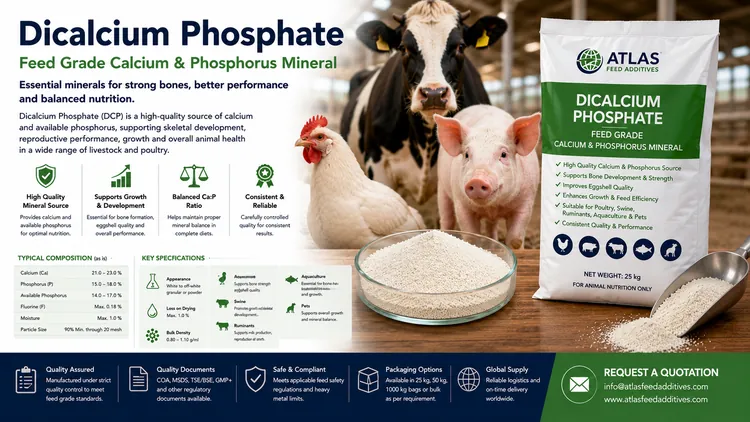
Dicalcium Phosphate is a feed-grade macro mineral ingredient used to supply calcium and phosphorus for balanced poultry, swine, ruminant, aquaculture, pet food, premix, and concentrate formulations.

Commercial Dicalcium Phosphate is usually evaluated by calcium assay, total phosphorus, available phosphorus, calcium-to-phosphorus ratio, fluorine, heavy metals, moisture, insoluble matter, granulation, dust level, bulk density, packaging, origin, and feed-grade compliance documents. The correct grade should match the buyer’s animal species, feed process, mineral matrix, and destination-market rules.

Dicalcium Phosphate feed additive visual

Product role

Where Dicalcium Phosphate fits

Dicalcium Phosphate is part of the macro minerals and electrolytes group. In animal nutrition, it is used mainly as a concentrated calcium and phosphorus source. It helps nutritionists balance mineral supply without relying only on variable raw materials such as limestone, bone-derived sources, oilseed meals, cereal by-products, or animal protein meals.

Phosphorus is an essential mineral for skeletal development, energy metabolism, cell function, reproduction, and growth. Calcium is essential for bone formation, eggshell quality, muscle function, nerve signaling, and mineral homeostasis. Dicalcium Phosphate is therefore widely used in mineral premixes, concentrates, poultry feed, pig feed, ruminant rations, aquafeed, and pet food formulas when its specification and local feed rules are suitable.

Atlas Feed Additives can coordinate international supplier options for feed mills, premix producers, integrators, distributors, mineral blend manufacturers, aquafeed producers, pet food companies, and importers that need consistent feed-grade Dicalcium Phosphate supported by technical and export documentation.

Technical identity

What buyers should know

Dicalcium Phosphate is commonly known as calcium hydrogen phosphate or dibasic calcium phosphate. Feed-grade products can vary depending on raw phosphate source, acidulation route, drying conditions, particle sizing, granulation technology, and impurity control. Some products are supplied as anhydrous material, while hydrated forms may also be encountered depending on manufacturing and specification.

  • Used primarily as a source of calcium and phosphorus in animal feed.
  • Usually compared by calcium percentage, phosphorus percentage, available phosphorus, fluorine, and heavy metal limits.
  • Can be supplied as fine powder, granular product, microgranular product, or custom mineral blend.
  • Requires attention to particle size, dust, bulk density, flowability, caking tendency, and premix compatibility.
  • Should be reviewed for feed-grade status, origin, contaminants, and destination-country import rules.

Commercial value

Why mineral specification matters

Two Dicalcium Phosphate offers can look similar by name but differ in real nutritional and commercial value. Feed formulators should compare cost per unit of available phosphorus and usable calcium, not simply product price per metric ton. The best choice depends on nutrient concentration, digestibility assumptions, contaminant profile, physical handling, packaging, and the buyer’s quality standards.

  • Assay accuracy: supports reliable calcium and phosphorus matrix values.
  • Available phosphorus: affects true formulation value and cost-in-use.
  • Fluorine control: important for animal safety, customer approval, and regulatory compliance.
  • Granulation: influences dust, flowability, segregation risk, and feed mill dosing.
  • Origin and process: affect impurity profile, document requirements, and buyer acceptance.

Procurement note

Ask for the right specification before comparing prices.

Price comparisons are meaningful only when calcium assay, phosphorus assay, available phosphorus, fluorine level, heavy metals, particle size, granulation, dust level, moisture, packaging, origin, and documentation are aligned. A cheaper Dicalcium Phosphate may cost more in use if phosphorus availability is lower, contamination limits are weaker, or the product creates handling losses through dust and poor flowability.

For mineral ingredients, buyers should also check whether the supplier’s specification matches the nutritionist’s feed formulation matrix. If the nutrition software assumes one calcium or phosphorus value while the purchased material delivers another, feed cost and animal performance targets can be affected.

Commercial specification

Typical specification points for Dicalcium Phosphate

The final specification must be confirmed by the supplier and aligned with the destination market. The table below shows practical parameters that purchasing, formulation, quality, and regulatory teams commonly review before approving a Dicalcium Phosphate source.

Parameter What to request Why it matters
Product name Dicalcium Phosphate, DCP, calcium hydrogen phosphate, dibasic calcium phosphate, or supplier-specific feed grade Confirms the mineral form and avoids confusion with monocalcium phosphate, tricalcium phosphate, defluorinated phosphate, or bone phosphate products.
CAS number CAS 7757-93-9 for anhydrous calcium hydrogen phosphate and relevant hydrated form declaration where applicable Supports customs, SDS, technical identity, and regulatory document matching.
Calcium assay Declared calcium percentage and analytical method Determines calcium matrix value and final diet calcium balance.
Total phosphorus Declared phosphorus percentage and analytical method Determines base phosphorus supply and cost comparison between phosphate sources.
Available phosphorus Supplier-supported available phosphorus, soluble phosphorus, or digestible phosphorus assumption where available More useful for formulation than total phosphorus alone, especially when comparing DCP, MCP, MDCP, and TCP.
Ca:P ratio Calcium-to-phosphorus ratio calculated from batch data Important for species-specific mineral balance and comparison with other mineral sources.
Physical form Powder, granule, microgranule, coarse granular product, or premix-grade form Affects dust, flowability, blending, segregation, and dosing equipment performance.
Particle size Mesh range, sieve analysis, or particle-size distribution Important for premix uniformity, pelleted feed quality, mineral distribution, and segregation control.
Dust level Dusting tendency or fine fraction percentage High dust can increase handling losses, worker exposure, equipment contamination, and uneven distribution.
Bulk density Loose and tapped bulk density where available Supports bin design, dosing settings, bag volume, container loading, and blending behavior.
Moisture Maximum moisture or loss-on-drying value Moisture affects caking, flowability, shelf life, and microbial or physical stability.
Insoluble matter Acid-insoluble matter or water-insoluble matter depending on supplier method Indicates non-nutritive mineral residues and helps compare purity between sources.
Fluorine Maximum fluorine limit and batch result Critical for phosphate feed materials because excessive fluorine can create animal and compliance risks.
Heavy metals Lead, cadmium, arsenic, mercury, and total heavy metals where required Supports food-chain safety, import approval, and customer quality standards.
Dioxins / PCBs Report or statement where required by buyer, region, or raw material source May be requested for mineral feed materials in sensitive markets and export programs.
Radioactivity Statement or test report where required for phosphate minerals from certain origins Some buyers require additional checks depending on phosphate rock source and destination rules.
Microbiology Total plate count, yeast and mold, Salmonella, E. coli, or buyer-required limits where relevant Usually less central for inorganic minerals, but may be required for premix-grade or pet food applications.
Packaging 25 kg bags, 50 kg bags, big bags, bulk shipment, inner liner, palletized units, or private-label packaging Packaging affects moisture protection, dust control, warehouse handling, and logistics cost.
Regulatory status Feed-grade declaration, destination-country compliance, origin certificate, and any market-specific limits Feed mineral rules and contaminant limits vary by country and buyer program.

Typical applications

Where Dicalcium Phosphate is commonly evaluated

  • Broiler diets: calcium and phosphorus balancing for starter, grower, and finisher formulas.
  • Layer diets: mineral programs supporting bone reserves and eggshell nutrition, usually alongside calcium carbonate or limestone.
  • Breeder diets: controlled mineral supply for reproductive performance, skeletal health, and hatchery-oriented programs.
  • Swine diets: nursery, grower-finisher, sow, and gilt formulas where digestible phosphorus and calcium balance must be controlled.
  • Ruminant rations: dairy, beef, sheep, and goat mineral programs where phosphorus supply and Ca:P balance are required.
  • Aquaculture feeds: fish and shrimp formulas where mineral digestibility, water stability, and phosphorus discharge are important.
  • Pet food: dog and cat food formulas where mineral balance, label guarantees, and contaminant limits must be carefully controlled.
  • Mineral premixes: vitamin-mineral premixes, farm concentrates, licking blocks, free-choice minerals, and custom mineral blends.

Application route

Where it can be added

  • Premix stage: common in mineral premixes when particle size and uniformity fit the carrier system.
  • Compound feed: direct inclusion in mash or pelleted feed through macro-ingredient or micro-ingredient systems.
  • Concentrates: use in poultry concentrates, pig concentrates, dairy concentrates, and farm-level mineral packs.
  • TMR systems: use in ruminant total mixed rations when uniform distribution can be achieved.
  • Aquafeed extrusion: inclusion in dry mix before extrusion, with attention to phosphorus solubility and environmental discharge targets.
  • Pet food extrusion: dry inclusion where finished-product calcium and phosphorus guarantees are required.
  • Mineral blocks and licks: use in specialty mineral systems where binding, hardness, and mineral availability must be validated.

Species and program fit

How formulators evaluate Dicalcium Phosphate by animal group

Animal group Common formulation objective Buyer questions to confirm
Broilers Balance calcium, available phosphorus, skeletal development, growth performance, and litter management. What available phosphorus value is used? Is phytase included? Does the product meet fluorine and heavy-metal limits?
Layers Support eggshell quality, skeletal reserves, and long-cycle mineral balance. How does DCP interact with limestone particle size, vitamin D strategy, and total dietary calcium?
Breeders Support reproductive performance, eggshell integrity, hatchability, and bone health. Is the Ca:P ratio aligned with breeder age, feed restriction, and mineral reserves?
Nursery pigs Support bone mineralization, growth, feed intake, and precise digestible phosphorus targets. Is the phosphorus digestibility matrix suitable for young pigs? Is the product fine enough for uniform feed distribution?
Grower-finisher pigs Control mineral cost, skeletal development, and phosphorus excretion. Is phytase matrix included? Is the DCP source consistent across batches?
Sows Support reproductive cycles, bone reserves, lactation, and long-term mineral balance. Does the formulation account for parity, lactation demand, and total diet Ca:P balance?
Dairy cattle Provide phosphorus and calcium in mineral mixes, concentrates, and transition programs. Is the ration already high in phosphorus from by-products? Is additional DCP needed or excessive?
Beef cattle Support mineral supplementation in feedlot, grazing, and backgrounding programs. Is the mineral program based on forage analysis, concentrate level, and regional phosphorus availability?
Aquaculture Balance phosphorus nutrition while managing water-quality and discharge considerations. Is the phosphate source suitable for the target species and extrusion process? What soluble phosphorus assumption is used?
Pet food Meet label guarantees and species-specific calcium-phosphorus balance. Is the grade suitable for pet food documentation, contaminants, and finished-product label claims?

Formulation profile

Practical benefits buyers look for

Dicalcium Phosphate is usually selected as a reliable mineral source rather than a performance additive by itself. Its value comes from consistent calcium and phosphorus supply, manageable physical handling, predictable formulation matrix values, and compliant contaminant levels.

  • Supplies calcium and phosphorus in one mineral ingredient.
  • Helps nutritionists control Ca:P ratio across species and production stages.
  • Supports bone, skeletal, eggshell, growth, reproduction, and mineral balance programs.
  • Can reduce reliance on variable phosphorus contributions from raw materials.
  • Works alongside phytase strategies, limestone, monocalcium phosphate, calcium carbonate, sodium chloride, magnesium sources, and trace mineral premixes.
  • Can support feed mill efficiency when granulation, dust level, and flowability are suitable.

Important limitations

What not to assume

  • Do not assume all Dicalcium Phosphate grades have the same phosphorus availability.
  • Do not compare DCP, MCP, MDCP, TCP, and bone phosphate only by price per metric ton.
  • Do not ignore fluorine, cadmium, lead, arsenic, mercury, and other contaminant limits.
  • Do not assume a fertilizer-grade phosphate is acceptable for feed use.
  • Do not assume powder and granular products will behave the same in dosing systems.
  • Do not overlook caking risk, moisture exposure, bag damage, and dust losses.
  • Do not formulate without checking total dietary Ca:P ratio and phytase matrix assumptions.
  • Do not make animal-health claims beyond the nutritional role allowed in the target market.

Quality assurance

Buyer quality checklist

A feed-grade phosphate should be evaluated by nutrient assay, contaminant profile, physical quality, packaging condition, origin, and compliance documents. For Dicalcium Phosphate, the most important quality review normally covers calcium, phosphorus, available phosphorus, fluorine, heavy metals, moisture, insoluble matter, granulation, dust, and batch traceability.

  • Product identity confirmation for Dicalcium Phosphate.
  • Batch-specific calcium and phosphorus assay on certificate of analysis.
  • Available phosphorus or soluble phosphorus support where the buyer requires it.
  • Fluorine result and maximum fluorine guarantee.
  • Heavy metals including cadmium, lead, arsenic, mercury, and other buyer-required elements.
  • Moisture or loss on drying within specification.
  • Acid-insoluble matter or other insoluble residue limit where required.
  • Particle-size distribution suitable for premix or feed mill handling.
  • Dust level, flowability, caking tendency, and bulk density.
  • Dioxins, PCBs, radioactivity, or other contaminant statements where required by region or customer program.
  • Feed-grade declaration, production origin, batch number, production date, expiry date, and shelf-life statement.
  • Packaging integrity, inner liner condition, pallet condition, and container loading quality.

Mineral comparison

Dicalcium Phosphate and alternative phosphate sources

Feed formulators often compare Dicalcium Phosphate with Monocalcium Phosphate, Mono-Dicalcium Phosphate, Tricalcium Phosphate, defluorinated phosphate, bone phosphate, and liquid phosphorus sources. These materials are not automatically interchangeable because they differ in calcium, phosphorus, solubility, digestibility assumptions, contaminant profile, pH behavior, handling, and regulatory status.

Product type Commercial notes Buyer questions
Dicalcium Phosphate Common calcium and phosphorus source with balanced mineral contribution and broad feed use. What are calcium, phosphorus, available phosphorus, fluorine, and heavy-metal results?
Monocalcium Phosphate Often higher in phosphorus availability and lower in calcium contribution than many DCP grades, depending on specification. Is MCP more economical on available phosphorus basis?
Mono-Dicalcium Phosphate Blended or intermediate phosphate source used in some markets for cost and formulation flexibility. What exact MCP:DCP composition and phosphorus availability are guaranteed?
Tricalcium Phosphate Higher calcium-to-phosphorus ratio and different solubility profile. Is the lower solubility or different matrix value suitable for the target species?
Defluorinated Phosphate Phosphate source processed to reduce fluorine, often used where contaminant control is central. What fluorine level is guaranteed and how does available phosphorus compare?
Bone-derived phosphate Animal-origin mineral source with additional regulatory, religious, and origin considerations. Are animal-origin, BSE/TSE, halal, kosher, and import restrictions relevant?
Liquid phosphorus sources Used in special liquid feed, water, or farm systems where allowed and practical. Is the buyer’s equipment suitable for liquid handling, corrosion control, and dosing accuracy?

Processing compatibility

Premix, pelleting, extrusion, and feed mill handling

Dicalcium Phosphate is generally stable under standard feed manufacturing conditions, but physical quality strongly affects handling. Fine powders can increase dust and segregation, while poor granulation can reduce flowability or create uneven mineral distribution. The selected grade should match the buyer’s dosing system, mixer type, feed form, and storage conditions.

Process factor What to check Recommended buyer action
Micro-dosing Bulk density, flowability, bridging, dusting, and dosing accuracy Check behavior in the actual feed mill or premix plant dosing equipment.
Premix blending Particle-size compatibility with limestone, salt, trace minerals, vitamins, and carriers Confirm uniformity and avoid segregation during storage or transport.
Pelleting Mineral distribution, pellet durability, abrasion, die wear, and steam moisture exposure Review inclusion level, particle size, and interaction with binders or fat addition.
Aquafeed extrusion Mineral solubility, water stability, extrusion effects, and phosphorus discharge concerns Use the nutritionist-approved phosphorus matrix and check finished-feed mineral retention.
Pet food extrusion Mineral uniformity, kibble texture, label guarantees, and finished-product ash level Verify finished-product calcium and phosphorus through laboratory analysis.
Mineral blocks Binding behavior, hardness, moisture, palatability, and mineral release Test in the actual block or lick manufacturing process.
Warehouse storage Humidity, caking, bag damage, dust, contamination, and long turnover time Store sealed packaging in a cool, dry area and follow FIFO inventory management.
Bulk handling Segregation, bin flow, contamination, truck cleanliness, and discharge behavior Use clean bulk handling systems and monitor moisture exposure during unloading.

Packaging

Packaging and handling considerations

Packaging should protect Dicalcium Phosphate from moisture uptake, contamination, caking, bag breakage, and excessive dust loss. The correct packaging depends on shipment route, warehouse climate, unloading method, turnover speed, and whether the customer needs bagged, big-bag, bulk, premix, or private-label supply.

  • Common commercial packaging may include 25 kg bags, 50 kg bags, 500 kg big bags, 1,000 kg big bags, palletized units, or bulk shipment.
  • Paper-plastic composite bags, woven bags, polyethylene inner liners, moisture-resistant packaging, and shrink-wrapped pallets may be available.
  • Granular grades can reduce dust and improve flowability, while fine powder grades may suit some premix applications.
  • Opened packaging should be resealed and protected from humidity, dust, pests, and cross-contamination.
  • Private-label or distributor orders should define label language, net weight, batch coding, expiry format, pallet configuration, and document format before production.
  • For humid climates or sea freight, buyers should review moisture barrier requirements, container desiccants, and pallet cover options.

Storage

Storage questions before ordering

  • What storage temperature and humidity conditions are recommended?
  • Is the product prone to caking in humid or coastal warehouses?
  • What is the shelf life at the declared storage condition?
  • Are calcium and phosphorus assays guaranteed through expiry or only at manufacture?
  • What pallet height and stacking limits apply?
  • Should the product be stored away from acids, liquid ingredients, strong odors, or high-moisture materials?
  • Can the product tolerate long sea freight without bag hardening or caking?
  • Are container liners, desiccants, or special pallet covers recommended?

Compliance note

Regulatory status is grade, origin, contaminant profile, and country specific

Dicalcium Phosphate should be reviewed under the feed additive, feed material, mineral supplement, premix, contaminant, labeling, and import rules of the destination market. A phosphate source accepted in one country may require additional documents, registration, contaminant testing, origin certificates, or label review in another.

Buyers should confirm whether the product is feed grade, whether the raw phosphate origin is acceptable, whether fluorine and heavy metal limits meet local rules, and whether additional dioxin, PCB, radioactivity, GMO, animal-origin, halal, kosher, or free-sale documents are required by the market or customer.

Atlas Feed Additives can help collect supplier documents for buyer review, but final import clearance, registration, label approval, feed use decision, and legal interpretation remain the responsibility of the buyer, importer, consultant, feed manufacturer, or competent authority in the destination country.

Procurement guidance

How to request a precise quotation

The most accurate quotation is based on a complete technical and logistics profile. When sending an inquiry, include all product requirements rather than only the product name and quantity.

  • Product name: Dicalcium Phosphate.
  • Required calcium percentage and phosphorus percentage.
  • Required available phosphorus, soluble phosphorus, or formulation matrix value if applicable.
  • Maximum fluorine level and heavy metal limits.
  • Preferred form: powder, granular, microgranular, coarse granule, or custom mineral blend.
  • Target application: poultry, swine, ruminant, aquaculture, pet food, premix, concentrate, or mineral block.
  • Required particle-size range, dust limit, bulk density, or flowability requirement.
  • Quantity per shipment and annual forecast.
  • Destination country and port.
  • Preferred Incoterms such as EXW, FCA, FOB, CFR, CIF, DAP, or DDP if applicable.
  • Required documents for customs, registration, quality approval, or customer review.
  • Packaging size, palletization, label language, private-label needs, and container-loading requirements.

Buyer comparison

Questions to ask every supplier

  • What calcium and phosphorus values are guaranteed on the COA?
  • Is available phosphorus, soluble phosphorus, or digestible phosphorus supported by data?
  • What maximum fluorine level is guaranteed?
  • What heavy metal limits are guaranteed, especially cadmium, lead, arsenic, mercury, and total heavy metals?
  • What is the particle-size distribution and dust level?
  • Is the product powder, granule, microgranule, or custom premix?
  • What is the moisture limit and caking behavior?
  • What is the country of origin and phosphate raw material source?
  • What storage conditions and shelf life are declared?
  • Can batch documents be issued before shipment?

Cost-in-use

Comparing Dicalcium Phosphate offers by real mineral value

Dicalcium Phosphate purchasing should be based on cost-in-use, not only product price per metric ton. A product with stronger phosphorus availability, cleaner contaminant profile, better granulation, and more complete documentation may be more economical even when the invoice price is higher.

Comparison point Why it changes real cost Buyer action
Total phosphorus Higher total phosphorus does not always equal higher usable phosphorus. Compare with available or digestible phosphorus assumptions where possible.
Calcium contribution Different calcium levels change limestone or calcium carbonate requirements. Recalculate the full mineral matrix, not only phosphate cost.
Available phosphorus Lower availability can require higher inclusion and increase diet cost. Use nutritionist-approved matrix values for each phosphate source.
Fluorine and contaminants High contaminant levels can create rejection, dilution, or compliance risk. Approve contaminant documents before shipment.
Dust and granulation Dusty materials can cause losses, poor handling, and workplace exposure. Choose powder or granular grade according to feed mill needs.
Moisture and caking Caked product can reduce dosing accuracy and increase handling cost. Check packaging and storage suitability for the destination climate.
Documentation Incomplete documents can delay customs, registration, or customer approval. Approve specification, COA format, SDS, origin, and compliance documents before shipment.

Formulation note

Use Dicalcium Phosphate inside a complete mineral strategy

Dicalcium Phosphate should be evaluated inside the full diet, not as an isolated mineral. Correct use depends on ingredient phosphorus, phytate phosphorus, phytase inclusion, limestone or calcium carbonate level, vitamin D program, animal age, production stage, feed intake, water quality, environmental discharge goals, and species-specific calcium-phosphorus requirements.

For new formulas or supplier changes, Atlas Feed Additives recommends sample approval, document review, laboratory verification, particle-size checks, feed mill handling review, formulation matrix confirmation, and finished-feed mineral analysis where guarantees or sensitive applications are involved. This is especially important for young animal diets, aquafeed, pet food, mineral blocks, export premixes, and markets with strict contaminant limits.

Document pack

Suggested document package for Dicalcium Phosphate orders

Document Purpose When to request
Product specification Defines calcium, phosphorus, available phosphorus, fluorine, moisture, insoluble matter, contaminants, particle size, and packaging. Before price comparison and sample approval.
Certificate of analysis Confirms batch-specific calcium, phosphorus, fluorine, moisture, and agreed quality parameters. For each production batch and shipment.
Safety data sheet Provides handling, storage, transport, and safety information. Before import, warehouse approval, and feed mill use.
Available phosphorus statement Supports formulation matrix comparison and nutritionist review. When comparing phosphate sources or changing supplier.
Fluorine report Supports feed safety and compliance review. For every batch or according to buyer protocol.
Heavy metal report Supports food-chain safety and customer quality standards. When required by buyer, importer, or market.
Dioxin / PCB statement Supports compliance for sensitive regions and export customers. When required by regulation or customer protocol.
Radioactivity statement Supports review of phosphate mineral origin where required. When requested by the buyer or destination authority.
Particle-size report Supports premix uniformity, dosing accuracy, and dust management. When feed mill handling or segregation control is important.
Feed-grade declaration Confirms intended suitability for animal feed use. Before order confirmation and regulatory review.
Origin certificate Supports customs, import, tariff, or customer origin requirements. When requested by importer or destination authority.
Free-sale or registration support document Supports local approval and market access. When required by the destination country.
GMO / animal-origin statement Supports customer requirements even when the product is mineral and inorganic. When required by pet food, export, halal, kosher, or private-label programs.
Shelf-life statement Defines validity period and storage conditions. Before order confirmation and inventory planning.

Questions

Useful answers

What is Dicalcium Phosphate used for in animal nutrition?

Dicalcium Phosphate is used as a calcium and phosphorus source in poultry, swine, ruminant, aquaculture, pet food, mineral premix, concentrate, and compound feed programs. It should be used according to the target species, formulation objective, calcium-phosphorus matrix, and applicable market rules.

Is Dicalcium Phosphate the same as Monocalcium Phosphate?

No. Dicalcium Phosphate and Monocalcium Phosphate are different calcium phosphate sources with different calcium levels, phosphorus levels, solubility, and available phosphorus assumptions. They should be compared on cost-in-use and nutrient matrix value, not only price per metric ton.

Why is available phosphorus important?

Total phosphorus shows how much phosphorus is present, but available or digestible phosphorus better reflects what the animal can use. Formulators should use the matrix value approved by their nutritionist and adjust for phytase programs where applicable.

Why should buyers check fluorine in Dicalcium Phosphate?

Phosphate minerals can contain fluorine depending on raw material source and processing. Excessive fluorine can create animal safety and compliance concerns, so buyers should request fluorine limits and batch results before shipment.

Can Dicalcium Phosphate be used in aquaculture feed?

It may be used in aquaculture feeds when the selected grade, phosphorus availability, water stability, extrusion process, environmental discharge goals, and local rules are suitable. Buyers should confirm the nutrient matrix with their aquaculture nutritionist.

Can Dicalcium Phosphate be used in pet food?

It may be used in pet food where the grade meets mineral, contaminant, documentation, and label requirements. Pet food buyers should pay close attention to calcium-phosphorus balance, heavy metals, origin, and finished-product guarantees.

Why does Dicalcium Phosphate price vary between suppliers?

Price varies because products may differ in phosphorus level, available phosphorus, calcium level, fluorine, heavy metals, raw phosphate source, granulation, dust level, moisture, packaging, origin, freight cost, and documentation package. Buyers should compare cost per usable phosphorus unit and compliance value.

Can Atlas Feed Additives quote Dicalcium Phosphate?

Yes. Send your required specification, calcium and phosphorus targets, fluorine limit, target application, quantity, destination country, packaging preference, and required documents so Atlas Feed Additives can review suitable supplier options for Dicalcium Phosphate.

What quality documents should buyers request?

Common documents include product specification, certificate of analysis, safety data sheet, calcium assay, phosphorus assay, fluorine report, heavy metal report, moisture, insoluble matter, particle-size data, shelf-life statement, storage guidance, origin information, feed-grade declaration, and market-specific certificates requested by the buyer.

What information is needed for a fast quotation?

Please send the required calcium and phosphorus values, available phosphorus requirement if any, maximum fluorine and heavy metal limits, preferred form, quantity, destination, Incoterms, packaging size, label requirements, and documentation requirements. This allows Atlas Feed Additives to compare supplier options correctly.

Request a quotation

Tell us what you need

Send your product list, target calcium and phosphorus specification, fluorine and heavy metal limits, destination country, target species or application, packaging preference, and required documents. Our team will review your request and respond from orders@feedgradeadditives.com.