Phytogenics and botanical extracts

Peppermint Oil

Feed-grade peppermint oil sourcing for phytogenic feed programs, natural-origin sensory applications, palatability support, digestive-comfort positioning, botanical extract blends, and production-resilience strategies where botanical identity, marker compounds, carrier, stability, processing tolerance, and documentation must be carefully aligned.

Mentha profile review Menthol marker Palatability support Botanical blends Encapsulation options Heat-stability review GC profile Export documents
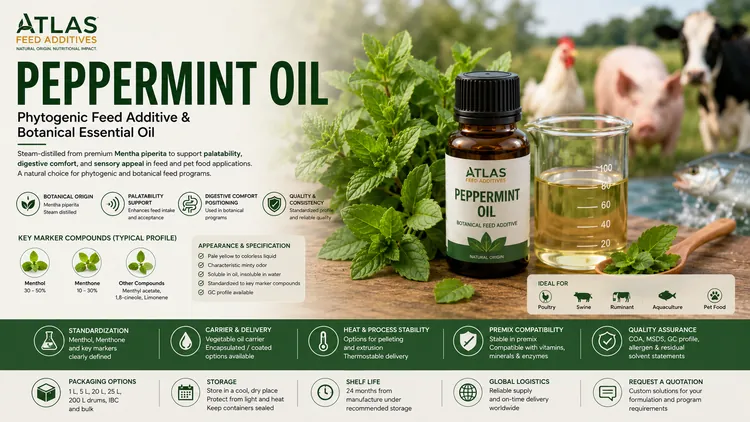
Peppermint Oil feed additive visual

Product role

Where Peppermint Oil fits

Peppermint Oil is part of the phytogenics and botanical extracts group. It is typically evaluated when feed mills, premix producers, integrators, distributors, pet food manufacturers, aquafeed producers, and botanical additive companies need a natural-origin essential oil for sensory feed applications, palatability programs, digestive-comfort positioning, or phytogenic blends.

In feed applications, peppermint oil may be supplied as a pure essential oil, standardized oil, liquid botanical blend, carrier-based powder, spray-dried preparation, encapsulated product, coated granule, or premix-ready phytogenic formulation. The practical fit depends on botanical identity, marker compounds, odor profile, carrier, oxidation control, heat stability, dose guidance, and destination-market authorization.

Commercial value is not defined only by the oil name. Buyers should compare botanical origin, Mentha species, plant part, extraction method, GC fingerprint, menthol and menthone profile, volatile stability, peroxide value, packaging quality, carrier system, premix compatibility, and whether the product is intended for sensory, technological, or zootechnical positioning.

Atlas Feed Additives can coordinate international supplier options for buyers that need consistent feed-grade material, clear marker-compound declarations, practical document review, packaging options, export-focused service, and quotation support from Ankara, Turkey.

Botanical identity

Understand the oil before comparing offers

“Peppermint Oil” is not a complete purchase specification by itself. Buyers should confirm the botanical species, plant part, growing origin, extraction method, standardization method, marker compounds, and whether the product is a pure oil, standardized oil, carrier dilution, encapsulated product, or phytogenic blend.

Common quality discussions include menthol, menthone, menthyl acetate, 1,8-cineole, limonene, pulegone limits where relevant, GC profile, odor profile, refractive index, density, optical rotation, acid value, peroxide value, color, carrier, antioxidant system, and storage stability.

Feed-grade procurement should also separate fragrance-grade, food-grade, feed-grade, technical-grade, and pharmaceutical-style documentation. These grades may differ in intended use, documentation, contaminant control, label rules, and customer acceptance.

Identity points to verify

  • Product name: Peppermint Oil.
  • Typical botanical identity: Mentha piperita oil or peppermint-based essential oil blend, depending on supplier specification.
  • Key markers: Menthol, menthone, menthyl acetate, 1,8-cineole, and GC fingerprint.
  • Common forms: Liquid oil, emulsified oil, carrier-based powder, encapsulated oil, coated granule, or botanical blend.
  • Buyer action: Compare marker compounds, oxidation status, stability, carrier, processing tolerance, and documents before price.

Functional objectives

Why Peppermint Oil is used in feed programs

Palatability and sensory support

Peppermint Oil may be selected where a recognizable fresh botanical aroma is useful for sensory feed positioning, feed acceptance programs, liquid supplements, pet food flavor systems, or young animal formulas.

Digestive-comfort positioning

In phytogenic programs, peppermint oil is often discussed as part of digestive-comfort, feeding-behavior, and natural-origin formulation concepts. Claims must remain aligned with supplier data and market rules.

Botanical blend flexibility

Peppermint Oil may be blended with oregano oil, thyme oil, cinnamon oil, eucalyptus oil, anise oil, garlic oil, carvacrol, thymol, cinnamaldehyde, or other botanicals to create broader phytogenic profiles.

Species-specific feed concepts

Poultry, swine, ruminant, aquaculture, and pet food programs may use peppermint-based products differently. Dose, form, carrier, odor intensity, palatability, and legal status should be species-specific.

Natural-origin positioning

Botanical oils are often selected for natural-origin or label-friendly feed concepts. Buyers should still verify standardization, contaminants, allergen statements, GMO status where relevant, and approved claim language.

Processing-compatible supply

Commercial value depends on volatility control, encapsulation, carrier, heat stability, oxidation protection, premix stability, packaging integrity, and finished-feed aroma retention after processing and storage.

Botanical pathway

How to think about Peppermint Oil value

Peppermint Oil value is created when botanical identity, marker-compound profile, dose, carrier, processing conditions, and target species are aligned. A practical program connects formulation, quality control, feed processing, sensory evaluation, storage, and regulatory claim review.

Botanical source GC marker profile Carrier or coating Feed application Sensory outcome Documented approval

This flow is conceptual. Commercial use should follow supplier guidance, buyer validation, qualified formulation review, and destination-market rules.

Typical applications

Where buyers commonly consider Peppermint Oil

  • Poultry, swine, ruminant, aquaculture, and pet food phytogenic programs.
  • Natural-origin feed concepts requiring botanical aroma or sensory differentiation.
  • Young animal diets where feed acceptance, aroma profile, and digestive-comfort positioning are part of the formula concept.
  • Premixes and botanical blends where peppermint oil contributes menthol-rich aromatic notes.
  • Liquid supplements, blocks, molasses-based feeds, mineral licks, and specialty products where aroma retention is important.
  • Pet food and companion animal products where flavor, odor, and consumer-facing botanical positioning require careful label review.
  • Programs comparing peppermint oil with oregano oil, thyme oil, cinnamaldehyde, carvacrol, thymol, anise oil, garlic oil, and eucalyptus oil.
  • Export programs requiring botanical origin, GC profile, contaminant statements, and market-specific documents.

Marker compounds

Review the GC profile and standardization method

Essential oil quality should be evaluated through a chemical profile, not only the product name. For peppermint oil, buyers often request a GC profile and marker-compound ranges to confirm identity, consistency, and suitability for the intended feed application.

Menthol

Menthol is commonly used as a key marker for peppermint oil identity and sensory profile. Buyers should confirm the declared range and whether the product is standardized.

Menthone

Menthone contributes to the peppermint profile and is often reviewed together with menthol and other volatile constituents. Batch-to-batch consistency matters for feed flavor programs.

Menthyl acetate

Menthyl acetate can influence aroma quality and product fingerprint. It may be included in the GC profile depending on supplier specification.

1,8-cineole

1,8-cineole may be monitored as part of the volatile profile. Buyers should compare the full GC fingerprint rather than a single marker compound.

Pulegone limits

Pulegone may be controlled by supplier specifications or market rules. Buyers should request limits and batch results where relevant to the destination market.

Oxidation indicators

Peroxide value, acid value, odor change, color, packaging oxygen exposure, and storage time can indicate oxidation risk in essential oil products.

Product forms

Commercial forms and formulation choices

Peppermint Oil can be supplied in different commercial formats. The correct form depends on whether the buyer needs direct oil blending, premix inclusion, pelleted feed use, liquid supplement use, high-stability storage, or a ready-to-use phytogenic blend.

Pure essential oil

Useful for buyers with blending capability and proper handling procedures. Requires careful dosing, sealed storage, oxidation control, and compatibility review.

Standardized oil

Standardized products define marker-compound ranges and may improve batch-to-batch consistency for feed flavor and phytogenic blend programs.

Emulsified liquid

May be used in liquid feeds, supplements, or water-compatible systems where permitted. Buyers should confirm emulsifier system, dilution, stability, and equipment compatibility.

Carrier-based powder

Powder preparations can support dry-feed and premix handling. Buyers should review carrier type, oil loading, flowability, dust level, and aroma retention.

Encapsulated oil

Encapsulation can improve volatility control, heat tolerance, handling safety, odor management, and release profile. Buyers should request encapsulation and recovery data.

Botanical blend

Peppermint Oil may be part of a blend with other essential oils or extracts. Buyers should verify each declared marker compound and the full blend specification.

Specification review

Key details to compare before selecting a Peppermint Oil supplier

Price comparisons are meaningful only when botanical identity, marker-compound profile, extraction method, carrier, active loading, oxidation status, physical form, packaging, origin, shelf-life, and documentation are aligned. Use the table below to structure supplier comparison and avoid comparing incomplete or non-equivalent offers.

Specification area What to request Why it matters
Botanical identity Botanical species, plant part, common name, Latin name, growing origin, extraction method, and whether the product is pure oil, diluted oil, or blend. Confirms that the offered product matches the buyer’s peppermint oil specification and intended feed application.
Marker compounds Menthol, menthone, menthyl acetate, 1,8-cineole, limonene, pulegone limits where relevant, and other GC-profile components. Marker compounds support identity, consistency, aroma profile, standardization, and customer approval.
GC profile Gas chromatography profile, batch chromatogram where available, specification ranges, and method used for volatile analysis. Essential oil quality should be compared by chemical fingerprint, not only by product name or odor.
Standardization Natural-range oil, standardized oil, adjusted marker levels, blend ratio, carrier dilution, and standardization method. Standardization affects batch consistency, dose calculation, label declaration, and cost-in-use.
Physical properties Appearance, color, odor, density, refractive index, optical rotation, solubility, viscosity, and evaporation behavior. Physical properties affect dosing, blending, quality control, and identity verification.
Oxidation status Peroxide value, acid value, antioxidant system, packaging oxygen barrier, headspace control, and opened-pack handling. Essential oils can oxidize, affecting odor, quality, stability, and customer acceptance.
Carrier or encapsulation Carrier type, oil loading, encapsulation technology, coating material, release behavior, dust level, and flowability. Carrier and encapsulation influence dose, heat stability, premix stability, aroma retention, and handling safety.
Dose guidance Recommended inclusion rate, target species, feed type, product form, active oil contribution, and maximum practical dose. Correct dose depends on marker profile, product form, target objective, palatability, and destination-market rules.
Processing stability Pelleting, extrusion, conditioning, drying, coating, post-pellet application, premix storage, and aroma retention data. Heat, moisture, and time can reduce volatile oil recovery and sensory effect.
Premix compatibility Compatibility with minerals, choline chloride, organic acids, enzymes, vitamins, probiotics, binders, carriers, and other essential oils. Botanical oils can interact with carriers and sensitive additives; stability should be checked in the actual matrix.
Contaminants Heavy metals, pesticide residues, PAHs where relevant, residual solvents where relevant, microbiology for carrier products, mycotoxins where relevant, and adulterant screening. Supports feed safety, import control, customer approval, and internal quality programs.
Adulteration control Authenticity statement, GC fingerprint, isotope or advanced testing where required, supplier traceability, and botanical sourcing controls. Essential oils can vary or be adulterated; authenticity control protects formulation consistency and buyer trust.
Handling safety SDS guidance, PPE, skin and eye precautions, flammability, ventilation, spill response, transport classification, and operator training requirements. Essential oils are concentrated aromatic materials and require safe storage and handling procedures.
Stability Shelf-life, expiry date, retest date, storage temperature, light protection, sealed-pack stability, humidity limits, and opened-pack handling. Helps buyers protect aroma, marker compounds, and physical quality during shipping, warehousing, and production use.
Packaging Net weight, aluminum bottle, HDPE drum, steel drum, IBC, bag, foil liner, oxygen barrier, pallet configuration, and batch coding. Affects logistics, oxidation protection, odor control, leakage prevention, warehouse handling, and traceability.
Documents Technical data sheet, product specification, COA, SDS, GC profile, origin statement, allergen statement, GMO statement where relevant, and market-specific certificates. Allows buyers to confirm quality and compliance before purchase, shipment, customs clearance, and production use.

Sensory formulation

Use aroma intensity carefully

Peppermint Oil has a strong aromatic profile. In feed and premix applications, this can be valuable for sensory positioning but can also create over-aroma, feed rejection, cross-odor, warehouse odor, or carryover concerns when dose and packaging are not controlled.

Palatability effect depends on species, diet type, age, previous exposure, total essential oil load, carrier system, feeding method, and finished-feed aroma retention. Buyers should test the selected dose in the target feed matrix before full commercial adoption.

Aroma threshold

Strong botanical aroma may be positive at one dose and excessive at another. Trial work should define the practical aroma range for each feed type.

Carryover control

Essential oil odor can carry into mixers, bags, bins, or nearby ingredients. Use cleaning, sequencing, and sealed packaging where needed.

Species response

Poultry, swine, ruminants, aquaculture species, and pets may respond differently to peppermint aroma. Species-specific testing is recommended.

Buyer quality checklist

Questions to answer before ordering

  • What botanical species and plant part are declared?
  • Is the product pure oil, standardized oil, carrier dilution, encapsulated oil, powder preparation, or botanical blend?
  • What are the declared menthol, menthone, menthyl acetate, and GC-profile ranges?
  • What oxidation indicators, peroxide value, acid value, and shelf-life are declared?
  • What is the target species, feed type, dose, and formulation objective?
  • Will the product be used in mash feed, pelleted feed, liquid feed, premix, pet food, aquafeed, or post-process application?
  • What heat stability, aroma retention, encapsulation, or finished-feed recovery data are available?
  • What contaminant, pesticide, residual solvent, heavy metal, and adulteration controls are provided?
  • What documents are required for customs, registration, buyer approval, and finished feed label review?

Program result factors

Why the same dose may perform differently

Peppermint Oil results can vary by marker-compound profile, species, feed matrix, processing conditions, carrier, and sensory acceptance. Buyers should validate the selected product under their own production and formulation conditions before full commercial adoption.

  • Menthol and menthone profile, GC fingerprint, and standardization method.
  • Pure oil versus encapsulated, emulsified, or carrier-based form.
  • Species, age, feed intake, feeding phase, and previous aroma exposure.
  • Pelleting, extrusion, drying, cooling, premix storage, or liquid application conditions.
  • Oxidation status, packaging barrier, storage temperature, and opened-pack handling.
  • Compatibility with acids, enzymes, probiotics, minerals, vitamins, and other essential oils.
  • Feed matrix fat level, moisture, carrier, odor background, and finished-feed storage.
  • Regulatory category, permitted claims, customer rules, and label language.

Formulation considerations

Use Peppermint Oil within a complete phytogenic strategy

Peppermint Oil should be evaluated inside the complete formula, not as an isolated aromatic ingredient. The formulator should review the target species, feed type, dose, botanical marker profile, aroma intensity, total essential oil load, processing conditions, premix stability, and claim language before commercial use.

In poultry and swine programs, peppermint oil may be positioned as part of natural-origin, palatability, and digestive-comfort concepts. In ruminant programs, it may be reviewed in mineral feeds, blocks, liquid supplements, or specialty blends. In pet food and aquaculture, aroma retention, palatability, extrusion stability, and label language require extra attention.

Important limitation

Peppermint Oil can support sensory and phytogenic feed concepts, but it should not be promoted with unsupported disease-treatment, prevention, immunity, antibiotic-replacement, or guaranteed-performance claims. Use only claims supported by supplier documentation and destination-market rules.

Application examples

Practical use cases by segment

Poultry feeds

May be evaluated in broiler, layer, breeder, turkey, and duck programs where phytogenic positioning, aroma profile, feed acceptance, and botanical blend design are part of the formula concept.

Swine feeds

Can be reviewed in piglet, nursery, grower, finisher, and sow programs where feed aroma, sensory appeal, and natural-origin phytogenic strategies are relevant.

Ruminant feeds

May be used in mineral feeds, lick blocks, molasses feeds, liquid supplements, and specialty ruminant blends where aroma, intake behavior, and carrier compatibility are important.

Aquaculture feeds

Requires review of extrusion temperature, oil coating, water stability, aroma retention, species response, and whether the product should be post-applied or encapsulated.

Pet food

Can be evaluated for botanical positioning and aroma concepts, but palatability, consumer perception, label wording, and species-specific safety should be reviewed carefully.

Premixes and blends

Premix producers need marker-compound declarations, carrier compatibility, aroma control, flowability, dust control, stability, and shelf-life data before inclusion.

Species and formulation review

Species-specific questions before commercial approval

Broilers and poultry

Review feed phase, dose, carrier, total essential oil load, pelleting recovery, feed intake, aroma intensity, and compatibility with enzymes, probiotics, acids, and coccidiostats where permitted.

Piglets and nursery pigs

Review aroma acceptance, feed transition, acidifier use, zinc or copper programs where permitted, gut-comfort positioning, dose, and the risk of over-aroma in starter diets.

Grower-finisher pigs

Review cost-in-use, feed intake, aroma retention after pelleting, botanical blend strategy, and whether the target claim is sensory or zootechnical.

Ruminants

Review delivery method, mineral mix carrier, molasses compatibility, lick-block processing, intake variability, rumen program context, and customer label expectations.

Aquaculture

Review extrusion stability, oil coating, post-process application, water stability, feed intake, species response, and essential oil release in aquatic feed systems.

Pet food

Review dog and cat suitability separately, palatability, aroma intensity, consumer-facing claims, botanical identity, and local rules for essential oil use in companion animal diets.

Processing stability

Protect volatile oil quality through production

Volatile loss

Essential oils can lose aroma during heating, mixing, drying, pelleting, or extrusion. Encapsulation, coating, or post-process application may be needed.

Oxidation control

Light, oxygen, heat, and opened packaging can affect oil quality. Review antioxidant system, oxygen-barrier packaging, headspace control, and storage temperature.

Premix environment

Minerals, acids, choline chloride, high humidity, and long storage can affect aroma and marker-compound stability. Use data from the actual premix matrix.

Carrier behavior

Carrier type affects oil loading, dust, flowability, segregation, release, and finished-feed aroma. Compare carrier-based products by active oil contribution.

Liquid application

Liquid systems require correct dilution, mixing, emulsification, pump calibration, nozzle condition, tank hygiene, and compatibility with other liquid additives.

Finished-feed storage

Finished feed stored in warm or open conditions can lose aroma. Review packaging, storage time, bag closure, bulk-bin exposure, and customer acceptance.

Control program

How to manage Peppermint Oil use more consistently

Define the objective

Identify whether the goal is palatability, sensory differentiation, botanical extract positioning, digestive-comfort concept, or inclusion in a wider phytogenic blend.

Confirm marker profile

Request menthol, menthone, full GC profile, oxidation values, origin, and standardization details before calculating dose and comparing supplier offers.

Match the feed process

Choose pure oil, powder, encapsulated oil, liquid emulsion, or coated granule according to premix, mash, pellet, extrusion, liquid feed, or post-process application needs.

Apply uniformly

Use validated mixing, carrier dilution, liquid dosing, or micro-dosing methods so aroma and active botanical compounds are distributed consistently across the batch.

Protect quality

Use sealed packaging, cool storage, light protection, stock rotation, clean equipment, and opened-pack controls to reduce oxidation and volatile loss.

Review acceptance

Track feed intake, odor acceptance, product complaints, batch aroma, storage stability, and customer feedback according to the intended application.

Compatibility review

Ingredients and additives to review before blending

Other essential oils

When peppermint oil is blended with oregano, thyme, cinnamon, anise, garlic, eucalyptus, or clove oils, review total essential oil load, marker declarations, and sensory balance.

Organic acids

Acidifiers can affect carrier systems, premix stability, odor, and release. Confirm compatibility before blending peppermint oil with acidifier products.

Enzymes and probiotics

Essential oils may be aggressive in concentrated premixes. Review whether enzymes, probiotics, and live microbial products should be separated or protected.

Trace minerals

Trace mineral premixes can be reactive or humid. Check carrier, oxidation, aroma retention, and marker-compound stability in mineral-containing premixes.

Fats and oils

Peppermint oil can be blended into fat systems or post-coating oils, but oxidation, aroma migration, tank compatibility, and uniform application should be reviewed.

Medications where permitted

Where medicated feed is allowed, check compatibility and label rules carefully. Botanical oil use should not conflict with veterinary additives or claim restrictions.

Risk management

Common risks to control before launch

Adulteration risk

Essential oils can vary or be adulterated. Use trusted suppliers, GC profiles, authenticity statements, and traceability documents to control identity risk.

Over-aroma

Too much peppermint aroma can reduce acceptance or create complaints. Conduct controlled dose trials and define practical sensory limits.

Volatile loss

Heat, time, and open storage can reduce aroma and marker-compound recovery. Select encapsulation, coating, or post-process application where needed.

Oxidation

Oxidized oil may change odor and quality. Review peroxide value, packaging, antioxidant system, storage temperature, and opened-pack controls.

Unsupported claims

Avoid disease, immunity, antibiotic-replacement, treatment, prevention, or guaranteed performance claims unless independently authorized and documented.

Documentation gaps

Missing GC profile, origin, contaminant statements, or market-specific documents can delay customs clearance, customer approval, and commercial launch.

Production and handling

Practical feed mill checkpoints

Receiving

Check supplier name, product name, botanical identity, batch number, manufacturing date, expiry or retest date, packaging condition, seal integrity, odor condition, and match against purchase order and documents before unloading.

Sampling

Retain representative samples according to the buyer’s quality procedure. Use suitable sealed containers to reduce volatile loss and clearly identify sample date, batch, supplier, and receiving reference.

Storage

Store closed packaging in a cool, dry, clean, ventilated area away from heat, direct sunlight, ignition sources, oxidizing chemicals, strong odors, and unauthorized access. Follow supplier-specific storage instructions.

Dosing

Use calibrated dosing, carrier dilution, micro-dosing, or liquid application procedures. Verify active oil contribution, dose, batch size, and inclusion point before production.

Mixing

Use validated mixing procedures to support uniform distribution. Check mixer order, carrier premix, liquid spray pattern, minimum mixing time, and odor carryover risk.

Handling safety

Review the safety data sheet before use. Essential oils may require gloves, eye protection, ventilation, spill procedures, flammability controls, and trained operators.

Quality documents

Documents commonly requested by buyers

Technical data sheet

Explains botanical identity, marker compounds, target applications, dose guidance, form, handling, storage, compatibility, and product positioning.

Product specification

Defines marker compound ranges, GC profile targets, appearance, odor, color, density, refractive index, peroxide value, carrier, shelf-life, and packaging.

Certificate of analysis

Confirms batch-specific marker compounds, GC profile, physical properties, oxidation indicators, contaminants, microbiology for carrier products, and agreed limits.

Safety data sheet

Provides handling, storage, transport, exposure, spill, first-aid, PPE, flammability, ventilation, and safety information for warehouse and feed mill teams.

GC profile

Supports botanical identity, marker-compound verification, standardization, authenticity review, and customer approval.

Stability information

May include shelf-life, oxidation stability, premix stability, heat exposure, aroma retention, humidity limits, and opened-package handling.

Compliance statements

May include allergen, GMO, pesticide, residual solvent, heavy metal, adulteration, natural-origin, or market-specific regulatory statements.

Origin and batch details

Supports import control, traceability, customer audits, registration review, and destination-market documentation.

Logistics documents

Commercial invoice, packing list, certificate of origin, bill of lading or airway bill, dangerous goods documentation where applicable, and special import documents.

Before commercial use

Internal approval questions

  1. Which species, feed type, and botanical objective is the product intended for?
  2. What botanical identity, marker-compound profile, and GC specification are required?
  3. Is the exact product authorized for the destination country, species, dose, and claim language?
  4. Will the product be applied as oil, emulsion, powder, encapsulated oil, coated granule, or blend component?
  5. What processing, heat stability, aroma retention, and premix stability data are available?
  6. What dose range, sensory target, and customer acceptance criteria will be used?
  7. Which PPE, storage, flammability, spill-control, and operator-training requirements apply?
  8. Does the supplier provide COA, SDS, TDS, specification, GC profile, origin statement, and batch traceability?
  9. Has the buyer calculated cost-in-use based on active oil contribution, marker profile, dose, carrier, and processing stability?

Supplier evidence

Useful evidence to request from suppliers

GC fingerprint

Ask for GC profile, marker ranges, batch chromatogram where available, method statement, and comparison against specification.

Authenticity support

Request botanical identity, origin, extraction method, traceability, authenticity statement, and adulteration-screening approach where required.

Stability data

Ask for oxidation stability, shelf-life, heat exposure, premix stability, encapsulation retention, and opened-pack handling guidance.

Carrier information

Request carrier identity, oil loading, release profile, dust level, flowability, solubility, and label implications for carrier-based or encapsulated products.

Contaminant controls

Review heavy metals, pesticide residues, residual solvents, PAHs where relevant, microbiology for carrier products, and customer-specific contaminant limits.

Regulatory package

Confirm whether the supplier can support destination-market review with product identity, feed-grade status, label wording, and required certificates.

Procurement note

Ask for the GC profile and marker compounds before comparing prices

Two Peppermint Oil offers can differ significantly in botanical species, origin, extraction method, menthol level, menthone level, GC profile, oxidation status, carrier, encapsulation, active oil loading, packaging, shelf-life, odor quality, and document package. For that reason, Atlas Feed Additives recommends comparing offers on a specification-aligned and cost-in-use basis rather than price per kilogram or liter alone.

For sensitive botanical products, buyers should also review storage conditions, opened-pack handling, volatile-loss risk, premix compatibility, pelleting or extrusion recovery, batch coding, retained-sample procedure, operator safety, and the legal status of the product in the destination market.

Information to include in your RFQ

  • Product name: Peppermint Oil
  • Required botanical identity: Mentha piperita oil, peppermint essential oil, standardized oil, or reference specification
  • Required marker compounds: menthol, menthone, menthyl acetate, 1,8-cineole, pulegone limit, or full GC profile
  • Preferred form: pure oil, standardized oil, emulsified liquid, carrier-based powder, encapsulated oil, coated granule, or botanical blend
  • Target species: poultry, swine, ruminant, aquaculture, pet food, or other approved species
  • Target application: premix, mash, pellet, extruded feed, liquid feed, supplement, block, pet food, or botanical blend
  • Target dose or active oil contribution per metric ton
  • Processing conditions: pelleting, extrusion, drying, post-application, or premix storage
  • Required contaminant, pesticide, residual solvent, allergen, GMO, or authenticity statements
  • Trial quantity, monthly demand, or annual forecast
  • Destination country and preferred Incoterms
  • Packaging preference: aluminum bottle, HDPE drum, steel drum, IBC, foil bag, carton, or pallet format
  • Required documents and certificate format
  • Target delivery date and preferred shipment method
Send RFQ details

Commercial fit

Who usually requests Peppermint Oil?

Feed mills

For compound feed, mash, pellets, crumbles, liquid feeds, and specialty formulas where botanical aroma, palatability, and phytogenic positioning are part of the feed concept.

Premix producers

For botanical premixes, essential oil blends, natural-origin concepts, and customized phytogenic additives requiring marker-compound documentation and stability data.

Poultry and swine integrators

For young animal, gut-comfort, sensory, and botanical feed programs where dose, processing stability, and approved claim language must be reviewed.

Ruminant nutrition companies

For mineral feeds, lick blocks, molasses feeds, liquid supplements, and specialty botanical formulas where aroma and intake behavior are important.

Aquafeed and pet food producers

For specialty feed systems where aroma retention, extrusion stability, coating, palatability, consumer-facing label language, and species suitability require careful review.

Distributors and importers

For market-ready botanical oil sourcing with supplier coordination, document review, packaging options, certificate support, and export-focused service.

Responsible positioning

Use clear and compliant claim language

Because botanical extracts, essential oils, feed flavors, and phytogenic additives may be regulated differently across countries, product labels, brochures, technical sheets, and product pages should be reviewed before commercial use. Peppermint Oil should be presented through supported sensory, botanical, or phytogenic language rather than unsupported therapeutic or disease-related claims.

  • Use “supports palatability” when the product is positioned as a sensory feed ingredient or flavoring component.
  • Use “botanical extract” or “phytogenic feed additive” when destination-market rules support that language.
  • Use “digestive-comfort positioning” only when claim wording is acceptable and supported by supplier documents.
  • Use “natural-origin feed concept” where documentation and customer rules support the claim.
  • Avoid disease, immunity, antibiotic-replacement, treatment, prevention, or guaranteed performance claims unless independently authorized and documented.
Regulatory reminder

Atlas Feed Additives can help organize supplier documents and quotation details, but buyers remain responsible for confirming registration, import permission, feed-label rules, additive authorization status, approved species, dose range, botanical declaration, and allowed marketing language in the destination market before purchase or commercial use.

Approval workflow

Suggested internal approval path

Formulation approval

Confirm target species, product form, dose, marker profile, sensory target, carrier, blend partners, and compatibility with the complete formula.

Quality approval

Review GC profile, COA format, specification, SDS, origin, batch coding, contaminants, oxidation limits, shelf-life, storage instructions, and retained-sample procedure.

Production approval

Check dosing equipment, carrier dilution, mixing uniformity, heat exposure, liquid application, aroma carryover, flammability controls, and operator safety.

Regulatory approval

Confirm permitted species, feed type, additive category, botanical declaration, label wording, import documents, and destination-market authorization.

Purchasing approval

Compare cost-in-use, supplier reliability, minimum order quantity, lead time, payment terms, packaging, shipment requirements, and reorder plan.

Commercial approval

Finalize customer acceptance, certificate wording, private-label needs, contract terms, claim language, aroma standard, and after-sales document support.

Implementation plan

Suggested steps from sample to commercial order

  1. Define the formulation objective. Identify the species, feed type, sensory target, phytogenic concept, dose range, and expected commercial positioning.
  2. Review the specification. Confirm botanical identity, extraction method, marker compounds, GC profile, oxidation values, carrier, encapsulation, and shelf-life.
  3. Check documents. Request technical data sheet, product specification, COA, SDS, GC profile, origin statement, contaminant statements, storage guidance, and market-specific certificates.
  4. Evaluate processing conditions. Decide whether the product will be used in mash feed, premix, pelleted feed, extruded feed, liquid supplement, block, pet food, or post-process application.
  5. Review safety and storage controls. Confirm PPE, flammability, ventilation, light protection, oxygen exposure, opened-pack handling, and stock rotation.
  6. Run a controlled trial. Use defined dose, batch records, retained samples, sensory checks, feed intake records, aroma retention review, and customer acceptance criteria.
  7. Approve commercial specification. Finalize marker profile, product form, packaging, document set, label wording, supplier quality expectations, shipment terms, and reorder plan.

Questions

Useful answers

What is Peppermint Oil used for in animal nutrition?

Peppermint Oil is used in phytogenic and botanical feed programs focused on palatability, sensory appeal, digestive-comfort positioning, botanical extract blends, and natural-origin formulation concepts. It should be used according to target species, dose, product form, supplier guidance, and applicable market rules.

Is Peppermint Oil one fixed specification?

No. Commercial peppermint oil products can differ by botanical species, origin, extraction method, menthol level, menthone level, GC profile, standardization method, carrier, encapsulation, oxidation status, packaging, shelf-life, and document package. Always request the exact supplier specification before comparing offers.

Which marker compounds are important?

Buyers commonly review menthol, menthone, menthyl acetate, 1,8-cineole, limonene, pulegone limits where relevant, and the complete GC profile. The required marker range should match the target application and market rules.

Can Peppermint Oil be used in pelleted feed?

It may be used in pelleted feed when the selected form is suitable for processing. Buyers should review volatile-loss risk, encapsulation, coating, carrier, pelleting temperature, aroma retention, and finished-feed stability before approval.

Can Peppermint Oil be used in premixes?

Yes, but premix compatibility should be reviewed carefully. Minerals, acids, choline chloride, enzymes, probiotics, humidity, and long storage may affect aroma or marker-compound stability.

How should buyers compare Peppermint Oil prices?

Buyers should compare botanical identity, marker-compound profile, GC fingerprint, oil loading, product form, carrier, encapsulation, oxidation status, packaging, shelf-life, document package, and cost-in-use. Price per kilogram or liter alone can be misleading.

What quality documents should buyers request for Peppermint Oil?

Common documents include technical data sheet, product specification, certificate of analysis, safety data sheet, GC profile, origin information, batch number, manufacturing date, expiry or retest date, storage conditions, contaminant statements, allergen or GMO statements where relevant, and market-specific certificates.

What storage conditions are important?

Store closed packaging in a cool, dry, clean, ventilated area away from heat, direct sunlight, oxygen exposure, ignition sources, oxidizing chemicals, strong odors, and unauthorized access. Follow supplier instructions and use proper stock rotation.

Does Peppermint Oil replace veterinary or hygiene programs?

No. Peppermint Oil is a botanical feed ingredient or additive concept and should not be used to replace veterinary care, hygiene management, biosecurity, diet quality, or approved health programs.

Can Atlas Feed Additives quote Peppermint Oil?

Yes. Send your required specification, marker profile, quantity, destination, packaging preference, and documents so Atlas Feed Additives can review suitable supplier options for Peppermint Oil.

What information is needed for a quotation?

Send the target species, feed type, required botanical identity, marker-compound targets, preferred form, dose, processing conditions, quantity, destination country, delivery term, packaging preference, and required documents so Atlas Feed Additives can review suitable supplier options.

Request a quotation

Tell us what you need

Send your product list, target specification, destination country, packaging preference, and required documents. Our team will review your request and respond from orders@feedgradeadditives.com.

For faster review, include required botanical identity, marker-compound target, preferred form, target species, dose, feed type, processing conditions, expected quantity, preferred Incoterms, destination port, packaging preference, and any required certificate format.