Flavors, sweeteners, and palatability enhancers

Anise Oil

Feed-grade anise aroma sourcing for programs where feed acceptance, intake consistency, sensory identity, raw-material transition, and flavor masking are important in sensitive feeding phases, young animal diets, pet food, aquaculture feed, and specialty feed applications.

Atlas Feed Additives supports buyers that need Anise Oil supplier comparison, sensory standard review, active-marker confirmation, carrier and form selection, processing guidance, storage instructions, export documentation, packaging confirmation, and quotation coordination for international feed and premix supply chains.

Feed aroma Palatability support Piglet & calf feeds Pet food Aquaculture feeds Specification matching
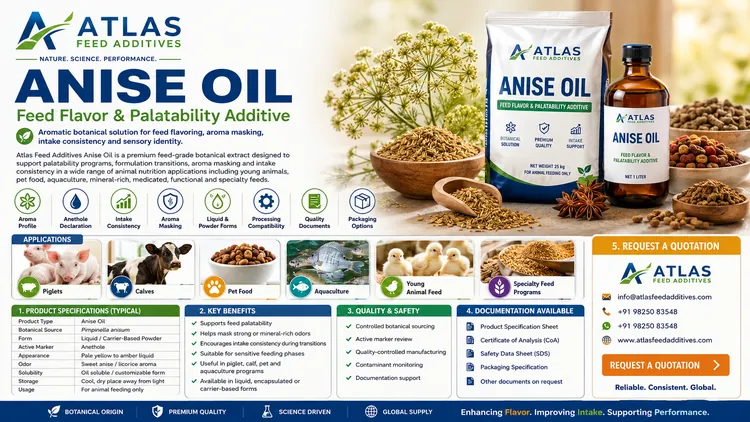
Anise Oil feed additive visual

Product role

Where Anise Oil fits

Anise Oil is part of the flavors, sweeteners, and palatability enhancers group. It is evaluated when feed mills, premix producers, pet food manufacturers, aquaculture feed producers, young animal feed manufacturers, distributors, and integrators need a sensory feed additive that can help create a recognizable aroma profile and support feed acceptance during formulation changes.

The product is commonly associated with a sweet, licorice-like, aromatic profile. In feed applications, the commercial objective is usually not nutrition replacement, but sensory management: improving aroma identity, supporting intake consistency, helping mask challenging raw-material notes, and maintaining feed familiarity across raw-material or formulation transitions.

Anise Oil should not be compared by product name alone. Two offers can differ in botanical source, active marker profile, anethole content where declared, aroma strength, carrier, concentration, product form, volatility, heat stability, solubility, storage requirement, regulatory status, and cost-in-use.

Atlas Feed Additives can coordinate international supplier options for buyers that need consistent feed-grade material, clear specification comparison, practical document review, packaging options, export-focused service, and quotation support from Ankara, Turkey.

Functional objectives

Why Anise Oil is used in feed flavor programs

Feed acceptance support

Anise Oil may be used where aroma and flavor cues are part of a feed acceptance strategy. It is especially relevant when animals face a new feed format, new raw-material profile, or transition between diets.

Intake consistency

Consistent aroma can help reduce sensory variation between batches. This matters in young animal diets, specialty feeds, pet food, and formulas where small changes in smell or taste may affect feeding behavior.

Raw-material masking

Some feed ingredients bring bitter, mineral, fermented, oxidized, herbal, sulfur, or marine notes. Anise aroma can be part of a masking system that makes the finished feed more familiar and acceptable.

Formula transition support

When feed mills change protein sources, oils, medication programs, mineral levels, organic acids, or functional additives, a recognizable flavor profile can help maintain continuity between old and new formulations.

Specialty feed differentiation

Pet food, treats, supplements, milk replacer-related products, young animal feeds, and specialty feeds may use flavor systems to create a repeatable sensory identity that supports brand consistency.

Premix and concentrate flexibility

Anise Oil can be supplied as a liquid, powder, encapsulated aroma, or carrier-based premix depending on the buyer’s mixing system, dose accuracy needs, processing conditions, and storage expectations.

Sensory profile

Typical aroma positioning

Anise Oil is normally selected for a recognizable sweet, aromatic, licorice-like sensory direction. The exact profile can vary by botanical source, active marker level, distillation quality, carrier, oxidation status, storage conditions, and whether the product is a pure oil, standardized blend, powder, or encapsulated preparation.

Sweet aromatic Licorice-like Warm herbal Masking support Feed identity

Sensory descriptions are indicative only. Commercial approval should be based on the buyer’s own feed matrix, sensory panel review, target species, and stability testing.

Typical applications

Where buyers commonly consider Anise Oil

  • Piglet starter, creep, prestarter, and transition feeds where early feed familiarity and intake consistency are priorities.
  • Calf starter feeds, milk replacer-related systems, and young ruminant programs where aroma continuity is important.
  • Pet food, treats, supplements, and specialty products where a recognizable aroma profile supports product identity.
  • Aquaculture feeds where attractant systems, coating liquids, or aroma cues are used as part of palatability management.
  • Mineral-rich, medicated, botanical, organic acid, or functional formulas where permitted and where masking is required.
  • Feed programs facing raw-material changes, alternative protein inclusion, strong oils, marine ingredients, fermented products, or bitter components.
  • Premixes and concentrates where a stable aroma system must distribute evenly into finished feed.

Format options

Common product forms and formulation choices

“Anise Oil” may refer to a pure essential oil, a standardized liquid flavor, an oil-based blend, a water-dispersible preparation, an encapsulated flavor, or a carrier-based powder preparation. Buyers should confirm the exact product form, active marker profile, carrier, concentration, dispersibility, stability, and regulatory status before comparing supplier offers.

Essential oil

Used where the buyer wants a concentrated anise aroma profile. It requires careful dosing, storage protection, and compatibility review with oils, carriers, acids, premix ingredients, and processing conditions.

Standardized liquid blend

May be selected when the buyer needs a repeatable aroma strength, easier dilution, oil compatibility, or use through liquid dosing systems, coating applications, or palatability blends.

Carrier-based powder

Useful for premix and dry feed systems where flowability, lower volatility, dust control, and uniform mixing are required.

Encapsulated flavor

May help protect volatile aroma compounds from heat, oxidation, moisture, and storage losses. Encapsulation can be important for pelleting or longer shelf-life products.

Customized flavor system

Anise notes may be combined with vanilla, milk, sweeteners, herbal notes, fruit notes, fermentation notes, attractants, or masking agents depending on species, feed category, and target sensory profile.

Premix-ready preparation

Designed for premix producers that need accurate dosing, consistent blending, reduced handling risk, clear documentation, and compatibility with vitamin-mineral systems.

Regulatory note

Flavor and sensory additive authorizations can differ by country, species, feed type, ingredient source, active marker, and claim language. Buyers should confirm registration status, permitted use, label wording, and maximum inclusion rules in the destination market before purchase or commercial use.

Specification review

Key details to compare before selecting an Anise Oil supplier

Price comparisons are meaningful only when botanical source, active marker profile, concentration, sensory standard, carrier, product form, solubility, packaging, origin, shelf-life, and documentation are aligned. Use the table below to structure supplier comparison and avoid comparing incomplete or non-equivalent offers.

Specification area What to request Why it matters
Product identity Trade name, botanical source, technical name, feed-grade status, functional group, intended species, and intended use. Confirms that the product matches the buyer’s formulation purpose, feed additive category, and destination-market requirements.
Sensory profile Aroma description, flavor direction, odor strength, reference standard, sensory panel notes, and batch-to-batch acceptance criteria. Flavor products are purchased for sensory function; consistent aroma is essential for feed acceptance and brand identity.
Active marker profile Anethole content where declared, chromatographic profile where available, marker range, assay method, and purity indicators. Marker profile helps compare source quality, standardization, strength, and potential batch variation.
Product form Essential oil, standardized liquid, encapsulated flavor, powder, granule, oil-based blend, water-dispersible blend, or carrier-based premix. Form affects dosing, mixing, volatility, stability, application equipment, and feed process compatibility.
Carrier system Carrier type, dilution base, silica or starch carrier where relevant, oil carrier, emulsifier, encapsulation matrix, and flowability data. Carrier selection influences uniformity, dusting, solubility, release profile, and compatibility with premixes or finished feed.
Solubility and dispersibility Oil solubility, water dispersibility, emulsification behavior, coating compatibility, and premix compatibility. Good dispersion is needed for consistent aroma distribution and reliable dosing in feed production.
Volatility Volatile component stability, odor loss during storage, opened-container handling, headspace control, and packaging protection. Essential oil aroma compounds can evaporate or oxidize if storage and packaging are not suitable.
Processing tolerance Pelleting, extrusion, conditioning, drying, cooling, oil coating, mixing, and premix storage guidance. Heat, moisture, pressure, and residence time can reduce aroma intensity or change release profile.
Dose guidance Recommended inclusion level, target species, feed type, application point, and sensory intensity guidance. Correct dose depends on feed matrix, masking challenge, animal species, and target aroma intensity.
Compatibility Compatibility with acids, minerals, vitamins, sweeteners, probiotics, enzymes, medication programs, binders, pigments, antioxidants, coating oils, and palatants. Some ingredients can alter aroma release, stability, or sensory perception in the final feed.
Microbiological quality Total plate count, yeast and mold, Salmonella status, Enterobacteriaceae limits, and other relevant microbiological parameters. Supports feed safety and buyer quality programs, especially for imported additives and premix applications.
Contaminants Heavy metals, pesticide residues, solvent residues where relevant, foreign matter, adulterants, and unwanted impurities. Supports feed safety, export compliance, customer approval, and internal quality programs.
Stability Shelf-life, expiry date, retest date, storage temperature, humidity limits, light protection, oxidation protection, and opened-pack handling. Helps buyers protect aroma strength and active profile during shipping, warehousing, and production use.
Packaging Net weight, bottle, drum, canister, bag, foil liner, oxygen barrier, pallet configuration, label language, and batch coding. Affects handling safety, aroma retention, moisture protection, logistics, warehouse control, and traceability.
Documents Technical data sheet, product specification, COA, SDS, origin statement, batch details, allergen or GMO statement where relevant, sensory profile, and market-specific certificates. Allows importers and feed manufacturers to confirm quality and compliance before purchase and shipment.

Buyer quality checklist

Questions to answer before ordering

  • What is the exact botanical source, product form, and sensory standard?
  • Is the product supplied as pure oil, standardized liquid, encapsulated flavor, powder, or premix-ready preparation?
  • Is an active marker such as anethole declared, and which analytical method is used?
  • Which species, feed types, and destination markets are authorized for the product?
  • What dose range is recommended for the target species and feed matrix?
  • Will the product be used in mash, pellet, extruded feed, coated feed, milk replacer-related products, mineral premix, or pet food?
  • How stable is the aroma through heat, moisture, oil coating, long storage, and opened-container handling?
  • What documents are required for customs, registration, buyer approval, finished feed label review, and internal QA?

Sensory result factors

Why the same dose may perform differently

Flavor response can vary between feed formulas, production systems, species, farms, and raw-material batches. Buyers should evaluate the selected specification under their own process conditions before full commercial adoption.

  • Feed intake pattern, animal age, feeding phase, and stress level.
  • Diet type, fat level, moisture level, and feed texture.
  • Background aroma from protein sources, oils, minerals, acids, botanicals, marine ingredients, and fermentation products.
  • Use of sweeteners, milk flavors, vanilla, fruit notes, yeast products, palatants, or masking agents.
  • Pelleting, extrusion, drying, cooling, and post-pellet coating conditions.
  • Storage temperature, oxygen exposure, packaging type, and opened-pack handling.
  • Distribution uniformity in premix and finished feed.
  • Customer sensory standard and acceptance range.

Formulation considerations

Use Anise Oil as part of a complete palatability program

Anise Oil should be evaluated within the full feed formula. The final sensory result depends on the target species, feed form, carrier system, dose, background ingredients, process conditions, and whether the formula also includes sweeteners, dairy notes, yeast products, organic acids, botanicals, probiotics, enzymes, medications, minerals, or other aroma components.

For young animals, the objective may be early feed familiarity and consistent intake. For pet food and specialty feeds, the objective may be brand aroma identity and consumer-recognizable product quality. For aquafeed, anise aroma may be considered as part of a broader attractant or coating system where water stability and oil compatibility are also important.

Responsible use note

Do not market Anise Oil with unsupported therapeutic, disease-treatment, growth, immunity, antibiotic-replacement, or medicinal claims. It should be positioned as a sensory feed additive or flavoring ingredient according to supplier documents and destination-market rules.

Application examples

Practical use cases by segment

Piglet feeds

May be considered in creep feed, prestarter, starter, and transition diets where aroma familiarity, early feed exploration, and raw-material masking are formulation priorities.

Calf feeds

Can be evaluated in calf starter, young ruminant feed, and milk replacer-related systems where aroma continuity and feed acceptance are important during early development.

Pet food

May support a recognizable sensory identity in kibble, treats, supplements, and specialty products. Buyers should confirm label rules, heat stability, oxidation stability, and consumer-facing aroma expectations.

Aquaculture feed

Can be reviewed as part of a palatability or coating system where feed aroma, oil compatibility, water stability, species-specific feeding behavior, and attractant combinations must be considered.

Mineral-rich formulas

May be used where mineral salts, trace elements, acids, or functional additives create challenging taste or odor notes, subject to permitted use and proper dose control.

Private-label premixes

Useful for distributors and premix producers that want a recognizable aroma profile in a custom palatability system with clear documentation and repeatable blending behavior.

Palatability-control program

How to manage aroma and intake consistency more effectively

Define the sensory target

Identify whether the goal is aroma identity, masking, intake support, diet transition, specialty product positioning, or compatibility with another flavor system.

Evaluate the feed matrix

Review the background odor and taste from oils, proteins, minerals, acids, yeast products, marine ingredients, botanicals, medications, alternative proteins, and processing aids.

Select the right form

Choose liquid oil, standardized blend, powder, encapsulated flavor, or premix-ready carrier depending on application equipment, processing temperature, and storage requirements.

Apply at the right point

Flavor may be added through premix, mixer addition, oil coating, post-pellet application, liquid system, or specialty blending depending on heat exposure and desired aroma retention.

Verify uniformity

Use proper dilution, dosing calibration, carrier selection, and mixing sequence to reduce uneven aroma distribution and batch-to-batch variation.

Monitor during storage

Use retained samples, sensory review, package checks, shelf-life monitoring, opened-container controls, and customer feedback to confirm whether aroma intensity remains acceptable.

Compatibility review

How Anise Oil may interact with other feed components

With sweeteners

Anise aroma may be paired with sodium saccharin, neohesperidin dihydrochalcone, or sweetener blends where permitted. The final profile should be tested in the actual feed matrix.

With milk or vanilla flavors

Young animal programs may combine anise with milk, vanilla, or creamy notes. The ratio should support the target aroma identity without overpowering the base feed.

With organic acids

Organic acids can create sharp notes that may need masking. Compatibility should be checked because acids, moisture, and pH can affect flavor release and storage stability.

With minerals

Mineral premixes may create metallic, salty, or bitter notes. Carrier selection and dose control are important when using flavor systems in high-mineral formulas.

With oils and coatings

Oil-based application can support aroma distribution, but the flavor must be compatible with the oil source, coating temperature, mixing time, and storage condition.

With probiotics and enzymes

Biological additives may have storage and process sensitivities. Moisture, carrier, acids, heat, and premix contact time should be reviewed before combining concentrated additives.

Production and handling

Practical feed mill checkpoints

Receiving

Check supplier name, product name, product form, concentration, batch number, manufacturing date, expiry or retest date, container condition, seal integrity, and match against purchase order and documents before unloading.

Sampling

Retain representative samples according to the buyer’s quality procedure. Identify samples with date, batch, supplier, product name, receiving reference, and sampler name so the material remains traceable.

Storage

Store closed packaging in a dry, cool, clean, ventilated area away from heat, direct sunlight, moisture, oxygen exposure, strong odors, pests, and incompatible chemicals. Follow supplier-specific storage instructions.

Dosing

Use calibrated scales, pumps, dosing systems, or premix dilution. Verify inclusion rate, dilution ratio, flow rate, carrier compatibility, and application point before production.

Mixing

Use a validated premix or dilution step when needed to improve distribution. Check mixer sequence, retention time, liquid addition order, and batch records to reduce under- or over-dosing risk.

Traceability

Keep supplier documents, receiving records, batch usage, production lots, retained samples, and shipment records connected so finished feeds can be traced back to the flavor batch.

Volatility control

Keep containers closed when not in use, avoid unnecessary headspace exposure, and limit exposure to hot surfaces, open air, or high-shear processing when aroma retention is critical.

Operator safety

Review SDS guidance for ventilation, skin contact, eye contact, inhalation, spill control, storage segregation, first aid, and personal protective equipment before handling concentrated oils.

Finished-feed review

Check final feed aroma, uniformity, retained sample condition, packaging integrity, odor drift, and customer feedback to confirm whether the flavor program is meeting expectations.

Quality documents

Documents commonly requested by buyers

Technical data sheet

Explains sensory profile, product form, target applications, dosage guidance, solubility, handling, storage, and positioning.

Product specification

Defines botanical source, active marker profile where available, appearance, carrier, physical form, quality limits, shelf-life, and storage conditions.

Certificate of analysis

Confirms batch-specific results for appearance, odor, marker content where tested, density, moisture, microbiology, contaminants, or other agreed quality limits.

Safety data sheet

Provides handling, storage, transport, exposure, spill, first-aid, and safety information for warehouse and feed mill teams.

Sensory profile

May include aroma descriptors, intensity, reference standard, batch acceptance criteria, sensory panel notes, and internal control standards where available.

Origin and batch details

Supports import control, traceability, customer audits, registration review, and destination-market documentation.

Compliance statements

May include GMO, allergen, BSE/TSE, pesticide, solvent residue, heavy metal, natural-origin, botanical-source, or food/feed-grade statements depending on buyer and market needs.

Stability information

May include shelf-life, aroma retention, light protection, oxidation protection, storage temperature, humidity limits, opened-container handling, and processing tolerance.

Logistics documents

Commercial invoice, packing list, certificate of origin, bill of lading or airway bill, and any special import documents requested by the buyer.

Before commercial use

Internal approval questions

  1. Which species, feed type, and sensory objective is the product intended for?
  2. Is the product an essential oil, standardized liquid, powder, encapsulated flavor, or premix-ready preparation?
  3. What active marker profile, sensory standard, and batch acceptance criteria are required?
  4. Will the flavor be added before pelleting, after drying, through oil coating, or through a premix?
  5. What heat, moisture, oxygen, and storage conditions will the product face?
  6. Which sensory method will be used to approve batch-to-batch consistency?
  7. Does the supplier provide COA, SDS, TDS, specification, origin statement, and batch traceability?
  8. Has the buyer calculated cost-in-use based on concentration, dose, aroma retention, and practical application method?

Procurement note

Ask for the sensory standard before comparing prices.

Two Anise Oil offers can differ significantly in botanical source, active marker profile, aroma strength, product form, carrier, solubility, encapsulation, volatility, heat stability, origin, packaging, shelf-life, and documentation. For that reason, Atlas Feed Additives recommends comparing offers on a specification-aligned and cost-in-use basis rather than price per kilogram alone.

For sensitive flavor products, buyers should also review packaging protection, oxygen exposure, opened-container handling, storage temperature, premix compatibility, pelleting or extrusion tolerance, batch coding, retained-sample procedure, and the legal status of the product in the destination market.

Information to include in your RFQ

  • Product name: Anise Oil
  • Target species and feeding phase
  • Feed type: mash, pellet, crumble, extruded, coated, liquid, premix, pet food, milk replacer-related product, or aquafeed
  • Sensory objective: aroma identity, masking, intake support, brand identity, or transition support
  • Required product form: essential oil, standardized liquid, encapsulated flavor, powder, or premix-ready preparation
  • Preferred active marker profile or reference specification
  • Expected inclusion rate or target aroma intensity
  • Processing method and application point
  • Trial quantity, monthly demand, or annual forecast
  • Destination country and preferred Incoterms
  • Packaging preference and label requirements
  • Required documents and certificate format
  • Target delivery date and preferred shipment method
Send RFQ details

Cost-in-use

Compare aroma value, not only invoice price

The economic value of Anise Oil depends on concentration, aroma strength, carrier level, dose, retention during processing and storage, product form, batch consistency, and the buyer’s target sensory result. A lower price per kilogram may not reduce total feed cost if a higher dose is required or aroma retention is weak.

  • Compare sensory strength and marker profile, not only product weight.
  • Confirm whether concentration is guaranteed at production, shipment, or expiry.
  • Review dose needed to achieve the target aroma in the actual feed matrix.
  • Include freight, duties, document fees, packaging, shelf-life, and storage risk.
  • Evaluate the cost of poor aroma retention, uneven distribution, feed refusal, product complaints, or reformulation.

Practical cost-in-use formula

Cost per metric ton of finished feed = flavor product price per kg × inclusion kg per metric ton of feed.

Cost per aroma system should also consider carrier level, marker profile, dose, sensory strength, and aroma retention after processing.

Use these calculations only after confirming that compared products have similar sensory profiles, concentration, form, processing stability, authorization status, and document package.

Commercial fit

Who usually requests Anise Oil?

Feed mills

For young animal diets, mineral-rich formulas, specialty products, and feed programs where aroma consistency and palatability support are commercial priorities.

Premix producers

For custom flavor premixes where anise aroma may be blended with sweeteners, milk notes, vanilla, fruit notes, masking agents, or functional additives.

Pet food producers

For kibble, treats, supplements, and specialty products where sensory identity, aroma retention, and consumer-facing product consistency matter.

Aquaculture feed producers

For palatability systems, attractant blends, coating liquids, and specialty aquafeeds where feed acceptance and water-related handling need review.

Integrators

For internal feeding programs where feed transitions, batch consistency, and reliable supply are part of performance and management planning.

Distributors and importers

For market-ready sensory additive sourcing with supplier coordination, document review, packaging options, and export-focused support.

Responsible positioning

Use clear and compliant claim language

Because flavoring and sensory feed additives may be regulated differently across countries, claim language should be reviewed before labels, brochures, product pages, and technical sheets are finalized. Anise Oil should be presented through supported sensory benefits rather than unsupported medical, therapeutic, growth, or disease-related claims.

  • Use “supports feed aroma consistency” when the product is positioned for sensory uniformity.
  • Use “supports feed acceptance” when the claim is consistent with supplier guidance and buyer validation.
  • Use “helps mask challenging raw-material notes” where the feed matrix and product form support that purpose.
  • Use “sensory feed additive” when appropriate under the destination market’s classification system.
  • Avoid disease, immunity, antibiotic replacement, treatment, medicinal, or guaranteed performance claims unless independently authorized and documented.
Regulatory reminder

Atlas Feed Additives can help organize supplier documents and quotation details, but buyers remain responsible for confirming registration, import permission, feed-label rules, sensory additive authorization status, maximum inclusion levels, handling requirements, and allowed claims in the destination market before purchase or commercial use.

Handling and storage

Protect aroma strength from heat, oxygen, light, and poor packaging control.

Anise Oil and anise aroma preparations can be affected by volatility, oxidation, heat, direct sunlight, oxygen exposure, moisture, damaged containers, long storage, and strong surrounding odors. Buyers should confirm supplier storage instructions and remaining shelf life before shipment.

Opened packaging should be closed tightly and used according to supplier guidance and internal quality procedures. Concentrated oils should be handled with suitable ventilation, spill control, and personal protective equipment according to the safety data sheet.

Storage checklist
  • Keep in original sealed packaging.
  • Store in a clean, dry, cool, ventilated area.
  • Protect from heat, direct sunlight, moisture, and oxygen exposure.
  • Keep away from strong odors and incompatible chemicals.
  • Use first-expired, first-out inventory rotation.
  • Check container integrity, seals, and batch coding before use.
  • Record batch number and usage in finished-feed production.

Risk management

Common mistakes in flavor sourcing

Comparing only price per kilogram

Price per kilogram can be misleading when aroma strength, concentration, carrier level, dose, encapsulation, and stability differ between products.

Ignoring the feed matrix

A flavor that works in one feed may not perform the same way in a formula with different oils, acids, proteins, minerals, medications, or processing conditions.

Skipping heat-stability review

Essential oil aroma can be reduced during pelleting, extrusion, drying, or long hot storage if the product form is not suited to the process.

Overlooking packaging

Poor packaging can allow aroma loss, oxidation, leakage, moisture entry, or contamination. Inner liners, seals, and oxygen barriers may matter.

Using unsupported claims

Marketing should focus on sensory additive positioning. Avoid therapeutic, disease, immunity, antibiotic-replacement, or guaranteed performance claims unless allowed and documented.

Buying too much stock

Large inventory may lose value if shelf life is short, warehouse conditions are poor, or aroma intensity declines before use.

Implementation plan

Suggested steps from sample to commercial order

  1. Define the sensory challenge. Identify the species, feed type, raw-material notes, transition issue, masking need, customer standard, and target aroma profile.
  2. Review the specification. Confirm botanical source, product form, sensory standard, active marker profile, carrier, solubility, processing tolerance, and shelf-life.
  3. Check documents. Request technical data sheet, product specification, COA, SDS, origin statement, sensory profile, storage guidance, handling guidance, and market-specific certificates.
  4. Evaluate application point. Decide whether the product should be added in premix, mixer, oil coating, post-pellet application, liquid system, pet food coating, aquafeed coating, or specialty blending.
  5. Run a controlled trial. Use a defined inclusion rate, batch records, sensory review, retained samples, and intake observation where appropriate so the buyer can evaluate cost-in-use objectively.
  6. Approve commercial specification. Finalize product form, aroma standard, packaging, document set, label wording, supplier quality expectations, shipment terms, and reorder plan.

Questions

Useful answers

What is Anise Oil used for in animal nutrition?

Anise Oil supports feed aroma, feed acceptance, intake consistency, and formulation transitions for sensitive feeding phases. It is used as a sensory feed additive concept where aroma identity, masking, or palatability support is required. It should be used according to target species, formulation objective, supplier recommendation, and applicable market rules.

Is Anise Oil one fixed specification?

No. Commercial offers can differ by botanical source, active marker profile, aroma strength, carrier, liquid or powder form, encapsulation, solubility, heat stability, origin, packaging, shelf-life, and documentation. Always request the exact supplier specification before comparing offers.

Which species commonly use anise-style flavor systems?

Potential programs may include piglets, calves, pets, aquaculture species, and specialty feed applications. Suitability depends on the destination-market authorization, dose, feed type, processing conditions, and buyer’s sensory objective.

Can Anise Oil mask unpleasant raw-material odors?

It may help as part of a masking system, especially when formulas contain mineral salts, organic acids, alternative proteins, marine ingredients, botanicals, medications, fermented materials, or strong oils. The final result depends on feed matrix, inclusion rate, product form, and processing conditions.

Can Anise Oil be used in pelleted or extruded feeds?

It can be considered, but buyers should confirm heat tolerance, volatility, aroma retention, carrier suitability, and whether the product should be added before pelleting or through post-pellet coating. Encapsulated or protected forms may be preferred for harsher processes.

Can Anise Oil be used in aquaculture feed?

It may be considered as part of a broader aquafeed palatability or attractant system. Buyers should review oil compatibility, coating behavior, water stability, target species, processing conditions, and local authorization status.

How should buyers compare Anise Oil prices?

Buyers should compare offers by sensory profile, active marker profile, concentration, product form, carrier, dose range, processing stability, shelf-life, packaging, documentation, and cost-in-use. Price per kilogram alone can be misleading when aroma strength and carrier levels differ.

What quality documents should buyers request for Anise Oil?

Common documents include technical data sheet, product specification, certificate of analysis, safety data sheet, sensory profile, active marker declaration where available, origin information, batch number, manufacturing date, expiry or retest date, storage conditions, contaminant statements, and market-specific certificates required by the buyer.

What storage conditions are important for Anise Oil?

Store closed packaging in a cool, dry, clean, ventilated area away from direct sunlight, heat, oxygen exposure, moisture, and strong odors. Follow the supplier’s storage instructions and use proper stock rotation to protect aroma strength.

What information is needed for a quotation?

Send the target species, feed type, sensory objective, preferred product form, reference specification, expected inclusion rate, quantity, destination country, delivery term, packaging preference, and required documents so Atlas Feed Additives can review suitable supplier options.

Can Atlas Feed Additives quote Anise Oil?

Yes. Send your required specification, quantity, destination, packaging preference, and documents so Atlas Feed Additives can review suitable supplier options for Anise Oil.

Request a quotation

Tell us what you need

Send your product list, target specification, destination country, packaging preference, and required documents. Our team will review your request and respond from orders@feedgradeadditives.com.

For faster review, include target species, feed type, sensory objective, preferred product form, active marker profile if required, expected dose range, processing method, quantity, preferred Incoterms, destination port, packaging preference, and required certificate format.