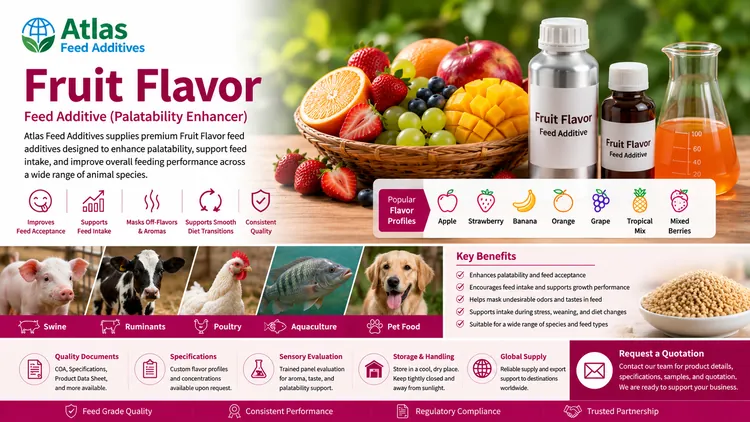
What is Fruit Flavor used for in animal nutrition?
Fruit Flavor supports feed acceptance, intake consistency, masking of undesirable raw-material notes, and
formulation transitions in sensitive feeding phases. It should be used according to the target species,
formulation objective, supplier instructions, and applicable market rules.
Is Fruit Flavor a single ingredient?
Usually no. Fruit Flavor is normally a formulated sensory blend. It may include flavoring substances,
natural extracts, carriers, encapsulation systems, emulsifiers, anti-caking agents, or other formulation
components depending on the supplier and product grade.
Which fruit profiles are available?
Common profiles include apple, berry, strawberry, raspberry, citrus, orange, lemon, peach, banana, tropical
fruit, red fruit, mixed fruit, and custom aroma profiles. Availability depends on the supplier and target
application.
Can Fruit Flavor improve feed intake?
Fruit Flavor can support feed acceptance and intake consistency, especially when the formula has unpleasant
notes or when animals are adapting to a new feed. The practical effect should be validated by preference
testing, intake observation, and field trials.
Can Fruit Flavor mask minerals or organic acids?
Yes, fruit aroma systems may help mask mineral, acidic, bitter, metallic, or medicinal notes in selected
formulas. For difficult masking challenges, a blend of flavor, sweetener, and masking agent may be more
suitable than a simple flavor alone.
Can Fruit Flavor be used in piglet feeds?
Fruit Flavor is commonly evaluated in piglet pre-starter, starter, and nursery diets. Suitability depends
on the flavor profile, inclusion rate, feed formula, processing conditions, supplier guidance, and local
regulation.
Can Fruit Flavor be used in calf feeds?
Fruit flavors may be considered in calf starters, supplements, and transition products where technically
suitable. Some buyers also compare fruit flavors with milk and vanilla profiles for young-animal programs.
Can Fruit Flavor be used in pet food?
Fruit Flavor may be used in pet food or companion animal products where permitted and suitable. Pet food
buyers should check palatability, aroma perception at bag opening, regulatory status, label declaration,
and compatibility with fats, coatings, and heat processing.
Can Fruit Flavor be used in aquafeed?
Fruit Flavor may be evaluated for aquafeed and specialty feeds where permitted and technically justified.
Extrusion stability, water exposure, coating method, species preference, and final feed aroma should be
checked carefully.
Is powder or liquid Fruit Flavor better?
Powder flavors are often easier to use in dry premixes and feed mills. Liquid flavors may be useful for
coating, liquid feed, or specialty applications. The better option depends on equipment, feed form,
processing conditions, and the supplier’s application guidance.
Does pelleting reduce flavor strength?
Heat, steam, pressure, and drying can reduce volatile aroma components. Buyers should ask for heat stability
information and test the final feed after pelleting or extrusion. Encapsulated or post-applied flavors may
be useful in some applications.
Can Fruit Flavor be combined with sweeteners?
Yes. Fruit flavors are often combined with sweeteners such as sodium saccharin or neohesperidin
dihydrochalcone where permitted and technically suitable. The combination should be tested for species
response, cost per ton, and formula compatibility.
What quality documents should buyers request for Fruit Flavor?
Common documents include product specification, certificate of analysis or quality statement, safety data
sheet, origin information, allergen and GMO statements where required, animal-origin statement, shelf-life
statement, storage statement, and any market-specific certificates required by the buyer.
How should Fruit Flavor be stored?
Follow the supplier’s SDS and label. In general, flavors should be stored in a cool, dry, well-ventilated
area, protected from direct sunlight, moisture, excessive heat, oxygen exposure, and strong odors. Containers
should be resealed tightly after opening.
How should buyers compare Fruit Flavor prices?
Buyers should compare cost per ton of finished feed, not only price per kilogram. Aroma strength, inclusion
rate, carrier, heat stability, shelf life, packaging, and documentation can all change the real commercial
value.
Can Atlas Feed Additives quote Fruit Flavor?
Yes. Send the target species, desired fruit profile, product form, inclusion target, quantity, destination,
packaging preference, processing conditions, and required documents so Atlas Feed Additives can review
suitable supplier options for Fruit Flavor.
Is Fruit Flavor allowed in every country?
No. Authorization, ingredient declaration, labeling, species scope, and import requirements can vary by
country and product composition. Buyers should verify current local rules before import, formulation, or
resale.