| Product name |
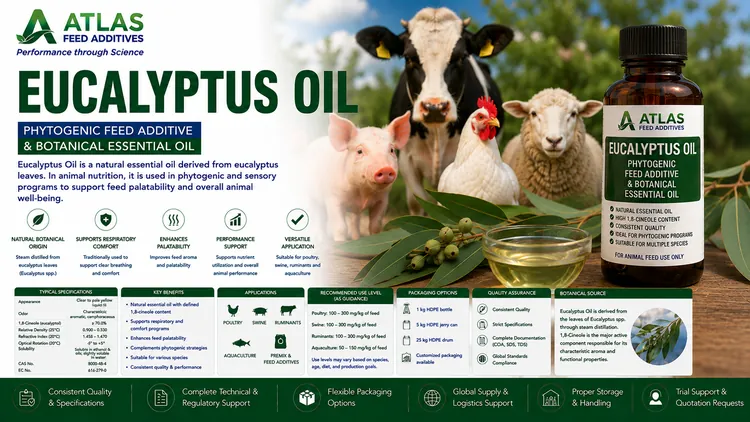
Eucalyptus Oil, eucalyptus essential oil, cineole-type eucalyptus oil, Eucalyptus globulus oil, standardized eucalyptus oil, or eucalyptus oil feed premix depending on supplier documentation and product form. |
| Common oil CAS reference |
8000-48-4 may be used for eucalyptus oil in many commercial documents. Buyers should confirm the CAS reference shown on the supplier specification and SDS. |
| Marker compound |
1,8-Cineole, also called eucalyptol or cineole, is the most common marker compound used for many eucalyptus oil specifications. |
| Marker CAS number |
470-82-6 for 1,8-cineole / eucalyptol. |
| Marker formula |
C10H18O for 1,8-cineole / eucalyptol. |
| Botanical source |
Common commercial sources may include Eucalyptus globulus and other cineole-rich Eucalyptus species. Buyers should request exact botanical name, plant part, country of origin, and production method. |
| Production method |
Typically steam distillation of leaves and terminal branches. Some materials may be rectified, standardized, blended, or formulated on carriers. |
| Appearance |
Liquid oil is typically clear to pale yellow, but color may vary by origin, age, and refinement. Powder products may appear white, off-white, beige, or granular depending on carrier and encapsulation system. |
| Odor profile |
Fresh, cooling, herbal, camphoraceous, and eucalyptus-like. Odor intensity depends on 1,8-cineole content, secondary terpenes, formulation, and storage age. |
| Assay / marker range |
Request the declared 1,8-cineole range and GC profile. Different species and grades may have different marker levels, so the target should be defined before quotation. |
| Analytical method |
GC-FID or GC-MS is commonly requested for essential oil composition, marker quantification, and fingerprint confirmation. Buyers should confirm whether the method is suitable for liquid oil, encapsulated powder, or carrier-based premix. |
| Secondary constituents |
Buyers may request information about alpha-pinene, limonene, p-cymene, gamma-terpinene, terpineol, globulol, aromadendrene, or other constituents when they are relevant to quality or regulatory review. |
| Carrier system |
For powder or premix forms, confirm carrier material, carrier percentage, flowability, particle size, dust profile, bulk density, and compatibility with vitamins, minerals, enzymes, acids, fats, and other botanicals. |
| Encapsulation |
For protected forms, request coating material, active release concept, heat-stability data, storage stability, and expected behavior during pelleting, extrusion, or long-term storage. |
| Solubility and dispersion |
Liquid eucalyptus oil is oil-soluble and poorly miscible with water. Dispersion in finished feed depends on dosing method, carrier, emulsifier system, mixer efficiency, and product form. |
| Contaminant controls |
Request limits or statements for heavy metals, pesticide residues, residual solvents, PAHs, mineral oil hydrocarbons if relevant, adulterants, foreign oils, and any destination-market restricted substances. |
| Microbiology |
Pure essential oils normally have a different microbiological profile than carrier-based powders. For dry products, buyers may request total plate count, yeast and mold, Salmonella, E. coli, and other tests required by their quality system. |
| Packaging |
Liquid oil may be supplied in aluminum bottles, fluorinated HDPE containers, steel drums, lined drums, or IBCs. Powder forms may be supplied in foil bags, paper bags with liners, cartons, drums, or big bags depending on order size. |
| Storage |
Store tightly closed in a cool, dry, well-ventilated area, protected from heat, sunlight, moisture, ignition sources, oxidation, and incompatible materials. Follow the supplier SDS and label instructions. |
| Shelf life |
Confirm production date, expiry date, retest date, shelf-life statement, storage conditions, and whether opened liquid containers require faster use, resealing, or reduced headspace. |
| Documentation |
Specification, COA, GC profile, SDS, origin declaration, botanical source statement, batch traceability, allergen statement, residual solvent statement, contaminant statement, packaging list, shelf-life statement, and market-specific feed documents. |