
Vitamins and vitamin-like nutrients

L-Carnitine

Feed-grade L-Carnitine is a vitamin-like nutrient used in premix, concentrate, complete feed, aquaculture, pet food, and specialty nutrition programs where active content, product form, stability, carrier system, and documentation must be reviewed before purchase.

  • Vitamin-like nutrient
  • Feed and premix applications
  • Active L-carnitine basis matters
  • Base, HCl, tartrate and premix grades
  • Specification-led sourcing support
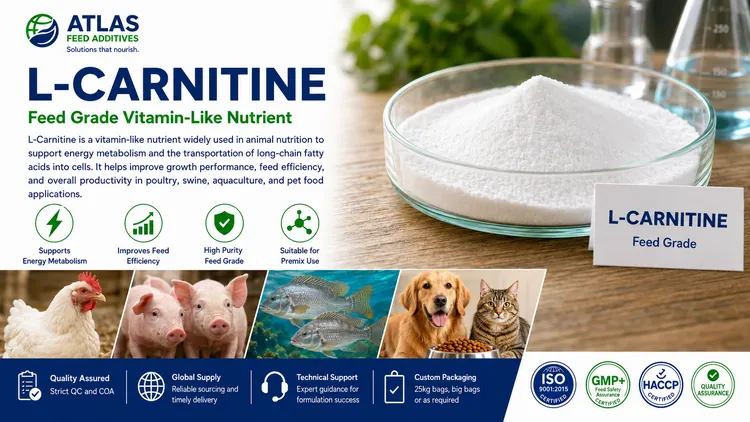
L-Carnitine feed additive visual
Product type Vitamin-like nutritional additive
Common active basis L-carnitine content declared by specification
Typical forms Base, HCl, tartrate, coated or adsorbed grade
Supply model Global sourcing and quotation support

Product role

Where L-Carnitine fits in animal nutrition

L-Carnitine is part of the vitamins and vitamin-like nutrients group. It is commonly discussed as a vitamin-like compound because it participates in nutrient metabolism rather than functioning like a classical vitamin premix component. In feed purchasing, it is evaluated by active L-carnitine content, chemical form, carrier, stability, flowability, process compatibility, and the target species.

In nutrition programs, L-Carnitine is typically reviewed where energy metabolism, lipid utilization, reproductive nutrition, young-animal development, high-performance feeding, aquaculture formulas, pet food positioning, or stress-period diets are part of the formulation objective. The correct use depends on species, life stage, diet composition, regulatory status, and the nutritionist's matrix values.

Buyers should not compare L-Carnitine products only by price per kilogram because different commercial forms may contain different active L-carnitine levels. A pure base, hydrochloride form, tartrate form, coated form, or adsorbed premix grade may have different assay values, carriers, hygroscopicity, particle size, odor profile, shelf life, and processing behavior.

Atlas Feed Additives can coordinate international supplier options for feed mills, premix producers, vitamin-mineral premix manufacturers, distributors, integrators, aquaculture feed producers, pet food manufacturers, and importers that need consistent feed-grade material with clear quality documentation.

Technical overview

Typical technical profile buyers request

Final values must always follow the manufacturer specification and certificate of analysis. The table below is a practical procurement guide for common feed-grade L-Carnitine requests.

Product name L-Carnitine, levocarnitine, feed-grade L-carnitine, L-carnitine base, L-carnitine hydrochloride, L-carnitine L-tartrate, or L-carnitine premix grade depending on the requested form.
Chemical identity L-Carnitine base is a quaternary ammonium compound with the molecular formula C7H15NO3 and an approximate molecular weight of 161.20 g/mol.
CAS number 541-15-1 for L-carnitine. Salt forms, tartrate forms, coated grades, and premix products may carry different identifiers or product-specific references.
Nutrient class Vitamin-like nutritional additive. It is commonly grouped with vitamins and vitamin-like nutrients for feed additive sourcing and premix planning.
Commercial forms L-carnitine base, L-carnitine hydrochloride, L-carnitine L-tartrate, adsorbed carrier grades, diluted premix grades, and coated or protected products may be offered. Active L-carnitine equivalence must be confirmed before price comparison.
Assay and potency Buyers should request the declared assay, active L-carnitine content, method of analysis, salt or carrier correction, and batch result. Comparing only total product weight can produce misleading price conclusions.
Appearance Depending on the commercial form, products may appear as white to off-white crystalline powder, granule, coated beadlet, or carrier-based powder. Color, odor, particle size, and flowability vary by supplier and grade.
Carrier and stabilization Premix grades may use silica, maltodextrin, starch, calcium carbonate, or other permitted carriers. Coated products may include fat, lipid, polymer, or matrix systems. Buyers should request a carrier declaration when required.
Solubility and hygroscopicity Some L-Carnitine forms can be moisture sensitive. Solubility, hygroscopicity, flowability, caking tendency, and compatibility with liquid or dry premix processes should be reviewed before purchase.
Processing compatibility Pelleting, extrusion, premix blending, mineral contact, choline chloride contact, organic acid blends, and high-humidity storage can affect handling or stability. Buyers should request supplier guidance for the intended feed process.
Packaging Common options may include 20 kg or 25 kg bags, cartons, fiber drums, foil-lined packaging, palletized shipments, or container-load supply. Final packaging depends on form, hygroscopicity, order size, and destination requirements.
Shelf life Use the manufacturer shelf-life statement. Store under dry, cool, clean, and ventilated conditions according to the supplier label and safety data sheet.
Regulatory status Use must comply with feed additive rules, import rules, labeling rules, registration requirements, claims restrictions, and species-specific requirements in the destination market.

Animal nutrition applications

Where feed mills and nutrition teams evaluate L-Carnitine

Swine feed

L-Carnitine may be evaluated in swine programs where reproductive nutrition, sow condition, piglet vitality, nursery performance, energy metabolism, or high-performance feeding objectives are part of the nutrition strategy.

  • Sow, gilt, lactation, gestation, and transition-period formulas
  • Piglet starter and nursery diets where early growth support is targeted
  • High-energy or specialty formulas requiring micronutrient precision
  • Use in premixes, concentrates, complete feed, or top-dress systems when permitted
  • Review with choline, methionine, lysine, B vitamins, antioxidants, and fat sources

Poultry feed

In poultry nutrition, L-Carnitine may be reviewed in broiler, layer, breeder, and turkey programs where lipid metabolism, breeder nutrition, high-energy diets, heat-stress periods, or feed efficiency objectives are considered by the nutrition team.

  • Broiler starter, grower, finisher, and withdrawal feed review
  • Layer, breeder, and turkey premix applications
  • High-fat or high-energy formulations where active nutrient contribution is reviewed
  • Stress-period and transition-period nutrition programs
  • Compatibility review with vitamins, trace minerals, enzymes, organic acids, and choline chloride

Aquaculture and pet food

L-Carnitine is often evaluated in aquaculture and pet food because these formulas may use high-energy ingredients, fish oils, poultry fats, plant oils, animal proteins, plant proteins, and extrusion processes that require careful micronutrient and process review.

  • Fish and shrimp feeds with lipid and protein-source optimization
  • Extruded aquafeed and pet food formulas requiring heat-process review
  • Dog, cat, and specialty pet nutrition applications
  • Weight-management, active-animal, senior, or reproductive pet formulas where allowed
  • Palatability, odor, stability, and label-declaration review with the product team
Formulation note: L-Carnitine should be evaluated by a qualified nutritionist using the complete diet matrix. Product form, active L-carnitine content, target species, fat source, vitamin program, processing conditions, and destination-market rules all influence whether supplemental L-Carnitine is appropriate.

Formulation value

Why active L-Carnitine basis matters before price comparison

L-Carnitine purchasing decisions should not be based only on price per kilogram. A meaningful comparison reviews the active L-carnitine delivered by the product, the salt or carrier system, analytical method, stability under the intended process, packaging protection, and documentation required by the buyer.

For example, an adsorbed premix grade may flow better in a vitamin-mineral premix, while a concentrated crystalline form may provide a higher assay but require stronger moisture control. A coated or protected product may be selected for a specific processing or digestive-delivery objective, but it should be compared only against products with similar active basis and application purpose.

  • Supports vitamin-like nutrient fortification strategies across multiple species
  • Useful in premix and specialty feed programs where energy metabolism is reviewed
  • Requires comparison on active L-carnitine content, not only gross product weight
  • May require different inclusion calculations for base, HCl, tartrate, coated, or carrier-based grades
  • Should be entered into formulation software using verified assay and matrix values
  • Must be used according to local feed additive regulations, claims rules, and buyer specifications

Practical formulation checks

Questions for the nutritionist and premix team

  • Which active basis is required? Confirm whether the formula calls for L-carnitine base equivalent, L-carnitine HCl, L-carnitine L-tartrate, or a declared premix potency.
  • Which species and life stage? Swine, poultry, aquaculture, pets, calves, and specialty animals may require different product forms, inclusion levels, and regulatory checks.
  • Which process will be used? Check premixing, pelleting, extrusion, high-temperature processing, liquid application, storage time, and humidity exposure before selecting the grade.
  • Which ingredients may affect stability? Review contact with choline chloride, trace minerals, organic acids, enzymes, antioxidants, fat sources, flavor compounds, and hygroscopic ingredients.

Quality assurance

Buyer quality checklist for L-Carnitine

A clear purchasing file helps reduce risk during supplier approval, import clearance, feed registration, premix production, warehouse receiving, and finished-feed declaration. Atlas Feed Additives can help buyers request the right documents before comparing offers.

Identity and potency

  • Product specification sheet
  • Certificate of analysis for each batch
  • Active L-carnitine content
  • Salt form or carrier-adjusted potency
  • Method of analysis
  • Moisture or loss on drying
  • Particle size, bulk density, and flowability information
  • Confirmation of L-form identity and D-carnitine or isomer control when required

Stability and handling

  • Shelf-life statement
  • Storage temperature and humidity guidance
  • Pelleting or extrusion stability data when available
  • Premix compatibility guidance
  • Carrier declaration for adsorbed products
  • Coating or protection-system declaration when applicable
  • Caking tendency and odor notes when relevant

Safety parameters

  • Safety data sheet
  • Heavy metals such as lead, arsenic, cadmium, and mercury
  • Microbiological status
  • Salmonella statement where required
  • Residual solvents if applicable to the production route
  • Dioxins, PCBs, or other contaminants if market requires
  • Melamine or adulterant testing when required by buyer policy

Traceability and market documents

  • Batch or lot number
  • Manufacturing date
  • Expiry or retest date
  • Country of origin
  • Manufacturer or approved supplier information
  • Packaging label copy
  • Free-sale, health, veterinary, Halal, Kosher, GMO, BSE/TSE, or registration documents if required

Storage and handling

Protect potency, flowability, and shelf life

L-Carnitine products should be handled as high-value vitamin-like feed additives. Storage and handling conditions can affect caking, odor, flowability, active content, dosing accuracy, and suitability for premix or feed mill systems.

  • Store in original, closed packaging in a clean, dry, and ventilated warehouse
  • Protect from moisture, condensation, high humidity, direct sunlight, and high heat
  • Keep away from strong odors, non-feed chemicals, fuels, pesticides, and cleaning products
  • Use pallets and avoid direct contact with floors or warehouse walls
  • Protect bags, cartons, or drums from tearing, puncture, water exposure, and contamination
  • Apply first-in, first-out stock rotation based on manufacturing date, expiry date, or retest date
  • Limit open-bag exposure and reseal partly used material according to the supplier guidance
  • Follow the supplier label, safety data sheet, and local occupational safety procedures

Procurement note

Ask for the right specification before comparing prices.

Price comparisons are meaningful only when active L-carnitine content, chemical form, carrier, coating, particle size, moisture, packaging, origin, documentation, Incoterm, delivery schedule, payment terms, and supplier approval status are aligned.

For sensitive or regulated markets, confirm feed additive authorization, import registration, label language, certificate format, claims restrictions, and whether the manufacturer or exporter must appear on official documents.

  • Define the required form. State whether you need L-carnitine base, L-carnitine HCl, L-carnitine L-tartrate, adsorbed premix grade, coated grade, or another declared form.
  • Confirm active equivalence. Compare cost per kilogram of active L-carnitine, not only cost per kilogram of supplied product.
  • Review process compatibility. Ask whether the product is suitable for your premix, pelleting, extrusion, top-dress, or specialty-feed process.
  • Check documentation before ordering. Review COA, SDS, specification, origin, shelf life, carrier declaration, production-route declarations, and destination-market certificates before shipment.

Quotation preparation

Information to send for a faster quotation

The more complete the request, the faster Atlas Feed Additives can compare suitable supplier options and avoid mismatched offers.

Commercial details

  • Required quantity and shipment frequency
  • Sample request, trial order, pallet quantity, FCL, or annual contract volume
  • Destination country, port, or delivery address
  • Preferred Incoterm such as EXW, FCA, FOB, CFR, CIF, CPT, or DAP
  • Target shipment date and delivery deadline
  • Payment preference and banking requirements

Technical details

  • Required product form and active L-carnitine content
  • Accepted origin or manufacturer list
  • Carrier, coating, particle size, or granulation preference
  • Packaging format, pallet requirements, and label requirements
  • Any internal specification or buyer standard
  • Species, formulation application, or intended feed category when relevant

Document details

  • COA and SDS requirements
  • Import registration documents
  • Health, veterinary, or free-sale certificates
  • Halal, Kosher, GMO, BSE/TSE, or origin statements
  • Carrier declaration, allergen statement, or production-route declaration if required
  • Label language, legalization, or chamber-stamp requirements

Questions

Useful answers

What is L-Carnitine used for in animal nutrition?

L-Carnitine is used as a vitamin-like nutritional additive in feed programs where micronutrient fortification, energy metabolism, lipid utilization, starter nutrition, reproductive nutrition, aquaculture applications, pet food, or stress-period feeding strategies require technical review. It should be used according to the target species, formulation objective, active content, and applicable market rules.

Is L-Carnitine a vitamin?

L-Carnitine is usually described as a vitamin-like nutrient rather than a classical vitamin. In feed sourcing, it is commonly grouped with vitamins and vitamin-like nutrients because it is used in micronutrient fortification systems, premixes, concentrates, and specialty nutrition programs.

What is the difference between L-Carnitine base, HCl, tartrate, and premix grades?

These products can differ in active L-carnitine content, chemical form, carrier, acidity, hygroscopicity, flowability, odor, stability, packaging, and handling. Buyers should compare offers on the same active L-carnitine basis and confirm the exact form on the specification and certificate of analysis.

Which species commonly evaluate L-Carnitine?

L-Carnitine may be evaluated in swine, poultry, aquaculture, pet food, calves, companion animals, and specialty feed programs. Correct use depends on species, production stage, formulation objective, diet composition, product form, and applicable feed rules.

Is L-Carnitine suitable for pelleting or extrusion?

Suitability depends on the product form, carrier, coating, process temperature, moisture exposure, residence time, and post-processing storage. Buyers should request supplier stability guidance or process compatibility information before using L-Carnitine in pelleted or extruded feeds.

Can Atlas Feed Additives quote L-Carnitine?

Yes. Send your required specification, active L-carnitine content, product form, quantity, destination, packaging preference, shipment timing, and required documents so Atlas Feed Additives can review suitable supplier options for L-Carnitine.

What quality documents should buyers request for L-Carnitine?

Common documents include specification, certificate of analysis, safety data sheet, origin information, active content declaration, carrier declaration, batch details, shelf-life statement, label copy, and any market-specific certificates required by the buyer or destination authority.

How should L-Carnitine be stored?

Store L-Carnitine in clean, dry, cool, and ventilated conditions in original closed packaging. Keep away from moisture, condensation, direct sunlight, high heat, damaged packaging, strong odors, and non-feed chemicals. Always follow the supplier label and SDS.

What should be checked before comparing two L-Carnitine offers?

Compare active L-carnitine content, product form, carrier, coating, particle size, origin, manufacturer, documents, packaging, shelf life, Incoterm, freight route, payment terms, and whether the source is accepted in the destination market.

Request a quotation

Tell us what you need

Send your product list, target specification, destination country, packaging preference, shipment timing, and required documents. Our team will review your request and respond from orders@feedgradeadditives.com.

Product: L-Carnitine base, HCl, L-tartrate, premix grade, coated grade, or your required specification
Active content: state the required L-carnitine basis, assay, potency, carrier, or coating requirements
Quantity: sample request, trial order, pallet quantity, FCL, or annual contract volume
Delivery: destination port, warehouse, or preferred Incoterm
Documents: COA, SDS, origin, health certificate, Halal, Kosher, GMO statement, BSE/TSE statement, carrier declaration, or registration file