What is Vitamin C Coated used for in animal nutrition?
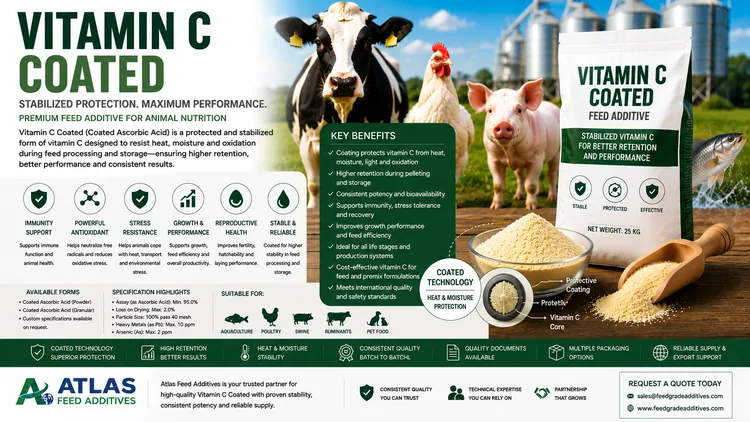
Vitamin C Coated is used as a stabilized vitamin C source in animal feed and premix fortification programs. It helps premix producers, feed mills and specialty feed manufacturers maintain more reliable vitamin C contribution where storage stability, processing tolerance and uniform distribution are important. Use should follow the target species, formulation objective, nutritionist guidance and applicable market rules.
Why is Vitamin C coated?
Vitamin C can be sensitive to oxidation, heat, moisture, oxygen, light and certain minerals. Coating or encapsulation helps protect the active ingredient during handling, storage, pelleting, extrusion and premix use. The level of protection depends on the supplier’s coating technology and process conditions.
Is Vitamin C Coated the same as ascorbic acid?
Not exactly. Ascorbic acid is the active vitamin C compound, while Vitamin C Coated usually means ascorbic acid or another vitamin C source protected with a coating or stabilization system. Buyers should compare active vitamin C potency, not only gross product weight.
What forms of Vitamin C Coated are commonly supplied for feed?
Vitamin C Coated may be supplied as a coated powder, granule, beadlet, microencapsulated preparation or carrier-based dry product, depending on supplier specification and application. Dry protected forms are commonly selected for premixes and complete feed manufacturing.
Can Vitamin C Coated be used in aquaculture feed?
Vitamin C Coated is commonly evaluated in aquaculture feeds where extrusion, drying, water exposure and storage stability can be important. Buyers should request stability and application guidance for the target fish or shrimp feed process.
Can Vitamin C Coated be used in pelleted feeds?
Vitamin C Coated may be used in feed systems that are later pelleted, but stability depends on active form, coating system, temperature, moisture, conditioning time and feed matrix. Buyers should request supplier guidance for heat exposure and finished-feed stability.
What quality documents should buyers request for Vitamin C Coated?
Common documents include specification, Certificate of Analysis, Safety Data Sheet, origin information, batch details, production date, expiry date, packaging specification, storage instructions, assay method information, coating details where available and any market-specific certificates required by the buyer.
What should be checked on the Certificate of Analysis?
Check product name, active form, batch number, date, assay, declared active vitamin C potency, moisture, physical quality, particle size where available, contaminants where tested, expiry date and whether the values match the agreed specification.
Why do Vitamin C Coated prices vary?
Prices vary because products may differ in active potency, coating technology, coating percentage, stability performance, assay basis, carrier, particle size, packaging, origin, shelf life, documentation, order quantity and freight conditions.
Can Atlas Feed Additives quote Vitamin C Coated?
Yes. Send your required Vitamin C Coated form, active potency, target species, quantity, destination, packaging preference and document requirements so Atlas Feed Additives can review suitable supplier options for Vitamin C Coated.
What information should I send for the fastest quotation?
Please send the product name, target active potency, coating or stability requirement, species or feed application, required quantity, destination country, preferred Incoterms, packaging preference, required documents and target delivery timing.
Can Vitamin C Coated make disease-treatment claims?
Feed additives should not be positioned as disease treatments unless specifically authorized under applicable regulations. Vitamin C Coated marketing, labeling and usage statements should follow the rules of the destination market.