Organic acids and acidifiers

Formic Acid Silage Preservative

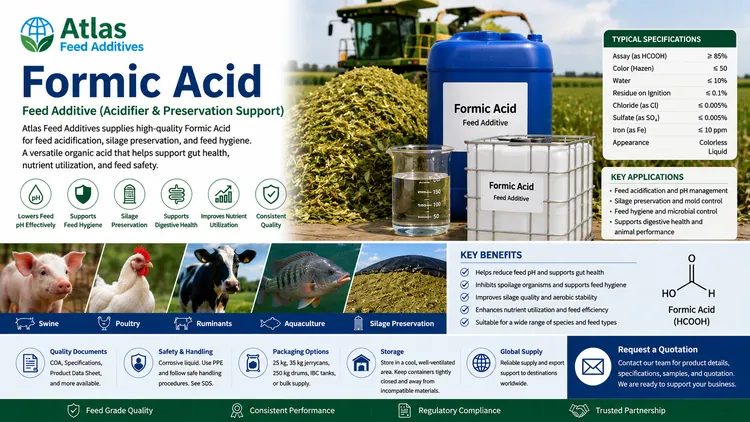
Formic Acid is a strong liquid organic acid used in pH management, feed hygiene, silage preservation, liquid-feed preservation, and digestive-support programs where permitted by applicable market rules.

Formic Acid feed additive visual

Product role

Where Formic Acid fits in feed and preservation programs

Formic Acid belongs to the organic acids and acidifiers group. In animal nutrition and feed production, it is commonly evaluated for acidification, feed hygiene, silage preservation, liquid feed preservation, pH reduction, and support of digestive-management strategies in swine, poultry, ruminant, aquaculture, and specialty feed systems where permitted.

Compared with many dry organic acids, Formic Acid is a liquid, highly active, highly acidic, and more handling-sensitive product. Buyers must evaluate not only the acid concentration, but also corrosion risk, worker safety, dosing equipment, packaging compatibility, transport classification, impurity limits, label requirements, and local authorization status.

Atlas Feed Additives can coordinate international supplier options for feed mills, premix producers, silage additive companies, liquid feed manufacturers, integrators, distributors, and importers that need consistent feed-grade acidifier material with documentation and export-focused service.

This page is written for purchasing, technical, quality, warehouse, logistics, and regulatory teams. It does not replace a supplier specification, safety data sheet, local regulation, veterinarian guidance, nutritionist recommendation, or professional chemical-handling procedure.

Why acidification matters

Formic Acid helps feed manufacturers manage pH, microbial pressure, and preservation risk.

Acidification is used in feed and forage programs to help manage the chemical and microbiological environment of raw materials, complete feeds, liquid feeds, and silage. Formic Acid can lower pH quickly, contribute to preservation programs, and support hygiene-focused feed management where the product is permitted and correctly applied.

  • Supports pH reduction in selected feed and preservation systems.
  • Can contribute to hygiene-focused strategies for feed materials.
  • May be used in silage programs to influence fermentation direction.
  • Can support liquid feed preservation when equipment and regulation are suitable.
  • May be used alone or in buffered/blended acidifier products where technically justified.

The commercial value of Formic Acid depends on concentration, application method, contact time, distribution uniformity, formula buffering capacity, target organism, moisture, storage conditions, and safety controls. Because concentrated Formic Acid is corrosive, successful use requires both technical formulation and proper handling discipline.

  • Useful when a strong liquid acid source is required.
  • Often compared with propionic acid, lactic acid, acetic acid, citric acid, and buffered acid blends.
  • Requires review of corrosion-resistant pumps, lines, tanks, seals, and dosing equipment.
  • Should be validated through feed pH, preservation indicators, microbial checks, and field performance.
  • Must be used only under applicable legal and safety requirements.

Technical identity

The simplest carboxylic acid with strong practical acidifying power

Formic Acid is the simplest carboxylic acid and is also known as methanoic acid. It is a colorless liquid with a sharp, pungent odor. Commercial feed-related products may be supplied as concentrated Formic Acid, diluted aqueous solutions, buffered liquid acidifiers, salts of formic acid, or carrier-supported dry formulations.

Because supplier grades can differ, buyers should not compare offers by product name alone. Confirm active acid concentration, water content, methanol and methyl formate limits where required, purity, color, density, packaging, corrosion guidance, transport classification, shelf life, origin, labeling, and document package before comparing prices.

Technical data

Typical Formic Acid specification points buyers review

Common technical profile

The values below are general purchasing references. Final values must always be confirmed against the supplier’s current specification, safety data sheet, certificate of analysis, and local regulatory requirements.

Product
Formic Acid
Chemical name
Methanoic acid
CAS number
64-18-6
EINECS number
200-579-1
Molecular formula
CH2O2 / HCOOH
Molecular weight
46.03 g/mol
Appearance
Clear, colorless to slightly yellow liquid depending on grade and storage history
Odor
Sharp, pungent, characteristic acidic odor
Typical commercial concentration
Often supplied as 75%, 80%, 85%, 90%, or higher concentration; confirm exact supplier grade
pKa reference
Approximately 3.75 at standard reference conditions; confirm formulation behavior in the actual matrix
Solubility behavior
Miscible with water; blend behavior depends on concentration, salts, buffers, and additives
Functional role
Acidifier, preservative-support ingredient, silage additive component, liquid feed preservation aid, pH-management acid
Key safety profile
Corrosive liquid; concentrated grades require strict SDS-based handling and emergency controls
Typical packaging
HDPE drums, IBCs, bulk tankers, lined containers, or supplier-specific corrosion-compatible packaging

Specification comparison

What to align before comparing Formic Acid prices

A low price per kilogram can be misleading if acid concentration, water content, packaging, transport cost, dangerous goods handling, corrosion requirements, shelf life, and documentation are different. Buyers should compare cost per active acid unit, delivered cost, and practical handling cost.

Parameter Why it matters What to ask the supplier
Active acid concentration Determines the real acid value and affects dosage, transport economics, and safety classification. Request exact concentration, assay method, and COA result for the batch.
Water content Changes concentration, corrosion behavior, freezing point, and landed cost per active unit. Confirm water percentage and whether price is based on product weight or acid equivalent.
Impurity profile Methanol, methyl formate, chloride, sulfate, metals, or residues may be restricted by buyer specifications. Ask for impurity limits and test methods relevant to feed or customer approval.
Grade Technical, feed, food, and blended acidifier grades may have different specifications and documents. Confirm intended-use statement and suitability for feed-related applications.
Buffered or unbuffered form Buffered blends may be safer or easier to handle but may contain lower active acid. Ask for full composition guidance, active acid equivalent, and handling benefits.
Salt or formate blend Formate salts differ from free Formic Acid in acidity, handling, corrosion, and regulatory status. Clarify whether the product is free acid, sodium formate, calcium formate, ammonium formate, or a blend.
Packaging Packaging must be compatible with corrosive acid and accepted for transport. Confirm drum, IBC, tanker, liner, venting, closure, pallet, and label details.
Transport classification Dangerous goods requirements affect freight options, costs, insurance, and lead time. Request SDS, dangerous goods declaration, UN number, packing group, and transport mode restrictions.
Equipment compatibility Incorrect pumps, seals, tanks, or lines can create leaks, corrosion, and safety incidents. Ask for compatible materials and confirm with the buyer’s engineering team.
Shelf life and storage Storage conditions influence quality, container integrity, and worker safety. Request shelf-life statement, storage temperature guidance, and container inspection recommendations.
Regulatory status Permitted uses, maximum levels, labeling, and safety statements vary by country and species. Request destination-market compliance statements before purchase.
Documents Missing documents can delay customs clearance, hazardous goods movement, and customer approval. List COA, SDS, origin, DG paperwork, certificates, and declarations required by the importer.

Applications

Typical application areas for Formic Acid in feed-related supply chains

Swine feed acidification

  • Starter, grower, and specialty formulas where feed acidification is permitted.
  • Programs designed to manage diet pH and acid-binding capacity.
  • Digestive-support programs during sensitive transition phases.
  • Liquid feed systems where dosing equipment is compatible with corrosive acids.
  • Blends with organic acids, salts, flavors, or palatability components where technically suitable.

Poultry feed acidification

  • Broiler, layer, breeder, and turkey feeds where acidifier use is authorized and technically justified.
  • Feed hygiene programs with organic acids and acid salts.
  • Formulas where pH reduction or microbial-pressure management is part of the technical objective.
  • Premix and liquid applications requiring uniform distribution and safety-controlled handling.
  • Programs monitored through feed pH, microbiology, litter quality, intake, and performance data.

Silage preservation

  • Hay crop silage and forage preservation programs where permitted.
  • Fermentation-control strategies for high-moisture forage systems.
  • Rapid pH reduction programs where crop type, dry matter, and application rate are evaluated.
  • Application through acid-resistant pumps, nozzles, tanks, and forage equipment.
  • Programs requiring clear worker safety procedures during handling and field application.

Liquid feed and raw material preservation

  • Liquid feed systems requiring pH control or preservation support.
  • By-product feed streams where acidification is technically suitable and permitted.
  • Wet ingredient preservation programs with controlled dosing and mixing.
  • Storage tanks and transfer systems requiring corrosion-compatible materials.
  • Quality programs that monitor pH, microbial counts, odor, gas formation, and storage stability.

Premixes and acidifier blends

  • Buffered liquid acidifier products for safer or easier handling.
  • Combination products with propionic, lactic, acetic, citric, sorbic, or benzoic acid sources.
  • Formate salts or carrier-supported acidifier blends for dry feed applications.
  • Private-label acidifier products requiring documentation and repeatable specification.
  • Custom blends designed around target pH, corrosion control, palatability, and handling needs.

Distribution and export supply

  • Supply to feed additive distributors and premix companies.
  • Container, IBC, drum, tanker, or trial-order planning depending on market demand.
  • Regional acidifier supply programs for feed mills and integrators.
  • Document coordination for customs brokers, importers, and customer approval teams.
  • Hazardous goods planning for road, sea, and warehouse operations.

Mode of action

How Formic Acid supports acidification and preservation strategies

Formic Acid contributes hydrogen ions that can reduce pH in selected feed, forage, and liquid systems. Lower pH can help create less favorable conditions for selected microorganisms and can support preservation programs when combined with proper raw material control, moisture management, dosing accuracy, and storage practice.

In digestive-support strategies, organic acids may contribute to the acid-base environment of the diet and may influence the microbial and chemical conditions of the upper digestive tract. The response depends on target species, feed type, inclusion level, buffering capacity, feed hygiene, water quality, and animal health.

  • pH reduction: Strong acidifying effect in selected matrices when correctly dosed and mixed.
  • Preservation support: Can contribute to silage and liquid-feed preservation programs.
  • Feed hygiene: Can support hygiene-focused feed strategies with good manufacturing practice.
  • Buffering strategy: Must be matched to diet acid-binding capacity and mineral profile.
  • Uniform mixing: Requires accurate dosing and thorough distribution to avoid hot spots.
  • Validation: Performance should be checked through pH, microbiology, storage stability, intake, and animal results.

Formulation notes

Practical factors that influence Formic Acid performance

Diet buffering capacity

The same Formic Acid concentration can perform differently depending on the diet. High mineral levels, limestone, phosphates, protein meals, and certain by-products can increase buffering capacity and reduce the pH effect of the acidifier.

  • Review calcium carbonate, phosphate, and mineral levels.
  • Measure feed pH and acid-binding capacity where relevant.
  • Do not assume the same inclusion level works in all formulas.
  • Validate in the real feed matrix rather than only in water.

Distribution and mixing

Liquid acids must be distributed uniformly. Poor distribution can create localized high-acid areas that may affect palatability, equipment, worker exposure, feed quality, or animal safety. Dosing systems must be calibrated and maintained.

  • Use acid-compatible dosing pumps and spray systems.
  • Confirm mixing time and application point.
  • Prevent localized acid concentration in feed or silage.
  • Use operator training and documented standard procedures.

Palatability and feed intake

Organic acids can influence taste and odor. Formic Acid has a sharp acidic profile and may reduce feed acceptance if used incorrectly. Palatability may be improved through controlled dosing, buffering, blending, coating, or combination with flavors and sweeteners where permitted and technically suitable.

  • Introduce acidifier programs with technical supervision.
  • Monitor intake, behavior, and performance during trials.
  • Consider buffered products where palatability or handling is a concern.
  • Review compatibility with fruit flavors, milk flavors, sweeteners, and masking agents.

Equipment compatibility

Formic Acid is corrosive and can damage unsuitable metals, seals, hoses, gaskets, pumps, and storage tanks. Engineering review is essential before switching supplier, concentration, packaging, or application system.

  • Check compatible materials for tanks, lines, pumps, seals, and nozzles.
  • Avoid unapproved metals or elastomers in contact with concentrated acid.
  • Inspect for leaks, corrosion, swelling, brittleness, and discoloration.
  • Keep emergency neutralization and spill procedures available.

Crop and silage conditions

In silage programs, the result depends on crop type, dry matter, chop length, packing density, oxygen exclusion, temperature, microbial load, application uniformity, and storage duration. Formic Acid cannot compensate for poor ensiling management.

  • Review crop dry matter and sugar content before application.
  • Apply uniformly through calibrated equipment.
  • Maintain good compaction and oxygen exclusion.
  • Monitor silage pH, odor, temperature, and fermentation profile.

Liquid feed conditions

Liquid feed preservation depends on pH, temperature, storage time, microbial pressure, agitation, hygiene, raw material variation, and tank cleaning. Formic Acid use should be supported by measurement and a documented quality plan.

  • Monitor pH before and after dosing.
  • Check microbial quality and storage stability.
  • Use compatible tanks, pumps, seals, and transfer lines.
  • Clean tanks and dosing systems according to defined procedures.

Safety and handling

Formic Acid requires trained handling and SDS-based controls.

Concentrated Formic Acid is a corrosive chemical. Handling must be based on the supplier’s current safety data sheet, local occupational safety rules, chemical storage regulations, transport rules, and the buyer’s internal safety procedures. Warehouse and production teams should be trained before receiving or using the product.

  • Review the safety data sheet before purchase, transport, storage, and use.
  • Use appropriate personal protective equipment according to SDS guidance.
  • Provide eye wash, emergency shower, spill kit, ventilation, and emergency response procedures.
  • Store only in compatible containers and secondary containment where required.
  • Keep away from incompatible chemicals listed in the SDS.
  • Do not transfer to unapproved containers or unlabeled tanks.
  • Train operators on acid transfer, dilution, dosing, spill response, and first-aid procedures.
  • Use controlled transfer methods to reduce splashing, vapor exposure, and accidental contact.
  • Do not mix with other chemicals unless the process has been reviewed and approved by qualified personnel.
  • Keep emergency contact numbers and SDS access available in storage and dosing areas.

Quality assurance

Buyer quality checklist for Formic Acid procurement

Documents to request

  • Current product specification
  • Certificate of analysis for each batch
  • Safety data sheet in the required language
  • Dangerous goods declaration and transport classification where applicable
  • Country of origin statement
  • Manufacturing site or producer declaration where available
  • Feed-grade or food/feed suitability statement, if applicable
  • Active acid concentration statement
  • Impurity limits, including methanol and methyl formate where required
  • Heavy metal and contaminant declarations where required
  • Packaging compatibility statement or packaging specification
  • Shelf-life and recommended storage condition statement
  • GMO, allergen, animal-origin, BSE/TSE, and irradiation statements where required
  • Halal, Kosher, FAMI-QS, GMP+, ISO, HACCP, or other certificates where relevant and available
  • Destination-market regulatory or label statements if required by the buyer

Batch review points

  • Batch number and manufacturing date
  • Expiry date or retest date
  • Active Formic Acid concentration
  • Water content or moisture level
  • Methanol and methyl formate results where specified
  • Color, clarity, odor, and appearance
  • Density or specific gravity if listed
  • Acidity, residue, ash, chloride, sulfate, iron, or other buyer-specific parameters
  • Packaging integrity at dispatch and receipt
  • UN label, hazard label, and transport marking consistency
  • Remaining shelf life at shipment
  • Label accuracy and destination-language requirements
  • Consistency between COA, SDS, invoice, packing list, and product label
  • Retention sample availability for future comparison

Supplier approval

How to evaluate a new Formic Acid supplier

A new Formic Acid source should be approved through document review, safety review, equipment review, and practical testing. Even if two suppliers quote the same concentration, differences in impurity limits, packaging, labeling, transport support, and technical documentation can significantly affect total risk and cost.

Evaluation step Purpose Recommended action
Document review Confirms whether the material can be considered before commercial discussion. Review specification, COA, SDS, transport classification, origin, and regulatory statements.
Safety review Protects workers, warehouse, equipment, and transport partners. Review PPE, spill response, storage, emergency aid, ventilation, and operator training needs.
Equipment review Prevents corrosion, leaks, pump failure, and unsafe transfer. Confirm tanks, pumps, seals, hoses, nozzles, and lines are compatible with the quoted concentration.
Sample review Creates a quality reference and confirms product identity. Check appearance, odor, concentration, density, and impurity results against specification.
Application test Shows technical behavior in the real feed, silage, or liquid system. Evaluate pH reduction, mixing, distribution, preservation indicators, and palatability.
Storage test Checks container integrity and quality under local warehouse conditions. Monitor package condition, leaks, corrosion, label stability, and product quality over time.
Logistics validation Confirms the supplier can ship safely and legally. Check dangerous goods documentation, carrier acceptance, lead time, and importer requirements.
Commercial validation Confirms supplier repeatability and practical value. Review batch consistency, complaint history, delivery reliability, and landed cost per active acid unit.

Storage and warehouse review

Recommended storage review for Formic Acid shipments

Always follow the supplier’s safety data sheet and product label. Because Formic Acid is corrosive and may be subject to dangerous goods rules, storage should be planned before the product arrives.

  • Store in a cool, dry, well-ventilated chemical storage area.
  • Keep containers tightly closed when not in use.
  • Protect from excessive heat, direct sunlight, and incompatible chemicals.
  • Use compatible containers, secondary containment, and corrosion-resistant flooring where required.
  • Keep away from oxidizers, strong alkalis, reactive metals, and other incompatible materials listed in the SDS.
  • Use first-expired, first-out stock rotation.
  • Inspect drums, IBCs, valves, caps, gaskets, pallets, labels, and hazard markings at receipt.
  • Separate damaged, leaking, swollen, or corroded containers for emergency review.
  • Maintain spill kits, neutralization materials if approved by site procedure, eyewash, and emergency shower access.
  • Restrict access to trained personnel only.
  • Keep warehouse records for batch number, receipt date, dispatch date, remaining stock, and container condition.

Regulatory note

Check authorization, maximum levels, label statements, and safety requirements before use.

Formic Acid rules can differ by country, species, application, concentration, feed type, and final market. Some jurisdictions may regulate it as a feed additive, preservative, acidifier, silage additive, processing aid, dangerous chemical, or transport-regulated material. The same product may require separate review for swine feed, poultry feed, ruminant silage, liquid feed, pet food, aquafeed, or premix use.

In the United States, Formic Acid appears in 21 CFR 573.480 with specific conditions for use as a preservative in hay crop silage and as a feed acidifying agent in complete feed for swine and poultry. The section also includes specifications and labeling/safety requirements. Buyers should always verify the current text and confirm whether it applies to their specific product, concentration, species, and application.

Buyers should confirm the latest local requirements with their regulatory team, importer, customs broker, dangerous goods advisor, occupational safety specialist, or official authority before purchase. This is especially important for export shipments, concentrated acid, private-label blends, silage additives, liquid feed preservatives, and products shipped in drums, IBCs, or tankers.

Atlas Feed Additives can help collect supplier statements and technical documents, but final compliance, safety, transport, and use decisions belong to the buyer, importer, manufacturer, carrier, warehouse operator, and local regulatory advisor.

Comparison guide

How buyers compare Formic Acid with related organic acids

Formic Acid is one option within a broader organic acidifier toolbox. The best acid or acid blend depends on the target pH effect, antimicrobial objective, feed type, species, palatability, corrosion risk, handling safety, transport cost, regulatory status, and document requirements.

Acidifier Common role Buyer notes
Formic Acid Strong liquid acidifier for pH management, silage preservation, and feed hygiene programs. High acidifying power but requires strict corrosion, safety, and transport review.
Propionic Acid Commonly used for mold control and preservation support. Often selected for grain and feed preservation; liquid and salt forms differ in handling.
Acetic Acid Acidification and preservation-support applications in selected systems. Strong odor and liquid handling characteristics should be evaluated.
Lactic Acid Acidification and palatability-oriented applications. Often used in liquid systems or blends; concentration and salt form matter.
Citric Acid Dry organic acidifier and chelating acid for selected feed and premix applications. Solid form is easier to handle than concentrated liquid acids but has different acid strength and cost profile.
Fumaric Acid Dry organic acid for premixes and feed acidification programs. Solid form is useful in dry applications; limited water solubility should be considered.
Sorbic Acid / Sorbates Preservation-focused acid and salts in selected applications. Regulatory status, pH range, and cost should be checked carefully.
Buffered acid blends Combination systems designed for safer handling, controlled release, or broader preservation effect. Compare active acid equivalent, carrier, pH profile, corrosion benefit, and declaration requirements.

Procurement note

Ask for the right specification before comparing prices.

Price comparisons are meaningful only when concentration, purity, impurity limits, packaging, transport classification, origin, shelf life, and documentation are aligned. For Formic Acid, buyers should also review dangerous goods cost, corrosion-compatible equipment, storage requirements, operator safety, and local regulatory limits before approving a supplier.

Atlas Feed Additives helps buyers prepare clear RFQs, compare supplier offers, review safety and quality documents, and coordinate export-focused service from quotation to shipment planning.

  • Define the target application: complete feed, silage, liquid feed, premix blend, distribution, or industrial feed use.
  • Confirm required concentration: 75%, 80%, 85%, 90%, or other buyer-specific grade.
  • State impurity limits and regulatory specifications if required.
  • Confirm destination country, end use, and final market.
  • Check whether the buyer can receive dangerous goods shipments.
  • Confirm packaging: drum, IBC, tanker, bulk, or custom packaging.
  • List all required documents before requesting final price.
  • Confirm lead time, minimum order quantity, freight options, and available stock before issuing a purchase order.

Logistics

Packaging, shipping, and import planning

Packaging review

Packaging must be compatible with corrosive liquid acid and accepted for the selected transport mode. The wrong packaging can create leaks, corrosion, rejected shipments, customs delays, and serious safety risk.

  • Confirm net weight and gross weight per drum, IBC, pallet, or tanker load.
  • Ask whether packaging is approved for the specific concentration and transport mode.
  • Request packaging photos, hazard labels, pallet details, and closure specifications.
  • Confirm container material compatibility and venting requirements.
  • Check whether packaging is suitable for long sea freight, hot climates, or inland transport.
  • Ask how partially used containers should be resealed and stored.

Shipment planning

For international shipments, documentation must be aligned early. Formic Acid shipments can be delayed or refused if the product name, concentration, UN number, hazard class, packing group, invoice, packing list, SDS, and dangerous goods declaration are inconsistent.

  • Confirm HS code with the importer or customs broker.
  • Confirm UN number, hazard class, packing group, and marine pollutant status where relevant.
  • Check whether the freight forwarder accepts the concentration and packaging type.
  • Confirm port, carrier, warehouse, and inland transport restrictions.
  • Request SDS and dangerous goods paperwork before dispatch.
  • Confirm whether legalized, apostilled, or chamber-certified documents are required.

Decision guide

When Formic Acid may be a good candidate

Formic Acid may be considered when the buyer needs a strong liquid acidifier for pH management, silage preservation, liquid feed preservation, feed hygiene, or acidifier blend development. The decision should be based on technical objective, regulatory permission, equipment compatibility, safety controls, and practical trial data.

  • The application requires rapid pH reduction or strong acidifying effect.
  • The buyer has compatible liquid dosing, transfer, and storage equipment.
  • The warehouse and operators are prepared for corrosive liquid handling.
  • The formula or preservation program can be validated through pH and quality testing.
  • The destination market permits the intended use and level.
  • The buyer can manage dangerous goods transport and documentation.
  • A buffered acid blend is not required, or free Formic Acid is specifically preferred.

Technical trial planning

How to test a new Formic Acid source

A new supplier should be approved through document review, safety review, equipment review, and controlled application testing. Formic Acid should not be introduced into production without operator training and approved handling procedures.

  • Request a representative sample or trial quantity from the same grade that will be quoted commercially.
  • Record supplier name, concentration, batch number, origin, packaging, and document package.
  • Check COA values against the buyer’s approved specification.
  • Review SDS, transport documents, label warnings, and emergency procedures.
  • Confirm dosing system compatibility with the quoted concentration.
  • Test pH reduction in the actual feed, silage, or liquid matrix.
  • Monitor mixing uniformity and avoid local over-application.
  • Check palatability, intake, storage stability, and microbial indicators where relevant.
  • Evaluate operator feedback, equipment condition, and corrosion signs after trial use.
  • Calculate cost per active acid unit and cost per ton of treated feed or forage.

Questions

Useful answers about Formic Acid

What is Formic Acid used for in animal nutrition?

Formic Acid is used in feed-related applications for pH management, feed hygiene, silage preservation, liquid feed preservation, and digestive-support programs. It should be used according to target species, formulation objective, supplier instructions, safety precautions, and applicable market rules.

What is the chemical name of Formic Acid?

The systematic chemical name of Formic Acid is methanoic acid. Its common formula is HCOOH, and its CAS number is 64-18-6.

Is Formic Acid an organic acid?

Yes. Formic Acid is the simplest carboxylic organic acid and is grouped with organic acids and acidifiers in feed additive sourcing.

Is Formic Acid corrosive?

Yes. Concentrated Formic Acid is corrosive and must be handled according to the supplier safety data sheet, local occupational safety rules, chemical storage procedures, and emergency response requirements.

Can Formic Acid be used in silage?

Formic Acid is commonly evaluated for silage preservation and fermentation-control programs where permitted. Crop type, dry matter, application rate, dosing equipment, worker safety, and local regulations must be reviewed before use.

Can Formic Acid be used in swine feed?

Formic Acid may be used in swine feed acidification programs where legally permitted and technically justified. Inclusion level and use conditions must be set by the buyer’s technical team according to local rules, supplier guidance, feed type, and animal production objective.

Can Formic Acid be used in poultry feed?

Formic Acid may be evaluated in poultry feed acidification and hygiene programs where permitted. Buyers should check local authorization, maximum levels, feed type, palatability, equipment compatibility, and safety requirements.

Can Formic Acid be used in drinking water?

Water application depends on the destination market, product grade, concentration, equipment, species, and supplier instructions. Buyers should verify local rules and use only equipment compatible with corrosive acids.

What is the difference between Formic Acid and calcium formate?

Formic Acid is the free liquid acid. Calcium formate is a salt of formic acid and usually has different acidity, handling, corrosion profile, solubility, regulatory status, and formulation behavior. They should not be substituted without technical review.

What is the difference between free Formic Acid and buffered acid blends?

Free Formic Acid usually provides strong acidifying power but requires strict corrosion and safety controls. Buffered blends may be easier to handle or less corrosive, but the active acid equivalent and pH effect may differ.

What quality documents should buyers request for Formic Acid?

Common documents include product specification, certificate of analysis, safety data sheet, origin statement, active concentration, impurity limits, dangerous goods documents, batch details, shelf-life statement, storage statement, and market-specific certificates required by the buyer or importer.

What should be checked on the certificate of analysis?

Buyers should check batch number, active acid concentration, water content, impurity limits, appearance, density where listed, manufacturing date, expiry or retest date, and consistency with the approved specification.

How should Formic Acid be stored?

Follow the supplier’s safety data sheet and label. In general, Formic Acid should be stored in a cool, dry, well-ventilated chemical storage area, in compatible containers, away from incompatible materials, with secondary containment and emergency equipment where required.

Does Formic Acid replace good feed hygiene practice?

No. Formic Acid can support acidification and preservation programs, but it does not replace clean raw materials, moisture control, sanitation, biosecurity, proper storage, water quality, mycotoxin control, or good manufacturing practice.

How should buyers compare Formic Acid prices?

Buyers should compare active acid concentration, delivered cost, dangerous goods freight, packaging, equipment compatibility, impurity limits, documentation, and cost per active acid unit. Price per kilogram alone may not show the real cost.

Can Atlas Feed Additives quote Formic Acid?

Yes. Send the required concentration, grade, quantity, destination, packaging preference, preferred Incoterm, application, and document requirements so Atlas Feed Additives can review suitable supplier options for Formic Acid.

Is Formic Acid allowed in every country?

No. Authorization, species scope, maximum level, labeling, safety statements, transport rules, and import requirements can vary by country and application. Buyers should verify current local rules before import, formulation, transport, storage, or resale.

Request a quotation

Tell us what you need

Send your product list, required concentration, target specification, destination country, packaging preference, delivery schedule, application, transport requirements, and required documents. Our team will review your request and respond from orders@feedgradeadditives.com.

Fast RFQ checklist

  • Product name: Formic Acid
  • Required concentration: 75%, 80%, 85%, 90%, or other
  • Required grade and impurity limits
  • Target application: feed, silage, liquid feed, blend, or distribution
  • Quantity: drum, IBC, container, tanker, or annual volume
  • Destination country and preferred Incoterm
  • Packaging, label, and pallet requirements
  • Dangerous goods and transport document requirements
  • Required certificates and approval documents
  • Preferred delivery schedule and receiving warehouse capability