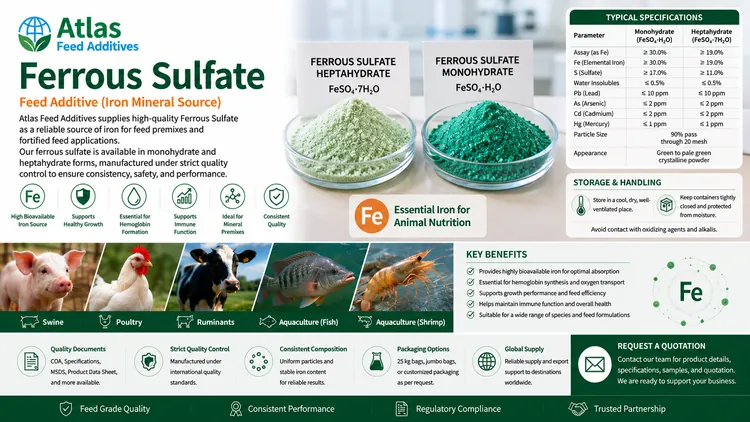
What is Ferrous Sulfate used for in animal nutrition?
Ferrous Sulfate is used as an inorganic iron source in feed and premix programs. It contributes iron for
hemoglobin-related nutrition, oxygen transport, myoglobin, enzyme systems, growth, reproduction, immune
function, and general trace mineral fortification.
What is the chemical identity of Ferrous Sulfate?
Ferrous Sulfate is iron(II) sulfate. It is commonly represented as FeSO4·xH2O because commercial products
often contain different amounts of water of crystallization.
What is the difference between ferrous sulfate monohydrate and heptahydrate?
Ferrous sulfate monohydrate contains one molecule of water of crystallization and has a higher theoretical
elemental iron percentage than ferrous sulfate heptahydrate, which contains seven molecules of water.
Formula inclusion rates must be adjusted when switching forms.
Why should buyers compare cost per active iron unit?
Different hydrate forms contain different iron percentages. A lower price per kilogram may not be cheaper if
the product contains less elemental iron or has higher moisture, lower assay, poorer handling, or weaker
documentation.
Can Ferrous Sulfate be used in swine feeds?
Ferrous Sulfate is commonly evaluated in swine mineral programs, including piglet, nursery, grower, finisher,
sow, gestation, and lactation feeds. Inclusion levels should be set by the buyer’s technical team according
to species, stage, basal diet, iron status, and local rules.
Can Ferrous Sulfate be used in poultry feeds?
Ferrous Sulfate may be used in poultry trace mineral premixes for broilers, layers, breeders, turkeys, and
specialty poultry where permitted. Buyers should review elemental iron content, contaminant limits, particle
size, and premix compatibility.
Can Ferrous Sulfate be used in ruminant feeds?
Ferrous Sulfate may be considered in dairy, beef, sheep, goat, calf, and mineral supplement programs where
iron fortification is needed. Ruminant formulas should consider antagonists, water mineral content, sulfur,
molybdenum, copper balance, and overall trace mineral design.
Can Ferrous Sulfate be used in pet food?
Ferrous Sulfate may be used in pet food and companion animal products where permitted and suitable. Pet food
buyers should review label declaration, finished-product guarantees, color impact, palatability, oxidation
risk, and local regulations.
Can Ferrous Sulfate be used in aquafeed?
Ferrous Sulfate may be used in aquafeed formulas where iron fortification is specified and permitted.
Extrusion stability, water exposure, mineral leaching, finished-feed guarantee, and species requirements
should be checked.
Does Ferrous Sulfate interact with vitamins?
Iron can contribute to oxidation and may reduce stability of sensitive vitamins in some premix conditions,
especially when moisture, heat, choline chloride, trace minerals, or long storage are involved. Buyers should
request compatibility guidance and validate premix stability.
Is Ferrous Sulfate dusty?
Some fine powder grades can be dusty. Dust depends on particle size, drying method, granulation, packaging,
handling, and transfer equipment. Buyers can request granulated or low-dust grades where plant hygiene and
operator exposure are priorities.
What quality documents should buyers request for Ferrous Sulfate?
Common documents include product specification, certificate of analysis, safety data sheet, origin statement,
elemental iron assay, hydrate form declaration, particle size, heavy metal and undesirable substance
statements, shelf-life statement, storage statement, and market-specific certificates required by the buyer.
What should be checked on the certificate of analysis?
Buyers should check batch number, elemental iron content, hydrate form, moisture, insoluble matter, particle
size where listed, contaminant results, manufacturing date, expiry or retest date, and consistency with the
approved specification.
How should Ferrous Sulfate be stored?
Follow the supplier’s SDS and label. In general, Ferrous Sulfate should be stored in a cool, dry,
well-ventilated area, protected from moisture, contamination, incompatible chemicals, and poor closure after
opening.
How should buyers compare Ferrous Sulfate prices?
Buyers should compare elemental iron content, hydrate form, assay, purity, solubility, particle size, dust
level, contaminant limits, packaging, shelf life, documentation, and cost per active iron unit. Price per
kilogram alone may not show real commercial value.
Can Atlas Feed Additives quote Ferrous Sulfate?
Yes. Send the required hydrate form, elemental iron specification, target species, quantity, destination,
packaging preference, preferred Incoterm, and required documents so Atlas Feed Additives can review suitable
supplier options for Ferrous Sulfate.
Is Ferrous Sulfate allowed in every country?
No. Authorization, declaration name, feed category, mineral limits, contaminant limits, import rules, and
label claims can vary by country. Buyers should verify current local requirements before import, formulation,
or resale.