Trace minerals and specialty minerals

Copper Sulfate

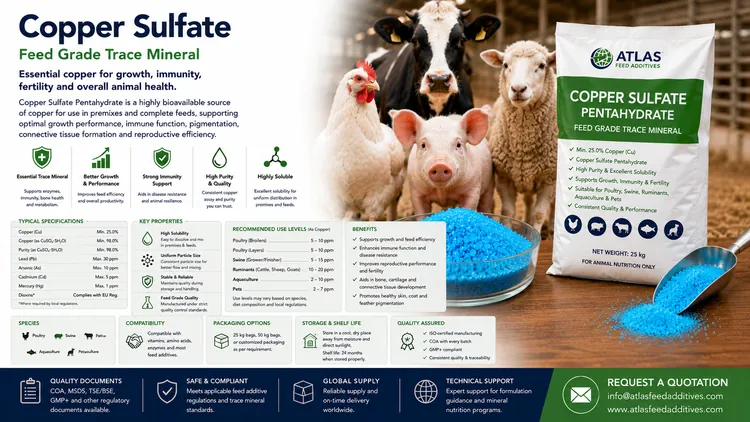
Copper Sulfate is a feed-grade inorganic copper source used to supply essential copper in poultry, swine, ruminant, aquaculture, pet food, premix, and specialty mineral programs.

Commercial Copper Sulfate is typically evaluated by hydrate form, elemental copper content, copper sulfate assay, solubility, particle size, moisture, free acid, purity, heavy metals, undesirable-substance limits, packaging, origin, and feed-grade compliance documents. The correct grade should match the buyer’s species, formulation matrix, premix process, handling system, and destination-market rules.

Copper Sulfate feed additive visual

Product role

Where Copper Sulfate fits

Copper Sulfate is part of the trace minerals and specialty minerals group. In animal nutrition, it is used mainly as an inorganic copper source for mineral premixes, compound feed, concentrates, specialty feed programs, and custom trace-mineral blends. Copper is required in small quantities, but the margin between adequate supply and excessive supply can be narrow for sensitive species, so formulation and regulatory control are essential.

Copper contributes to normal trace mineral nutrition associated with enzyme systems, iron metabolism, connective tissue formation, pigmentation, antioxidant systems, reproduction, immune function, skeletal development, and product quality. It is commonly included in premixes for poultry, swine, cattle, sheep, goats, aquaculture, pets, and other animals where the species, copper source, dose, and local rules are appropriate.

Atlas Feed Additives can coordinate international supplier options for feed mills, premix producers, mineral blend manufacturers, integrators, distributors, aquafeed producers, pet food companies, and importers that need consistent feed-grade Copper Sulfate supported by technical and export documentation.

Technical identity

What buyers should know

Copper Sulfate generally refers to copper(II) sulfate and its hydrated forms. In feed markets, Copper Sulfate Pentahydrate is common because it is readily soluble and provides a concentrated inorganic copper source. The commercial product may appear as blue crystals, granular crystals, snow crystals, or powder depending on particle size and manufacturing process.

  • Used primarily as a source of elemental copper in trace mineral nutrition.
  • Usually compared by elemental copper percentage, copper sulfate assay, hydrate form, and purity.
  • Highly soluble grades can be effective nutrient sources but may be reactive in sensitive premix systems.
  • Requires attention to particle size, dust, caking, hygroscopicity, free acid, and compatibility with vitamins, enzymes, probiotics, fats, and other additives.
  • Must be formulated with species-specific copper tolerance, total dietary copper, antagonists, and legal maximums in mind.

Commercial value

Why copper source selection matters

Two Copper Sulfate offers can look similar by name but differ in real value. Buyers should compare elemental copper content, hydrate form, solubility, impurities, particle size, dust level, packaging, and documentation. In some formulas, the lower invoice price of one source may be offset by handling issues, vitamin reactivity, caking, poor flow, weak documentation, or stricter contaminant limits in the destination market.

  • Elemental copper: determines true nutrient value and cost per unit of copper.
  • Hydrate form: affects copper concentration, appearance, moisture behavior, and assay comparison.
  • Solubility: influences nutritional availability and premix reactivity.
  • Particle size: affects uniformity, segregation, dust, and dosing accuracy.
  • Impurity control: heavy metals and undesirable substances are critical for feed safety.
  • Species sensitivity: sheep and some other animals can be particularly sensitive to copper accumulation.

Procurement note

Ask for the right specification before comparing prices.

Price comparisons are meaningful only when hydrate form, elemental copper percentage, copper sulfate assay, solubility, particle size, moisture, free acid, packaging, origin, and documentation are aligned. A lower-priced product may not be economical if it delivers less copper, contains undesirable impurities, has poor particle consistency, causes premix reactivity, or lacks required documents for import and customer approval.

For trace minerals, buyers should compare cost per kilogram of elemental copper and compatibility with the nutritionist’s mineral matrix. The right product is not always the one with the lowest product price; it is the one that delivers consistent copper safely, legally, and reliably in the target feed system.

Commercial specification

Typical specification points for Copper Sulfate

The final specification must be confirmed by the supplier and aligned with the destination market. The table below shows practical parameters that purchasing, formulation, quality, and regulatory teams commonly review before approving a Copper Sulfate source.

Parameter What to request Why it matters
Product name Copper Sulfate, Copper Sulphate, Cupric Sulfate, Copper(II) Sulfate, or supplier-specific feed grade Confirms identity and avoids confusion with copper oxide, tribasic copper chloride, copper carbonate, organic copper complexes, or non-feed copper chemicals.
Hydrate form Pentahydrate, monohydrate, anhydrous, or supplier-specific hydrated form declaration Hydrate form changes elemental copper percentage, appearance, moisture behavior, and cost comparison.
CAS number CAS for the declared form, such as Copper Sulfate Pentahydrate or anhydrous Copper Sulfate where applicable Supports customs, SDS, technical identity, and regulatory document matching.
Elemental copper Declared copper percentage and analytical method Determines nutrient matrix value and cost per kilogram of copper supplied.
Copper sulfate assay Assay of copper sulfate or copper sulfate pentahydrate depending on product form Confirms purity and consistency against the supplier’s specification.
Sulfate content Sulfate or sulfur declaration where required Supports full mineral accounting and distinguishes forms.
Appearance Blue crystals, blue granules, blue powder, or supplier-defined appearance range Useful for incoming inspection and detecting moisture damage, contamination, or incorrect grade.
Physical form Large crystals, small crystals, snow crystals, powder, granular material, or premix-grade form Affects dissolution, blending, segregation, dust, handling, and dosing accuracy.
Particle size Mesh range, sieve analysis, or particle-size distribution Important for premix uniformity, micro-dosing systems, segregation control, and dust management.
Solubility Water solubility, insoluble matter, and clarity of solution where required Supports quality review and confirms suitability for premix or liquid applications where relevant.
Moisture / loss on drying Maximum moisture or loss-on-drying value, matched to the hydrate form Moisture affects caking, flowability, shelf life, and assay interpretation.
Free acid Free sulfuric acid or acidity limit where specified Important for premix compatibility, handling safety, corrosion risk, and customer specifications.
pH pH in solution or supplier method where required Supports compatibility review with vitamins, enzymes, probiotics, organic acids, and carriers.
Bulk density Loose and tapped bulk density where available Supports dosing settings, bag volume, bin behavior, and freight planning.
Flowability Flow data, anti-caking treatment, or handling guidance Important for micro-ingredient systems and premix manufacturing.
Heavy metals Lead, cadmium, arsenic, mercury, and other buyer-required metals Supports food-chain safety, import approval, and customer quality standards.
Undesirable substances Dioxins, PCBs, nickel, chromium, iron, zinc, or other impurities where required by market or buyer Feed mineral rules and customer standards can require wider contaminant control.
Origin Country of origin, manufacturing site, and raw material source where available Supports traceability, customs, customer approval, and risk assessment.
Packaging 25 kg bags, drums, fiber drums, big bags, inner liner, palletized units, or private-label packaging Packaging affects moisture protection, corrosion risk, handling, dust, and logistics cost.
Regulatory status Feed-grade declaration, destination-country compliance, maximum-use considerations, and any market-specific documents Copper source permissions, maximum copper levels, and label rules vary by country and species.

Typical applications

Where Copper Sulfate is commonly evaluated

  • Vitamin-mineral premixes: routine copper source in premixes where particle size, reactivity, and uniformity are controlled.
  • Broiler and turkey diets: trace mineral programs for growth, skin and feather condition, enzyme systems, and production efficiency.
  • Layer and breeder diets: copper nutrition for reproductive programs, eggshell-related mineral balance, pigmentation-related pathways, and long-cycle production.
  • Swine diets: trace mineral programs for nursery, grower-finisher, sow, and gilt feeds; high-copper uses require careful legal and nutritional review.
  • Ruminant rations: cattle, dairy, goat, and sheep programs where copper status, antagonists, and species sensitivity must be evaluated carefully.
  • Aquaculture feeds: fish and shrimp formulas where copper supply, water quality, bioavailability, and environmental rules must be considered.
  • Pet food: copper supplementation where label guarantees, species requirements, and contaminant limits are tightly controlled.
  • Specialty mineral blends: custom trace mineral packs, farm concentrates, blocks, tubs, and premixes where local rules allow.

Application route

Where it can be added

  • Premix stage: common in trace mineral premixes, with careful separation from sensitive vitamins and enzymes when needed.
  • Compound feed: direct inclusion in complete feed through micro-dosing systems where uniform distribution is validated.
  • Concentrates: use in poultry, pig, dairy, beef, and farm-level concentrates.
  • Mineral blocks and tubs: use in specialty ruminant products where copper level and target species are strictly controlled.
  • Aquafeed dry mix: inclusion before extrusion where the approved copper matrix and environmental limits are followed.
  • Pet food dry mix: use in finished products where copper guarantee and label rules are confirmed.
  • Custom blends: combination with zinc, manganese, iron, iodine, selenium, cobalt, vitamins, and specialty minerals after compatibility review.

Species and program fit

How formulators evaluate Copper Sulfate by animal group

Animal group Common formulation objective Buyer questions to confirm
Broilers Supply copper for trace mineral nutrition, enzyme systems, growth programs, and product quality. What total copper level is legal and nutritionally justified? Is the premix designed to limit vitamin interaction?
Layers Support long-cycle trace mineral nutrition, feather condition, reproduction-related programs, and product consistency. How does copper interact with zinc, iron, manganese, calcium, phytate, and organic trace mineral strategy?
Breeders Support reproductive and skeletal trace mineral programs where precision is important. Is copper source and dose aligned with breeder age, production phase, and hatchery-related objectives?
Nursery pigs Support trace mineral nutrition and selected high-copper programs where permitted. Does local law allow the intended copper level? Is copper from all sources included in the total calculation?
Grower-finisher pigs Maintain trace mineral balance while controlling cost, copper excretion, and compliance. Are legal maximums, withdrawal or phase restrictions, and environmental copper considerations reviewed?
Sows Support reproductive trace mineral nutrition, hoof condition, and long-term mineral balance. Is the copper level appropriate for parity, feed intake, and other trace mineral sources?
Dairy cattle Support copper status in herds where antagonists such as molybdenum, sulfur, and iron may affect availability. Is the ration tested for antagonists? Is liver copper status or blood copper monitoring part of the program?
Beef cattle Support mineral supplementation in feedlot, grazing, and backgrounding programs. Does forage and water analysis indicate copper deficiency, antagonism, or toxicity risk?
Sheep Highly cautious copper supplementation due to species sensitivity and toxicity risk. Is copper supplementation allowed and justified? Are copper-sensitive breeds or high-risk conditions present?
Goats Support copper nutrition with attention to differences from sheep and local formulation practice. Is the product formulated specifically for goats and not accidentally using sheep mineral assumptions?
Aquaculture Supply copper while managing environmental discharge and species-specific requirements. Is the copper level, source, and water-quality impact suitable for the species and production system?
Pet food Meet finished-product copper guarantees and species-specific nutrient profiles. Does the copper source meet pet food documentation, contaminant, and label requirements?

Formulation profile

Practical benefits buyers look for

Copper Sulfate is usually selected as a reliable inorganic copper source with high solubility and broad availability. Its value comes from consistent elemental copper contribution, predictable assay, compatible physical form, and suitable documentation for feed-grade use.

  • Supplies elemental copper for trace mineral premixes and complete feeds.
  • Supports normal copper-dependent enzyme systems and trace mineral nutrition.
  • Allows precise copper formulation when assay and copper percentage are documented.
  • Can be used in multi-mineral premixes with zinc, manganese, iron, iodine, selenium, and cobalt sources.
  • Can be compared with tribasic copper chloride and organic copper sources for cost-in-use and compatibility.
  • Offers water solubility that may be useful in specific applications, while also requiring reactivity control in premixes.

Important limitations

What not to assume

  • Do not assume all copper sulfate products are feed grade.
  • Do not compare anhydrous, monohydrate, and pentahydrate forms without adjusting elemental copper percentage.
  • Do not ignore species sensitivity, especially in sheep and copper-sensitive animals.
  • Do not exceed legal copper limits or customer-specific restrictions.
  • Do not ignore copper antagonists such as molybdenum, sulfur, iron, zinc, and phytate.
  • Do not assume high solubility is always beneficial; it can increase premix reactivity.
  • Do not place reactive copper sources next to sensitive vitamins, enzymes, probiotics, or pigments without stability review.
  • Do not make drug, antimicrobial, disease-treatment, or performance claims unless specifically allowed in the target market.

Quality assurance

Buyer quality checklist

A feed-grade copper source should be evaluated by elemental assay, chemical identity, hydrate form, solubility, purity, particle size, contaminant profile, packaging condition, origin, and compliance documents. For Copper Sulfate, the most important quality review normally covers copper percentage, copper sulfate assay, free acid, moisture, insoluble matter, heavy metals, and feed-grade suitability.

  • Product identity confirmation for Copper Sulfate and declared hydrate form.
  • Batch-specific elemental copper assay on certificate of analysis.
  • Copper sulfate assay or purity result matched to the product form.
  • Solubility or insoluble matter result where required.
  • Moisture or loss-on-drying value consistent with the declared hydrate form.
  • Free acid or pH control where required by the buyer.
  • Particle-size distribution suitable for premix or feed mill handling.
  • Dust level, caking tendency, flowability, and bulk density.
  • Heavy metals such as lead, cadmium, arsenic, mercury, and other buyer-required elements.
  • Dioxins, PCBs, or other undesirable-substance statements where required by region or customer.
  • Feed-grade declaration, production origin, batch number, production date, expiry date, and shelf-life statement.
  • Packaging integrity, inner liner condition, pallet condition, and container loading quality.

Mineral comparison

Copper Sulfate and alternative copper sources

Feed formulators often compare Copper Sulfate with Tribasic Copper Chloride, copper oxide, copper carbonate, copper amino acid complexes, copper proteinate, copper methionine, and other organic or inorganic copper sources. These products are not automatically interchangeable because they differ in copper concentration, solubility, bioavailability assumptions, reactivity, cost-in-use, handling, and market acceptance.

Product type Commercial notes Buyer questions
Copper Sulfate Highly soluble inorganic copper source commonly used in premixes and compound feed. What hydrate form and elemental copper percentage are guaranteed?
Tribasic Copper Chloride Inorganic copper source often selected for improved handling and reduced premix reactivity compared with copper sulfate in some systems. Is the higher product price offset by stability, flowability, and cost-in-use benefits?
Copper Oxide Inorganic copper source with different solubility and availability assumptions. Is the product approved and nutritionally suitable for the target species?
Copper Carbonate Inorganic copper source used in selected mineral programs depending on market and specification. What copper percentage, solubility, and contaminant profile are guaranteed?
Copper Amino Acid Complex Organic or complexed copper source used where interaction control or specialty positioning is desired. What ligand, complex strength, copper level, and regulatory status are documented?
Copper Proteinate Organic trace mineral source used in premium mineral programs. What protein hydrolysate source, copper level, and label definition apply?
Copper Methionine Specialty copper source where amino acid ligand and trace mineral positioning are relevant. Is the product registered and suitable for the intended species and claim?
Custom copper blend Combination of inorganic and organic copper sources for performance, cost, or stability goals. Are all components declared and supported by matrix values and legal approval?

Processing compatibility

Premix, pelleting, extrusion, and feed mill handling

Copper Sulfate is widely used in feed manufacturing, but its solubility and reactivity mean that handling and premix design matter. The selected grade should match the buyer’s dosing system, mixer type, feed form, vitamin stability targets, storage time, and warehouse climate.

Process factor What to check Recommended buyer action
Micro-dosing Bulk density, flowability, bridging, dusting, and dosing accuracy Check behavior in the actual feed mill or premix plant dosing equipment.
Premix blending Particle-size compatibility with carriers, vitamins, enzymes, probiotics, and other minerals Confirm uniformity and use separation strategies for sensitive ingredients where needed.
Vitamin stability Potential reactivity with vitamins, pigments, fats, enzymes, and probiotics Use stability data, coated sources, alternative copper sources, or formulation separation if needed.
Pelleting Steam moisture, heat, mineral distribution, corrosive risk, and active ingredient stability Review finished-feed mineral uniformity and compatibility with heat-sensitive additives.
Aquafeed extrusion Heat, pressure, water stability, leaching, copper discharge, and species sensitivity Use approved copper matrix values and environmental compliance review.
Pet food extrusion Finished-product copper guarantee, vitamin stability, label claims, and kibble quality Verify finished-product copper and sensitive nutrient retention by lab analysis.
Mineral blocks Moisture, binding behavior, palatability, copper level, and target species safety Confirm suitability for the target species, especially avoiding sheep exposure where not intended.
Warehouse storage Humidity, caking, bag damage, corrosion, dust, contamination, and long turnover time Store sealed packaging in a dry, clean area and follow FIFO inventory management.
Worker handling Dust exposure, skin and eye irritation, spills, corrosion, and environmental release Follow SDS guidance, PPE recommendations, spill procedures, and good housekeeping practices.

Packaging

Packaging and handling considerations

Packaging should protect Copper Sulfate from moisture uptake, contamination, bag breakage, caking, and label damage. Because copper sulfate can be reactive and moisture-sensitive in some conditions, packaging quality is important for long-distance logistics, humid climates, and premix plant handling.

  • Common commercial packaging may include 25 kg bags, 50 kg bags, fiber drums, plastic drums, big bags, palletized units, or supplier-specific packaging.
  • Paper-plastic composite bags, woven bags, polyethylene inner liners, moisture-resistant packaging, sealed drums, and shrink-wrapped pallets may be available.
  • Fine powder grades should be handled with dust-control procedures and good housekeeping practices.
  • Opened packaging should be resealed and protected from humidity, acids, alkalis, strong oxidizers, feeds, pests, and cross-contamination.
  • Private-label or distributor orders should define label language, net weight, batch coding, expiry format, hazard statements, pallet configuration, and document format before production.
  • For humid climates or sea freight, buyers should review moisture barrier requirements, container desiccants, pallet covers, and liner options.

Storage

Storage questions before ordering

  • What storage temperature and humidity conditions are recommended?
  • Is the product prone to caking in humid or coastal warehouses?
  • What is the shelf life at the declared storage condition?
  • Is the elemental copper assay guaranteed through expiry or only at manufacture?
  • What pallet height and stacking limits apply?
  • Should the product be stored away from acids, alkalis, oxidizers, metal surfaces, or liquid ingredients?
  • Can the product tolerate long sea freight without caking, bag hardening, or corrosion issues?
  • Are desiccants, container liners, or special pallet covers recommended?
  • What dust-control, PPE, spill, and cleanup recommendations are listed on the SDS?

Compliance note

Regulatory status is species, dose, claim, source, and country specific

Copper Sulfate should be reviewed under the feed additive, trace mineral, premix, contaminant, labeling, environmental, and import rules of the destination market. A copper source accepted in one country may require additional documents, registration, maximum-use review, residue consideration, or customer approval in another.

Buyers should confirm whether the product is feed grade, whether the copper source is authorized for the target species, whether maximum copper levels apply, whether high-copper growth-related uses are allowed, whether sheep or copper-sensitive species could be exposed, and whether manure copper or environmental limits affect the program.

Atlas Feed Additives can help collect supplier documents for buyer review, but final import clearance, registration, label approval, feed use decision, environmental compliance, and legal interpretation remain the responsibility of the buyer, importer, consultant, feed manufacturer, or competent authority in the destination country.

Procurement guidance

How to request a precise quotation

The most accurate quotation is based on a complete technical and logistics profile. When sending an inquiry, include all product requirements rather than only the product name and quantity.

  • Product name: Copper Sulfate.
  • Required form: pentahydrate, monohydrate, anhydrous, crystal, granule, powder, or premix-grade form.
  • Required elemental copper percentage and copper sulfate assay.
  • Target application: poultry, swine, ruminant, aquaculture, pet food, premix, concentrate, or specialty mineral blend.
  • Required particle-size range, dust limit, bulk density, flowability, or solubility requirement.
  • Maximum heavy metal and undesirable-substance limits.
  • Any restrictions on source origin, industrial grade, free acid, carrier, or contaminants.
  • Quantity per shipment and annual forecast.
  • Destination country and port.
  • Preferred Incoterms such as EXW, FCA, FOB, CFR, CIF, DAP, or DDP if applicable.
  • Required documents for customs, registration, quality approval, or customer review.
  • Packaging size, palletization, label language, private-label needs, and container-loading requirements.

Buyer comparison

Questions to ask every supplier

  • What hydrate form is supplied?
  • What elemental copper percentage is guaranteed on the COA?
  • What copper sulfate assay or purity is guaranteed?
  • What particle-size distribution and dust profile are supplied?
  • What free acid, pH, moisture, and insoluble matter limits are declared?
  • What heavy metal and undesirable-substance documents are available?
  • Is the material specifically declared as feed grade?
  • What country of origin and manufacturing site are used?
  • What storage conditions and shelf life are declared?
  • Can batch documents be issued before shipment?
  • Is packaging suitable for the destination climate and shipment route?

Cost-in-use

Comparing Copper Sulfate offers by real mineral value

Copper Sulfate purchasing should be based on cost-in-use, not only product price per metric ton. A product with stronger copper assay, better particle consistency, lower contaminants, better packaging, and stronger documentation may be more economical even when its invoice price is higher.

Comparison point Why it changes real cost Buyer action
Elemental copper Different hydrate forms deliver different copper percentages per kilogram. Compare cost per kilogram of elemental copper, not only product price.
Assay and purity Lower assay reduces delivered copper and may increase impurity load. Use batch COA values and not only brochure values.
Particle size Very fine material may dust; coarse crystals may segregate or dissolve more slowly. Select particle size according to premix or feed mill equipment.
Premix reactivity Highly soluble copper sources can accelerate degradation of sensitive ingredients. Review vitamin stability, storage time, and alternative copper sources if needed.
Contaminant profile Heavy metals or undesirable substances can cause rejection or require dilution. Approve contaminant documents before shipment.
Packaging Weak packaging can cause moisture uptake, caking, corrosion, and handling loss. Choose packaging suitable for the destination climate and storage conditions.
Regulatory fit Maximum copper levels and authorized claims vary by market and species. Confirm local rules before purchase and formulation.
Documentation Incomplete documents can delay customs, registration, or customer approval. Approve specification, COA format, SDS, origin, and compliance documents before shipment.

Formulation note

Use Copper Sulfate inside a complete trace mineral strategy

Copper Sulfate should be evaluated inside the full diet, not as an isolated mineral. Correct use depends on total dietary copper, background copper from raw materials, zinc level, iron level, molybdenum, sulfur, phytate, fiber, water minerals, animal age, production stage, health status, species sensitivity, legal maximums, and environmental copper considerations.

For new formulas or supplier changes, Atlas Feed Additives recommends sample approval, document review, laboratory verification, particle-size checks, feed mill handling review, premix stability review, formulation matrix confirmation, and finished-feed mineral analysis where guarantees or sensitive applications are involved. This is especially important for sheep, young animals, high-copper swine programs, aquafeed, pet food, export premixes, and markets with strict contaminant or maximum-copper limits.

Document pack

Suggested document package for Copper Sulfate orders

Document Purpose When to request
Product specification Defines hydrate form, elemental copper, copper sulfate assay, solubility, moisture, free acid, particle size, contaminants, and packaging. Before price comparison and sample approval.
Certificate of analysis Confirms batch-specific copper assay and agreed quality parameters. For each production batch and shipment.
Safety data sheet Provides handling, dust exposure, storage, transport, spill, and safety information. Before import, warehouse approval, and feed mill use.
Feed-grade declaration Confirms intended suitability for feed-related use. Before order confirmation and regulatory review.
Hydrate declaration Confirms whether the product is pentahydrate, monohydrate, anhydrous, or another declared form. When comparing copper percentage and cost-in-use.
Solubility or insoluble matter report Supports quality review and formulation compatibility. When required by buyer specification or liquid application.
Particle-size report Supports premix uniformity, dosing accuracy, and dust management. When feed mill handling or segregation control is important.
Free acid or pH statement Supports handling safety and premix compatibility review. When required by customer, formulation, or process conditions.
Heavy metal report Supports food-chain safety and customer quality standards. When required by buyer, importer, or market.
Dioxin / PCB statement Supports compliance for sensitive regions and export customers. When required by regulation or customer protocol.
Origin certificate Supports customs, import, tariff, or customer origin requirements. When requested by importer or destination authority.
Free-sale or registration support document Supports local approval and market access. When required by the destination country.
GMO / animal-origin statement Supports customer requirements even when the product is inorganic. When required by pet food, export, halal, kosher, or private-label programs.
Shelf-life statement Defines validity period and storage conditions. Before order confirmation and inventory planning.

Questions

Useful answers

What is Copper Sulfate used for in animal nutrition?

Copper Sulfate is used as an inorganic copper trace mineral source in premixes, compound feeds, concentrates, and specialty mineral programs. Copper contributes to normal trace mineral nutrition linked with growth, enzyme systems, connective tissue, pigmentation, reproduction, immune function, and product quality. It should be used according to target species, formulation objective, copper matrix, and applicable market rules.

Is Copper Sulfate the same as Tribasic Copper Chloride?

No. Copper Sulfate and Tribasic Copper Chloride are different inorganic copper sources. They differ in copper concentration, solubility, reactivity, hygroscopicity, handling, premix stability, and cost-in-use. Buyers should compare elemental copper contribution, bioavailability assumptions, and compatibility with the full feed system.

Why does hydrate form matter?

Hydrate form changes the elemental copper percentage and product behavior. Copper Sulfate Pentahydrate, monohydrate, and anhydrous Copper Sulfate should not be compared on product price alone because each form contributes a different amount of copper per kilogram.

Why is species sensitivity important?

Some species, especially sheep and certain copper-sensitive animals, can be vulnerable to copper accumulation. Buyers should confirm target species, total dietary copper, antagonists, legal maximums, and veterinary or nutrition guidance before use.

Can Copper Sulfate be used in high-copper swine programs?

High-copper use is market-specific and may be restricted by feed additive rules, phase, claim, and environmental regulations. Buyers should confirm local legal maximums, permitted claims, phase requirements, and total copper from all ingredients before purchasing or formulating.

Can Copper Sulfate affect premix stability?

Yes. Highly soluble and reactive copper sources can interact with sensitive vitamins, enzymes, probiotics, pigments, fats, and other additives. Buyers should review stability, storage time, humidity, premix separation, and alternative copper sources where needed.

What contaminants should be checked?

Buyers commonly check lead, cadmium, arsenic, mercury, nickel, chromium, iron, zinc, insoluble matter, free acid, and any region-specific undesirable substances. Dioxin and PCB statements may also be requested in some markets or customer programs.

Why does Copper Sulfate price vary between suppliers?

Price varies because products may differ in hydrate form, elemental copper percentage, purity, particle size, solubility, moisture, free acid, heavy metals, packaging, origin, freight cost, and documentation package. Buyers should compare cost per kilogram of elemental copper and compliance value.

Can Atlas Feed Additives quote Copper Sulfate?

Yes. Send your required specification, copper percentage, hydrate form, target application, quantity, destination country, packaging preference, and required documents so Atlas Feed Add packaging, origin, freight cost, and documentation package. Buyers should compare cost per kilogram of elemental copper and compliance value.

Can Atlas Feed Additives quote Copper Sulfate?
What quality documents should buyers request?

Common documents include product specification, certificate of analysis, safety data sheet, elemental copper assay, copper sulfate assay, hydrate declaration, solubility or insoluble matter result, particle-size data, moisture, free acid, heavy metal report, shelf-life statement, storage guidance, origin information, feed-grade declaration, and market-specific certificates requested by the buyer.

What information is needed for a fast quotation?

Please send the required copper percentage, hydrate form, particle size, target application, maximum contaminant limits, quantity, destination, Incoterms, packaging size, label requirements, and documentation requirements. This allows Atlas Feed Additives to compare supplier options correctly.

Request a quotation

Tell us what you need

Send your product list, target copper specification, hydrate form, destination country, target species or application, packaging preference, and required documents. Our team will review your request and respond from orders@feedgradeadditives.com.