Trace minerals and specialty minerals

Tribasic Copper Chloride

Feed-grade Tribasic Copper Chloride, also known as TBCC or copper hydroxychloride, is a concentrated copper source used in animal nutrition programs where reliable trace mineral supply, premix stability, and controlled product quality are important.

Atlas Feed Additives supports international buyers with supplier coordination, specification review, documentation follow-up, packaging options, and export-focused quotation service for feed mills, premix manufacturers, distributors, and integrated animal production companies.

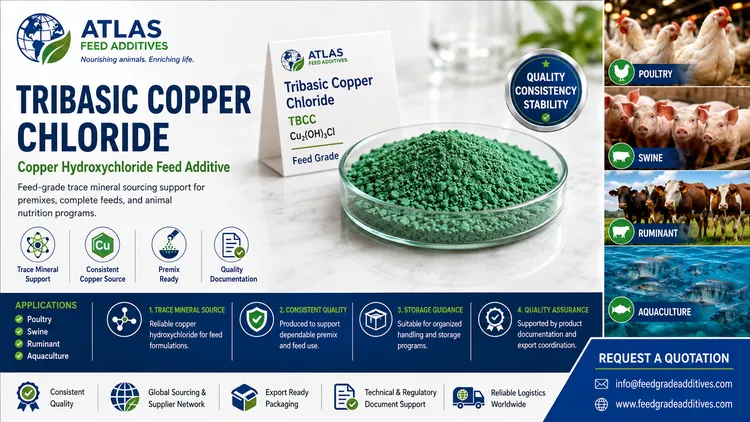
Tribasic Copper Chloride feed additive visual

Product role

Where Tribasic Copper Chloride fits

Tribasic Copper Chloride belongs to the trace minerals and specialty minerals group. It is used as an inorganic copper source in compound feed, premixes, mineral supplements, concentrates, and specialty nutrition programs. Copper is an essential trace element involved in many biological systems, including enzyme activity, iron metabolism, connective tissue formation, antioxidant defense, pigmentation, reproduction, and immune response.

In feed manufacturing, buyers typically evaluate TBCC by comparing copper assay, chloride level, particle size, crystalline form, solubility profile, flowability, dust level, storage stability, origin, heavy metal limits, batch consistency, and available quality documents. Because copper is regulated in many markets, final inclusion rates should always be determined by a qualified nutritionist and checked against local feed legislation.

Atlas Feed Additives can coordinate international sourcing for customers that require consistent feed-grade material, export documentation, supplier comparison, and responsive communication throughout the purchasing process.

Technical identity

Product names and identification

Tribasic Copper Chloride is a basic copper chloride compound used in feed applications as a source of copper. Depending on supplier terminology and market practice, it may appear in documents under several related names.

  • Tribasic Copper Chloride
  • TBCC
  • Copper hydroxychloride
  • Copper trihydroxyl chloride
  • Dicopper chloride trihydroxide
  • Basic copper chloride

Nutrition role

Why copper matters in feed

Copper is required in small but important amounts. In animal nutrition, copper supports normal physiological functions and is commonly managed through carefully formulated trace mineral programs.

  • Supports copper-dependent enzyme systems
  • Contributes to normal growth and development
  • Helps maintain connective tissue integrity
  • Supports immune and antioxidant functions
  • Contributes to reproduction and productivity targets
  • Supports pigmentation and product quality in relevant species

Formulation value

Why buyers evaluate TBCC

Tribasic Copper Chloride is often considered when buyers want a copper source with practical handling advantages in premixes and complete feed. Compared with highly soluble copper sources, TBCC is commonly evaluated for lower hygroscopic behavior, improved flow, lower reactivity with sensitive ingredients, and suitability in formulations where vitamin stability, enzyme compatibility, and storage conditions matter.

Its value should be reviewed as part of the full formulation, not only as a price-per-kilogram comparison. A meaningful commercial comparison should consider elemental copper content, delivered cost per unit of copper, bioavailability expectations, feed processing conditions, documentation quality, and regulatory fit for the target market.

Typical applications

Where Tribasic Copper Chloride is commonly used

Premix manufacturing

TBCC can be used in vitamin-mineral premixes, trace mineral blends, concentrates, and specialty formulations. Buyers often review particle size, flowability, dust level, and compatibility with vitamins, enzymes, organic acids, and other sensitive ingredients.

Poultry nutrition

Used in broiler, layer, breeder, turkey, and other poultry programs where copper contribution, feed stability, and mineral consistency are part of the formulation strategy. Inclusion should follow species-specific limits and the nutritionist's target copper level.

Swine nutrition

Used in piglet, grower, finisher, and sow diets where controlled trace mineral delivery is needed. Buyers should compare total copper from all ingredients and confirm that the final feed complies with the destination market.

Ruminant nutrition

Used in dairy, beef, calf, sheep, goat, and mineral supplement programs. Ruminant copper formulation requires particular care because copper tolerance and requirements differ by species and because sulfur, molybdenum, iron, and other antagonists can affect copper status.

Aquaculture feed

May be used in aquafeed formulations where trace mineral supply, pellet quality, water stability, and environmental rules are important. Final use should be checked against species needs and local aquaculture feed legislation.

Pet and specialty feed

Can be reviewed for pet food, equine feed, game animal feed, and specialty nutrition applications when a feed-grade copper source with consistent documentation is required.

Specification guide

What to check before approving a supplier

Tribasic Copper Chloride specifications vary by manufacturer. Before comparing offers, buyers should align the technical and commercial details below so that each quotation is evaluated on the same basis.

Parameter Why it matters What to request
Elemental copper assay Determines the delivered copper contribution and cost per unit of active copper. Minimum and typical copper percentage, test method, and COA confirmation.
Chemical identity Confirms that the material matches the required TBCC or copper hydroxychloride source. Product name, formula, CAS or internal product code, and supplier declaration.
Physical form Affects mixing, flowability, dusting, dosing accuracy, and worker handling. Powder or granule form, bulk density, particle size range, and appearance.
Solubility profile Influences reactivity in premixes and compatibility with sensitive ingredients. Supplier solubility data or product technical sheet where available.
Moisture High moisture can affect caking, flow, shelf-life, and storage performance. Maximum moisture level and recommended storage conditions.
Heavy metals and undesirable substances Important for feed safety, regulatory compliance, and customer approval. Limits for lead, cadmium, arsenic, mercury, dioxins, PCBs, and other required parameters.
Feed-grade declaration Confirms suitability for animal feed rather than industrial or agricultural non-feed uses. Feed-grade statement, manufacturing standard, and relevant compliance documents.
Packaging Impacts handling, warehouse planning, container loading, and moisture protection. Bag size, pallet configuration, liner type, big-bag option, and container loading quantity.
Shelf-life Supports inventory planning and quality assurance. Manufacturing date, expiry or retest date, shelf-life, and storage instructions.
Documentation Required for customs, import registration, audits, and customer qualification. Specification, COA, SDS, origin, batch documents, and market-specific certificates.

Buyer quality checklist

Documents to request

  • Product specification sheet
  • Certificate of Analysis for the offered batch or latest representative batch
  • Safety Data Sheet
  • Country of origin statement
  • Feed-grade declaration
  • Manufacturing date, batch number, and shelf-life
  • Heavy metal and undesirable substance limits
  • Statement of compliance with buyer or destination-market requirements
  • Non-GMO, allergen, BSE/TSE, halal, kosher, or other statements when required
  • Packing list format and shipping document support

Application review

Questions for technical approval

  • Which animal species and production stage will use the product?
  • What is the target copper level in the final feed or premix?
  • What other copper sources are already present in the formulation?
  • Will the product be used in a vitamin-mineral premix, concentrate, or complete feed?
  • Will the feed be pelleted, extruded, expanded, or stored in humid conditions?
  • Are there antagonists such as high sulfur, molybdenum, iron, or zinc to consider?
  • Does the destination country have a maximum copper limit for the target species?
  • Are special customer audits, registrations, or certificates required?

Procurement note

Ask for the right specification before comparing prices.

Price comparisons are meaningful only when assay, physical form, origin, packing, documentation, payment terms, and delivery basis are aligned. A lower price per kilogram may not be the best option if the copper assay is lower, the documentation is incomplete, the product has poor flowability, or the supplier cannot support the required export documents.

For sensitive formulations, buyers should also review storage conditions, shelf-life, vitamin compatibility, premix stability, pelleting conditions, and the total copper contribution from all ingredients. Atlas Feed Additives can help collect supplier details so your technical and procurement teams can compare offers clearly.

Storage and handling

Practical warehouse guidance

Storage guidance should always follow the supplier's SDS and technical documents. In general, feed-grade mineral additives should be kept in clean, dry, well-ventilated warehouses, protected from moisture, direct sunlight, incompatible materials, and contamination.

  • Keep bags closed when not in use.
  • Store on pallets and away from walls or wet floors.
  • Avoid mixing with incompatible chemicals outside controlled feed production.
  • Use dust-control practices and appropriate personal protective equipment.
  • Follow first-in, first-out inventory rotation.
  • Keep product labels, batch numbers, and traceability records intact.

Packaging options

Common commercial packing

Available packaging depends on supplier, order volume, and destination requirements. Atlas Feed Additives can request packaging options during quotation.

  • Small bags for premix and specialty users
  • Multi-layer bags with inner liner for moisture protection
  • Palletized cargo for easier warehouse handling
  • Big bags for large-volume feed mills or mineral blenders
  • Container-load options for distributors and importers
  • Private label or customer-specific labeling when available

Quotation preparation

Information to send for a faster offer

To prepare a complete quotation, please include the information below. The more details you provide, the easier it is to match the correct supplier, specification, documentation, and shipping option.

Product details

  • Product name: Tribasic Copper Chloride / TBCC
  • Target copper assay or current specification
  • Powder or granule preference
  • Particle size or flowability requirement
  • Any restricted origin or approved manufacturer list

Commercial details

  • Required quantity
  • Trial order or regular monthly volume
  • Destination country and port
  • Preferred Incoterms
  • Target delivery schedule

Documentation details

  • Required COA parameters
  • Feed registration documents
  • SDS and technical data sheet
  • Origin and compliance statements
  • Special certificates required by importer or customer

Commercial support

How Atlas Feed Additives supports your purchase

Supplier matching

We review your requested specification, target market, order size, and documentation needs to identify suitable supplier options for feed-grade Tribasic Copper Chloride.

Specification comparison

We help collect key details such as copper assay, physical form, moisture, heavy metal limits, packing, shelf-life, and available batch documents so your team can compare offers clearly.

Export coordination

We coordinate communication around packing, labeling, shipping documents, order timing, and delivery terms for international customers.

Responsive communication

Our team responds from orders@feedgradeadditives.com and can also communicate through phone or WhatsApp for urgent quotation requests.

Questions

Useful answers

What is Tribasic Copper Chloride used for in animal nutrition?

Tribasic Copper Chloride is used as a feed-grade copper source in trace mineral programs. It contributes essential copper for normal growth, reproduction, immune function, enzyme activity, connective tissue integrity, pigmentation, and product quality. It should be used according to the target species, formulation objective, nutritionist guidance, and applicable market rules.

Is Tribasic Copper Chloride the same as copper hydroxychloride?

In feed additive purchasing, Tribasic Copper Chloride is commonly referred to as TBCC or copper hydroxychloride. Supplier documents may also use names such as basic copper chloride, copper trihydroxyl chloride, or dicopper chloride trihydroxide. Buyers should confirm the exact chemical identity and specification before approval.

Why do some feed producers choose TBCC instead of copper sulfate?

Feed producers may evaluate TBCC because of its handling characteristics, lower hygroscopic tendency, reduced reactivity with sensitive ingredients, and suitability for premix stability programs. The best choice depends on the target species, total diet formulation, local regulations, cost per unit of copper, and buyer quality requirements.

What quality documents should buyers request for Tribasic Copper Chloride?

Common documents include specification, certificate of analysis, safety data sheet, origin information, batch details, shelf-life, feed-grade declaration, heavy metal limits, undesirable substance statement, packaging information, and any market-specific certificates required by the buyer.

Can Atlas Feed Additives quote Tribasic Copper Chloride?

Yes. Send your required specification, target copper assay, quantity, destination, packaging preference, delivery terms, and document requirements so Atlas Feed Additives can review suitable supplier options for Tribasic Copper Chloride.

What information is needed for a fast quotation?

Please provide the product name, quantity, destination country and port, preferred Incoterms, packaging preference, required documents, target specification, and whether the order is for a trial, spot purchase, tender, or regular monthly supply.

Can TBCC be used for all species?

TBCC can be considered for many animal nutrition programs, including poultry, swine, ruminants, aquaculture, pet food, and specialty feeds. However, final inclusion levels and suitability must be determined by a qualified nutritionist and must comply with local maximum copper limits and species-specific requirements.

How should Tribasic Copper Chloride be stored?

Follow the supplier's SDS and technical sheet. In general, keep the product in a clean, dry, ventilated warehouse, away from moisture, direct sunlight, contamination, and incompatible materials. Keep bags sealed when not in use and maintain batch traceability.

Request a quotation

Tell us what you need

Send your product list, target specification, destination country, packaging preference, required documents, and expected order volume. Our team will review your request and respond from orders@feedgradeadditives.com.

Suggested message details

  • Required product: Tribasic Copper Chloride / TBCC
  • Target copper assay or supplier specification
  • Order quantity and delivery schedule
  • Destination country and port
  • Preferred packaging and pallet requirements
  • Required certificates and import documents