Trace minerals and specialty minerals

Zinc Sulfate

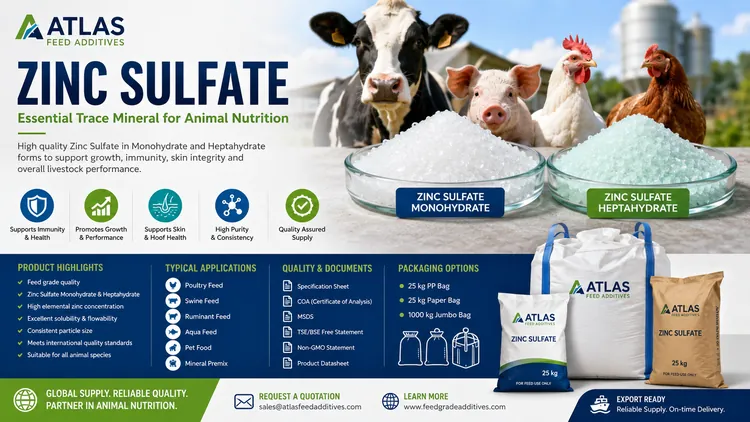
Zinc Sulfate contributes essential mineral nutrition for growth, reproduction, immune function, enzyme activity, skin and hoof integrity, and product quality across professionally formulated animal nutrition programs.

  • Trace mineral sourcing
  • Elemental zinc review
  • Hydrate form check
  • Premix compatibility
  • Export documentation
Zinc Sulfate feed additive visual

Product role

Where Zinc Sulfate fits

Zinc Sulfate is part of the trace minerals and specialty minerals group. It is used in animal nutrition programs where formulators need an inorganic zinc source for mineral premixes, compound feed, concentrates, supplements, and specialized feed formulations.

Zinc is involved in many biological systems, including enzyme function, protein metabolism, immune response, reproduction, skin and hoof integrity, feather and wool quality, and general growth performance. The final inclusion strategy should always be designed by qualified nutrition personnel according to target species, age, production phase, basal diet mineral contribution, antagonistic interactions, and local regulatory limits.

Buyers typically evaluate Zinc Sulfate by matching elemental zinc concentration, hydrate form, assay basis, solubility, particle size, moisture, purity, undesirable substance limits, physical form, packaging, origin, storage requirements, and documentation package.

Atlas Feed Additives can coordinate international supplier options for feed mills, premix producers, mineral premix manufacturers, distributors, integrators, and animal nutrition companies that need consistent feed-grade material and export-focused supplier communication.

Procurement overview

Zinc Sulfate should be compared by elemental zinc value, not only by price per kilogram

Zinc Sulfate products can differ significantly in hydrate form, elemental zinc level, assay basis, solubility, particle size, dust level, moisture, impurity profile, packaging, and documentation. A meaningful commercial comparison should consider the cost per unit of elemental zinc delivered to the buyer, not only the invoice price of the product.

Elemental zinc Confirm the declared zinc percentage, test method, assay basis, and whether the COA matches the quoted specification.
Hydrate form Check whether the material is monohydrate, heptahydrate, or another specification because this affects zinc concentration.
Physical quality Review particle size, flowability, dust profile, caking risk, solubility, and premix compatibility.
Total value Compare active mineral content, purity, packaging, shelf life, freight cost, and document support together.

Application areas

Typical applications

  • Vitamin-mineral premixes for poultry, swine, ruminants, aquaculture, equine, and companion animal feeds.
  • Broiler, layer, breeder, piglet, sow, dairy, beef, sheep, goat, and finishing programs where zinc supply is part of the mineral strategy.
  • Mineral concentrates and farm supplements designed to correct or maintain trace mineral supply.
  • Hoof, skin, feather, wool, reproduction, immune, and product-quality-oriented programs designed by qualified nutritionists.
  • Feed mill formulations where inorganic zinc is used alone or alongside organic zinc sources depending on the formulation objective.
  • Aquaculture and pet food applications where permitted and supported by product-specific documentation.
  • Specialty formulations where bioavailability, antagonistic interactions, or undesirable substance control must be reviewed carefully.

Quality focus

Buyer quality checklist

  • Declared elemental zinc concentration and assay range.
  • Hydrate form declaration, such as monohydrate or heptahydrate.
  • Certificate of analysis confirming zinc content for the offered batch.
  • Solubility and physical form, including powder, granular, crystalline, or free-flowing material.
  • Particle size distribution, bulk density, dust profile, and flowability.
  • Moisture content, caking tendency, and storage guidance.
  • Heavy metals and undesirable substance limits, including lead, cadmium, arsenic, mercury, and other market-specific parameters where required.
  • Feed-grade declaration, origin statement, batch number, packaging, and traceability details.
  • GMO, allergen, dioxin, and market-specific statements where required by the buyer.

Commercial focus

Buying criteria

  • Required elemental zinc percentage.
  • Preferred hydrate form or approved supplier reference.
  • Required grade: feed grade, premix grade, granular grade, or customer-specific specification.
  • Particle size, solubility, dust, and flowability expectations.
  • Target species, production phase, and premix or feed application.
  • Packaging size, palletization, moisture barrier, and storage expectations.
  • Minimum order quantity, lead time, and quotation validity.
  • Required Incoterm, destination country, and shipment route.

Technical profile

Key points to confirm before ordering

Zinc Sulfate should be evaluated by its trace mineral contribution and its suitability for the intended feed process. A lower-priced product may not be the best choice if the zinc percentage, hydrate form, solubility, particle size, impurity profile, caking risk, or documentation package does not match the buyer’s specification.

Review area What to confirm
Product identity Full product name, chemical form, hydrate form, feed-grade status, supplier reference, and intended animal nutrition use.
Elemental zinc Declared zinc percentage, assay basis, test method, specification range, and batch COA result.
Hydrate form Whether the product is zinc sulfate monohydrate, zinc sulfate heptahydrate, or another declared form.
Assay basis Whether the specification is expressed as zinc, zinc sulfate, zinc sulfate monohydrate, zinc sulfate heptahydrate, or another equivalent basis.
Solubility Water solubility, dissolution behavior, and suitability for the intended premix or feed process.
Physical form Powder, granular, crystalline, free-flowing material, dust level, segregation risk, and bulk density.
Particle size Particle distribution, mixing uniformity, solubility, dust, sorting risk, and compatibility with premix production.
Purity and contaminants Heavy metals, undesirable substances, insoluble matter, unwanted minerals, microbiological quality where required, and market-specific limits.
Storage conditions Humidity control, moisture protection, shelf life, caking risk, sealed packaging, and remaining shelf life at shipment.
Packaging Bag size, liner, moisture barrier, palletization, label format, batch code, big-bag option, and container loading requirements.
Compliance Destination-country rules, feed additive status, label requirements, import documents, undesirable substance limits, and customer-specific approvals.
Commercial terms MOQ, lead time, Incoterms, payment terms, quotation validity, document availability, and shipment frequency.

Procurement note

Ask for the right specification before comparing prices.

Price comparisons are meaningful only when elemental zinc concentration, hydrate form, assay basis, solubility, particle size, moisture, packaging, origin, undesirable substance limits, storage guidance, and documentation are aligned. For trace minerals, buyers should also consider cost per unit of elemental zinc and compatibility with the final premix or feed process.

Atlas Feed Additives helps buyers clarify these details before supplier comparison, reducing the risk of mismatched assay basis, incomplete documents, unsuitable particle size, caking during storage, or delays during customer approval and import review.

Handling and feed mill control

Operational topics buyers often review

Moisture and caking control

Zinc Sulfate can be sensitive to moisture depending on form and packaging. Buyers should confirm liner quality, moisture barrier, pallet wrapping, warehouse conditions, caking risk, and whether bags should remain sealed until use.

Mixing uniformity

Particle size, bulk density, flowability, and segregation tendency affect distribution in premixes, mineral blends, concentrates, and compound feeds. Ask for particle-size information when precise distribution is required.

Dust management

Fine powders can increase dust exposure and product loss during handling. Review dust level, granulation, flow aids, bag design, and plant dust-control practices before ordering.

Mineral interactions

Zinc can interact nutritionally with other minerals such as copper, iron, calcium, and phytate-containing ingredients. Final inclusion should be set by the nutritionist within the complete diet formulation.

Premix compatibility

Trace minerals can influence vitamin stability and premix behavior. Buyers should review moisture, acidity, particle size, and storage duration when using Zinc Sulfate in vitamin-mineral premixes.

Environmental limits

Zinc supplementation should respect local maximum limits and environmental rules. Buyers should confirm legal limits for the destination market and avoid over-formulation.

Batch traceability

Each shipment should be traceable through product name, batch number, production date, expiry date, COA reference, supplier information, packaging labels, and shipment documents.

Label and claim control

Functional claims should match local feed additive rules, product registration status, and supplier documentation. Marketing, labels, and technical documents should not exceed the permitted claim framework.

Document retention

Keep specification sheets, COAs, SDS documents, import papers, batch records, supplier approvals, and customer confirmations for audits, traceability, and feed safety system compliance.

Sourcing process

How Atlas Feed Additives supports Zinc Sulfate buyers

  1. Requirement review

    Atlas reviews your target elemental zinc level, hydrate form, physical form, species application, quantity, destination country, packaging preference, and required documents.

  2. Specification matching

    Potential supplier options are compared against zinc percentage, hydrate form, assay basis, particle size, solubility, impurity limits, shelf life, and documentation readiness.

  3. Technical document check

    Available technical data, COA, SDS, specification, origin information, heavy metal results, storage guidance, and product handling documents are reviewed for fit with your request.

  4. Supplier option check

    Available sources are evaluated based on commercial availability, lead time, export suitability, minimum order quantity, quality records, and ability to provide required certificates.

  5. Quotation alignment

    The quote is checked for elemental zinc basis, hydrate form, packaging, Incoterms, validity, dispatch timeline, payment terms, and whether the offer matches your technical requirement.

  6. Shipment follow-up

    Atlas supports communication from order confirmation through dispatch planning, document preparation, shipment tracking, and post-shipment follow-up.

Common buying risks

What can go wrong without enough detail?

Important: Zinc Sulfate should be selected and used according to applicable market rules, target species, product label, ration formulation objectives, maximum permitted levels, and professional nutrition recommendations. Atlas Feed Additives provides sourcing and quotation support; the buyer is responsible for confirming final regulatory acceptance and suitability in the destination market.

Risk How to reduce it
Misleading price comparison Compare cost per unit of elemental zinc, not only price per kilogram of product.
Wrong hydrate form Confirm whether the product is monohydrate, heptahydrate, or another declared specification.
Wrong assay basis Clarify whether the percentage refers to zinc, zinc sulfate, zinc sulfate monohydrate, zinc sulfate heptahydrate, or another equivalent.
Undesirable substance risk Request heavy metal and impurity results where required by the buyer, customer, or destination market.
Poor flowability or caking Confirm moisture, particle size, anticaking support, packaging liner, humidity protection, and storage requirements.
Excessive dust Request particle size information, dust profile, granulation options, and handling guidance.
Incomplete documentation List all mandatory documents before order confirmation, especially for regulated import markets or customer audits.
Unclear landed cost Compare Incoterms, freight assumptions, packaging format, palletization, MOQ, and customs document requirements.
Unsupported product claims Confirm that marketing statements, technical claims, and label use match the supplier documentation and local rules.

Commercial details

Information that improves quotation accuracy

Specification details

  • Exact product name or current supplier reference.
  • Required elemental zinc concentration.
  • Hydrate form: monohydrate, heptahydrate, or specified equivalent.
  • Assay basis and acceptable tolerance range.
  • Powder, crystalline, granular, or free-flowing product format.
  • Particle size, solubility, dust, and flowability expectations.
  • Target species, production phase, and feed application.

Quality document details

  • Product specification sheet.
  • Certificate of analysis.
  • Safety data sheet.
  • Technical data sheet.
  • Elemental zinc analysis.
  • Heavy metal results where required.
  • Origin statement and batch traceability.
  • Shelf-life and storage condition statement.

Destination details

  • Country of import and final use market.
  • Preferred port, airport, warehouse, or delivery city.
  • Required language for labels or documents.
  • Import permit, registration, or consignee requirement.
  • Customer-specific approval documents.
  • Target delivery date and shipment mode.

Order details

  • Trial quantity, first order volume, or annual demand.
  • Preferred Incoterm and shipment route.
  • Payment preference and quotation validity needs.
  • Packaging size and palletization requirement.
  • Private label or neutral label expectations, if any.
  • Required dispatch period or delivery deadline.

Packaging details

  • Bag size, carton size, drum, or big-bag requirement.
  • Moisture barrier and inner liner requirements.
  • Anticaking and humidity-control expectations.
  • Label format and batch coding needs.
  • Pallet wrapping and container loading preference.
  • Storage and warehouse handling requirements.

Supplier comparison details

  • Comparable elemental zinc concentration.
  • Comparable hydrate form and assay basis.
  • Comparable solubility and particle size.
  • Comparable purity and heavy metal limits.
  • Comparable packaging and shelf-life condition.
  • Comparable document package.
  • Comparable Incoterm, lead time, and freight assumptions.

Species and formulation review

Application planning by animal segment

Segment Common review points
Poultry Broiler growth, breeder reproduction, layer shell and feather quality, premix stability, mineral interactions, and local maximum zinc limits.
Swine Nursery, grower-finisher, sow, and boar programs; trace mineral balance; ingredient interactions; and regulatory limits for zinc use.
Dairy cattle Hoof integrity, reproduction, immune support, milk production objectives, forage mineral contribution, and interaction with copper and other minerals.
Beef cattle and feedlot Growth programs, finishing rations, hoof and skin integrity, mineral supplement design, and environmental zinc limits.
Aquaculture Water-quality considerations, species-specific mineral needs, feed processing stability, solubility, and environmental discharge requirements.
Companion animals Pet food mineral balance, coat and skin support, regulatory labeling, palatability, and customer documentation needs.
Mineral premix production Blend uniformity, flowability, particle size, segregation risk, vitamin stability, carrier compatibility, and final label values.

Specification language

Terms buyers should clarify

Term Why it matters
Elemental zinc The actual zinc contribution used in formulation and cost comparison.
Monohydrate A hydrate form with lower water content and typically higher zinc concentration than heptahydrate.
Heptahydrate A hydrate form with more water of crystallization and different zinc concentration and handling behavior.
Assay basis Clarifies whether a percentage refers to zinc, zinc sulfate, or a specific hydrate form.
Solubility Important for process behavior, application suitability, and analytical expectations.
Particle size Affects mixing uniformity, dust, segregation risk, and compatibility with premix production.
Heavy metals Lead, cadmium, arsenic, mercury, and other contaminants may be regulated or customer-limited.
Caking Moisture-related clumping that can reduce handling efficiency and mixing consistency.
Shelf life Remaining shelf life at shipment and arrival is important for maintaining expected product quality and usability.

Buyer documentation

Recommended document package

A complete document package improves internal approval, customer review, import handling, and feed safety records. Availability can vary by supplier, product grade, market, and order size.

Core documents

  • Product specification sheet.
  • Certificate of analysis.
  • Safety data sheet.
  • Technical data sheet.
  • Batch number and production date.
  • Expiry date or retest date.

Technical documents

  • Elemental zinc concentration statement.
  • Hydrate form declaration.
  • Assay basis declaration.
  • Solubility or particle size data where required.
  • Heavy metal results where required.
  • Handling, mixing, and storage guidance.

Market documents

  • Country-of-origin statement.
  • Feed-grade declaration.
  • GMO status statement where required.
  • Allergen statement where required.
  • Dioxin, undesirable substance, or contaminant statements where required.
  • Registration or authorization support documents where available.
  • Customer-specific certificates for audits or tenders.

Questions

Useful answers

What is Zinc Sulfate used for in animal nutrition?

Zinc Sulfate contributes essential mineral nutrition for growth, reproduction, immune function, enzyme activity, skin and hoof integrity, feather or wool quality, and product quality. It should be used according to the target species, formulation objective, product label, and applicable market rules.

Can Atlas Feed Additives quote Zinc Sulfate?

Yes. Send your required specification, elemental zinc target, hydrate form, quantity, destination, packaging preference, delivery terms, and documents so Atlas Feed Additives can review suitable supplier options for Zinc Sulfate.

What quality documents should buyers request for Zinc Sulfate?

Common documents include specification, certificate of analysis, safety data sheet, technical data sheet, elemental zinc analysis, hydrate form declaration, origin information, batch details, shelf-life statement, storage guidance, and any market-specific certificates required by the buyer.

What is the difference between Zinc Sulfate monohydrate and heptahydrate?

They differ in water of crystallization, which changes elemental zinc concentration and cost comparison. Buyers should confirm the exact hydrate form and zinc percentage before comparing prices.

How should two Zinc Sulfate offers be compared?

Compare elemental zinc concentration, hydrate form, assay basis, solubility, particle size, moisture, dust level, heavy metal limits, packaging, shelf life, documents, lead time, Incoterms, and total landed cost.

Is higher zinc concentration always better?

No. Higher zinc concentration can reduce cost per unit of zinc, but buyers should also consider solubility, particle size, impurity profile, handling behavior, documentation, and compatibility with the final premix or feed process.

Why does assay basis matter?

Assay basis explains whether the declared percentage refers to elemental zinc, zinc sulfate, zinc sulfate monohydrate, zinc sulfate heptahydrate, or another equivalent. Without this detail, two offers may not be comparable.

Why are heavy metal results important?

Trace minerals can contain undesirable substances depending on source and production route. Buyers should request heavy metal and impurity results where required by their customer, quality system, or destination market.

Can Zinc Sulfate be used in all animal species?

No single specification should be assumed suitable for every species, phase, or market. Suitability depends on product grade, local regulation, diet formulation, maximum permitted levels, and customer requirements.

What storage conditions should be checked?

Buyers should confirm recommended temperature range, humidity protection, sealed packaging requirements, caking risk, shelf life, and handling after opening.

What information helps Atlas respond faster?

The fastest quotation requests usually include required elemental zinc concentration, hydrate form, particle size or physical form, quantity, destination country, Incoterm, packaging preference, required documents, and order timeline.

What does cost per unit of elemental zinc mean?

It means evaluating the offer based on the zinc actually supplied by the product after considering zinc percentage, hydrate form, packaging, freight, and total landed cost, rather than only the product price per kilogram.

Does Atlas Feed Additives provide regulatory approval?

Atlas Feed Additives provides sourcing, quotation, and documentation coordination support. Buyers should confirm regulatory acceptance, product registration, label claims, maximum limits, and final use permissions with local authorities or qualified regulatory advisors.

Request a quotation

Tell us what you need

Send your product list, target specification, elemental zinc concentration, hydrate form, destination country, packaging preference, and required documents. Our team will review your request and respond from orders@feedgradeadditives.com.