Trace minerals and specialty minerals

Ferrous Fumarate

Ferrous Fumarate is an organic iron mineral source used in feed-grade trace mineral programs where buyers need reliable iron fortification, controlled specification, and strong documentation for premixes, concentrates, supplements, pet food, aquafeed, and specialty animal nutrition applications.

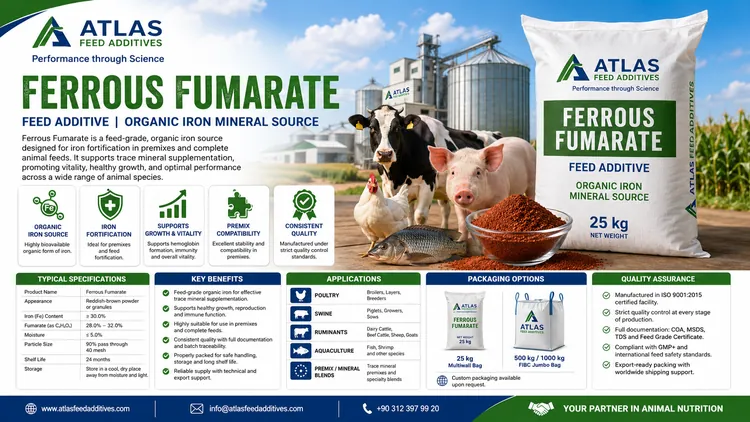
Ferrous Fumarate feed additive visual

Product role

Where Ferrous Fumarate fits in feed and premix production

Ferrous Fumarate is part of the trace minerals and specialty minerals group. In animal nutrition, it is used as an organic iron salt in complete feeds, concentrates, vitamin-mineral premixes, mineral supplements, young animal diets, breeder programs, pet food, aquafeed, ruminant concentrates, and specialty formulations where iron fortification is required and permitted by applicable market rules.

Iron is needed for hemoglobin-related nutrition, oxygen transport, myoglobin function, cellular respiration, enzyme systems, immune function, growth, reproduction, and general metabolic performance. Ferrous Fumarate is commonly selected when formulators want an iron source based on fumaric acid rather than sulfate, oxide, or other inorganic mineral sources.

Buyers usually evaluate Ferrous Fumarate by matching elemental iron content, ferrous iron assay, fumarate identity, active specification, purity, solubility, particle size, dust level, flowability, oxidation status, contaminant limits, physical form, packaging, shelf life, documentation package, and destination-market requirements.

Atlas Feed Additives can coordinate international supplier options for feed mills, premix producers, mineral blend manufacturers, pet food companies, aquafeed producers, livestock integrators, distributors, and importers that need consistent feed-grade specialty iron sources with export-focused service.

Why iron source selection matters

Ferrous Fumarate supplies iron through a fumarate-based organic salt.

Iron is an essential trace mineral in animal nutrition. It supports hemoglobin-related nutrition, oxygen transport, myoglobin, enzyme systems, cellular metabolism, immune function, and rapidly growing tissues. Iron supply is especially important in young animals, reproductive animals, high-performance production systems, and formulas where basal raw materials do not provide enough available iron.

  • Supports iron fortification in complete feeds, concentrates, premixes, and supplements.
  • Relevant for young-animal, breeder, gestation, lactation, pet food, and specialty feed programs.
  • Can be used where a fumarate-based iron source is preferred over sulfate or oxide forms.
  • Helps nutrition teams meet target iron specifications in finished feed.
  • Can be compared with inorganic and organic iron sources depending on formulation goals.

Iron nutrition must be balanced carefully. Low iron availability can limit performance, while excessive iron or poor-quality mineral sources can increase oxidation risk, interact with other nutrients, create premix stability problems, or contribute undesirable contaminants. A good Ferrous Fumarate source should therefore be evaluated by nutritional value, physical behavior, and quality-control profile.

  • Compare products by elemental iron content and cost per active iron unit.
  • Check whether the quoted grade is pure Ferrous Fumarate or a diluted carrier-supported blend.
  • Review heavy metals and undesirable substance limits before approval.
  • Evaluate particle size, dust, flowability, and mixing uniformity for premix use.
  • Confirm compatibility with vitamins, fats, enzymes, probiotics, organic acids, and other trace minerals.

Technical identity

Ferrous Fumarate is iron(II) fumarate, the ferrous salt of fumaric acid.

Ferrous Fumarate is an iron(II) salt formed with fumaric acid. It is generally supplied as a reddish-brown, reddish-orange, or orange-red powder depending on supplier grade, particle size, purity, oxidation status, carrier system, and storage history. Commercial feed-related products may be supplied as pure assay material, granulated grade, fine powder, coated product, or a formulated mineral premix dilution.

Pure Ferrous Fumarate has a theoretical elemental iron content of approximately 32.87%. Commercial products must always be compared against the supplier’s certificate of analysis because assay, moisture, purity, carrier content, and manufacturing route can change the actual iron contribution per kilogram.

Ferrous Fumarate is generally less water-soluble than highly soluble sulfate salts. This can influence premix behavior, dissolution expectations, and comparison with other iron sources. Buyers should review species target, feed matrix, bioavailability data, finished-feed guarantee, and local authorization before replacing one iron source with another.

Iron content and source comparison

Compare Ferrous Fumarate by active iron contribution, not only product price.

Iron sources differ in theoretical iron percentage, solubility, reactivity, compatibility, handling, and regulatory status. The values below are general comparison references. Final formula values must always be confirmed against the supplier’s specification and batch certificate of analysis.

Iron source Typical identity Approximate theoretical iron basis Buyer notes
Ferrous Fumarate Iron(II) fumarate About 32.87% Fe in pure material Organic fumarate salt; compare assay, solubility, source, particle size, and cost per active iron unit.
Ferrous Sulfate Monohydrate Iron(II) sulfate monohydrate About 32.9% Fe on theoretical basis Common soluble inorganic source; may be more reactive in some premix systems.
Ferrous Sulfate Heptahydrate Iron(II) sulfate heptahydrate About 20.1% Fe on theoretical basis Higher water of crystallization means lower iron per kilogram and different storage behavior.
Iron Oxide Iron oxide source Depends on oxide type and purity Often lower solubility and different bioavailability expectations; may also influence feed color.
Iron Chelate / Organic Complex Supplier-specific ligand or chelate Depends on mineral guarantee and ligand Used where interaction control or specialty positioning is desired; compare evidence and cost-in-use.

Pure assay material

Pure or high-assay Ferrous Fumarate is usually compared by elemental iron percentage, purity, fumarate identity, solubility, and contaminant profile. It may be preferred when buyers want a defined organic iron salt with a relatively high iron density.

  • Compare by elemental iron assay and cost per active Fe unit.
  • Request purity and identity testing where customer approval is strict.
  • Review solubility and bioavailability expectations for the target species.
  • Confirm contaminant limits before approval for sensitive applications.

Premix-grade dilutions

Some commercial Ferrous Fumarate products may be diluted, granulated, coated, or carrier-supported to improve handling, dosing accuracy, blend uniformity, or dust control. These grades must be compared by active iron basis rather than product weight.

  • Ask for carrier declaration and active iron percentage.
  • Confirm particle size and bulk density for micro-dosing systems.
  • Check whether coating changes release, mixing, or declaration requirements.
  • Compare cost per active iron unit after accounting for carrier weight.

Technical data

Typical Ferrous Fumarate specification points buyers review

Common commercial profile

Ferrous Fumarate specifications vary by supplier, source, manufacturing route, assay level, particle size, carrier system, and intended market. The points below are general purchasing references. Final values must always be confirmed against the supplier’s current specification, safety data sheet, certificate of analysis, and local regulatory requirements.

Product
Ferrous Fumarate
Chemical identity
Iron(II) fumarate
CAS number
141-01-5
Molecular formula
C4H2FeO4
Molecular weight
169.90 g/mol
Theoretical elemental iron
Approximately 32.87% in pure Ferrous Fumarate; confirm actual commercial assay by COA
Appearance
Reddish-brown, reddish-orange, orange-red, brown-red, or supplier-specific powder or granule
Odor
Usually odorless or slight characteristic mineral odor depending on grade and storage history
Solubility behavior
Slightly soluble in water; solubility and bioavailability expectations should be reviewed in the target feed matrix
Typical commercial forms
Pure powder, fine powder, granule, low-dust grade, coated grade, carrier-supported blend, or mineral premix dilution
Main nutritional role
Iron fortification for complete feed, concentrates, mineral premixes, supplements, pet food, and aquafeed
Primary comparison basis
Elemental iron content, purity, identity, particle size, solubility, contaminants, stability, and cost per active iron unit
Typical packaging
Bags, lined bags, cartons, drums, fiber drums, foil-lined packaging, pallets, or supplier-specific moisture-protective packaging

Specification comparison

What to align before comparing Ferrous Fumarate prices

A low price per kilogram can be misleading if active iron content, purity, carrier, particle size, contaminant limits, solubility, packaging, shelf life, and documentation are different. Buyers should compare cost per active iron unit and cost per ton of finished feed, not only product price.

Parameter Why it matters What to ask the supplier
Elemental iron content Determines the real iron value being purchased. Request Fe percentage, assay method, and batch COA.
Identity and purity Confirms that the material is Ferrous Fumarate rather than another iron salt or blend. Ask for chemical identity, purity, and test method.
Assay basis Dry-basis and as-is basis values can differ because moisture and carrier affect active content. Confirm whether the assay is reported on dry basis, anhydrous basis, or as-is commercial basis.
Solubility Ferrous Fumarate behaves differently from highly soluble sulfate salts. Request solubility guidance and species-specific performance data where available.
Particle size Influences mixing uniformity, segregation risk, dust, and dosing accuracy. Request mesh range, sieve analysis, or particle size distribution.
Dust level Dust affects operator exposure, premix losses, contamination, and plant housekeeping. Ask for granulated or low-dust grade if handling is a concern.
Carrier or coating Carrier-supported products may improve handling but lower active iron content. Request carrier declaration, active iron percentage, and coating purpose.
Contaminant profile Trace mineral sources can carry heavy metals or undesirable substances if not controlled. Request lead, cadmium, arsenic, mercury, fluorine, dioxins, PCBs, and other relevant results.
Compatibility Iron can interact with vitamins, fats, enzymes, probiotics, and other minerals. Ask for premix compatibility guidance and compare with sulfate or chelated iron sources.
Moisture and caking Moisture can reduce flowability and increase caking or oxidation risk. Request moisture limit, packaging details, and warehouse recommendations.
Regulatory status Permitted forms, declaration names, and mineral limits vary by country and species. Ask for destination-market compliance statements before purchase.
Commercial basis The cheapest material may not be cheapest in use if active iron content differs. Compare cost per kilogram of elemental iron and cost per ton of finished feed.

Applications

Typical application areas for Ferrous Fumarate in feed-related supply chains

Swine nutrition

  • Piglet, nursery, grower, finisher, sow, gestation, and lactation mineral programs.
  • Young-animal diets where iron supply and trace mineral design are carefully managed.
  • Specialty iron programs where a fumarate-based source is preferred.
  • Vitamin-mineral premixes for commercial swine feed mills and integrators.
  • Formulas requiring careful control of trace mineral interactions and oxidation risk.

Poultry nutrition

  • Broiler, layer, breeder, turkey, duck, and specialty poultry feeds.
  • Layer and breeder premixes where iron, zinc, copper, manganese, selenium, and vitamins are balanced.
  • Starter feeds and high-performance programs requiring consistent trace mineral fortification.
  • Mineral blends that require controlled particle size and low segregation risk.
  • Premixes where iron interaction with vitamins and fats must be managed.

Ruminant nutrition

  • Dairy, beef, sheep, and goat mineral supplements and concentrates.
  • Calf starters and young-ruminant programs where iron fortification is specified.
  • Free-choice mineral products where palatability, color, and intake control matter.
  • Premixes with buffers, salts, trace minerals, vitamins, and specialty additives.
  • Programs requiring review of antagonists such as sulfur, molybdenum, copper, and high-mineral water.

Pet food and companion animal products

  • Complete vitamin-mineral premixes for dogs, cats, and companion animals.
  • Dry pet food, wet pet food, treats, supplements, and functional nutrition products.
  • Products requiring precise mineral declaration and consistent finished-product guarantees.
  • Formulas where iron source, color contribution, taste, and oxidation risk should be reviewed.
  • Private-label products requiring strong traceability and documentation.

Aquafeed and specialty species

  • Fish and shrimp feeds where iron fortification is required and permitted.
  • Extruded aquafeeds requiring stability and processing review.
  • Specialty species diets with low-inclusion mineral precision requirements.
  • Premixes combined with phosphorus sources, binders, vitamins, pigments, and functional additives.
  • Programs where water stability, mineral leaching, and finished-feed shelf life are evaluated.

Premixes, concentrates, and supplements

  • Trace mineral premixes for feed mills and integrators.
  • Vitamin-mineral premixes for complete feed production.
  • Basemixes, concentrates, mineral blocks, loose minerals, top-dress products, and supplements.
  • Distributor blends requiring stable specification and export-ready documentation.
  • Custom mineral programs where elemental iron, particle size, and contaminant limits are controlled.

Nutritional function

Ferrous Fumarate supplies iron for hemoglobin-related and metabolic functions.

Iron is required for hemoglobin and myoglobin systems that support oxygen transport and oxygen storage. It is also involved in many enzyme systems connected with cellular energy metabolism, immune function, antioxidant defense, tissue development, and general animal performance. Ferrous Fumarate provides iron through an organic fumarate salt form that may be selected for specialty formulations and comparison against sulfate or oxide sources.

The response to supplemental iron depends on species, age, basal diet, iron status, gut health, mineral interactions, water quality, raw-material contribution, and the level of antagonists in the diet. Iron should be formulated as part of a complete mineral program, not as an isolated ingredient decision.

  • Oxygen transport: Supports hemoglobin-related nutrition and red blood cell function.
  • Muscle metabolism: Contributes to myoglobin-related oxygen storage in muscle tissue.
  • Enzyme systems: Supports iron-dependent metabolic enzymes and energy pathways.
  • Growth-stage feeding: Relevant in young animals and high-performance production systems.
  • Reproduction and immunity: Iron status can influence reproductive and immune-related nutrition programs.
  • Mineral balance: Must be coordinated with copper, zinc, manganese, selenium, calcium, phosphorus, sulfur, and other minerals.

Compatibility and formulation notes

Iron source selection affects premix stability, oxidation, and mineral balance.

Vitamin compatibility

Iron can participate in oxidation reactions that may reduce the stability of sensitive vitamins and fats, especially in moist, warm, or long-storage premixes. Ferrous Fumarate may behave differently from Ferrous Sulfate because of its fumarate anion and lower solubility, but compatibility should still be tested in the actual premix environment.

  • Review whether vitamins and trace minerals should be separated.
  • Check stability when Ferrous Fumarate is blended with choline chloride or hygroscopic ingredients.
  • Use low-moisture carriers and barrier packaging where stability is critical.
  • Request supplier guidance for premix shelf-life and nutrient overages.

Fat and oil oxidation

Iron can contribute to lipid oxidation if feed fat quality, antioxidant protection, or storage conditions are poor. This is especially relevant in pet food, aquafeed, high-fat feeds, milk replacers, and specialty supplements where rancidity can affect palatability and product quality.

  • Review peroxide value and antioxidant systems in high-fat formulas.
  • Check whether a coated or specialty iron source is preferred.
  • Store mineral premixes away from heat and moisture.
  • Monitor finished-feed odor, color, palatability, and shelf-life stability.

Mineral interactions

Iron can interact with other minerals and dietary factors. Excessive iron may influence copper and zinc utilization, while high sulfur, molybdenum, calcium, phosphorus, phytate, fiber, and water mineral content can influence mineral availability and final formulation decisions.

  • Balance iron with copper, zinc, manganese, and other trace minerals.
  • Review antagonists in raw materials and water.
  • Check whether a chelated, coated, or fumarate-based source is preferred for specialty formulas.
  • Consider phytase and mineral release programs in plant-based diets.

Particle size and uniformity

Trace minerals are often added at low inclusion levels, so particle size and bulk density matter. Very fine powder can create dust and operator exposure, while coarse particles can segregate during handling, transport, and storage of premixes.

  • Match particle size to the carrier and mixing system.
  • Validate mixer uniformity through representative sampling.
  • Control dust to improve plant hygiene and reduce losses.
  • Use granulated or low-dust grades where handling is a priority.

Color and sensory effects

Ferrous Fumarate is typically reddish-brown to orange-red, and it may influence the color of light-colored premixes or finished feeds. In pet food, milk replacers, young-animal feeds, or palatability-sensitive diets, buyers may need to review color, taste, odor, and compatibility with flavors or sweeteners.

  • Check visible color change in light-colored premixes or finished feeds.
  • Evaluate palatability when inclusion is high or formulas are sensitive.
  • Review iron source if metallic taste or dark coloration is a concern.
  • Use retained samples to compare batch-to-batch appearance.

Processing conditions

Ferrous Fumarate is generally used as a mineral ingredient in dry premixes and feeds, but the complete premix may be sensitive to heat, steam, moisture, extrusion, or long storage. Processing trials should focus on finished-feed mineral recovery and compatibility with vitamins, fats, enzymes, and probiotics.

  • Check finished-feed mineral guarantee after processing where required.
  • Review compatibility with extrusion and oil-coated aquafeed systems.
  • Protect premixes from humidity during production and storage.
  • Use appropriate overages only under technical and regulatory guidance.

Quality assurance

Buyer quality checklist for Ferrous Fumarate procurement

Documents to request

  • Current product specification
  • Certificate of analysis for each batch
  • Safety data sheet in the required language
  • Elemental iron assay and test method
  • Ferrous iron content where specified
  • Ferrous Fumarate identity and purity statement
  • Fumaric acid or fumarate basis where specified
  • Moisture or loss on drying statement
  • Particle size or mesh specification
  • Water-insoluble or acid-insoluble matter where required
  • Carrier or coating declaration if applicable
  • Country of origin statement
  • Manufacturing site or producer declaration where available
  • Feed-grade suitability statement where applicable
  • Heavy metal and undesirable substance statements
  • Allergen, GMO, animal-origin, BSE/TSE, irradiation, and solvent statements where required
  • Shelf-life and recommended storage condition statement
  • Halal, Kosher, FAMI-QS, GMP+, ISO, HACCP, or other certificates where relevant and available
  • Regulatory or destination-market compliance statements if required by the buyer

Batch review points

  • Batch number and manufacturing date
  • Expiry date or retest date
  • Elemental iron result
  • Assay basis: dry basis, as-is basis, or supplier-specific basis
  • Moisture or loss on drying
  • Appearance, color, odor, and physical condition
  • Particle size or mesh range where specified
  • Bulk density and flowability where specified
  • Water-insoluble or acid-insoluble matter where specified
  • Lead, cadmium, arsenic, mercury, fluorine, dioxins, PCBs, and other contaminants where required
  • Packaging integrity and liner condition
  • Remaining shelf life at dispatch
  • Label accuracy and destination-language requirements
  • Consistency between COA, invoice, packing list, label, and product specification
  • Retention sample availability for future comparison

Supplier approval

How to evaluate a new Ferrous Fumarate supplier

A new Ferrous Fumarate supplier should be approved through document review, laboratory comparison, premix handling checks, contaminant review, compatibility testing, and commercial validation. Products with the same name may differ in iron assay, purity, particle size, dust level, carrier system, solubility, and undesirable substance profile.

Evaluation step Purpose Recommended action
Document review Confirms whether the material can be considered for approval. Review specification, COA, SDS, origin, Fe assay, purity, contaminant limits, and regulatory statements.
Sample approval Creates a reference standard for future deliveries. Retain a sealed sample with supplier name, product code, batch number, assay, and date.
Laboratory comparison Checks active content and quality consistency. Compare iron assay, moisture, identity, solubility, particle size, and contaminants.
Premix trial Shows behavior in the buyer’s actual carrier and formula. Test flowability, dust, mixing uniformity, segregation risk, and dosing performance.
Compatibility review Protects vitamins, fats, enzymes, probiotics, and other sensitive ingredients. Evaluate interactions with vitamins, choline chloride, organic acids, trace minerals, and high-fat ingredients.
Storage test Checks stability under local warehouse conditions. Monitor caking, moisture pickup, color change, dusting, and packaging condition over time.
Finished-feed check Verifies that the product works in production-scale feed systems. Check finished-feed mineral recovery, appearance, palatability, and customer acceptance where relevant.
Commercial validation Confirms supplier reliability and landed value. Review batch consistency, complaint history, lead time, document accuracy, and cost per active iron unit.

Storage and handling

Recommended storage review for Ferrous Fumarate shipments

Always follow the supplier’s safety data sheet and product label. Ferrous Fumarate should be protected from moisture, contamination, excessive heat, poor closure after opening, and conditions that accelerate caking, color change, or loss of flowability.

  • Store in a cool, dry, well-ventilated warehouse.
  • Protect from moisture, condensation, direct rain exposure, and high humidity.
  • Keep bags, cartons, drums, and liners tightly closed when not in use.
  • Store away from strong oxidizing agents, incompatible chemicals, and materials listed in the SDS.
  • Use first-expired, first-out stock rotation.
  • Inspect packaging for punctures, broken seals, caking, moisture damage, or label problems at receipt.
  • Use dust control procedures when handling fine powder grades.
  • Avoid cross-contamination with medicated additives or incompatible mineral sources.
  • Use clean, dry scoops, dosing equipment, hoppers, and transfer containers.
  • Keep retained samples and warehouse records for batch number, receipt date, dispatch date, and stock rotation.

Regulatory note

Check authorization, mineral limits, contaminants, and label declarations before use.

Ferrous Fumarate rules can differ by country, product grade, animal species, feed category, mineral level, contaminant profile, and final label claim. Some markets may treat Ferrous Fumarate as a nutritional feed additive, trace element compound, mineral source, organic iron source, or ingredient used for iron fortification. Requirements may include specific declarations, permitted forms, maximum levels, undesirable substance limits, registration, or customer approval.

Buyers should verify whether the supplier grade is suitable for feed use, whether the iron level and fumarate source match destination-market rules, which undesirable substance limits apply, and whether the finished feed label can declare iron, Ferrous Fumarate, iron fumarate, organic iron source, or another approved term. Requirements may differ between livestock feed, pet food, aquafeed, mineral supplements, organic production, export premixes, and private-label products.

Extra care is recommended when Ferrous Fumarate is used in high-mineral premixes, young-animal diets, pet food, aquafeed, ruminant mineral supplements, organic or specialty products, and products shipped across multiple regulatory markets. These applications may require additional documentation, label review, contaminant testing, or customer-specific approval.

Atlas Feed Additives can help collect supplier statements and technical documents, but final compliance, labeling, formulation, and use decisions belong to the buyer, importer, manufacturer, and local regulatory advisor.

Comparison guide

How buyers compare Ferrous Fumarate with related mineral products

Ferrous Fumarate is one iron source within a broader trace mineral toolbox. The correct mineral program depends on species, feed type, basal raw materials, target mineral levels, bioavailability goals, processing conditions, oxidative stability, contaminant limits, and local regulation.

Mineral product Common role Buyer notes
Ferrous Fumarate Organic iron fumarate salt for specialty iron fortification in feeds and premixes. Compare elemental iron, purity, solubility, particle size, contaminants, and cost per active iron unit.
Ferrous Sulfate Common inorganic iron source for feed and premix iron fortification. Often more soluble; compare hydrate form, iron percentage, reactivity, and storage behavior.
Iron oxide Iron source or color-related ingredient in selected applications. Usually lower solubility and different bioavailability expectations than Ferrous Fumarate or Ferrous Sulfate.
Iron chelate or organic iron complex Specialty iron source where bioavailability or interaction control is desired. Compare ligand, mineral guarantee, stability, legal status, and cost-in-use.
Copper Sulfate Inorganic copper source in trace mineral premixes. Highly reactive; manage interaction with vitamins, fats, enzymes, and other minerals.
Tribasic Copper Chloride Specialty copper source with different solubility and reactivity profile. Often considered where lower premix reactivity or better handling is desired.
Zinc Oxide Inorganic zinc source and specialty mineral ingredient in selected formulas. Compare zinc content, particle size, contaminants, and regulatory restrictions.
Zinc Sulfate Inorganic zinc source with high solubility. Review moisture, caking, reactivity, and vitamin compatibility in premixes.

Procurement note

Ask for the right specification before comparing prices.

Price comparisons are meaningful only when elemental iron content, assay basis, purity, solubility, particle size, contaminant limits, carrier or coating system, packaging, origin, shelf life, and documentation are aligned. For Ferrous Fumarate, buyers should also review dust control, premix compatibility, color impact, heavy metal limits, and the finished-feed iron guarantee expected by the customer.

Atlas Feed Additives helps buyers prepare clear RFQs, compare supplier offers, request samples, review quality documents, and coordinate export-focused service from quotation to shipment planning.

  • Define whether you need pure Ferrous Fumarate, feed grade, food/feed suitable grade, granulated grade, coated grade, or premix dilution.
  • State the required elemental iron percentage and assay method if specified.
  • Confirm whether particle size, bulk density, or dust control is critical for your dosing system.
  • Identify the target species and feed type.
  • Share whether the product will be used in a mineral-only premix or a combined vitamin-mineral premix.
  • List heavy metal and undesirable substance limits before requesting final price.
  • Request samples and approve retained references before commercial order.
  • Compare cost per active iron unit, not only price per kilogram.

Logistics

Packaging, shipping, and import planning

Packaging review

Packaging affects moisture control, caking risk, dust containment, shelf life, container loading, and customer approval. Ferrous Fumarate should be protected from humidity and poor closure after opening, especially in warm or humid climates.

  • Confirm net weight and gross weight per bag, carton, drum, or pallet.
  • Ask whether the product uses inner liners, moisture barriers, foil bags, or sealed bags.
  • Request pallet dimensions and container loading estimates.
  • Ask for label photos before shipment if customs or customer approval is strict.
  • Confirm whether packaging is suitable for long sea freight or humid climates.
  • Ask how opened packaging should be resealed and stored.

Shipment planning

For international shipments, align documentation early. Ferrous Fumarate shipments can be delayed if product name, grade, HS code, batch number, origin, invoice, packing list, SDS, COA, and certificates are inconsistent.

  • Confirm HS code with the importer or customs broker.
  • Check whether the destination requires feed additive registration or pre-approval.
  • Align invoice name with approved product specification.
  • Request SDS and batch quality documents before dispatch.
  • Confirm whether legalized, apostilled, or chamber-certified documents are required.
  • Plan storage and rotation because moisture pickup and caking can affect handling.

Decision guide

When Ferrous Fumarate may be a good mineral source candidate

Ferrous Fumarate may be considered when the buyer needs an organic iron fumarate source for complete feeds, concentrates, mineral premixes, supplements, pet food, aquafeed, or specialty feed programs. The decision should be based on target species, elemental iron requirement, formula context, supplier data, contaminant limits, local authorization, and practical handling performance.

  • The formula requires a defined iron contribution.
  • The buyer wants a fumarate-based iron source instead of sulfate, oxide, or another iron source.
  • The premix system can manage iron reactivity, dust, and compatibility with vitamins and fats.
  • The product meets the buyer’s heavy metal and undesirable substance limits.
  • The finished feed carries mineral guarantees or customer-specific trace mineral specifications.
  • The supplier can provide consistent COA results and destination-market documents.
  • The product can legally be used in the destination market and target feed application.

Technical trial planning

How to test a new Ferrous Fumarate source

A new Ferrous Fumarate supplier should be approved through document review, sample testing, premix evaluation, compatibility review, and commercial validation. Ferrous Fumarate should not be substituted only by name because iron percentage, purity, particle size, dust level, contaminant profile, solubility, and handling behavior can vary.

  • Request a representative sample from the same grade that will be quoted commercially.
  • Record supplier name, product code, batch number, origin, assay, packaging, and document package.
  • Check COA values against the buyer’s approved specification.
  • Compare appearance, color, odor, particle size, flowability, caking tendency, and dust level.
  • Test micro-dosing accuracy and mixing uniformity in the actual premix carrier.
  • Evaluate compatibility with vitamins, choline chloride, organic acids, enzymes, probiotics, fats, and other minerals.
  • Check finished-feed mineral recovery after pelleting, extrusion, or storage if relevant.
  • Run retained-sample monitoring for color change, caking, oxidation, and moisture pickup.
  • Calculate cost per active iron unit and cost per ton of finished feed.
  • Keep approved reference samples for future batch comparison.

Questions

Useful answers about Ferrous Fumarate

What is Ferrous Fumarate used for in animal nutrition?

Ferrous Fumarate is used as an organic iron source in feed and premix programs. It contributes iron for hemoglobin-related nutrition, oxygen transport, myoglobin, enzyme systems, growth, reproduction, immune function, and general trace mineral fortification.

What is the chemical identity of Ferrous Fumarate?

Ferrous Fumarate is iron(II) fumarate, the ferrous salt of fumaric acid. Its common formula is C4H2FeO4 and its CAS number is 141-01-5.

How much iron is in Ferrous Fumarate?

Pure Ferrous Fumarate has a theoretical elemental iron content of approximately 32.87%. Commercial products must be checked against the supplier’s certificate of analysis because assay, moisture, purity, and carrier content can change the actual value.

What is the difference between Ferrous Fumarate and Ferrous Sulfate?

Ferrous Fumarate is an iron salt of fumaric acid, while Ferrous Sulfate is an iron sulfate salt. They differ in anion, solubility, handling behavior, reactivity, compatibility, active iron basis, and cost-in-use. Substitution should be reviewed by the buyer’s technical team.

Why should buyers compare cost per active iron unit?

Different iron sources and commercial grades contain different iron percentages. A lower price per kilogram may not be cheaper if the product contains less active iron, more carrier, poorer handling, weaker documentation, or higher contaminant risk.

Can Ferrous Fumarate be used in swine feeds?

Ferrous Fumarate may be evaluated in swine mineral programs, including piglet, nursery, grower, finisher, sow, gestation, and lactation feeds. Inclusion levels should be set by the buyer’s technical team according to species, stage, basal diet, iron status, and local rules.

Can Ferrous Fumarate be used in poultry feeds?

Ferrous Fumarate may be used in poultry trace mineral premixes for broilers, layers, breeders, turkeys, and specialty poultry where permitted. Buyers should review elemental iron content, contaminant limits, particle size, and premix compatibility.

Can Ferrous Fumarate be used in ruminant feeds?

Ferrous Fumarate may be considered in dairy, beef, sheep, goat, calf, and mineral supplement programs where iron fortification is needed. Ruminant formulas should consider antagonists, water mineral content, sulfur, molybdenum, copper balance, and overall trace mineral design.

Can Ferrous Fumarate be used in pet food?

Ferrous Fumarate may be used in pet food and companion animal products where permitted and suitable. Pet food buyers should review label declaration, finished-product guarantees, color impact, palatability, oxidation risk, and local regulations.

Can Ferrous Fumarate be used in aquafeed?

Ferrous Fumarate may be used in aquafeed formulas where iron fortification is specified and permitted. Extrusion stability, water exposure, mineral leaching, finished-feed guarantee, and species requirements should be checked.

Does Ferrous Fumarate interact with vitamins?

Iron can contribute to oxidation and may reduce stability of sensitive vitamins in some premix conditions, especially when moisture, heat, choline chloride, trace minerals, or long storage are involved. Buyers should request compatibility guidance and validate premix stability.

Is Ferrous Fumarate dusty?

Some fine powder grades can be dusty. Dust depends on particle size, drying method, granulation, packaging, handling, and transfer equipment. Buyers can request granulated or low-dust grades where plant hygiene and operator exposure are priorities.

What quality documents should buyers request for Ferrous Fumarate?

Common documents include product specification, certificate of analysis, safety data sheet, origin statement, elemental iron assay, identity statement, particle size, heavy metal and undesirable substance statements, shelf-life statement, storage statement, and market-specific certificates required by the buyer.

What should be checked on the certificate of analysis?

Buyers should check batch number, elemental iron content, identity, assay basis, moisture, insoluble matter, particle size where listed, contaminant results, manufacturing date, expiry or retest date, and consistency with the approved specification.

How should Ferrous Fumarate be stored?

Follow the supplier’s SDS and label. In general, Ferrous Fumarate should be stored in a cool, dry, well-ventilated area, protected from moisture, contamination, incompatible chemicals, and poor closure after opening.

How should buyers compare Ferrous Fumarate prices?

Buyers should compare elemental iron content, assay basis, purity, solubility, particle size, dust level, contaminant limits, packaging, shelf life, documentation, and cost per active iron unit. Price per kilogram alone may not show real commercial value.

Can Atlas Feed Additives quote Ferrous Fumarate?

Yes. Send the required elemental iron specification, target species, quantity, destination, packaging preference, preferred Incoterm, and required documents so Atlas Feed Additives can review suitable supplier options for Ferrous Fumarate.

Is Ferrous Fumarate allowed in every country?

No. Authorization, declaration name, feed category, mineral limits, contaminant limits, import rules, and label claims can vary by country. Buyers should verify current local requirements before import, formulation, or resale.

Request a quotation

Tell us what you need

Send your product list, required elemental iron specification, grade, destination country, packaging preference, delivery schedule, target species, premix application, contaminant limits, and required documents. Our team will review your request and respond from orders@feedgradeadditives.com.

Fast RFQ checklist

  • Product name: Ferrous Fumarate
  • Required elemental iron percentage and assay basis
  • Required grade: pure, feed grade, granulated, coated, low-dust, or carrier-supported blend
  • Target species and feed type
  • Application: mineral premix, complete feed, pet food, aquafeed, supplement, or distribution
  • Particle size, dust, flowability, and solubility requirements
  • Heavy metal and undesirable substance limits
  • Annual volume and first order quantity
  • Destination country and preferred Incoterm
  • Packaging and pallet requirements
  • Required certificates and approval documents