What is Feed Grade Urea used for in animal nutrition?
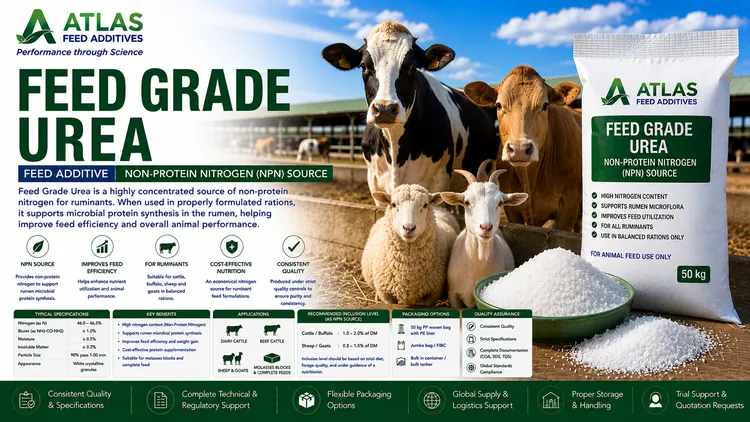
Feed Grade Urea is used as a non-protein nitrogen source in properly balanced ruminant feeds. It can help nutritionists formulate economical nitrogen supply when the ration has sufficient fermentable energy, appropriate minerals, controlled intake, and uniform mixing.
Is Feed Grade Urea the same as a protein meal?
No. Urea is not a true protein meal and does not provide amino acids directly. It provides nitrogen that rumen microorganisms may use to synthesize microbial protein when the diet is properly formulated.
Can Feed Grade Urea be used for poultry or swine?
Feed Grade Urea is normally associated with ruminant diets, not poultry or swine diets. It should not be used for non-ruminants unless the destination-market regulations and a qualified professional formulation program specifically allow it.
Can Feed Grade Urea be fed directly to animals?
No. It should not be fed directly, top-dressed, or left accessible to animals in pure form. It must be incorporated into a professionally formulated and uniformly mixed feed system with controlled intake.
What makes feed-grade material different from fertilizer-grade material?
Feed-grade procurement requires feed suitability documentation, controlled specification, traceability, safety data, and compliance with the buyer's feed regulations. Fertilizer-grade material should not be assumed suitable for feed use without supplier confirmation and appropriate documents.
What specification points are most important?
Buyers commonly review assay, nitrogen content, biuret, moisture, appearance, particle size, insoluble matter, contaminant limits, packaging, shelf life, origin, and batch traceability. Exact limits should be agreed before quotation.
What quality documents should buyers request?
Common documents include specification sheet, certificate of analysis, safety data sheet, feed-grade declaration, country of origin, manufacturer declaration, batch traceability, packing list, and any local registration or quality certificates required by the destination market.
What information is needed for a quotation?
Send the required specification, order quantity, destination country and port, preferred Incoterm, packaging preference, delivery schedule, required documents, and intended application. This helps Atlas Feed Additives match your request with suitable supplier options.
How should Feed Grade Urea be stored?
Store in sealed packaging in a dry, cool, well-ventilated warehouse. Protect from moisture, contamination, bag damage, and animal access. Follow the supplier SDS and local warehouse safety procedures.
Can Atlas Feed Additives quote Feed Grade Urea?
Yes. Send your required specification, quantity, destination, packaging preference, Incoterm, delivery timeline, and document requirements so Atlas Feed Additives can review suitable supplier options for Feed Grade Urea.