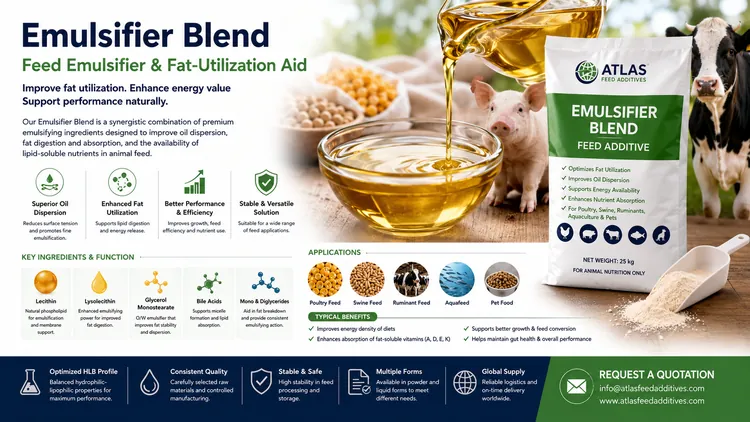
Emulsifiers and fat-utilization aids

Emulsifier Blend

Emulsifier Blend supports oil dispersion, fat-digestion strategies, and uniform distribution of lipid-soluble ingredients in feed programs where energy density, oil inclusion, young-animal digestion, liquid application, or feed manufacturing consistency are important.

HLB profile Helps match surfactant behavior to oil and water phases
Fat support Used in high-energy diet and oil-dispersion strategies
Flexible forms Liquid, powder, granule, or carrier-based premix
Application fit Species, fat source, and process conditions matter
Emulsifier Blend feed additive visual

Product role

Where Emulsifier Blend fits

Emulsifier Blend is part of the emulsifiers and fat-utilization aids group. It is used when feed manufacturers want better dispersion of fats, oils, and lipid-soluble ingredients, or when nutritionists want to support fat digestion strategies in high-energy diets, young-animal diets, aquafeeds, milk replacers, and liquid feed applications.

Feed emulsifier products are not interchangeable. A product may be based on lecithin, lysolecithin, mono- and diglycerides, glycerol monostearate, bile acids, polyglycerol esters, sorbitan esters, carrier-based surfactants, or proprietary active combinations. Buyers normally evaluate HLB profile, active concentration, emulsification index, fat-source compatibility, physical form, carrier, inclusion rate, thermal stability, shelf life, and feed-grade documentation.

Atlas Feed Additives can coordinate international supplier options for feed mills, premix producers, oil and fat processors, aquafeed manufacturers, milk replacer producers, pet food companies, distributors, and livestock integrators that need consistent feed-grade emulsifier products with export-ready documentation.

Important positioning

Emulsifier Blend should be presented as a formulation and processing support tool, not as a guaranteed performance enhancer. Results depend on diet fat level, fat source, animal age, bile secretion, digestive capacity, feed process, inclusion rate, and product-specific data.

How it works

Surface-active support for fat and oil handling

Emulsifiers contain surface-active molecules with both water-compatible and oil-compatible characteristics. In feed systems, this property can help improve the dispersion of oils, fats, fat-soluble nutrients, pigments, flavors, essential oils, and other lipophilic ingredients. In digestive systems, suitable emulsifier strategies may support smaller fat droplets, greater surface area, and better interaction with natural bile salts and lipase activity.

The practical effect depends on the full diet. Young animals, high-fat diets, saturated fat sources, animal fats, recycled oils, fish oils, vegetable oils, milk replacer systems, and aquafeeds may require different emulsifier characteristics. The right product should match the fat source and the target animal rather than being selected only by the word “emulsifier.”

  • Supports dispersion of added fats and oils in feed and liquid systems
  • Can help distribute lipid-soluble vitamins, carotenoids, pigments, flavors, and botanicals
  • May support fat-digestion strategies where product data and formulation fit are suitable
  • Used in powder premixes, liquid fat systems, milk replacers, aquafeeds, and high-energy diets
  • Requires careful evaluation of HLB profile, fat type, dose, carrier, and process stability

Buyer clarity

What buyers should define before comparing offers

Two Emulsifier Blend offers can differ in active chemistry, HLB value, solubility, carrier, application target, and performance. A liquid oil-soluble product for fat tanks is not directly comparable to a powder emulsifier for premixes or a bile-acid-based product for digestive support.

  • Target species and production stage
  • Fat source: soybean oil, palm oil, tallow, poultry fat, fish oil, acid oil, or mixed fats
  • Application objective: feed manufacturing, digestion support, milk replacer stability, or aquafeed coating
  • HLB range or emulsification profile
  • Active composition and concentration
  • Liquid, powder, coated, granule, or premix format
  • Recommended inclusion rate and cost per ton of feed
  • Destination-market authorization and permitted label wording

Typical applications

Application areas in feed and premix programs

Emulsifier Blend products are used in professional feed manufacturing and nutrition programs where lipid handling, energy utilization, oil dispersion, or fat-soluble ingredient distribution is important. Final use should be aligned with species, diet design, processing conditions, and local feed rules.

Poultry feed

Used in broiler, layer, breeder, and turkey diets where high energy density, oil inclusion, fat digestibility, pellet quality, and uniform distribution of lipid-soluble nutrients are important. Young birds and diets with higher saturated fat may require special attention to emulsifier selection.

Swine feed

Used in piglet, nursery, grower-finisher, sow, and gilt diets where fat utilization, feed transition, high-energy formulation, and young-animal digestive capacity are priorities. Buyers often review acidifier compatibility, pelleting stability, and cost per ton of treated feed.

Aquafeed

Used in extruded and coated aquafeeds where fish oil, vegetable oil, lecithin systems, pigments, and fat-soluble nutrients must be distributed effectively. Buyers should review extrusion exposure, post-coating compatibility, water stability, and species-specific requirements.

Milk replacers

Used in calf, lamb, kid, piglet, and specialty milk replacer systems where fat dispersion, powder reconstitution, emulsion stability, and digestibility are important. Product selection should consider water temperature, mixing equipment, fat source, and final emulsion stability.

Premixes and concentrates

Used by premix manufacturers to support distribution of lipid-soluble vitamins, carotenoids, pigments, essential oils, flavors, and high-fat ingredients. Powder flowability, carrier compatibility, and moisture control are key quality points.

Liquid fat and oil applications

Used in liquid fat systems, oil tanks, spray systems, post-pellet application, and feed coating programs. Buyers should check oil solubility, viscosity, pump compatibility, tank stability, and mixing sequence.

Claims and compliance note

Do not market Emulsifier Blend as a medicine, guaranteed growth promoter, or guaranteed feed-conversion improver unless the exact product has the correct authorization and evidence. Label wording, claims, species, and use levels must be confirmed locally.

Specification guide

Typical technical points requested by buyers

The following table is a practical procurement guide. Exact values depend on supplier, active chemistry, carrier system, product form, processing method, and destination-market requirements. Always confirm the offered specification and lot-specific certificate of analysis before ordering.

Product name Emulsifier Blend, feed emulsifier, fat-utilization aid, nutritional emulsifier, oil dispersion additive, lipid digestion support product, or emulsifier premix depending on supplier documentation and market classification.
Functional category Technological additive, sensory carrier support, nutritional support ingredient, or functional feed additive depending on formulation, authorization, and claim.
Common active families Lecithins, lysolecithins, mono- and diglycerides, glycerol monostearate, bile acid products, polyglycerol esters, sorbitan esters, sugar esters, organic acid esters, and proprietary surfactant blends.
HLB profile Request HLB value or HLB range where available. Lower HLB products may be more oil-compatible, while higher HLB products may support oil-in-water dispersion. Final suitability must be confirmed by supplier data and application testing.
Active concentration Request active percentage, declared surfactant fraction, phospholipid content, lysophospholipid content, mono-glyceride content, bile acid content, or supplier-defined active markers.
Analytical method Depending on active chemistry, common buyer requests may include phospholipid analysis, lysophospholipid profile, acid value, saponification value, iodine value, peroxide value, moisture, HPLC, GC, titration methods, or supplier-validated tests.
Emulsification test Request test method, oil type, water phase, dosage, mixing speed, emulsion stability time, droplet-size data where available, and visual or instrumental scoring criteria.
Physical form Liquid, viscous liquid, paste, spray-dried powder, carrier-based powder, coated granule, water-dispersible powder, oil-soluble concentrate, or premix.
Appearance Liquid products may be yellow, amber, brown, or oily. Powder products may be white, cream, tan, yellow, or brown depending on active material and carrier.
Solubility and dispersion Confirm whether the product is oil-soluble, water-dispersible, water-soluble, fat-dispersible, or designed for premix application. Misalignment can cause poor application results.
Carrier system For powder products, confirm carrier identity, carrier percentage, particle size, bulk density, dust level, flowability, moisture, anticaking system, and compatibility with premixes.
Fat-source compatibility Request compatibility guidance for soybean oil, canola oil, sunflower oil, palm oil, coconut oil, animal fat, poultry fat, tallow, fish oil, acid oil, soapstock derivatives, and mixed-fat systems.
Feed process compatibility Review compatibility with pelleting, extrusion, expansion, liquid application, fat coating, mineral premix production, milk replacer mixing, and long-term storage.
Heat stability Request active retention, physical stability, and functional performance after conditioning, pelleting, extrusion, spray drying, or warm storage where relevant.
Oxidation status For lipid-based emulsifiers, request peroxide value, acid value, rancidity indicators, antioxidant system, and storage guidance to reduce oxidation risk.
Moisture and water activity For dry products, controlled moisture supports flowability and shelf life. Request moisture, water activity where available, and caking tendency.
Particle size Particle size affects mixing, segregation, dusting, and application uniformity. Request particle-size distribution for powder and granule products.
Recommended inclusion Inclusion depends on active concentration, species, fat source, feed type, processing method, and formulation objective. Buyers should request dose per ton of feed and cost per ton at the recommended rate.
Compatibility Review compatibility with enzymes, organic acids, probiotics, essential oils, pigments, fat-soluble vitamins, minerals, antioxidants, choline chloride, medicated premixes where legally used, and liquid molasses systems.
Contaminants Request heavy metals, dioxins and PCBs where relevant, pesticide residues, residual solvents, mineral oil hydrocarbons where required, microbiological status for powders, and undesirable substances according to market rules.
Packaging Liquid forms may be packed in bottles, jerrycans, drums, lined drums, or IBCs. Powder forms may be packed in foil bags, lined paper bags, cartons, fiber drums, pails, or big bags.
Storage Store sealed in a cool, dry, well-ventilated area, protected from heat, sunlight, moisture, oxidation, strong odors, pests, and contamination. Follow supplier SDS and label instructions.
Shelf life Confirm production date, expiry or retest date, shelf-life statement, storage temperature, humidity limits, oxidation control, and handling after opening.
Documentation Specification, COA, SDS, technical data sheet, active composition, HLB/emulsification profile, origin declaration, carrier statement, contaminant statements, packaging list, shelf-life statement, and market-specific certificates.

Note: This table is procurement guidance only. Final specifications, claims, permitted uses, and inclusion rates must be verified against supplier documents, diet conditions, feed processing conditions, and destination-market regulations.

Procurement note

Ask for the right specification before comparing prices.

Price comparisons are meaningful only when active composition, HLB profile, inclusion rate, fat-source compatibility, product form, carrier, packaging, origin, shelf life, and documentation are aligned. A low-cost emulsifier may be less economical if it requires a higher dose, is poorly matched to the fat source, or does not remain stable in the intended process.

For sensitive products, also review liquid viscosity, pour point, pump compatibility, powder flowability, caking risk, oxidation status, pelleting stability, extrusion stability, and whether the supplier can provide repeatable batch quality.

Recommended comparison rule

Compare offers by cost per ton of feed at the recommended inclusion rate and by delivered active surfactant effect, not only by product price per kilogram. Include active concentration, application method, processing loss, storage stability, freight, packaging, and documentation.

Quality checklist

Buyer quality checklist for Emulsifier Blend

A complete quality checklist helps buyers avoid confusion between simple lecithin, high-active lysolecithin, bile-acid-based products, glyceride blends, liquid oil emulsifiers, and carrier-based powder premixes.

Identity and active profile

  • Product name and grade
  • Active composition and concentration
  • HLB value or emulsification profile
  • Analytical method and active markers
  • Vegetable, animal, synthetic, or blended origin
  • Carrier and dilution details if supplied as powder

Function and stability

  • Emulsification index or performance test
  • Fat-source compatibility
  • Heat and process stability
  • Oxidation status and antioxidant system
  • Liquid viscosity or powder flowability
  • Storage stability and shelf life

Compliance and documents

  • Specification and COA
  • SDS and technical data sheet
  • Feed-grade suitability statement
  • Contaminant and microbiological statements
  • Batch traceability and origin declaration
  • Market-specific authorization or claim support

Best RFQ practice

For faster supplier matching, send the target species, fat source, desired product form, HLB or emulsification requirement, intended application, inclusion-rate expectation, destination country, order quantity, packaging preference, Incoterm, and complete documentation list.

Formulation considerations

Use the right emulsifier for the fat source and animal stage.

Emulsifier Blend should be selected according to fat chemistry, animal digestive capacity, and feed manufacturing method. Unsaturated vegetable oils, saturated fats, animal fats, fish oils, acid oils, soapstock-derived materials, milk replacer fats, and post-pellet coating oils may require different emulsifier characteristics.

  • For young animals, review bile secretion, pancreatic lipase activity, diet transition, and fat digestibility goals.
  • For poultry, evaluate soybean oil, palm oil, tallow, poultry fat, and mixed-fat systems separately.
  • For swine, review piglet vs grower-finisher programs and compatibility with acidifiers.
  • For aquafeed, check extrusion stability, oil coating, water stability, and pigment distribution.
  • For milk replacers, confirm reconstitution, emulsion stability, water temperature, and mixing instructions.
  • For premixes, review compatibility with vitamins, pigments, essential oils, carriers, and minerals.

Processing considerations

Manufacturing conditions influence emulsifier performance.

A product that performs well in a laboratory oil-water test may not behave the same in a feed mill, fat tank, pelleting line, extrusion line, mineral premix, or milk replacer plant. Buyers should request application-specific data or run pilot tests when changing emulsifier system.

  • For liquid application, check viscosity, pumpability, tank mixing, and spray pattern.
  • For powder premixes, check flowability, dust, segregation, and uniformity.
  • For pelleted feed, review heat stability and interaction with fat addition point.
  • For extrusion, review shear, moisture, temperature, and post-coating strategy.
  • For milk replacers, test powder wetting, dispersion, foam, and separation over time.
  • For long storage, monitor oxidation, caking, phase separation, odor, and active retention.

Fat-utilization program design

Emulsifiers work best inside a complete energy-formulation strategy.

Emulsifier Blend can support a fat-utilization program, but it does not replace good fat sourcing, oxidation control, balanced energy formulation, digestive-health management, or quality control. The best results usually come from matching emulsifier chemistry to the fat source and animal age while maintaining consistent feed manufacturing.

Before product approval

  • Define target fat source
  • Confirm HLB or emulsification requirement
  • Review active composition
  • Check process compatibility
  • Request performance support
  • Verify destination-market status

During production

  • Use accurate dosing
  • Control mixing sequence
  • Monitor fat temperature
  • Check liquid spray uniformity
  • Control moisture and caking
  • Record batch traceability

After feed production

  • Monitor feed appearance
  • Check pellet quality
  • Track oil separation
  • Review animal response
  • Retain samples
  • Adjust dose when diet fat changes

Regulatory and claim responsibility

Atlas Feed Additives can help collect supplier documents and coordinate quotations, but final approval for import, product registration, label claims, species use, and inclusion rate must be confirmed by the buyer, importer, regulatory advisor, and qualified nutrition team.

Documentation package

Documents commonly requested by professional buyers

Because emulsifier products may be sold as liquids, powders, carrier-based premixes, bile-acid products, lecithin systems, or proprietary blends, documentation should confirm both composition and practical feed-use performance.

Core product documents

  • Product specification sheet
  • Lot-specific certificate of analysis
  • Safety data sheet
  • Technical data sheet
  • Recommended inclusion guidance
  • Packaging specification
  • Shelf-life and storage statement

Technical support

  • Active composition or marker profile
  • HLB or emulsification data
  • Fat-source compatibility guidance
  • Heat and processing stability
  • Liquid viscosity or powder flow data
  • Milk replacer or aquafeed data where relevant
  • Recommended dose by species or application

Safety and compliance

  • Feed-grade suitability statement
  • Country of origin declaration
  • Heavy metals statement
  • Dioxins and PCBs statement where relevant
  • Residual solvent or processing-aid statement if required
  • GMO, allergen, halal, kosher, or vegan statement if required
  • Market authorization or registration documents

Document review before dispatch

Do not wait until customs clearance or customer intake to check emulsifier documentation. Confirm active composition, COA, SDS, origin, feed-grade suitability, contaminant statements, label language, and packaging before shipment.

Handling and storage

Practical handling guidance for liquid and powder emulsifiers

Emulsifier Blend products should be handled according to product form. Liquid products may require temperature control, pump compatibility, and mixing before use. Powder products may require moisture protection, dust control, and flowability management.

Liquid product handling

Store containers closed and protect from extreme heat, cold, sunlight, oxidation, and contamination. Check viscosity, phase separation, crystallization, or sediment before use, and follow supplier guidance for mixing or warming.

Powder product handling

Keep bags sealed until use and protect from humidity. Monitor caking, dusting, and flowability. Use ventilation and personal protective equipment according to the SDS and internal safety procedures.

Production handling

Use calibrated dosing systems and validated mixing sequence. For liquid fat systems, confirm whether the emulsifier is added to the oil tank, feed mixer, post-pellet line, or premix stage.

Traceability records

Maintain lot number, production date, expiry or retest date, received quantity, released quantity, retained sample, and customer allocation records for every batch.

Finished feed control

Production teams should record inclusion rate, product batch number, target formula, fat source, fat addition point, mixing time, processing temperature, and any observed change in pellet quality, oil separation, or feed appearance.

Logistics and packaging

Packaging options should match product form and stability.

Emulsifier Blend logistics depend on whether the product is liquid, paste, powder, granule, or premix. Buyers should confirm packaging, palletization, temperature exposure, oxidation control, and destination-market documentation before shipment.

Liquid packaging Bottles, jerrycans, HDPE drums, steel drums, lined drums, flexitanks, or IBCs may be available depending on viscosity, order size, and supplier capability.
Dry packaging Foil bags, PE-lined paper bags, cartons, pails, fiber drums, plastic drums, or big bags may be available for powder, granule, or carrier-based emulsifier products.
Palletization Confirm pallet type, pallet dimensions, stretch wrap, corner protection, moisture protection, total net weight, total gross weight, and stacking limits.
Label information Product name, batch number, net weight, production date, expiry or retest date, storage instructions, supplier details, hazard labels where required, and feed-use labeling where applicable.
Shipment planning Confirm Incoterm, destination port, HS code support, container type, temperature exposure, dangerous-goods status if applicable, customs documents, and expected transit time.
Sampling Buyers may request a laboratory approval sample, pre-shipment sample, retained sample, or sealed batch sample for active profile, emulsification testing, viscosity, flowability, and customer approval testing.

Application objectives

Define the objective before choosing the blend.

Emulsifier Blend products are not interchangeable unless active chemistry, HLB profile, fat source, dose, product form, and target species match. Buyers should define whether the primary objective is feed manufacturing, fat digestion support, milk replacer emulsion stability, aquafeed oil coating, or distribution of lipid-soluble ingredients.

Fat digestion strategy

Used where nutritionists want to support utilization of dietary fat, especially in young animals, high-energy diets, or diets containing more saturated fat sources. Review animal age, fat source, bile capacity, and product-specific evidence.

Oil dispersion and coating

Used where oils, pigments, flavors, essential oils, or fat-soluble nutrients need more uniform dispersion. Review mixing order, oil temperature, carrier, spray pattern, and final feed appearance.

Milk replacer stability

Used where powder reconstitution, fat dispersion, wetting, and emulsion stability are important. Review water temperature, mixing energy, foam, creaming, separation, and storage time after mixing.

Product-specific testing matters

Do not assume all emulsifiers behave the same. Lecithin-rich, lysolecithin-rich, glyceride-based, bile-acid-based, and proprietary surfactant blends may perform differently depending on fat source, diet matrix, dose, and processing conditions.

Quotation workflow

How Atlas Feed Additives reviews Emulsifier Blend requests

Atlas Feed Additives supports buyers by matching fat-utilization and oil-dispersion requirements with suitable supplier options, available documentation, logistics conditions, and destination-market requirements.

  1. Define the target application. Share the target species, production stage, feed type, fat source, fat inclusion level, and whether the program is focused on digestion support, oil dispersion, milk replacer stability, aquafeed coating, or premix uniformity.
  2. Confirm product form and active needs. Tell us whether you need liquid, powder, granule, premix, lecithin-based, lysolecithin-based, bile-acid-based, glyceride-based, or a proprietary multi-active blend.
  3. Review technical and processing conditions. Provide pelleting temperature, extrusion conditions, liquid fat system details, mixing sequence, storage temperature, and any HLB or emulsification test requirement.
  4. Check documents and compliance. Atlas reviews specification, COA, SDS, active composition, carrier statement, origin declaration, contaminant statements, shelf-life data, and optional certificates requested by the buyer.
  5. Compare commercial and logistics terms. Confirm quantity, packaging, destination, Incoterm, payment terms, lead time, palletization, freight option, temperature control, and quotation validity.
  6. Prepare supplier options. When suitable options are available, Atlas can provide pricing, specification summary, packaging details, available documents, and next steps for sample or order confirmation.

Incoming quality control

Suggested receiving checks

Feed mills, premix manufacturers, oil processors, and distributors should define incoming inspection standards before shipment. The receiving plan should match the purchase contract, supplier COA, internal quality procedures, and destination-market requirements.

  • Confirm product name, batch number, net weight, and packaging against documents.
  • Inspect drums, IBCs, bags, pails, or cartons for leaks, swelling, moisture, damage, odor, phase separation, caking, or contamination.
  • Verify COA values against agreed active, HLB, moisture, acid value, peroxide value, or specification limits.
  • Check appearance, odor, color, viscosity, flowability, and sediment where relevant.
  • Confirm SDS, technical data sheet, storage instructions, and expiry date before release.
  • Retain a representative sample according to internal quality policy.
  • Store released product under stated conditions and segregate non-conforming lots.
  • Record production use by batch for traceability and inclusion-rate verification.

Risk reduction

Common procurement risks to avoid

  • Buying by generic name without confirming active composition.
  • Comparing products only by price per kilogram instead of cost per ton of feed.
  • Ignoring HLB profile and fat-source compatibility.
  • Using a powder product in a liquid oil tank without solubility support.
  • Using a liquid product in premixes without carrier and mixing guidance.
  • Skipping oxidation, peroxide value, or storage stability review for lipid-based products.
  • Assuming performance in poultry automatically applies to swine, aquafeed, or milk replacers.
  • Failing to review destination-market authorization and label language.

Buyer questions

Questions to include in your inquiry

To help Atlas Feed Additives review suitable options quickly, include as many of the following details as possible in your first message.

Technical request

  • Required active family
  • Required HLB range or emulsification profile
  • Liquid, powder, granule, or premix form
  • Target fat or oil source
  • Inclusion-rate expectation
  • Heat-stability requirement
  • Performance or trial support needed

Application request

  • Target species
  • Production stage
  • Feed type or premix type
  • Fat inclusion level
  • Pellet, mash, extrusion, liquid, or milk replacer use
  • Existing fat-utilization program
  • Target claim or positioning

Commercial request

  • Order quantity
  • Annual demand estimate
  • Destination country and port
  • Preferred Incoterm
  • Packaging preference
  • Target delivery schedule
  • Required documents and certificates
Feed emulsifier Fat-utilization aid HLB profile Lecithin blend Lysolecithin Glycerol monostearate Bile acids Oil dispersion Milk replacer Aquafeed coating High-energy diets COA review SDS available Global sourcing

Questions

Useful answers

What is Emulsifier Blend used for in animal nutrition?

Emulsifier Blend is used to support oil dispersion, fat-utilization strategies, and uniform distribution of lipid-soluble ingredients in feed. It may be used in poultry, swine, aquaculture, milk replacers, premixes, liquid applications, and high-energy diet programs depending on product form and authorization.

What does HLB mean?

HLB means hydrophilic-lipophilic balance. It describes the balance between water-compatible and oil-compatible behavior in a surfactant system. Buyers use HLB guidance to match emulsifier chemistry with the intended oil, fat, water phase, and feed application.

Is Emulsifier Blend the same as lecithin?

Not always. Some emulsifier blends contain lecithin, while others contain lysolecithin, glycerides, bile acids, or proprietary surfactant combinations. Buyers should request the active composition before comparing offers.

Which animals commonly use feed emulsifiers?

Feed emulsifiers are commonly considered in poultry, swine, aquaculture, young-animal feeds, milk replacers, and pet food programs. Suitability depends on product authorization, diet design, fat source, inclusion rate, and local market rules.

Can Emulsifier Blend improve fat digestibility?

Some products are positioned to support fat-digestion strategies, but results depend on product chemistry, dose, diet fat source, animal age, digestive capacity, and trial support. Buyers should request product-specific evidence before making performance claims.

What is the difference between liquid and powder emulsifiers?

Liquid emulsifiers may be suited for oil tanks, fat systems, and liquid application. Powder emulsifiers may be easier for premixes, mineral feeds, and dry feed manufacturing. The correct form depends on equipment, process, carrier, and application objective.

What quality documents should buyers request?

Common documents include specification sheet, certificate of analysis, safety data sheet, technical data sheet, active composition, HLB or emulsification profile, carrier statement, origin declaration, contaminant statements, packaging list, shelf-life statement, and market-specific feed documents.

How should Emulsifier Blend be stored?

Store in sealed packaging in a cool, dry, well-ventilated area. Protect from heat, sunlight, moisture, oxidation, strong odors, pests, and contamination. Liquid products may need protection from freezing or excessive heat, depending on supplier guidance.

What information is needed for a quotation?

Send the target species, fat source, desired active profile, product form, feed type, processing conditions, inclusion-rate expectation, quantity, destination, packaging preference, Incoterm, delivery timing, and required documents.

Can Atlas Feed Additives quote Emulsifier Blend?

Yes. Send your required active profile, target species, fat source, product form, quantity, destination, packaging preference, Incoterm, target delivery timing, and required documents so Atlas Feed Additives can review suitable supplier options for Emulsifier Blend.

Request a quotation

Tell us what you need

Send your product list, target specification, active profile, HLB or emulsification requirement, fat source, feed application, destination country, packaging preference, quantity, Incoterm, and required documents. Our team will review your request and respond from orders@feedgradeadditives.com.

Helpful message example

Please quote Emulsifier Blend for feed use. Target species: broiler / piglet / aquafeed / milk replacer. Fat source: soybean oil, palm oil, tallow, poultry fat, fish oil, or mixed fat. Required form: liquid, powder, granule, or premix. Quantity: 500 kg trial order or 1 FCL. Destination: CIF Mersin / or your destination. Required documents: COA, SDS, specification, active composition, HLB or emulsification profile, origin declaration, contaminant statements, shelf-life statement, and feed-grade suitability statement.

Before sending your inquiry

If your request involves a specific feed process, include the expected pelleting temperature, extrusion conditions, oil application method, tank system, or milk replacer mixing conditions. This helps review whether the product form is suitable.