Emulsifiers and fat-utilization aids

Lysolecithin

Lysolecithin supports oil dispersion, fat digestion strategies, feed energy optimization, and uniform distribution of lipid-soluble ingredients in poultry, swine, aquaculture, milk replacer, premix, and high-energy feed applications.

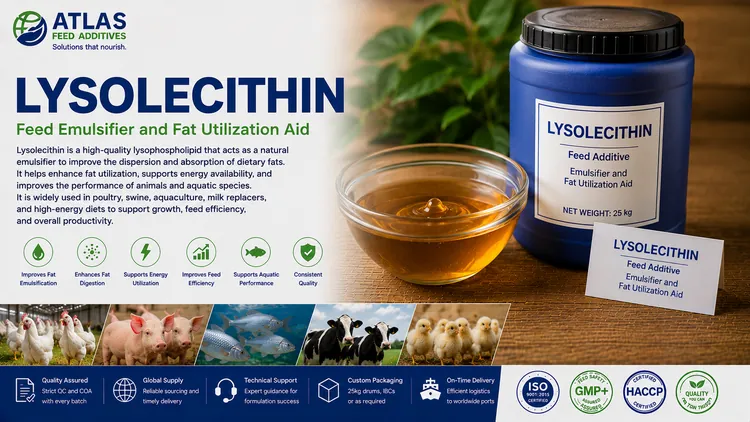
Lysolecithin feed additive visual

Product role

Where Lysolecithin fits

Lysolecithin is part of the emulsifiers and fat-utilization aids group. It is used in animal nutrition where formulators want to improve oil dispersion, support fat-digestion strategies, improve distribution of lipid-soluble ingredients, and optimize the use of energy-rich raw materials.

Buyers typically evaluate Lysolecithin by matching active lysophospholipid content, total phospholipid profile, HLB or emulsification behavior, product form, carrier system, intended species, processing conditions, dosing method, storage stability, and documentation requirements.

Atlas Feed Additives can coordinate international supplier options for feed mills, premix producers, aquafeed manufacturers, milk replacer producers, distributors, and integrators that need consistent feed-grade material with export-oriented documentation and responsive quotation support.

Technical identity

Key product profile

  • Product group: emulsifiers and fat-utilization aids.
  • Functional role: supports emulsification, oil dispersion, fat digestion strategies, and distribution of fat-soluble ingredients.
  • Common active family: lysophospholipids derived from lecithin processing, depending on supplier specification.
  • Commercial forms: liquid, powder, granular, or carrier-based product formats.
  • Application areas: complete feed, premix, concentrates, aquafeeds, milk replacers, fat-coated products, and liquid feed systems.
  • Buyer focus: active concentration, emulsification profile, carrier, stability, handling behavior, origin, and documentation.
  • Processing relevance: compatibility with mixing, pelleting, extrusion, liquid dosing, spray application, and fat-coating systems should be checked.

How it is evaluated

Why specifications matter

Lysolecithin offers should not be compared by product name alone. Different suppliers may offer different active concentrations, raw material origins, carrier systems, moisture levels, acid values, peroxide values, HLB behavior, physical forms, and recommended application methods.

For a meaningful comparison, buyers should align the intended use, species, feed process, product form, active concentration, application dosage basis, packaging, documents, and storage requirements before comparing price per kilogram.

Applications

Typical use areas in animal nutrition

Poultry feed

In poultry nutrition, Lysolecithin is often evaluated in energy-dense diets where oils and fats are important contributors to formulation cost and performance. It may be used in broiler, layer, breeder, and pullet programs according to the nutritionist’s target and applicable market rules.

  • High-energy broiler diets
  • Layer and breeder feed programs
  • Starter and grower feed strategies
  • Oil-rich formulations and fat-added diets
  • Premixes containing lipid-soluble ingredients

Swine feed

In swine feed, Lysolecithin can be reviewed for diets where fat utilization, energy density, ingredient dispersion, and feed processing compatibility are important. Product choice should consider piglet, grower, finisher, and sow formulation objectives.

  • Nursery and piglet diets
  • Grower and finisher formulations
  • Sow feeding programs
  • High-fat or energy-optimized diets
  • Premix or complete-feed inclusion

Aquaculture feed

Aquafeed buyers may evaluate Lysolecithin for oil dispersion, lipid handling, extrusion compatibility, and uniform ingredient distribution. Aquaculture formulations often require close attention to physical stability, pellet quality, water-interface behavior, and species-specific nutritional objectives.

  • Fish and shrimp feeds
  • Extruded feed systems
  • Oil-coated aquafeeds
  • High-energy aquatic diets
  • Specialty premixes for aquatic species

Milk replacers and young animal nutrition

Lysolecithin may be assessed in milk replacers and young animal feeds where fat dispersion, powder reconstitution, emulsion stability, and digestive support strategies are important. Buyers should review whether the product is suitable for the specific application and manufacturing process.

  • Calf milk replacers
  • Lamb and kid milk replacers
  • Young animal specialty feeds
  • Powder reconstitution systems
  • Liquid or dry blending applications

Premix and concentrate manufacturing

Premix producers may use Lysolecithin in systems where uniform distribution of fat-soluble vitamins, oils, flavors, pigments, or other lipid-associated ingredients is important. Carrier choice, flowability, and stability should be reviewed before purchasing.

  • Vitamin and mineral premixes
  • Fat-coated or oil-treated premixes
  • Functional additive blends
  • Concentrate manufacturing
  • Powder or liquid dosing lines

Liquid applications and fat coating

Liquid Lysolecithin or suitable emulsifier blends may be evaluated for direct application into liquid systems, oils, or post-pellet fat-coating processes. Buyers should confirm viscosity, pumpability, temperature behavior, and compatibility with dosing equipment.

  • Liquid dosing systems
  • Oil premixing
  • Post-pellet fat application
  • Spray and coating equipment
  • Energy-dense feed processing

Specification control

Common specification points to request

  • Active lysophospholipid content or declared active concentration
  • Total phospholipid profile, where available
  • Lecithin or raw material origin
  • Liquid, powder, granule, or carrier-based product form
  • Carrier type and carrier declaration
  • HLB or emulsification profile, where provided
  • Moisture level
  • Acid value
  • Peroxide value or oxidation indicators
  • pH or relevant physical-chemical profile, where applicable
  • Viscosity for liquid products
  • Particle size and bulk density for powder products
  • Flowability, dust level, and anti-caking information
  • Thermal stability and processing compatibility
  • Storage stability and shelf-life information
  • Heavy metals, microbiology, and contaminant limits where required

Quality documents

Buyer quality checklist

  • Product specification sheet
  • Certificate of Analysis
  • Safety Data Sheet
  • Technical data sheet or product brochure
  • Composition or active declaration
  • Carrier declaration for powder or granulated products
  • Country of origin statement
  • Batch number and manufacturing date
  • Shelf-life or retest-date statement
  • Packaging declaration
  • Feed-grade or feed-use suitability declaration
  • GMO, allergen, BSE/TSE, halal, kosher, or other declarations if requested
  • Market-specific import and compliance documents

Procurement note

Ask for the right specification before comparing prices.

Price comparisons are meaningful only when active concentration, product form, carrier, emulsification profile, packaging, origin, shelf life, and documentation are aligned. A low price per kilogram may not be comparable if one offer is liquid, another is powder, or the products differ in active concentration and recommended inclusion basis.

For sensitive or high-value formulations, buyers should also review storage conditions, oxidative stability, compatibility with oils and fats, pelleting or extrusion conditions, liquid dosing requirements, premix blending behavior, and documentation needed for the destination market.

Processing compatibility

Manufacturing considerations for feed and premix plants

Liquid versus powder handling

Liquid Lysolecithin may require heated storage, pumps, dosing lines, spray systems, or oil premixing equipment depending on viscosity and temperature behavior. Powder or granulated products may be easier to dose through dry premix systems but should be evaluated for dust, flowability, and carrier uniformity.

Mixing uniformity

Uniform distribution is important when Lysolecithin is used in complete feed, premixes, or concentrates. Product density, particle size, carrier, liquid viscosity, addition point, and mixing time can influence final distribution.

Pelleting and extrusion

Buyers should confirm whether the offered grade is suitable for pelleting, extrusion, post-pellet coating, or liquid application. Heat, pressure, moisture, residence time, and fat addition point can affect handling and performance expectations.

Oil and fat compatibility

Lysolecithin is often used in formulations containing vegetable oils, animal fats, acid oils, mixed fats, or other lipid sources. Compatibility should be reviewed with the specific fat source, formulation objective, and processing system.

Oxidation and freshness

Because Lysolecithin products are associated with lipid chemistry, buyers should pay attention to storage stability, peroxide value, odor, color change, packaging integrity, and shelf life. Proper storage can help maintain product quality during warehousing and use.

Application point

The ideal application point depends on product form and feed process. Some products may be added in the mixer, some into oil systems, some into premixes, and some through liquid coating lines. Supplier guidance and plant trials can help confirm practical handling.

Packaging

Common packaging options

Packaging availability depends on supplier, product form, order quantity, and destination-market requirements. Atlas Feed Additives can review suitable packaging options during quotation.

  • Plastic drums or metal drums for liquid products
  • IBC totes for larger liquid shipments where available
  • 25 kg bags for powder or granulated products
  • Cartons or composite packaging depending on supplier format
  • Palletized shipment for export handling
  • Moisture-protected and contamination-protected packaging
  • Private-label or buyer-specific marking where available
  • Containerized shipment for international orders

Storage and handling

Practical handling guidance

  • Store in a clean, dry, covered, and well-ventilated area.
  • Keep packaging closed when not in use.
  • Protect from moisture, direct sunlight, excessive heat, and contamination.
  • Follow supplier recommendations for storage temperature, especially for liquid products.
  • Use first-in, first-out stock rotation.
  • For liquid products, confirm pumpability and viscosity before use in dosing systems.
  • For powder products, control dust and avoid exposure to open humidity.
  • Follow the Safety Data Sheet and local occupational safety rules.

Quotation preparation

Information to send for a faster Lysolecithin quotation

Technical details

  • Required product form: liquid, powder, granule, or premix
  • Target active concentration or lysophospholipid content
  • Required emulsification profile or HLB range, if specified
  • Carrier preference, if any
  • Moisture, acid value, peroxide value, or other quality limits
  • Required stability or shelf-life expectations
  • Target species and feed application

Commercial details

  • Required quantity
  • Trial order or annual volume estimate
  • Preferred packaging
  • Destination country and delivery address or port
  • Preferred Incoterms
  • Target shipment period
  • Preferred payment and documentation process

Manufacturing details

  • Complete feed, premix, milk replacer, aquafeed, or liquid application
  • Pelleting, extrusion, spray coating, or mixer addition
  • Liquid dosing requirements or pump limitations
  • Powder flowability or dust limitations
  • Fat source used in the formulation
  • Application point in the manufacturing process
  • Any previous supplier specification used as reference

Documentation details

  • COA format requirements
  • SDS language requirements
  • Origin documentation
  • Feed-grade declaration
  • GMO, allergen, BSE/TSE, halal, kosher, or other declarations
  • Import permit or registration needs
  • Labeling and package marking requirements

Buyer comparison

How to compare Lysolecithin offers

When several suppliers quote Lysolecithin, compare each offer against the same technical, application, and logistics baseline.

  • Active basis: compare active lysophospholipid or declared active concentration.
  • Product form: separate liquid, powder, granulated, and carrier-based products.
  • Application basis: compare cost according to recommended inclusion and active contribution, not only price per kilogram.
  • Emulsification profile: review HLB, supplier data, and suitability for the target fat or oil system.
  • Stability: check shelf life, oxidation indicators, packaging integrity, and storage requirements.
  • Process fit: confirm dosing, mixing, pelleting, extrusion, or liquid application compatibility.
  • Documents: confirm COA, SDS, specification, origin, and declarations before purchase.
  • Total landed cost: compare product price together with freight, duties, local handling, storage, and application cost.

Risk control

Questions to ask before placing an order

  • Is the product suitable for the intended species and feed application?
  • Is the product liquid, powder, granule, or carrier-based?
  • What is the declared active concentration?
  • Is the COA batch-specific or representative?
  • What is the peroxide value or oxidation-control profile?
  • What storage temperature is recommended?
  • Can the product be used in the buyer’s dosing or mixing system?
  • Is the product suitable for pelleting, extrusion, or post-pellet coating?
  • Are all import and feed-use documents available before shipment?

Atlas support

Export-focused sourcing for functional feed additives

Atlas Feed Additives supports buyers by reviewing technical requirements, supplier availability, product form, active specification, packaging options, quality documentation, destination logistics, and quotation details. For Lysolecithin, this can include comparing liquid and powder options, confirming active content, checking packaging suitability, and requesting supplier documents.

Atlas can help feed mills, premix producers, aquafeed plants, milk replacer manufacturers, distributors, and integrators source feed-grade emulsifier products that match their commercial and technical requirements.

Best-fit buyer profile

  • Feed mills producing energy-dense diets
  • Premix producers handling lipid-soluble ingredients
  • Aquafeed manufacturers using oil-rich formulations
  • Milk replacer producers requiring dispersion support
  • Distributors building functional additive portfolios
  • Integrators seeking consistent feed additive sourcing

Questions

Useful answers about Lysolecithin

What is Lysolecithin used for in animal nutrition?

Lysolecithin supports oil dispersion, fat digestion strategies, feed energy optimization, and uniform distribution of lipid-soluble ingredients. It should be used according to the target species, formulation objective, process conditions, and applicable market rules.

Can Atlas Feed Additives quote Lysolecithin?

Yes. Send your required specification, product form, active concentration, quantity, destination, packaging preference, and required documents so Atlas Feed Additives can review suitable supplier options for Lysolecithin.

What quality documents should buyers request for Lysolecithin?

Common documents include specification, Certificate of Analysis, Safety Data Sheet, composition statement, origin information, batch details, shelf-life statement, packaging declaration, feed-grade statement, and any market-specific certificates required by the buyer.

Is liquid Lysolecithin better than powder Lysolecithin?

Neither form is automatically better. Liquid products may suit liquid dosing, oil systems, and fat-coating applications, while powder or granulated products may suit dry premixes and standard feed mill dosing. The best choice depends on equipment, formulation, handling, active concentration, and process conditions.

Why is active concentration important?

Active concentration affects the economic comparison between products. Two Lysolecithin products may have different inclusion rates and active contributions, so buyers should compare on an active basis and not only on price per kilogram.

What is HLB and why might buyers ask for it?

HLB, or hydrophilic-lipophilic balance, is often used to describe emulsifier behavior. It can help buyers understand whether the product is more suitable for certain oil-water systems, although final suitability should be checked against the actual feed process and supplier data.

Can Lysolecithin be used in aquafeed?

Lysolecithin may be evaluated in aquafeed applications where oil dispersion, lipid handling, pellet quality, and energy utilization strategies are important. Buyers should confirm suitability with the product specification, processing method, and species-specific formulation objective.

Does Atlas provide dosage recommendations?

Atlas Feed Additives supports sourcing, documentation, and quotation coordination. Inclusion rates and formulation decisions should be made by qualified nutrition professionals according to species, diet design, feed process, supplier recommendations, and local regulations.

What information should I include in my quotation request?

Please include required product form, active concentration, quantity, destination, packaging preference, target species, feed application, processing method, delivery terms, and required documents. A previous specification sheet or COA is helpful when available.

Request a quotation

Tell us what you need

Send your product list, target specification, product form, active concentration, destination country, packaging preference, order quantity, delivery terms, and required documents. Our team will review your request and respond from orders@feedgradeadditives.com.