What is Lecithin used for in animal nutrition?
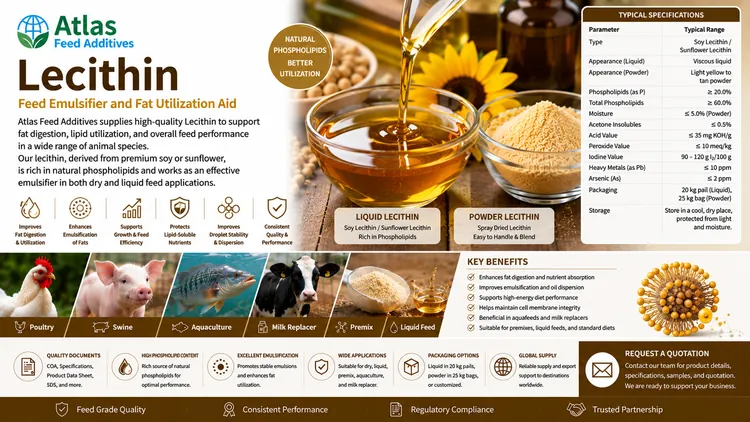
Lecithin supports oil dispersion, emulsion stability, fat-utilization strategies, phospholipid contribution, and uniform distribution of lipid-soluble ingredients. It should be used according to the target species, formulation objective, process conditions, supplier guidance, and applicable market rules.
Can Atlas Feed Additives quote Lecithin?
Yes. Send your required specification, source preference, product form, phospholipid target, quantity, destination, packaging preference, and required documents so Atlas Feed Additives can review suitable supplier options for Lecithin.
What quality documents should buyers request for Lecithin?
Common documents include specification, Certificate of Analysis, Safety Data Sheet, composition statement, origin information, batch details, acid value, peroxide value, acetone-insoluble matter, shelf-life statement, packaging declaration, feed-grade statement, and any market-specific certificates required by the buyer.
Is liquid Lecithin better than powder Lecithin?
Neither form is automatically better. Liquid Lecithin may suit oil systems, liquid dosing, and fat-coating applications, while de-oiled powder or granulated products may suit dry premixes and standard feed mill dosing. The best choice depends on equipment, formulation, handling, active concentration, and process conditions.
What is acetone-insoluble matter?
Acetone-insoluble matter is commonly used as an indicator of phospholipid-rich material in Lecithin products. Buyers often use it to compare active basis, composition, and commercial value between different grades.
Why are acid value and peroxide value important?
Acid value and peroxide value help evaluate hydrolysis and oxidation status. These values can affect odor, color, freshness, storage stability, and suitability for sensitive feed or premix applications.
Can Lecithin be used in aquafeed?
Lecithin may be evaluated in aquafeed applications where phospholipid contribution, oil dispersion, lipid handling, pellet quality, and energy-utilization strategies are important. Buyers should confirm suitability with the product specification, processing method, and species-specific formulation objective.
Can Lecithin be combined with Lysolecithin?
Lecithin and Lysolecithin may be used in related emulsification and fat-utilization strategies, but they are not identical products. Buyers should compare phospholipid profile, active basis, emulsification behavior, inclusion target, and supplier guidance before combining or substituting them.
Does Atlas provide dosage recommendations?
Atlas Feed Additives supports sourcing, documentation, and quotation coordination. Inclusion rates and formulation decisions should be made by qualified nutrition professionals according to species, diet design, feed process, supplier recommendations, and local regulations.
What information should I include in my quotation request?
Please include required source, product form, phospholipid or acetone-insoluble target, quantity, destination, packaging preference, target species, feed application, processing method, delivery terms, and required documents. A previous specification sheet or COA is helpful when available.