Pigments and colorants

Beta-Carotene

Beta-Carotene is a carotenoid feed additive used in programs where egg yolk color, poultry skin and shank tone, aquaculture pigmentation, ornamental color expression, pet food appearance, or selected provitamin A nutrition objectives must be managed consistently.

  • Used in color-management programs for layers, broilers, breeders, aquaculture, ornamental fish, pet food, and specialty feeds
  • Available as stabilized beadlets, powders, granules, emulsions, liquid dispersions, or premix preparations depending on supplier specification
  • Specification support available for active concentration, stabilization system, carrier, dispersibility, particle size, processing stability, and documentation
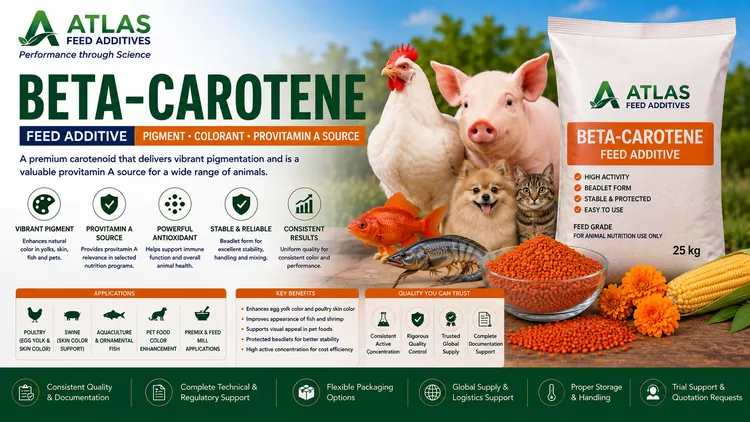
Beta-Carotene feed additive visual

Product role

Where Beta-Carotene fits in feed formulation

Beta-Carotene is part of the pigments and colorants group. It is a carotenoid used in animal nutrition where color consistency, market appearance, product differentiation, and selected nutritional objectives are important. In commercial feed programs, buyers usually evaluate Beta-Carotene by active pigment concentration, isomer profile where declared, physical form, beadlet quality, carrier system, antioxidant or stabilization system, dispersibility, color-expression data, target species, processing conditions, and documentation requirements.

In layer and poultry programs, Beta-Carotene can be considered when egg yolk tone, skin color, shank color, breeder nutrition, or a balanced carotenoid profile must be managed. In aquaculture and ornamental feeds, it may be reviewed as part of a wider pigmentation strategy alongside astaxanthin, canthaxanthin, lutein, zeaxanthin, paprika extract, marigold extract, spirulina, or other natural and synthetic color sources. In pet food and specialty feeds, Beta-Carotene may be used for product appearance and label-positioning objectives, subject to local rules.

Atlas Feed Additives coordinates international supplier options for feed mills, premix manufacturers, poultry integrators, aquafeed producers, pet food manufacturers, distributors, private-label buyers, and regional importers that need consistent feed-grade Beta-Carotene with suitable technical, commercial, and quality documents.

Functional purpose

Why formulators use Beta-Carotene

  • Color-management support: helps manage yellow-orange to orange-red tones in selected animal products and feeds when the product form and dosage are suitable.
  • Egg yolk and poultry programs: may be reviewed in layer, breeder, and broiler programs where yolk tone, skin color, shank color, and carotenoid balance are commercial topics.
  • Aquaculture and ornamental feed support: may be included in broader pigmentation systems for fish, shrimp, ornamental species, or specialty aquatic feeds.
  • Provitamin A relevance: beta-carotene is known as a provitamin A carotenoid, but conversion efficiency and nutritional value depend on species, diet, physiology, and regulation.
  • Product appearance: supports visual differentiation in pet food, specialty feed, treats, premixes, and functional nutrition concepts.
  • Premium positioning: may support natural-color, carotenoid, or appearance-focused product concepts when the claim language is allowed in the target market.
  • Formulation flexibility: can be combined with other carotenoids and colorants to achieve more precise color targets.

Buying focus

Key points before comparing offers

  • Confirm the active beta-carotene concentration, such as percentage, grams per kilogram, or IU-equivalent information when applicable.
  • Check whether the product is synthetic, fermentation-derived, plant-derived, algae-derived, or a supplier-specific commercial preparation.
  • Review physical form: beadlet, powder, granule, oil dispersion, emulsion, liquid suspension, or premix blend.
  • Ask for stabilization details because carotenoids are sensitive to oxygen, light, heat, humidity, and long storage.
  • Compare dosage cost per metric ton of complete feed, not only price per kilogram of product.
  • Request color-expression support data when a specific yolk, skin, fish, shrimp, or ornamental color target must be reached.
  • Confirm authorized species, maximum levels, label wording, and required documents for the destination market.

Technical overview

Color response depends on active content, form, matrix, and species

Beta-Carotene products are not interchangeable only by product name. Commercial forms may differ in active concentration, beadlet technology, carrier, emulsifier system, antioxidant protection, water dispersibility, oil dispersibility, particle size, stability, and biological availability. These differences can influence how the pigment survives storage, mixing, pelleting, extrusion, oil coating, digestion, absorption, and final color expression.

Color response is also affected by the feed matrix. Fat level, oil quality, vitamin and antioxidant system, mineral premix, choline chloride, organic acids, pelleting temperature, storage duration, oxidized fats, mycotoxin binders, and other pigments can all influence final results. For animal-product color, the response is also influenced by genetics, health status, age, feed intake, production stage, gut condition, stress level, and existing carotenoid background in the diet.

Atlas Feed Additives can help buyers request comparable supplier data so that offers are reviewed according to active content, stabilization, dosage, physical form, processing tolerance, color objective, and documentation rather than only price per bag.

Typical applications

Application areas in animal nutrition

Layer feed and egg yolk color

In layer diets, Beta-Carotene may be reviewed as part of an egg-yolk color program when producers need a consistent yellow-orange contribution, a balanced carotenoid profile, or a differentiated label concept. It is often evaluated together with lutein, zeaxanthin, canthaxanthin, paprika extract, marigold extract, corn gluten meal, alfalfa meal, and other pigment sources. Final yolk color depends on total carotenoid intake, absorption, deposition, feed intake, hen age, production stage, gut health, and background dietary pigments.

  • Commercial layer feeds targeting consistent yolk tone
  • Free-range, organic, premium, or differentiated egg programs where permitted
  • Programs balancing yellow and red carotenoid sources
  • Premix systems requiring uniform pigment distribution and storage stability

Broiler and breeder programs

In broiler and breeder nutrition, Beta-Carotene may be evaluated where skin color, shank color, breeder nutrition, reproductive-stage support, or carotenoid profile is relevant. Local market preference can strongly influence the desired skin tone, and color expression depends on breed, growth rate, feed intake, fat deposition, pigment sources, and feed-processing conditions.

  • Broiler skin and shank pigmentation programs
  • Breeder feeds where carotenoid and provitamin A status are formulation topics
  • Premium poultry concepts requiring consistent visual appearance
  • Programs combining beta-carotene with xanthophyll or red-carotenoid sources

Aquaculture feed

In aquaculture, Beta-Carotene may be considered in fish and shrimp feeds as part of a broader pigment and antioxidant-support strategy. It is usually evaluated alongside astaxanthin, canthaxanthin, lutein, spirulina, paprika, marigold, and other pigment sources depending on the target species, color objective, feed process, and legal status. Aquafeed applications should review extrusion temperature, oil coating, water stability, pellet storage, and pigment retention.

  • Salmonid and trout feeds when part of a wider carotenoid system
  • Shrimp feeds where body color, appearance, and product positioning are relevant
  • Tilapia, carp, seabass, seabream, ornamental, and specialty aquafeed concepts
  • Extruded feeds requiring stability review during heat and oil coating

Ornamental fish and pet food

In ornamental fish and pet food, Beta-Carotene may be used to support product appearance, animal color expression, or premium formulation positioning. For ornamental species, color response depends on species genetics, diet background, pigment blend, feed intake, water quality, and husbandry. For pet food, processing stability, label wording, palatability, visual appearance, and market rules must be reviewed.

  • Ornamental fish diets for color expression support
  • Pet food and treats where product color and visual appeal are important
  • Specialty nutrition products requiring colorant and documentation review
  • Products where carotenoid label positioning must match local regulations

Ruminant and specialty feed

In dairy, beef, sheep, goat, and specialty feed programs, Beta-Carotene may be evaluated where reproductive nutrition, antioxidant-support concepts, or vitamin A precursor considerations are being reviewed by a qualified nutritionist. Application should be based on species-specific needs, ration design, local regulation, and the selected product’s bioavailability and stability.

  • Dairy and beef premixes where beta-carotene status is a nutrition topic
  • Specialty ruminant concentrates and seasonal nutrition programs
  • Feeds requiring careful vitamin A and carotenoid balance review
  • Applications where claim language must be verified before use

Premix and distributor products

Premix producers and distributors often require consistent active concentration, low dust, uniform particle size, stable color, strong oxidative protection, and reliable documentation. Beta-Carotene can be sensitive to storage conditions, so premix compatibility and shelf-life should be reviewed carefully.

  • Vitamin-mineral premixes
  • Layer and broiler pigment premixes
  • Aquaculture pigment blends
  • Private-label distributor products requiring recurring specification control

Pigment strategy

How Beta-Carotene fits with other carotenoids

Beta-Carotene is one tool in a wider pigment strategy. In many feed programs, it is combined or compared with xanthophylls and other carotenoids to reach a specific color tone. Yellow and orange tones may be influenced by lutein, zeaxanthin, beta-carotene, corn gluten meal, alfalfa, marigold extract, and other natural carotenoid sources. Red-orange tones may be influenced by canthaxanthin, astaxanthin, paprika extract, or other red pigment sources depending on the target species and legal status.

  • Beta-Carotene: orange-yellow carotenoid with provitamin A relevance and color-management use.
  • Lutein and zeaxanthin: yellow xanthophylls often used in egg yolk and poultry pigmentation programs.
  • Canthaxanthin: red-orange carotenoid commonly used for stronger red tone contribution where permitted.
  • Astaxanthin: important red carotenoid in salmonid, shrimp, and ornamental feed concepts.
  • Natural extracts: marigold, paprika, spirulina, algae, and other sources may support natural-positioned pigment programs.

Evaluation questions

What nutritionists and buyers should confirm

  • What is the target color: yellow, orange, red-orange, skin tone, yolk score, fish flesh tone, shrimp color, or ornamental expression?
  • Which pigments already exist in the formula through corn, corn gluten meal, alfalfa, marigold, paprika, algae, or other ingredients?
  • Is the product selected for color, provitamin A contribution, marketing position, or a combined objective?
  • What color scale or visual reference will be used for evaluation?
  • How long is the feeding period before color response is measured?
  • Does the supplier provide product-specific color-expression support data?
  • Are claims, species, and dosage levels authorized in the destination market?

Specification guidance

Typical feed-grade specification items

The values below are procurement guidance points, not a universal specification. Exact limits vary by manufacturer, source, active concentration, formulation technology, carrier, antioxidant system, product form, and contract. Buyers should always confirm the latest supplier specification and certificate of analysis before purchase.

Common specification review table

Parameter Typical buyer question Why it matters
Product identity Is the product Beta-Carotene, a beta-carotene blend, a carotenoid premix, or a colorant blend? Prevents confusion between pure active, formulated beadlet, dilution, premix, and multi-pigment products.
Active concentration What percentage or grams per kilogram of beta-carotene is declared? Core value for dosage, cost calculation, formulation, and color-response comparison.
Assay method Is active content measured by HPLC, spectrophotometry, or another validated method? Different methods and reporting bases can affect comparability between suppliers.
Isomer profile Is all-trans beta-carotene declared, or is total beta-carotene reported? May matter for technical comparison and regulatory documentation.
Source Is the product synthetic, fermentation-derived, algae-derived, plant-derived, or mixed-origin? Relevant for label positioning, buyer preference, and market-specific documentation.
Physical form Beadlet, powder, granule, oil dispersion, emulsion, liquid suspension, or premix? Impacts dosing, mixing, stability, handling, and process compatibility.
Carrier system What carrier, coating, encapsulation, emulsifier, or matrix is used? Affects bioavailability, stability, label review, allergen status, and compatibility.
Stabilization system Which antioxidants or protective technologies are used? Carotenoids are sensitive to oxidation, light, heat, humidity, and storage time.
Dispersibility Is the product water-dispersible, oil-dispersible, premix-compatible, or feed-grade dry? Important for premix, liquid application, aquafeed coating, and uniform distribution.
Particle size Is the particle-size distribution suitable for premix and complete feed production? Supports uniform mixing and reduces segregation risk.
Bulk density What is the typical bulk density? Useful for dosing equipment, packaging volume, and premix design.
Moisture / loss on drying What is the moisture limit? Influences caking risk, flowability, shelf-life, and oxidation stability.
Processing stability What active recovery remains after pelleting, extrusion, or coating? Heat, steam, pressure, shear, and oxygen exposure can reduce carotenoid activity.
Premix stability How stable is the product in vitamin-mineral premixes? Minerals, choline chloride, organic acids, and moisture can affect stability during storage.
Finished-feed stability What active recovery remains after storage in complete feed? Important for feed mills, distributors, and long supply chains.
Heavy metals Are lead, arsenic, cadmium, and mercury controlled? Required for feed safety, import clearance, and customer quality programs.
Microbiological status Are total plate count, yeast, mold, Salmonella, and other parameters declared? Important for feed-safety systems, premix producers, and export markets.
Residual solvents or contaminants Are residual solvents, PAHs, dioxins, PCBs, or other contaminants relevant to the source? May be required for natural extracts, oil-based products, or market-specific compliance.
Packaging Is the product supplied in foil bags, cartons, drums, bags, bottles, or IBCs? Impacts oxidation protection, moisture control, handling, and shipment planning.
Shelf-life What is the expiry or retest period under recommended storage? Needed for stock planning, distributor resale, and quality control.
Country of origin Where is the product manufactured? Often required for import clearance, customer approval, and traceability.

Processing compatibility

Mixing, pelleting, extrusion, coating, and premix use

Beta-Carotene is sensitive to oxygen, heat, light, humidity, oxidized fats, and aggressive premix environments. Product selection should match the feed process. A stabilized beadlet may perform differently from a fine powder, liquid dispersion, oil suspension, or premix blend. Buyers should confirm how the product behaves under their actual manufacturing conditions.

  • Dry premix use: requires uniform particle size, low segregation, stable carrier, and compatibility with vitamins and minerals.
  • Complete feed addition: requires good distribution, oxidation protection, and recovery after storage.
  • Pelleted feed: requires active recovery data after conditioning temperature, steam, pressure, and cooling.
  • Extruded aquafeed or pet food: requires review of heat, shear, drying, oil coating, and final pigment retention.
  • Liquid or oil coating: requires dispersibility, dosing-system compatibility, suspension stability, and oil-quality control.
  • Multi-pigment blends: require compatibility review with xanthophylls, red carotenoids, antioxidants, fats, oils, and premix carriers.

Factory questions

Questions to ask before purchase

  • What is the active recovery after the buyer’s pelleting or extrusion process?
  • Is the product more suitable for premix, direct feed addition, or post-process coating?
  • Does the product require protection from high mineral load, choline chloride, organic acids, or oxidized fats?
  • Is the product compatible with the buyer’s oil-coating or liquid dosing system?
  • Does the product have low dust and good flowability for the intended dosing equipment?
  • How long can the product remain stable in premix and finished feed?
  • Does the supplier provide retained-sample, stability, and color-expression support data?

Procurement note

Ask for the right pigment specification before comparing prices.

Price comparisons are meaningful only when active concentration, product form, carrier, stabilization technology, dosage, color objective, processing stability, storage stability, packaging, origin, and documentation are aligned. A lower price per kilogram can be misleading if the product has lower active content, weak stability, poor dispersibility, unsuitable carrier, incomplete documentation, or requires a higher inclusion rate.

For Beta-Carotene products, the most useful commercial comparison is often cost per metric ton of complete feed at the target active dose, supported by stability and color-expression data in the target process. Atlas Feed Additives can help buyers collect supplier specifications and review offers on a comparable basis.

Quality assurance

Documents buyers should request

Documentation requirements vary by buyer, country, species, feed process, source type, final label, and import procedure. Atlas Feed Additives can help collect and review supplier documentation before confirming an order.

Core commercial and quality documents

  • Product specification sheet
  • Certificate of analysis for the offered batch or representative lot
  • Active beta-carotene content and assay method
  • Safety data sheet
  • Commercial invoice and packing list
  • Certificate of origin or origin declaration when required
  • Batch number, manufacturing date, expiry date, or retest date
  • Packaging details, pallet configuration, and loading quantity

Technical support documents

  • Recommended inclusion guidance by species and color target, if available
  • Stability data for storage, premix, and finished feed when available
  • Processing stability or heat-recovery data for pelleting or extrusion
  • Color-expression support data for egg yolk, poultry skin, aquaculture, or ornamental programs
  • Carrier, antioxidant, emulsifier, and coating declaration when required
  • Compatibility notes for vitamins, minerals, organic acids, choline chloride, oils, and other pigments

Feed-safety and compliance documents

  • Heavy-metal declaration
  • Microbiological declaration
  • GMO status statement when required
  • Allergen statement when required
  • Animal-origin-free, BSE/TSE, or animal-origin declaration where applicable
  • Residual solvent or contaminant declaration when relevant
  • Halal, Kosher, ISO, GMP+, FAMI-QS, HACCP, or other certificates when available and relevant
  • Market-specific documents for feed registration or import clearance

Traceability and supplier qualification

  • Manufacturer name and site information when disclosed
  • Country of origin
  • Lot number and production date
  • Retained-sample policy, if available
  • Change-control statement for recurring supply programs
  • Distributor authorization or supply-chain confirmation when required

Storage and handling

Protect pigment activity from oxygen, light, heat, and moisture

Beta-Carotene should be stored according to the supplier’s instructions. Carotenoids can degrade when exposed to oxygen, light, heat, moisture, oxidizing agents, incompatible chemicals, or long storage beyond the recommended shelf-life. Practical warehouse control is especially important for distributors and feed mills that store pigment products before premix or finished-feed production.

  • Store in a cool, dry, well-ventilated warehouse.
  • Keep bags, cartons, bottles, drums, or containers sealed until use.
  • Protect from direct sunlight, UV exposure, rain, humidity, and condensation.
  • Keep away from heat sources, steam lines, boilers, and hot warehouse walls.
  • Avoid contact with strong oxidizing agents, strong acids, strong alkalis, and incompatible materials.
  • Use clean scoops, closed transfer systems, and good housekeeping to reduce contamination.
  • Apply first-in, first-out stock rotation.
  • Do not use damaged, wet, caked, discolored, overheated, or contaminated packages without quality review.

Packaging and logistics

Plan packaging around oxidation protection and shelf-life

Packaging, palletization, container loading, label language, and document preparation should be confirmed before shipment. Beta-Carotene products may require extra attention to light protection, oxygen barrier, moisture control, temperature exposure, and long transit times. Export buyers should also check whether their importing country requires feed registration, special labeling, veterinary clearance, colorant approval, or additional certificates.

  • Common packaging may include foil bags, aluminum-laminate bags, cartons, drums, bottles, or liquid containers depending on supplier.
  • Oxygen- and moisture-protective packaging may be important for activity retention.
  • Palletized or non-palletized loading should be agreed before quotation.
  • Container loading quantity depends on packaging, pallet use, temperature exposure, and local road or port limits.
  • Buyers should confirm HS code, import permits, feed registration, and colorant-specific label requirements with local authorities.

Supplier qualification

How Atlas Feed Additives supports Beta-Carotene buyers

1. Requirement review

We review your target species, color objective, active concentration requirement, product form, feed process, destination country, packaging preference, delivery terms, and documentation requirements before matching supplier options.

2. Specification alignment

We help align offers so that active content, assay method, beadlet quality, carrier, stabilization system, dispersibility, processing stability, packaging, origin, and quality documents can be compared clearly.

3. Quotation coordination

We coordinate price, lead time, payment terms, shipment terms, packaging, palletization, document availability, sample availability, and market-specific requirements before order confirmation.

4. Export-focused follow-up

We support buyers with practical export communication, document tracking, shipment coordination, and recurring-supply planning from inquiry stage through commercial execution.

Trial planning

Suggested evaluation approach

Before moving to large-scale use, buyers may run a controlled feed trial in the target species and production system. The goal is to confirm practical color expression, active recovery, and feed-mill suitability in the real feed matrix, not only in an ingredient specification.

  • Define the color target before the trial, such as yolk score, skin tone, fish appearance, shrimp color, ornamental expression, or feed appearance.
  • Record the existing pigment contribution from corn, corn gluten meal, alfalfa, marigold, paprika, algae, or other raw materials.
  • Set a control diet and one or more test inclusion levels.
  • Keep fat level, oil quality, antioxidant system, vitamin premix, and other pigments consistent where possible.
  • Monitor feed intake, production performance, color response, storage time, processing temperature, and product appearance.
  • Evaluate cost per ton of complete feed together with color response, stability, and customer acceptance.

Buyer checklist

Information to send for a faster quotation

  • Product name: Beta-Carotene
  • Required active concentration or preferred supplier specification
  • Preferred form: beadlet, powder, granule, oil dispersion, liquid, or premix blend
  • Target species and feed phase
  • Color objective or reference target
  • Feed process: mash, pellet, crumble, extruded feed, premix, liquid application, or post-process coating
  • Monthly, trial, or spot quantity requirement
  • Destination country and delivery port or address
  • Preferred Incoterms, such as EXW, FOB, CFR, CIF, or DAP
  • Packaging preference and pallet requirement
  • Required certificates, declarations, registration support, or label documents

Commercial comparison

How to compare competing Beta-Carotene offers

  • Compare cost per active unit: calculate the price based on active beta-carotene contribution, not only product weight.
  • Compare cost per ton of finished feed: evaluate offers at the recommended inclusion rate needed to reach the target color or nutrition objective.
  • Review product form: beadlet, powder, granule, oil dispersion, and liquid products can behave differently in production and storage.
  • Check stabilization: antioxidant protection, packaging, and carrier technology can strongly affect activity retention.
  • Review processing recovery: a cheaper product may become expensive if active content is lost during pelleting, extrusion, or storage.
  • Check label and regulatory fit: source, carrier, antioxidant, and claim language may matter in the destination market.
  • Validate color response: color outcome depends on species, diet matrix, background pigments, feed intake, health, and feeding duration.
  • Review documentation: ensure COA, SDS, origin, traceability, and certificates are acceptable for your market.
  • Evaluate supplier consistency: recurring supply programs need stable active content, batch traceability, and reliable document flow.

Questions

Useful answers about Beta-Carotene

What is Beta-Carotene used for in animal nutrition?

Beta-Carotene is used in programs where egg yolk color, poultry skin or shank tone, aquaculture pigmentation, ornamental fish color, pet food appearance, or selected provitamin A nutrition objectives need to be managed consistently. Use should follow the target species, formulation objective, desired color outcome, and applicable market rules.

Is Beta-Carotene only a pigment?

Beta-Carotene is primarily purchased in feed markets as a carotenoid pigment or color-management additive, but it is also known as a provitamin A carotenoid. Its vitamin A contribution depends on species, diet, physiological status, product form, and local regulations. It should not automatically replace vitamin A supplementation without nutritionist review.

Can Beta-Carotene be used in layer feed?

Yes. It may be evaluated in layer feeds where egg yolk tone, carotenoid profile, premium positioning, or color consistency is relevant. Final yolk color depends on total pigment intake, background ingredients, hen age, feed intake, gut health, and the balance of yellow and red pigment sources.

Can Beta-Carotene be used in broiler feed?

Yes. It may be reviewed in broiler programs where skin tone, shank color, or carotenoid nutrition is part of the formulation objective. Local consumer preference, breed, diet background, feed intake, health, and processing conditions all influence the final color response.

Can Beta-Carotene be used in aquaculture feed?

Yes. It may be used in selected fish, shrimp, and ornamental feeds as part of a broader pigment strategy. Suitability depends on species, target color, processing temperature, oil coating, feed storage, active concentration, and regulatory status.

How is Beta-Carotene different from astaxanthin or canthaxanthin?

Beta-Carotene, astaxanthin, canthaxanthin, lutein, and zeaxanthin are different carotenoids with different color tones, biological roles, target applications, and regulatory conditions. Beta-Carotene is associated with yellow-orange to orange color contribution and provitamin A relevance, while astaxanthin and canthaxanthin are often selected for stronger red-orange pigmentation in certain applications.

What product form should buyers choose?

The best form depends on the application. Stabilized beadlets or powders may be suitable for premix and dry feed use, while oil dispersions or liquid suspensions may be useful for coating or liquid application systems. Buyers should review active content, dispersibility, stability, processing conditions, and dosing equipment.

What is the most important quality parameter?

Active beta-carotene concentration and the assay method are critical. Buyers should also review product form, carrier system, antioxidant protection, particle size, dispersibility, processing stability, premix stability, finished-feed stability, microbiological status, and contaminant declarations.

Is a higher active concentration always better?

Not always. Higher active concentration can reduce inclusion rate, but stability, dispersibility, bioavailability, mixing behavior, processing recovery, and cost per active unit must also be considered. A lower-concentration product with better stability may perform better in some processes.

What documents should buyers request?

Common documents include product specification, certificate of analysis, active content and assay method, safety data sheet, origin declaration, batch details, manufacturing date, expiry or retest date, stability data when available, carrier and antioxidant declarations when required, heavy-metal declaration, microbiological declaration, and market-specific certificates required by the buyer.

How should Beta-Carotene be stored?

Store according to supplier instructions, generally in a cool, dry, well-ventilated warehouse. Keep packages sealed, protect from light, oxygen, heat, and moisture, avoid incompatible materials, and use first-in, first-out stock rotation.

Can Atlas Feed Additives support recurring supply?

Yes. Atlas Feed Additives can review recurring monthly demand, supplier availability, active concentration, packaging needs, shipment planning, documentation requirements, and distributor support for regular pigment and colorant supply programs.

Can Atlas Feed Additives quote Beta-Carotene?

Yes. Send your required active concentration, product form, target species, quantity, destination, packaging preference, delivery terms, and required documents so Atlas Feed Additives can review suitable supplier options for Beta-Carotene and prepare a quotation.

Request a quotation

Tell us what you need

Send your product list, target specification, active concentration requirement, target species, color objective, destination country, packaging preference, quantity, delivery terms, and required documents. Our team will review your request and respond from orders@feedgradeadditives.com.

For faster pricing, include:

  • Required active beta-carotene concentration
  • Preferred form: beadlet, powder, granule, liquid, oil dispersion, or premix
  • Target species and color objective
  • Feed process and storage conditions
  • Order quantity and delivery frequency
  • Destination country and port
  • Packaging and pallet preference
  • Required certificates, declarations, registration documents, or label documents