Pigments and colorants

Astaxanthin

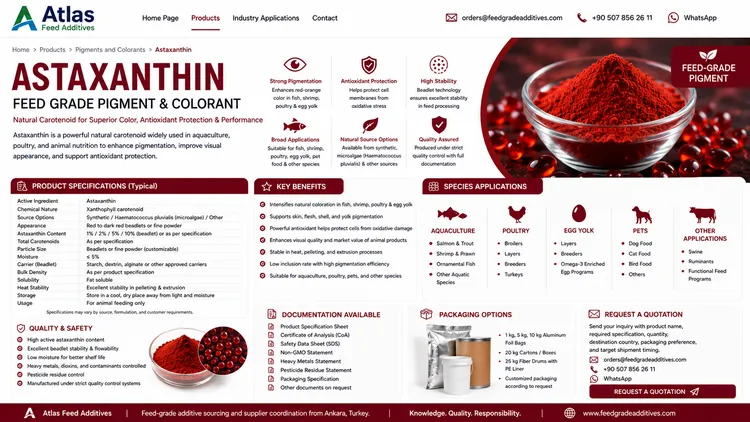
Astaxanthin is a red-orange carotenoid pigment used in feed programs where aquaculture flesh color, shrimp and crustacean appearance, ornamental fish color, egg yolk tone, skin pigmentation, or premium feed appearance must be managed consistently.

Feed-grade Astaxanthin is normally evaluated by active pigment concentration, source, formulation type, beadlet stability, color-expression performance, shelf life, packaging protection, and the regulatory status of the intended species and destination market.

Astaxanthin feed additive visual

Product role

Where Astaxanthin fits in feed programs

Astaxanthin belongs to the pigments and colorants group. It is selected when feed manufacturers need a controlled red-orange pigment source for aquaculture, poultry, ornamental fish, pet food, and specialty nutrition programs. In commercial feed purchasing, the product is not judged only by color strength on paper; buyers also review pigment concentration, formulation stability, species authorization, color deposition, processing tolerance, storage behavior, and documentation quality.

Astaxanthin is a carotenoid, and carotenoids are sensitive to oxygen, light, heat, moisture, and aggressive premix conditions. For this reason, many commercial feed-grade products are supplied as stabilized beadlets, encapsulated powders, carrier-based blends, or protected premix forms designed to improve handling and pigment retention during storage and feed manufacturing.

Atlas Feed Additives can coordinate international supplier options for feed mills, aquafeed producers, premix producers, poultry integrators, distributors, importers, private-label brands, and specialty feed companies that need consistent feed-grade Astaxanthin supported by technical and export documentation.

Technical identity

What buyers should know

Astaxanthin is a lipid-soluble xanthophyll carotenoid with strong red-orange coloring properties. In feed applications, it is normally used to support visible pigmentation rather than to supply bulk nutrition. Commercial outcomes depend on active concentration, digestibility, formulation protection, dose, species metabolism, diet fat level, processing conditions, and the color measurement system used by the buyer.

  • Used mainly where consistent pigment deposition or visible product appearance is important.
  • Often supplied as a stabilized beadlet or protected powder because carotenoids can degrade under heat, oxygen, light, and moisture.
  • May be synthetic, nature-derived, algae-derived, yeast-derived, bacterial-derived, or supplier-specific depending on product grade and market permissions.
  • Requires careful regulatory review because permitted species, maximum levels, label wording, and approved sources vary by destination country.

Commercial value

Why formulation quality matters

Two Astaxanthin products with the same label concentration may perform differently in finished feed. Beadlet design, antioxidant system, carrier selection, particle-size distribution, storage stability, and compatibility with oils, minerals, acids, and heat processing can all affect pigment retention and final color results.

  • Concentration: determines how much product is needed to reach a pigment target.
  • Stability: affects pigment retention during storage and processing.
  • Bioavailability: influences how efficiently the animal absorbs and deposits pigment.
  • Uniformity: supports even color expression in feed and animal products.
  • Documentation: supports import, customer approval, quality control, and label compliance.

Procurement note

Ask for the right specification before comparing prices.

Price comparisons are meaningful only when active pigment concentration, source, assay method, beadlet type, carrier, particle size, stabilization system, packaging, shelf life, origin, and documentation are aligned. A cheaper product may cost more in use if the active assay is lower, stability is weaker, color expression is inconsistent, or the product is not authorized for the buyer’s target application.

For Astaxanthin, the key commercial question is not only “price per kilogram,” but also “price per unit of active pigment that remains stable, mixes uniformly, and produces the target color under the buyer’s feed process and storage conditions.”

Commercial specification

Typical specification points for Astaxanthin

The final specification must be confirmed by the supplier and aligned with the destination market. The table below shows practical parameters that purchasing, formulation, quality, and regulatory teams commonly review before approving an Astaxanthin source.

Parameter What to request Why it matters
Product name Astaxanthin, Astaxanthin preparation, algal meal, yeast-derived pigment, or supplier-specific trade grade Clarifies whether the offer is pure active, beadlet, premix, natural-source meal, or finished feed additive preparation.
Active concentration Declared Astaxanthin percentage, g/kg, mg/g, or equivalent assay basis Determines dosing, cost-in-use, finished-feed concentration, and comparison between offers.
Assay method HPLC, spectrophotometric method, or supplier-validated method with extraction conditions Different methods and extraction protocols can produce different active-pigment results.
Source Synthetic, Haematococcus algae, Phaffia yeast, Paracoccus source, krill/shrimp-derived, or other approved origin Source can affect regulatory status, customer positioning, isomer profile, ester form, sustainability claims, and price.
Physical form Beadlet, powder, granular product, oil-dispersible form, water-dispersible form, or premix Affects dosing accuracy, mixing behavior, processing compatibility, and application route.
Carrier system Starch, gelatin, carbohydrate matrix, silica, oil carrier, calcium carbonate, plant carrier, or supplier-specific matrix Carrier affects flowability, dusting, allergen/GMO status, solubility, and compatibility with feed matrices.
Stabilization system Antioxidant package, encapsulation, coating, beadlet design, or moisture barrier Critical for protecting carotenoids from oxygen, light, heat, and humidity.
Particle size Mesh range or particle-size distribution Important for premix uniformity, segregation control, dust reduction, and dosing equipment performance.
Bulk density Loose and tapped density where available Helps calculate bag volume, dosing settings, warehouse space, and blending behavior.
Loss on drying / moisture Maximum moisture or drying loss specification Moisture can influence beadlet stability, flowability, microbial risk, and shelf life.
Heavy metals Lead, arsenic, mercury, cadmium, and total heavy metals where required Supports regulatory review, food-chain safety, and customer quality approval.
Microbiology Total plate count, yeast and mold, Salmonella, E. coli, coliforms, and other buyer-required limits Especially important for natural-source products, meals, and carrier-based preparations.
Shelf life Declared shelf life under defined storage conditions Supports inventory planning and avoids pigment loss during long storage.
Packaging Foil bag, carton, drum, vacuum pack, light-protective bag, nitrogen-flushed packaging, or moisture-barrier liner Packaging directly affects oxidation resistance, moisture protection, and logistics suitability.
Regulatory status Species permissions, maximum use level, source authorization, label wording, and destination-market documents Astaxanthin permissions vary by country, species, source, and use claim.

Typical applications

Where Astaxanthin is commonly evaluated

  • Salmonid feeds: used in salmon and trout pigmentation programs to help manage pink to orange-red flesh color targets.
  • Shrimp and crustacean feeds: used where shell, body, or cooked-color appearance is part of product value.
  • Ornamental fish diets: used in color-enhancement programs for species where red-orange expression is commercially important.
  • Layer feeds: sometimes evaluated for egg yolk tone, usually in combination with yellow pigments depending on the desired color profile and local permissions.
  • Broiler and breeder programs: considered where skin tone, tissue carotenoid supply, or premium appearance programs are relevant and allowed.
  • Pet and specialty feed: used in visual-positioning concepts, premium formulas, and color-managed specialty products where permitted.

Application route

Where it can be added

  • Premix stage: suitable when the beadlet is stable in the selected mineral-vitamin matrix.
  • Compound feed: useful for direct feed inclusion when mixing and dosing equipment can handle low inclusion levels accurately.
  • Aquafeed extrusion: requires stability confirmation because heat, moisture, pressure, and drying can degrade carotenoids.
  • Post-coating: often considered in aquafeed where pigment retention or oil coating compatibility must be optimized.
  • Private-label blends: possible when the buyer needs a custom concentration, carrier, or multi-pigment package.

Species and program fit

How formulators evaluate Astaxanthin by animal group

Animal group Common formulation objective Buyer questions to confirm
Salmon and trout Manage pink to orange-red flesh color, support consistent fillet appearance, and meet customer color targets. Is the source authorized for salmonids in the destination market? What is the maximum allowed level? Is the product stable through extrusion and feed storage?
Shrimp and crustaceans Support body color, shell color, and cooked-color appearance in market-facing products. Is the selected source permitted for the species? What inclusion level is recommended? Is the pigment stable in aquatic feed processing?
Ornamental fish Enhance red-orange color expression in ornamental species where visual appeal drives product value. Is the pigment form suitable for small-pellet or flake-feed production? Are claims allowed in the sales market?
Laying hens Adjust egg yolk color tone, often as part of a multi-pigment program using yellow and red carotenoids. Is Astaxanthin allowed for layer feed in the target market? How does it interact with lutein, zeaxanthin, canthaxanthin, paprika, or marigold sources?
Broilers Support skin tone or premium appearance programs where consumer preference and regulation allow pigment use. What is the target color shade? Is the source permitted? Does the diet already contain maize, xanthophylls, or other pigments?
Pet food Support premium visual positioning, antioxidant-oriented formulation concepts, or controlled product color. Is the ingredient permitted for pet food in the market? Is it stable through extrusion, drying, and fat coating?

Color management

Practical factors affecting final color

Astaxanthin performance is influenced by more than the amount added to feed. The final visual result depends on feed intake, pigment absorption, animal age, production stage, health status, dietary fat, competing pigments, processing losses, storage time, genetics, water quality in aquaculture, and the color measurement method used by the buyer.

  • Define the desired color target before selecting the grade and inclusion level.
  • Use a consistent color scale or instrument-based measurement method where possible.
  • Check whether the product is intended to shift color toward red-orange, deepen existing color, or complement yellow pigments.
  • Confirm if the pigment is free, esterified, beadlet-protected, oil-dispersible, water-dispersible, or carrier-bound.
  • Evaluate pigment deposition with the actual feed formula, raw materials, processing method, and storage conditions.

Color tools

Common measurement approaches

  • Visual color fans: common in egg yolk and poultry programs for practical field comparison.
  • Instrumental colorimetry: L*, a*, b* values can help quantify brightness, redness, and yellowness.
  • Fillet color cards: frequently used in salmonid markets to align producer and buyer expectations.
  • HPLC pigment analysis: useful where active pigment deposition or residual pigment levels must be measured analytically.
  • Finished-feed assay: helps confirm whether the pigment remains present after processing and storage.

Source options

Common Astaxanthin source categories

Source selection affects price, positioning, regulatory status, assay basis, isomer profile, esterification, documentation, and customer acceptance. The correct choice depends on the intended species, country, label claim, buyer preference, and technical performance target.

Source category Commercial notes Questions for buyers
Synthetic Astaxanthin Often supplied in standardized beadlet forms with controlled active concentration and strong use in aquaculture pigmentation programs. Is the grade authorized for the intended species and destination? What is the beadlet stability profile?
Haematococcus algae meal or extract Natural-source option based on algae-derived Astaxanthin; may be selected for natural-positioned programs where permitted. What is the active Astaxanthin level? Is the material a meal, extract, beadlet, or premix? Are heavy metals and microbiology controlled?
Phaffia yeast-derived material Yeast-derived Astaxanthin source used in some fish-feed color applications where authorized. Is the yeast strain and product form permitted? What is the active content and stability under feed processing?
Paracoccus-derived pigment Bacterial-source carotenoid material may contain Astaxanthin with other carotenoids depending on grade and production process. Which carotenoids are declared? Is the product authorized for the target animal group and country?
Krill or crustacean-derived material Marine-source material may be used in specialty feeds, but active concentration and sustainability documentation must be reviewed carefully. What is the active pigment level? Are sustainability, contaminant, and marine-origin documents available?
Custom pigment premix Blend of Astaxanthin with other pigments, carriers, antioxidants, or feed additives to meet a specific customer target. Does the premix have uniformity data, stability data, and clear active-pigment declaration?

Quality assurance

Buyer quality checklist

A feed-grade Astaxanthin product should be evaluated as both a pigment and a sensitive formulated additive. Buyers should check active assay, impurity profile, stability, physical handling, regulatory status, and batch traceability before issuing a purchase order.

  • Active Astaxanthin concentration with batch-specific certificate of analysis.
  • Source declaration and manufacturing route where required by customer or regulation.
  • Assay method and extraction basis, preferably with clear analytical reference.
  • Stabilization system, beadlet quality, coating type, and expected pigment retention.
  • Particle size, flowability, dusting behavior, bulk density, and mixing uniformity.
  • Heavy metals including lead, arsenic, mercury, and cadmium where required.
  • Microbiological limits for natural-source, fermentation-derived, or carrier-based products.
  • Residual solvent, pesticide, dioxin, PCB, or marine contaminant checks where relevant to source and market.
  • Shelf-life declaration for unopened and opened packaging when available.
  • Storage condition statement covering heat, humidity, light, and oxygen exposure.
  • Regulatory documents for target species, market, source, claim, and maximum use level.

Processing compatibility

Pelleting, extrusion, premix, and storage stability

Astaxanthin can lose activity and color strength when exposed to oxygen, light, moisture, high temperature, long storage, or reactive premix ingredients. The right commercial form should be chosen according to how the buyer will use the product: premix blending, mash feed, pelleting, aquafeed extrusion, oil coating, post-application, or private-label repacking.

Process factor What to check Recommended buyer action
Premix minerals Compatibility with trace minerals, salts, choline chloride, organic acids, and high-pH ingredients Request premix stability data or minimize storage time in aggressive premix matrices.
Pelleting Temperature, conditioning time, moisture, pressure, and pigment retention after processing Ask for heat-stability data and verify finished-feed active pigment where color claims are important.
Aquafeed extrusion High heat, pressure, shear, drying, oil coating, and storage stability Consider protected beadlets or post-coating depending on the feed process and target retention.
Oil coating Oil compatibility, dispersion, oxidation risk, and surface distribution Confirm whether the grade is designed for oil-dispersible or dry-feed use.
Light exposure Warehouse lighting, translucent packaging, and opened-bag exposure Use light-protective packaging and reseal opened units quickly.
Humidity Moisture uptake, caking, beadlet degradation, and microbial risk Store in original sealed packaging in a cool, dry place and avoid humid warehouses.
Long storage Assay decline over time under stated storage conditions Match shipment size to turnover and request shelf-life data for the intended climate.

Packaging

Packaging and handling considerations

Astaxanthin packaging should protect against oxygen, light, moisture, heat, and physical damage. Because active pigment can degrade during long storage or poor handling, the packaging format is part of the technical specification, not only a logistics detail.

  • Common commercial units may include 1 kg, 5 kg, 10 kg, 20 kg, or 25 kg packaging depending on concentration and supplier.
  • Foil liners, sealed cartons, drums, vacuum packs, nitrogen-flushed packs, and light-resistant bags may be used for sensitive grades.
  • Opened containers should be resealed quickly and used within the supplier’s recommended open-container period.
  • Private-label orders should define label language, net weight, batch coding, expiry format, pallet configuration, and document format before production.
  • For sea freight or hot-climate routes, buyers should confirm temperature exposure, container conditions, and shelf-life warranty.

Storage

Storage questions before ordering

  • What temperature range is recommended for unopened original packaging?
  • Does the product require refrigeration, cool storage, or standard dry warehouse storage?
  • What humidity and light exposure limits should be avoided?
  • What is the shelf life at the declared storage condition?
  • Is the active assay guaranteed through expiry or only at manufacture?
  • How quickly should opened packaging be used?
  • Can the product tolerate long sea freight routes without assay loss?
  • Are temperature loggers recommended for summer shipments or tropical destinations?

Compliance note

Regulatory status is source, species, dose, claim, and country specific

Astaxanthin should be reviewed under the feed additive, color additive, and labeling rules of the destination market. A product source that is permitted for one species or country may not automatically be permitted for another. Maximum use levels, final feed declarations, animal-product labeling, customer claims, and documentation requirements can differ substantially.

In some markets, Astaxanthin rules are highly specific to salmonid fish feed, color purpose, approved source, maximum finished-feed level, stabilized color-additive mixture requirements, and labeling. Buyers should confirm the exact local status before importing, manufacturing, or making customer claims.

Atlas Feed Additives can help collect supplier documents for buyer review, but final import clearance, registration, label approval, and legal interpretation remain the responsibility of the buyer, importer, consultant, or competent authority in the destination country.

Procurement guidance

How to request a precise quotation

The most accurate quotation is based on a complete technical, regulatory, and logistics profile. When sending an inquiry, include all product requirements rather than only the name “Astaxanthin” and a quantity.

  • Product name: Astaxanthin.
  • Required active concentration or acceptable concentration range.
  • Preferred source: synthetic, algae-derived, yeast-derived, bacterial-derived, marine-derived, or no preference.
  • Target species and use objective.
  • Desired color target or existing pigment program.
  • Feed type: premix, mash, pellet, extruded aquafeed, oil-coated feed, pet food, or specialty application.
  • Quantity per shipment and annual forecast.
  • Destination country and port.
  • Preferred Incoterms such as EXW, FCA, FOB, CFR, CIF, DAP, or DDP if applicable.
  • Required documents for customs, registration, quality approval, or customer review.
  • Packaging size, palletization, label language, and private-label requirements.
  • Any restrictions on carrier, gelatin, allergens, GMO status, animal-origin ingredients, or antioxidant system.

Buyer comparison

Questions to ask every supplier

  • What is the active Astaxanthin concentration and assay method?
  • Is the product a pure active, beadlet, premix, algal meal, yeast product, or other preparation?
  • What source is used and is it authorized for the intended species and market?
  • What carrier and coating system are used?
  • What antioxidants or stabilizers are included?
  • What is the shelf life in sealed packaging and after opening?
  • What heat, extrusion, pelleting, or premix stability data are available?
  • What heavy metal, microbiology, and contaminant limits are guaranteed?
  • Can the supplier provide samples from the same grade proposed for commercial order?
  • Can documents be issued per batch and per shipment?

Cost-in-use

Comparing Astaxanthin offers by delivered active pigment

Astaxanthin purchasing should be based on cost-in-use, not only product price per kilogram. A product with higher active concentration, better processing retention, or stronger finished-feed stability can be more economical even when its invoice price is higher.

Comparison point Why it changes real cost Buyer action
Active concentration Lower active level requires more product to reach the same finished-feed target. Calculate cost per kilogram of active Astaxanthin, not only cost per kilogram of product.
Processing retention Heat, moisture, extrusion, and drying can reduce retained pigment. Ask for retained activity after the buyer’s actual process.
Storage stability Pigment loss during storage can reduce color expression before feed is consumed. Request stability data at relevant temperature and humidity.
Color deposition Different sources and formulations may deposit pigment differently in animal tissue or yolk. Run field or pilot trials with the full feed program.
Regulatory fit An unauthorized source or use can create import delays, relabeling, or rejection risk. Confirm destination-market rules before purchase.
Documentation Incomplete documents can delay customs, registration, or customer approval. Approve the document package before shipment.

Formulation note

Use Astaxanthin inside a complete color-management strategy

Astaxanthin performance should be evaluated inside the full feed and production system. In aquaculture, fish size, diet fat level, raw material quality, feeding duration, water temperature, processing method, and harvest target can affect color outcome. In poultry, basal diet pigments, maize level, marigold or paprika use, bird age, breed, feed intake, fat quality, and health status can influence yolk or skin color.

For new programs, Atlas Feed Additives recommends sample approval, laboratory assay verification, pilot feed production, color measurement, and shelf-life review before large commercial rollout. This is especially important for extruded aquafeeds, hot-climate logistics, private-label premixes, and products sold with strict color targets.

Document pack

Suggested document package for Astaxanthin orders

Document Purpose When to request
Product specification Defines active concentration, source, physical form, carrier, moisture, purity, contaminants, and packaging. Before price comparison and sample approval.
Certificate of analysis Confirms batch-specific active assay and agreed quality parameters. For each production batch and shipment.
Safety data sheet Provides handling, storage, transport, and safety information. Before import, warehouse approval, and customer registration.
Source declaration Confirms whether the product is synthetic, algae-derived, yeast-derived, bacterial-derived, marine-derived, or blended. Before regulatory review and customer positioning.
Assay method statement Explains how active Astaxanthin is measured. When comparing suppliers or checking laboratory results.
Stability statement Defines expected shelf life and storage conditions. Before order confirmation and inventory planning.
Color-expression support data Supports expected performance in the target species or feed application. When the buyer needs predictable color results.
GMO statement Supports buyer or market requirements related to genetic modification. When the destination market or customer requires it.
Allergen statement Identifies possible carrier-related or processing-related allergen concerns. For pet food, specialty feed, private-label products, and sensitive customer programs.
Origin certificate Supports customs, import, tariff, or customer origin requirements. When requested by importer or destination authority.
Free-sale or registration support document Supports local approval and market access. When required by the destination country.

Questions

Useful answers

What is Astaxanthin used for in animal nutrition?

Astaxanthin is used as a pigment and colorant in feed programs where egg yolk, poultry skin, salmonid flesh, shrimp, crustacean, ornamental fish, pet food, or specialty feed appearance must be managed consistently. It should be used according to the target species, formulation objective, source, dose, and applicable market rules.

Is Astaxanthin only used in aquaculture?

No. Aquaculture is one of the most important commercial areas, especially for salmonids and shrimp, but Astaxanthin can also be evaluated in ornamental fish, poultry, pet food, and specialty feed programs where the selected source and use are permitted by local rules.

What is the difference between pure Astaxanthin and a beadlet?

Pure Astaxanthin refers to the active pigment. A beadlet is a formulated commercial preparation that may contain active Astaxanthin, carrier, coating materials, antioxidants, and stabilizers. Feed manufacturers usually buy formulated products rather than unprotected active pigment because stability and handling are important.

Can Astaxanthin survive pelleting or extrusion?

Survival depends on the grade, beadlet design, temperature, moisture, pressure, residence time, drying, oil coating, and storage conditions. Buyers should request processing-stability data for their actual feed process or confirm retained active pigment through finished-feed analysis.

What active concentration should I request?

The correct concentration depends on target species, desired color, regulatory limits, feed type, dosing equipment, and cost-in-use. Send your target finished-feed level or color objective so Atlas Feed Additives can review suitable grades and supplier options.

Can Astaxanthin be combined with other pigments?

Yes, it is often considered with other carotenoids such as canthaxanthin, lutein, zeaxanthin, beta-carotene, paprika, or marigold-derived pigments. The blend should match the intended color target and must be allowed under the destination market’s feed rules.

Why does Astaxanthin price vary so much?

Price varies because of active concentration, source, stabilization technology, beadlet quality, assay guarantee, packaging, origin, regulatory support, production scale, and documentation package. Buyers should compare cost per unit of active pigment and expected performance, not only price per kilogram.

Can Atlas Feed Additives quote Astaxanthin?

Yes. Send your required active concentration, source preference, target species, quantity, destination country, packaging preference, and required documents so Atlas Feed Additives can review suitable supplier options for Astaxanthin.

What quality documents should buyers request for Astaxanthin?

Common documents include product specification, certificate of analysis, safety data sheet, active pigment assay, assay method statement, source declaration, stability statement, storage instructions, origin information, batch details, microbiology results, heavy metal results, GMO/allergen statements where required, and any market-specific certificates requested by the buyer.

What information is needed for a fast quotation?

Please send the active concentration, source preference, target species, intended application, feed process, quantity, destination, Incoterms, packaging size, label requirements, and documentation requirements. This allows Atlas Feed Additives to compare supplier options correctly.

Request a quotation

Tell us what you need

Send your product list, target active concentration, source preference, destination country, target species, packaging preference, feed process, and required documents. Our team will review your request and respond from orders@feedgradeadditives.com.