
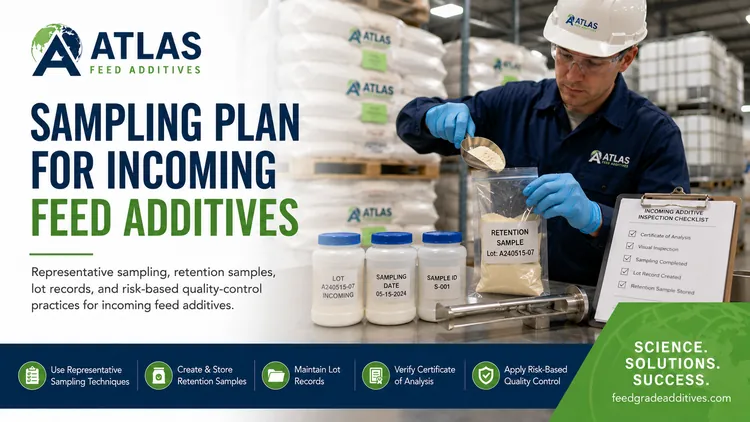
Feed additive decisions are strongest when they begin with a clear production objective. Sampling Plan for Incoming Feed Additives is not a single-product decision; it is a practical process of matching supplier documents, lot identity, product risk, receiving conditions, sampling method, and the commercial target.
Why this topic matters
Representative sampling and retention practices are important because feed additives are often high-value, low-inclusion products. A small issue with identity, concentration, contamination, moisture, packaging, or lot traceability can affect many tons of finished feed if the product enters production without proper review.
In real operations, the result depends on supplier reliability, product type, packaging condition, lot coding, warehouse control, analytical methods, staff training, and how consistently the sampling plan is applied. A good receiving program should connect purchasing, quality control, warehouse, nutrition, and production teams before the additive is released for use.
Key areas to review
A sampling plan should be practical enough for daily use but detailed enough to protect product identity and traceability. The plan should explain which products are sampled, how many units are checked, how samples are labeled, how retention samples are stored, and when additional testing is required.
- Product identity: confirm product name, supplier, lot number, batch number, production date, expiry date, and label information.
- Document match: compare the certificate of analysis, specification, packing list, invoice, and received product lot code.
- Packaging condition: check for damaged bags, broken seals, moisture exposure, contamination, odor, leakage, or unusual appearance.
- Sampling method: use clean tools, avoid cross-contamination, and collect increments that represent the received lot.
- Retention practice: keep clearly labeled samples under suitable storage conditions for future reference or dispute review.
Practical approach
A practical incoming additive program starts with risk classification. High-value, sensitive, regulated, or historically variable products may need more frequent sampling or laboratory testing. Lower-risk products from approved suppliers may follow a lighter but still documented inspection process.
- Set specifications that are practical, measurable, and agreed before purchase.
- Use risk-based sampling and retain representative samples from incoming lots.
- Separate approved, pending, rejected, and quarantined stock clearly in the warehouse.
- Record who sampled the product, when it was sampled, which lot was sampled, and where the retention sample is stored.
- Document deviations, supplier communication, corrective actions, and final release or rejection decisions.
Sampling and retention considerations
Sampling should be performed with clean, dry, product-appropriate tools. The sample should represent the lot, not just the easiest bag or container to reach. When multiple bags, drums, pallets, or containers are delivered, the quality team should decide how many units to sample based on product risk, lot size, supplier history, and customer requirements.
Retention samples should be sealed, labeled, and stored in conditions that protect the product from moisture, heat, sunlight, pests, and mix-ups. Labels should include product name, supplier, lot number, receiving date, sample date, sampler name, and quantity received. For sensitive additives such as vitamins, probiotics, enzymes, antioxidants, pigments, and certain specialty minerals, storage conditions are especially important.
Testing and release considerations
Not every incoming additive requires the same analytical testing, but every lot should have a clear release decision. Some programs rely on document review and visual inspection, while others require identity checks, active content analysis, moisture testing, microbiological review, heavy metal screening, or other product-specific checks.
If results do not match the specification or certificate of analysis, the product should remain on hold until the issue is reviewed. The decision may require resampling, supplier clarification, third-party testing, return, rejection, or controlled use under written approval. Clear records help protect the buyer, supplier, and final feed customer.
Product groups to review
Depending on the challenge, the following product groups may be worth reviewing with your nutrition, technical, quality-control, or procurement team:
Buyer checklist
Before ordering, request the product specification, certificate of analysis, shelf-life, storage conditions, recommended inclusion range, packaging details, handling guidance, and destination-market documents. For commercial trials, define the baseline, control group, feed batches, performance indicators, and review period before the additive is introduced.
For incoming sampling programs, also confirm the lot coding format, minimum sample quantity, retention period, acceptable analytical methods, release criteria, quarantine process, supplier notification procedure, and whether customer-specific documents are required. This helps avoid delays when the product arrives at the warehouse or feed mill.
How Atlas Feed Additives can support
Atlas Feed Additives can help buyers compare feed-grade additive options, coordinate supplier documentation, and structure inquiries for international shipments. Send the target application, current challenge, product group, specification requirements, sampling expectations, expected quantity, destination country, and required documents so we can review the request efficiently.