Feed additive decisions are strongest when they begin with clear documentation. A Certificate of Analysis, often called a COA, helps buyers confirm that the delivered product lot matches the agreed specification before it is released into inventory, production, or resale. It is not only a laboratory document; it is also a practical purchasing, quality control, and traceability tool.
Why this topic matters
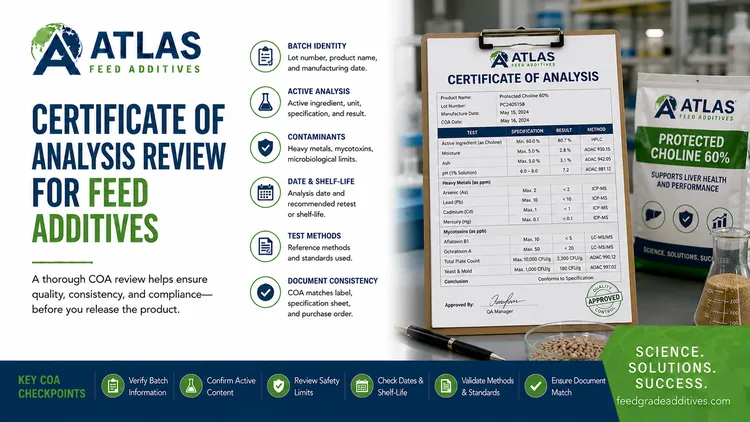
Key fields buyers should check before release include product identity, lot number, manufacturing date, expiry or retest date, active content, specification limits, analytical results, and approval status. In real operations, a COA can help prevent wrong-lot acceptance, expired stock movement, undocumented substitution, and quality disputes after the product has already entered the feed chain.
The value of the review depends on how well the COA is connected to the purchase order, supplier specification, product label, packing list, and physical goods received. A good COA review should be simple enough for routine receiving teams to use, but detailed enough for technical and quality teams to identify unusual results before the product is used.
Practical approach
- Confirm that the product name, grade, batch number, and packaging details match the purchase order and delivery documents.
- Check that specifications are practical, measurable, and agreed before purchase, not negotiated only after shipment.
- Compare the reported assay, purity, activity, concentration, or potency against the agreed minimum and maximum limits.
- Review relevant safety parameters such as heavy metals, microbiology, moisture, insoluble matter, solvent residues, or other product-specific limits.
- Use risk-based sampling and retain representative samples from incoming lots, especially for high-value or high-risk additives.
- Document deviations, supplier explanations, corrective actions, and final release decisions in a traceable way.
COA fields buyers should review
A useful COA should clearly identify the tested lot and show whether it meets the agreed product specification. Buyers should pay special attention to the following areas:
- Identity: Product name, feed grade status, supplier name, production site, lot number, and document issue date.
- Dates: Manufacturing date, expiry date, retest date, and shelf-life statement where applicable.
- Active content: Assay, concentration, enzyme activity, vitamin potency, mineral percentage, or viable count depending on the additive type.
- Physical properties: Appearance, color, odor, particle size, bulk density, moisture, flowability, or carrier information when relevant to feed manufacturing.
- Contaminant controls: Heavy metals, pathogens, yeast and mold, dioxins, mycotoxins, or other risk parameters requested by the buyer or destination market.
- Method and approval: Analytical method, specification limit, actual result, quality approval, and authorized signature or electronic release status.
Product groups to review
COA review priorities vary by additive group. Vitamins may require attention to potency, stability, carrier, and expiry date. Trace minerals may require assay, solubility, particle size, and heavy metal limits. Antioxidants may require active content, appearance, melting range, moisture, or product-specific purity criteria.
Depending on the challenge, the following product groups may be worth reviewing with your nutrition, technical, or procurement team:
Common review mistakes
Many COA problems are not caused by a failed result, but by missing or inconsistent information. Examples include a lot number that does not match the bag label, a COA issued for a different product grade, a result shown without a specification limit, or a shelf-life statement that is shorter than expected for the shipment route.
Another common mistake is checking only the headline assay and ignoring supporting parameters. For example, a product may meet active content but still require review for moisture, microbial limits, heavy metals, or physical condition depending on its intended use and storage environment.
Buyer checklist
Before ordering, request the product specification, certificate of analysis, shelf-life, storage conditions, recommended inclusion range, packaging details, label information, and destination-market documents. For import or export shipments, also confirm whether the buyer needs a health certificate, free sale certificate, origin document, non-GMO statement, allergen statement, halal statement, or other customer-specific declarations.
For commercial trials, define the baseline, control group, feed batches, performance indicators, and review period before the additive is introduced. Keep a copy of the COA with the trial records so that performance results can be connected to the exact product lot used.
Release decision guidance
A COA review should support a clear decision: release, hold, reject, or request clarification. Minor formatting differences may only require supplier confirmation, while specification failures, missing lot identity, expired shelf-life, or unexplained contaminant results should be escalated before the material is used. Internal quality teams should define who has authority to release product lots and how exceptions are recorded.
How Atlas Feed Additives can support
Atlas Feed Additives can help buyers compare feed-grade additive options, coordinate supplier documentation, and structure inquiries for international shipments. Send the target application, current challenge, product group, quantity, destination country, required documents, and preferred specification format so we can review the request efficiently.