
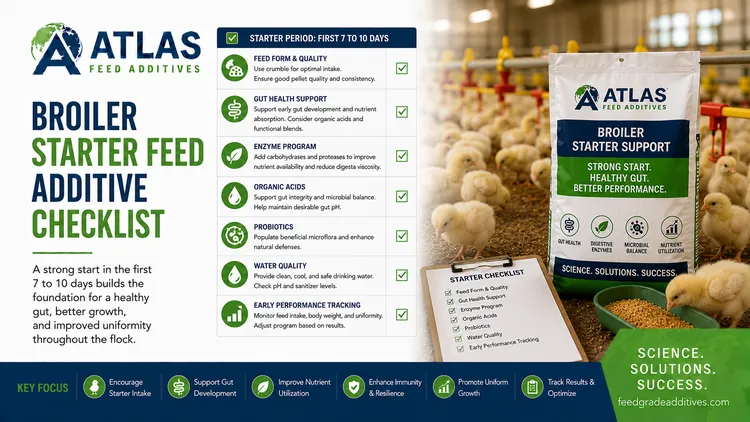
Feed additive decisions are strongest when they begin with a clear production objective. Broiler Starter Feed Additive Checklist is not a single-product decision; it is a practical process of matching chick needs, raw material risk, feed manufacturing conditions, water quality, farm management, and the commercial target for the first week of life.
Why this topic matters
Starter diet planning for the first seven to ten days is important because early feed and water intake influence gut development, flock uniformity, immune readiness, and later feed conversion. A strong starter program gives chicks fast access to digestible nutrients while helping them adapt to the house environment, litter, feed form, and health program.
In real operations, additive performance depends on feed quality, farm management, genetics, chick quality, brooding temperature, health pressure, storage, and how consistently the additive is applied. If feed form is poor, water lines are dirty, or brooding conditions are unstable, even a technically suitable additive may not deliver the expected result.
Practical approach
- Check feed form, crumb quality, feeder access, and water quality before blaming additive performance.
- Align additives with bird age, genetics, health program, raw material variability, and the expected production challenge.
- Confirm that selected additives are stable under the feed manufacturing process, especially pelleting temperature and storage conditions.
- Keep the first feed fresh, easy to consume, and consistently available during the critical early placement period.
- Track feed conversion, mortality, litter condition, body weight, uniformity, treatment records, and processing results.
Key additive functions to consider
Broiler starter additives are commonly used to support nutrient availability, gut balance, early intake, and resilience during the first phase of growth. The correct selection depends on the raw material base, local disease pressure, feed form, and whether the program is designed for conventional, antibiotic-reduced, or specialty production systems.
- Feed enzymes: Enzyme programs can help improve nutrient release from grains and protein meals, especially when raw material quality changes between batches.
- Organic acids and acidifiers: These may support feed hygiene, water quality programs, and digestive environment management when used correctly.
- Probiotics and fermentation products: Gut-support tools may help establish a more stable microbial environment during early development.
- Vitamins and trace minerals: Starter diets require reliable micronutrient coverage to support early growth, bone development, antioxidant status, and immune function.
- Mycotoxin risk tools: When raw material risk is high, binders or risk-control products may be reviewed as part of the broader quality program.
Product groups to review
Depending on the challenge, the following product groups may be worth reviewing with your nutrition, technical, or procurement team. Each product should be evaluated against the starter feed formula, processing method, target inclusion rate, and the farm performance issue being addressed.
Starter feed and management points
A broiler starter additive program works best when the base diet is already well designed. The starter feed should have suitable nutrient density, digestible ingredients, good crumb structure, low dust, and consistent intake characteristics. Excessive fines, poor pellet or crumb durability, rancid fat, mold risk, or large changes in ingredient quality can reduce early consumption and weaken the response to additives.
Management should support the feed program. Place chicks into a properly prepared house, confirm temperature and ventilation, provide enough feeder and drinker space, and monitor crop fill during the first hours after placement. Early signs such as weak intake, wet litter, poor uniformity, slow weight gain, or uneven crop fill should be investigated before adjusting the additive program.
Buyer checklist
Before ordering, request the product specification, certificate of analysis, shelf-life, storage conditions, recommended inclusion range, packaging details, and destination-market documents. For poultry starter use, also ask about heat stability, carrier type, compatibility with premix or complete feed production, and whether the product is intended for mash, crumb, pellet, or water application.
For commercial trials, define the baseline, control group, feed batches, performance indicators, and review period before the additive is introduced. Useful indicators include seven-day body weight, feed intake, feed conversion, mortality, culls, uniformity, litter score, medication records, and final processing results.
Common mistakes to avoid
A common mistake is evaluating a starter additive only at final harvest without measuring the early signals that explain the result. The first week should be monitored separately because early gains or problems may be hidden later by changes in feed phase, farm conditions, or flock management.
Another mistake is changing several additives at the same time without a clear trial design. When enzymes, acids, probiotics, binders, and premix changes are introduced together, it becomes difficult to identify which change created the performance response. A practical evaluation should be simple, measurable, and connected to the farm’s main production objective.
How Atlas Feed Additives can support
Atlas Feed Additives can help buyers compare feed-grade additive options, coordinate supplier documentation, and structure inquiries for international shipments. Send the target application, broiler age range, feed type, current challenge, product group, quantity, destination country, and required documents so we can review the request efficiently.