
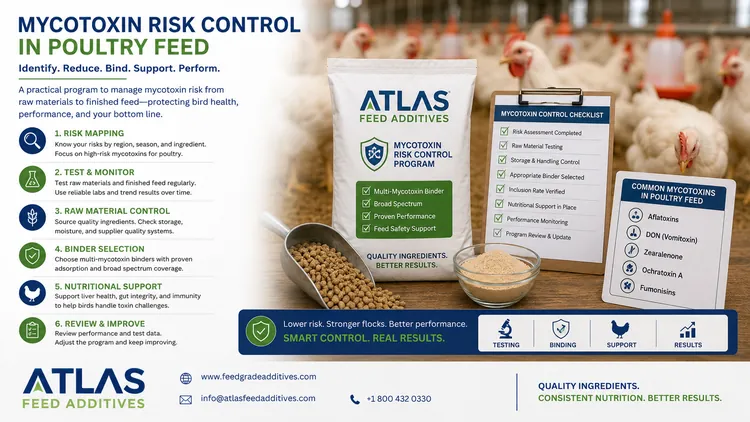
Feed additive decisions are strongest when they begin with a clear production objective. Mycotoxin Risk Control in Poultry Feed is not a single-product decision; it is a practical process of matching poultry species, production phase, raw material risk, feed manufacturing conditions, health status, and the commercial target.
Why this topic matters
Mycotoxin risk can vary by crop season, supplier, grain origin, storage condition, moisture level, and ingredient mix. Poultry feeds often include corn, wheat, soybean meal, by-products, and other raw materials that may carry different risk profiles. A practical control program helps buyers avoid relying only on visual inspection or assumptions about a single ingredient.
Risk mapping, testing, and binder selection for poultry feed mills should be reviewed together. In real operations, the result depends on feed quality, sampling method, farm management, species, genetics, age, health status, storage, and how consistently the additive is applied.
Practical approach
- Check feed form, water quality, storage conditions, and raw material quality before blaming additive performance.
- Align mycotoxin control with age, genetics, health program, vaccination timing, litter condition, and raw material variability.
- Use routine testing and risk mapping to identify high-risk ingredients, suppliers, seasons, and storage points.
- Track feed conversion, mortality, litter quality, uniformity, egg production, shell quality, processing results, and veterinary observations.
Risk mapping and testing
A mycotoxin program should begin with a clear map of where risk enters the feed mill. This may include incoming grain, stored raw materials, high-risk by-products, finished feed, and retained samples. Sampling quality is important because mycotoxins may not be evenly distributed across a load or silo.
Testing plans should reflect the poultry category and the raw materials being used. Broilers, layers, breeders, and turkeys may have different performance indicators and different levels of sensitivity depending on age, diet, and health pressure. The technical team should connect laboratory results with farm observations instead of viewing test numbers in isolation.
Binder selection considerations
Mycotoxin binders and detox support products can differ in composition, binding profile, carrier, particle size, inclusion range, and documentation. Some products are designed around clay minerals, yeast cell wall components, enzymes, plant extracts, or multi-component approaches. The most suitable option depends on the expected mycotoxin challenge and the feed program.
Buyers should review whether the product has data relevant to the target mycotoxins, species, inclusion level, and feeding conditions. It is also important to check compatibility with vitamins, trace minerals, medications, coccidiosis programs, pelleting conditions, and other additives in the formula.
Program design for poultry operations
A poultry mycotoxin program should not rely only on one binder decision. Raw material approval, supplier qualification, storage hygiene, moisture control, silo rotation, finished feed monitoring, and farm feedback all contribute to risk control. When risk is high, the buyer may need to adjust sourcing, increase testing, or review inclusion strategy with the nutrition team.
For broilers, useful indicators may include daily gain, feed conversion, mortality, uniformity, litter moisture, immune pressure, and processing results. For layers and breeders, egg production, shell quality, fertility, hatchability, feed intake, livability, and flock uniformity may be more relevant. The selected indicators should match the production phase.
Product groups to review
Depending on the challenge, the following product group may be worth reviewing with your nutrition, technical, veterinary, quality, or procurement team:
Buyer checklist
Before ordering, request the product specification, certificate of analysis, shelf-life, storage conditions, recommended inclusion range, packaging details, and destination-market documents. For mycotoxin control products, also review active composition, target mycotoxin profile, carrier type, particle size, heat stability, compatibility with premixes, and supporting technical data.
For commercial trials, define the baseline, control group, feed batches, testing plan, performance indicators, and review period before the additive is introduced. Useful indicators may include mycotoxin analysis, raw material risk score, feed intake, feed conversion, mortality, litter quality, egg production, shell quality, breeder fertility, hatchability, medication records, and retained sample results.
How Atlas Feed Additives can support
Atlas Feed Additives can help buyers compare feed-grade additive options, coordinate supplier documentation, and structure inquiries for international shipments. We can support discussions around binder type, detox support options, target poultry category, raw material risk, packaging preference, and destination-market requirements.
Send the target species, production phase, raw materials used, current challenge, testing data if available, product group, expected quantity, destination country, and required documents so we can review the request efficiently.