
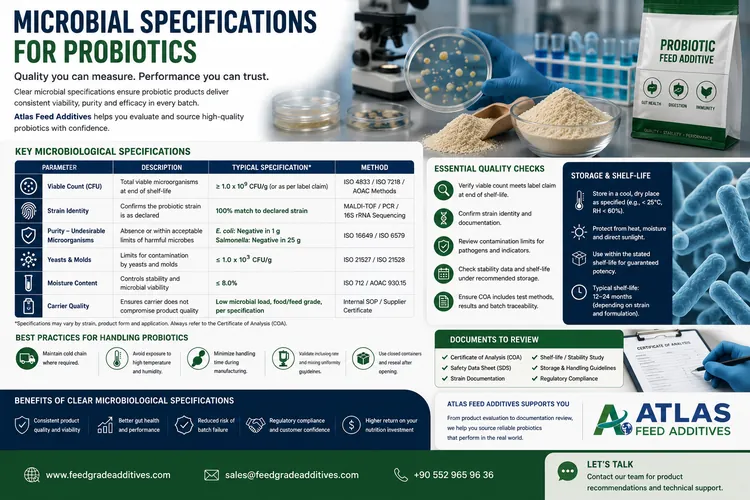
Feed additive decisions are strongest when they begin with a clear production objective. Microbial Specifications for Probiotics are not only a laboratory topic; they are a practical purchasing and quality-control process for confirming that a probiotic product matches the intended species, application route, shelf-life, and commercial target.
Why this topic matters
Viable counts, strain identity, and contamination checks matter because probiotic products are selected for biological activity. If the viable count is too low, the strain is not clearly identified, or the product is exposed to unsuitable storage conditions, the expected performance value may not be delivered in the finished feed or farm program.
In real operations, the result depends on product form, strain stability, feed processing conditions, storage temperature, moisture exposure, packaging quality, shelf-life, farm management, and how consistently the additive is applied. Specifications should therefore be practical, measurable, and agreed before purchase.
Practical approach
- Define the target strain, viable count, shelf-life guarantee, and intended use before confirming an order.
- Specifications must be practical, measurable, and supported by a certificate of analysis or supplier documentation.
- Use risk-based sampling and retain representative samples for traceability and complaint review.
- Check storage temperature, moisture sensitivity, packaging integrity, and transport conditions for live microbial products.
- Document deviations, investigation results, corrective actions, and supplier responses when specifications are not met.
Specification points to review
A probiotic specification should normally describe the organism or strain, declared viable count, unit of measurement, analytical method, shelf-life, storage conditions, carrier material, physical form, packaging, and batch identification. Buyers should confirm whether the viable count is guaranteed at production, at shipment, or until the end of shelf-life.
For feed applications, it is also useful to check whether the product is suitable for mash feed, pelleted feed, premix use, water application, top-dressing, or another delivery route. Processing heat, moisture, pressure, direct acid exposure, and long premix storage can all influence practical viability.
Contamination and safety checks
Quality programs should also review unwanted microbial contamination. Depending on the product and destination market, buyers may request limits or test results for organisms such as Salmonella, Escherichia coli, yeasts and molds, total plate count, or other relevant microbiological indicators. These checks should match local rules, supplier standards, and the product’s intended use.
Contamination review is especially important when probiotics are used in young animal diets, high-value feeds, or sensitive production systems. Clear documentation helps the buyer separate normal probiotic activity from unwanted contamination and supports faster decisions if a batch is questioned at arrival.
Product groups to review
Depending on the challenge, the following product group may be worth reviewing with your nutrition, technical, quality, or procurement team. The right choice should match the target species, production phase, application route, processing conditions, and expected stability during storage and use.
Buyer checklist
Before ordering, request the product specification, certificate of analysis, shelf-life, storage conditions, recommended inclusion range, packaging details, safety data sheet, batch traceability, strain or active description, and destination-market documents. Confirm the viable count unit, test method, sampling method, release criteria, and whether the product has special transport or storage requirements.
For commercial trials, define the baseline, control group, feed batches, inclusion point, processing conditions, performance indicators, and review period before the additive is introduced. Practical indicators may include feed intake, fecal quality, growth, feed conversion, mortality, treatment records, uniformity, and customer feedback on product handling.
Sampling and documentation
A practical sampling plan should define when samples are taken, who takes them, how they are sealed, where they are stored, and which laboratory or internal method is used. Retained samples should be linked to batch numbers, delivery documents, and certificates so that any later complaint can be investigated clearly.
Documentation should be reviewed before shipment whenever possible. Product name, strain identity, batch number, production date, expiry date, net weight, storage conditions, and certificate values should match the order and labels. Small inconsistencies can create delays or uncertainty during quality review and import clearance.
How Atlas Feed Additives can support
Atlas Feed Additives can help buyers compare feed-grade probiotic and fermentation product options, coordinate supplier documentation, and structure inquiries for international shipments. Send the target species, production phase, current challenge, application route, product group, order volume, destination country, and required documents so we can review the request efficiently.