
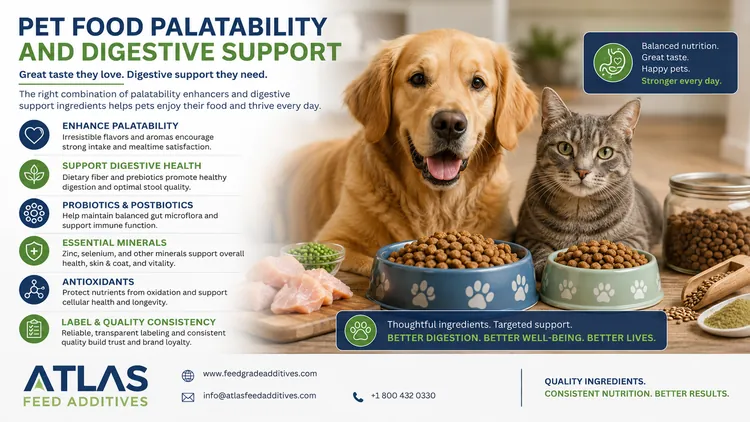
Feed additive decisions are strongest when they begin with a clear production objective. Pet Food Palatability and Digestive Support is not a single-product decision; it is a practical process of matching animal needs, product format, raw material quality, processing conditions, label expectations, and the commercial target.
Why this topic matters
Pet food must satisfy both the animal and the owner. A formula may look strong on paper, but if pets reject the aroma, taste, texture, or mouthfeel, the product may fail in real use. Palatability also affects repeat purchase behavior, feeding consistency, and customer confidence in the finished diet.
Digestive support is equally important because stool quality, tolerance, ingredient consistency, and perceived comfort are closely watched by pet owners. In real operations, results depend on raw material quality, processing method, fat freshness, storage, packaging, animal species, breed size, life stage, and how consistently the additive is applied.
Practical approach
- Palatability, oxidation control, stool quality, and label consistency should be reviewed together rather than separately.
- Use ingredients and additives suitable for the finished product format, including kibble, wet food, semi-moist products, treats, or supplements.
- Review heat stability, coating behavior, aroma release, and compatibility with fats, proteins, minerals, fibers, and probiotics.
- Track shelf-life, aroma, fat freshness, stool quality, owner feedback, return rates, and batch-to-batch consistency.
Palatability considerations
Palatability programs may include flavors, sweeteners, yeast derivatives, hydrolysates, fats, surface coatings, or aroma systems depending on the species and product format. Dogs and cats can respond differently, so a palatability tool should be selected with the target animal, life stage, formula type, and feeding occasion in mind.
For dry kibble, surface application, fat coating, aroma stability, and dust control can influence acceptance. For wet food or treats, heat processing, texture, moisture, and ingredient aroma may be more important. Buyers should request details on recommended application method, carrier type, dosage range, heat stability, and storage conditions before confirming a product.
Digestive support considerations
Fiber sources, probiotics, fermentation products, minerals, and selected functional ingredients may be reviewed when the target is digestive support. The correct approach depends on whether the product is positioned for daily maintenance, sensitive digestion, stool quality, hairball support, weight management, or life-stage nutrition.
Digestive support should be evaluated with practical indicators such as stool consistency, stool odor, feed acceptance, transition tolerance, and owner feedback. Ingredient quality and formula balance remain important; additives should support the diet rather than compensate for poor raw material control or inconsistent processing.
Product groups to review
Depending on the challenge, the following product groups may be worth reviewing with your nutrition, technical, or procurement team:
Buyer checklist
Before ordering, request the product specification, certificate of analysis, shelf-life, storage conditions, recommended inclusion range, packaging details, and destination-market documents. For pet food applications, also review species suitability, product format suitability, label positioning, allergen considerations, heat stability, odor profile, and compatibility with the finished recipe.
For commercial trials, define the baseline, control group, production batches, performance indicators, and review period before the additive is introduced. Useful indicators may include acceptance testing, bowl return, intake pattern, aroma after storage, stool score, customer feedback, complaint rate, shelf-life observations, and comparison between pilot and commercial batches.
How Atlas Feed Additives can support
Atlas Feed Additives can help buyers compare feed-grade additive options, coordinate supplier documentation, and structure inquiries for international shipments. We can support discussions around palatability direction, digestive support targets, mineral form, probiotic or fermentation product options, packaging preference, and destination-market requirements.
Send the target species, product format, current challenge, product group, expected quantity, destination country, label requirements, and required documents so we can review the request efficiently.